A blockchain certification course is a structured program that formally validates knowledge of distributed ledger technology, development, or business strategy. Top 2026 options include Cornell’s $3,750 Blockchain Essentials, ISACA’s Blockchain Fundamentals, and EC-Council’s hands-on Blockchain Developer Certification.
Key Takeaways
- Top providers include eCornell, ISACA, EC-Council, MIT Professional Education, AICPA & CIMA, and 101 Blockchains, each targeting a different professional role.
- Cornell’s Blockchain Essentials costs $3,750, runs 2 months at 3–5 hours per week, and awards 40 professional development hours (4 CEUs).
- EC-Council’s Blockchain Developer Certification includes 81 hands-on labs and a 40% hands-on learning component, making it the strongest pick for developers.
- AICPA & CIMA’s program costs $109–$169 and awards 5 CPE credits, making it the most accessible entry point for accounting and finance professionals.
- UCLA Extension’s Blockchain Technology Management certificate is closing at the end of Summer 2026 and is no longer admitting new students.
- No single program fits every learner. Match the credential to your target role before you enroll.
This guide compares the most reputable blockchain certification course offerings, explains what they cover, and gives you a step-by-step method for choosing one that aligns with your career goals. The information below is drawn directly from program pages published by eCornell, ISACA, EC-Council, and other providers.
What Is a Blockchain Certification Course?

Definition and Core Concepts
A blockchain certification course is an educational offering that formally assesses and validates a learner’s understanding of distributed ledger technology. Blockchain itself is a distributed digital ledger that records transactions across a network of computers, or nodes. Transactions are grouped into time-stamped blocks, cryptographically linked together, and validated through a consensus mechanism. This creates a secure, tamper-resistant record that is extremely difficult to alter, according to EC-Council.
A defining feature of blockchain is its decentralized architecture. Instead of relying on a central authority, participating nodes collectively validate transactions and maintain the shared ledger. This improves security, increases transparency, and removes single points of failure. A blockchain certification course typically covers these principles, along with applications such as digital payments, supply chain management, digital identity, smart contracts, and cryptocurrencies.
When combined with artificial intelligence, blockchain creates more intelligent, secure, and transparent systems. EC-Council notes that blockchain provides trusted, tamper-resistant data, while AI improves automation, analytics, and decision-making. Several providers now integrate AI concepts into their curricula, making the training more relevant to current enterprise needs.
How Certification Differs from a Degree or Single Course
Unlike a full degree program, a blockchain certification course is shorter, often ranging from a few weeks to a few months. Cornell’s Blockchain Essentials is designed to be completed in two months with three to five hours of study per week. A single course may introduce one topic, while a certification program usually bundles multiple courses or modules in a prescribed sequence. The eCornell program consists of four courses completed in order: Cryptocurrencies and Ledgers, Cryptography Essentials, Blockchain Fundamentals, and Applications of Blockchain Technology.
Certification also typically includes assessment, feedback, and a credential. This makes it more rigorous than reading a book or watching free videos. Many programs award continuing education units (CEUs) or professional development hours. Cornell’s program awards 40 professional development hours, equivalent to 4 CEUs. That structured assessment is a key reason professionals choose a formal program rather than informal self-study.
The Role of Accreditation and Industry Recognition
Accreditation matters when choosing a blockchain certification course because it signals that a recognized institution has reviewed the curriculum. University-backed programs from Cornell Tech, MIT Professional Education, and UCLA Extension carry the weight of their parent institutions. Industry bodies such as ISACA and AICPA & CIMA offer credentials aligned with established professional standards in IT audit, security, and accounting.
Vendor-specific certifications like EC-Council’s Blockchain Developer Certification and 101 Blockchains’ Certified Enterprise Blockchain Professional are designed to meet specific job-market demands. They often include hands-on labs and are updated to reflect industry trends. No single accreditation body governs all blockchain certification offerings, so verify the issuing organization’s reputation and the program’s alignment with your field before enrolling.
“Completing a program from eCornell really has allowed me to think outside the box at work. It gave me the confidence I needed to take a seat at that table and say I am ready.” – Kasey M., eCornell graduate (via eCornell program page)
Why Earn a Blockchain Certification in 2026?
Enterprise Demand and Real-World Adoption
Blockchain adoption continues to grow across industries, making certification an effective way for professionals to validate their skills. According to ISACA’s Blockchain Fundamentals program page, demand for IT professionals skilled in blockchain is rising, with enterprise market value growth expected to reach $19.9 billion by 2025. That figure is a projection from an earlier period, but it reflects the technology’s sustained enterprise momentum. Earning a recognized credential positions you squarely in that demand curve.
EC-Council emphasizes that blockchain is more than just crypto, listing sectors including banking and financial services, government and voting, defense and law enforcement, retail and e-commerce, communications, agriculture, energy, insurance, travel, and healthcare. This breadth of adoption means the credential can be valuable for professionals across many fields, not just developers.
Career Potential Without Exaggerated Numbers
The competitor content reviewed for this guide does not include specific salary figures, so we won’t invent them. What the evidence does show is sustained employer interest: specialized programs from Cornell, MIT, and ISACA don’t get built and maintained unless organizations are hiring for these skills. Roles that commonly benefit include blockchain developer, solutions architect, product manager, compliance officer, and enterprise strategist. A well-chosen credential signals initiative and current knowledge, which strengthens your candidacy for these positions. It’s not a guarantee of employment, but it’s a meaningful differentiator.
Blockchain Is Still Relevant, but the Focus Has Shifted
Some ask whether blockchain is still a thing in 2026. The evidence from active program pages says yes, but the emphasis has moved from cryptocurrency speculation to enterprise applications, decentralized finance (DeFi), decentralized autonomous organizations (DAOs), and AI integration. EC-Council has updated its developer and fintech certifications with AI content. A blockchain certification course in 2026 is therefore likely to stress practical use cases and emerging tech convergence rather than speculative token trading. That shift makes the credential more relevant for traditional industries, not less.
Pros and Cons of a Blockchain Certification Course
Pros
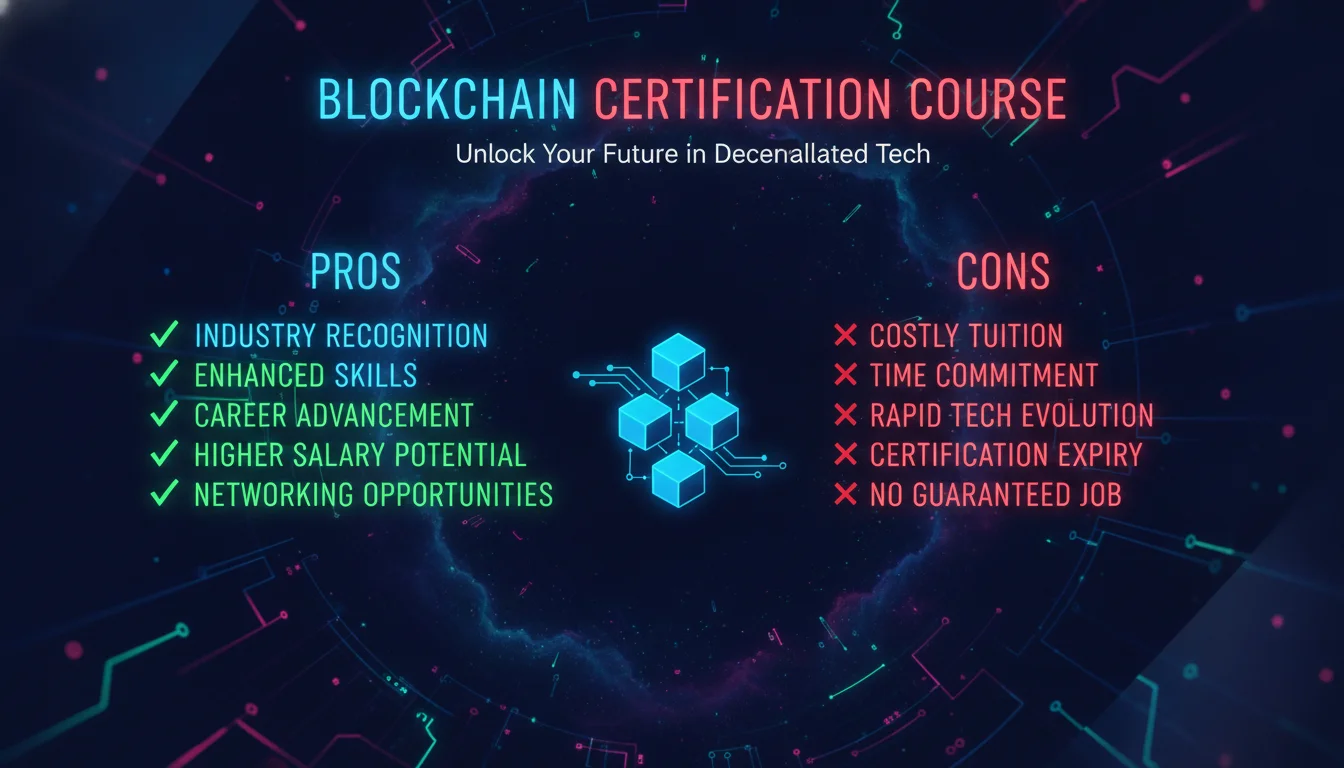
- Structured, validated learning: Programs from accredited institutions provide a curriculum vetted by industry experts, not just a YouTube playlist.
- Professional development credits: Cornell awards 40 PD hours (4 CEUs); ISACA’s course awards 5 CPE; AICPA’s program awards 5 CPE in Information Technology. These credits matter for licensed professionals.
- Role-specific tracks: Whether you’re a developer, auditor, executive, or product manager, there’s a program calibrated to your needs.
- AI integration: Leading providers like EC-Council have updated curricula to cover blockchain plus AI, keeping the training current.
- Flexible formats: Self-paced, live online, and hybrid options mean you can fit study around a full-time job.
Cons
- Cost varies widely: Cornell’s program runs $3,750. If budget is tight, that’s a significant commitment relative to a $109 AICPA alternative.
- No universal standard: No single accreditation body governs all blockchain certifications, so credential recognition varies by industry and employer.
- Not a substitute for experience: For technical roles, a certificate without personal projects or proficiency in Solidity or Python will only take you so far.
- Some programs are closing: UCLA Extension’s Blockchain Technology Management certificate is shutting down at the end of Summer 2026, a reminder that the market is still consolidating.
- Renewal policies vary: Provider pages don’t always specify expiration or renewal requirements, so you’ll need to verify directly.
Types of Blockchain Certification Courses
University-Backed Professional Certificates
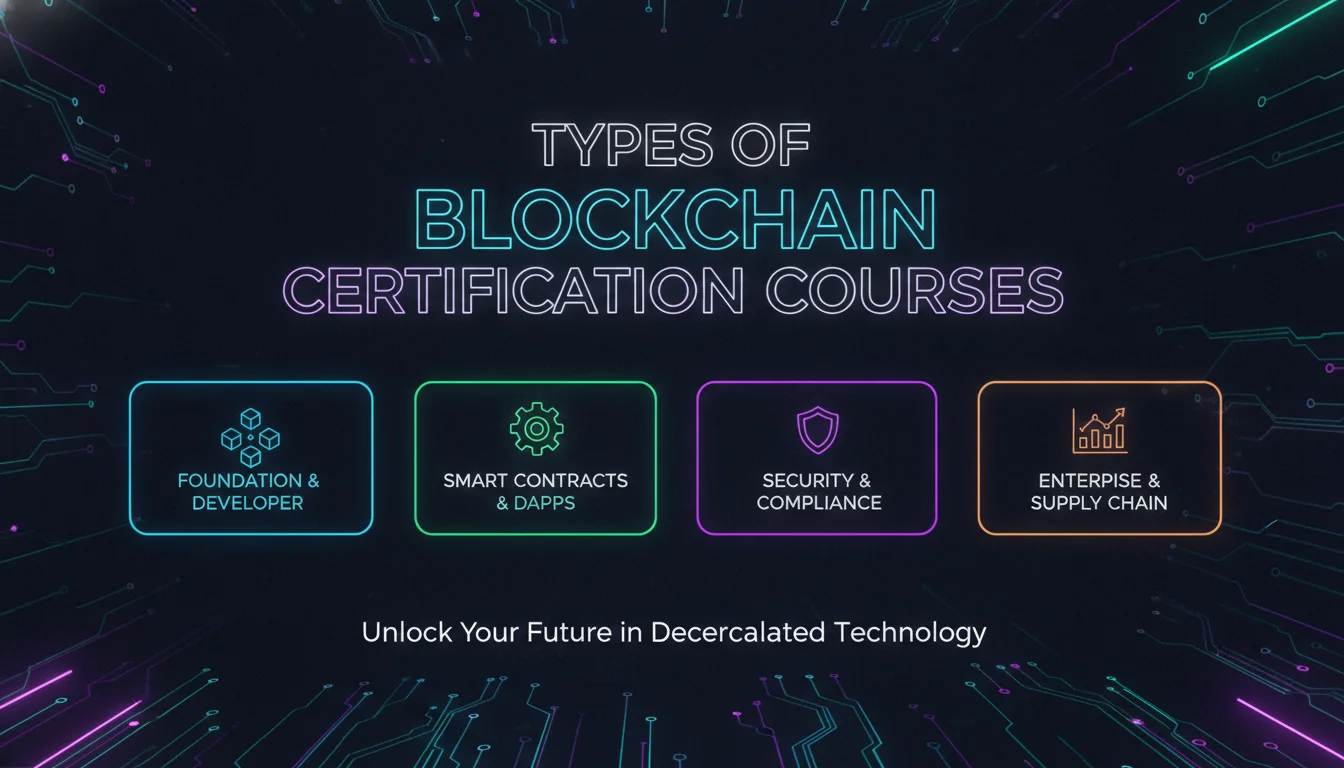
University programs often target business leaders, technology managers, and professionals who need a strategic understanding of blockchain. Cornell’s Blockchain Essentials, developed by Cornell Tech faculty Ari Juels and Rafael Pass, focuses on cryptographic foundations and business applications. MIT Professional Education’s Blockchain: Disruptive Technology is an 8-week online course that teaches fundamentals with an eye toward career transformation. UCLA Extension’s Blockchain Technology Management certificate covers distributed ledger technology, enterprise blockchain, DeFi, and DAOs, aimed at professionals seeking leadership and business-focused training. Note that UCLA Extension has announced the program will close at the end of Summer 2026 and is no longer admitting new students. If you were considering that specific program, look at the Cornell or MIT alternatives instead.
Vendor-Specific and Industry Certifications
Industry certification providers target hands-on technical roles. EC-Council’s Blockchain Developer Certification (BDC) includes 81 hands-on labs (45 core plus 36 self-study) and states that 40% of the learning is hands-on. It covers smart contracts, dApps, security, and enterprise blockchain platforms, with AI and security integrated throughout. EC-Council also offers a Blockchain Fintech Certification (BFC) focused on banking, payments, DeFi, digital assets, and enterprise financial systems. 101 Blockchains offers a range of self-paced certifications: the Certified Enterprise Blockchain Professional (CEBP) with 30 lessons at $399, the Certified Web3 Blockchain Developer with 350 lessons at $399, and the Certified Enterprise Blockchain Architect with 66 lessons at $399. These programs suit learners who want a hands-on, vendor-neutral credential.
Accounting, Finance, and Compliance-Focused Certificates
For finance and accounting professionals, the AICPA & CIMA Blockchain and Digital Assets Fundamentals Certificate is a self-study online course priced between $109 and $169 (member discounts available). It awards 5 CPE credits and covers blockchain history, infrastructure, consensus mechanisms, digital asset basics, regulation, stablecoins, DeFi, taxation, and financial reporting. This type of program is ideal for accountants, auditors, tax professionals, and personal financial planners who need to navigate the digital asset landscape without becoming developers. ISACA’s Blockchain Fundamentals Certificate similarly serves IT audit and governance professionals, with a hybrid learning approach and a separate lab package for hands-on reinforcement covering Encryption, Proof of Work, and Blockchain Creation.
How to Choose the Best Blockchain Certification Course
Align Your Career Goal with the Program’s Focus
Not every blockchain certification course suits every learner. A developer should prioritize programs with coding labs, smart contracts, and security content, such as EC-Council’s BDC. A business leader should look for strategy, governance, and use-case analysis, as found in Cornell’s program. An accountant should choose AICPA’s fundamentals certificate. 101 Blockchains offers role-specific tracks like Certified Blockchain Product Manager and Certified Enterprise Blockchain Architect, each with distinct lesson counts. Start by defining which role you want to advance toward, then select a program that matches that trajectory.
Compare Cost, Time Commitment, and Learning Format
Cost varies widely. Cornell’s Blockchain Essentials is $3,750. AICPA’s program is $109 to $169. 101 Blockchains certifications are $399 across the catalog. Time commitments also differ: Cornell requires 2 months at 3–5 hours per week, while ISACA’s self-paced course and lab package can be completed on demand. Learning formats include live online sessions (Cornell), self-paced online (AICPA, 101 Blockchains), and hybrid (ISACA). Consider whether you need structured deadlines or maximum flexibility. A program with live sessions may be better for networking; a self-paced one is ideal for busy professionals.
A Step-by-Step Selection Process
- Identify your target role and industry. Are you a developer, auditor, executive, or consultant? This determines whether you need a technical, business, or compliance-focused program.
- List three to five programs that match that role. For technical roles, consider EC-Council BDC or 101 Blockchains developer tracks. For business roles, consider Cornell or MIT. For finance, consider AICPA or ISACA.
- Check prerequisites, duration, and cost against your budget and schedule. Cornell requires no prior blockchain experience but costs $3,750 and takes 2 months. AICPA has no prerequisites and costs under $170.
- Evaluate the hands-on component. EC-Council’s 81 labs and 40% hands-on learning may be essential for developers. ISACA’s lab package includes Encryption, Proof of Work, and Blockchain Creation labs.
- Verify the credential’s recognition in your field. University names like Cornell and MIT carry broad recognition. ISACA and AICPA are trusted in audit and accounting. Vendor certifications are valued in specific tech communities.
Top Blockchain Certification Course Programs Compared
Detailed Program Profiles
Here is a concise factual summary of each program based on publicly available information from the providers’ own pages. Use this section alongside the comparison table to identify the best fit for your needs.
eCornell Blockchain Essentials: $3,750, 2 months, 3–5 hours per week, four courses in sequence, awards 40 PD hours (4 CEUs), developed by Cornell Tech faculty Ari Juels and Rafael Pass. Focuses on cryptographic foundations and business applications.
ISACA Blockchain Fundamentals Certificate: Hybrid learning approach. The self-guided online course awards 5 CPE upon completion. The separate lab package covers Encryption, Proof of Work, and Blockchain Creation, awards 4.5 CPE, and is available on demand for six months after purchase. No prerequisites. Pricing is not listed on the program excerpt; contact ISACA directly.
EC-Council Blockchain Developer Certification (BDC): 81 hands-on labs (45 core plus 36 self-study), 40% hands-on learning, AI plus blockchain plus security focus. Also offers the BFC for fintech professionals. Pricing is not listed in the available excerpt.
MIT Professional Education Blockchain: Disruptive Technology: 8-week online course teaching fundamentals. Pricing is not listed in the available excerpt; check the MIT Professional Education site directly.
AICPA & CIMA Blockchain and Digital Assets Fundamentals: $109–$169, online self-study, 5 CPE credits, 1-year access, no prerequisites. Focuses on accounting and finance implications of blockchain and digital assets.
101 Blockchains Certified Enterprise Blockchain Professional (CEBP): $399, 30 lessons, self-paced. Other certifications in the catalog range from 66 to 350 lessons, all at $399.
UCLA Extension Blockchain Technology Management: Online certificate with 2 required and 2 elective courses. Closing at the end of Summer 2026; no longer admitting new students. Focus on enterprise blockchain, DeFi, DAOs, governance, and Industry 4.0.
Comparison Table
| Program | Provider | Format | Duration | Cost | Key Focus |
|---|---|---|---|---|---|
| Blockchain Essentials | eCornell / Cornell Tech | Online, live sessions | 2 months, 3–5 hrs/week | $3,750 | Business applications, cryptography; 40 PD hours |
| Blockchain Fundamentals Certificate | ISACA | Hybrid, self-paced + labs | Self-paced; 5 CPE course, 4.5 CPE lab | Not listed | Core principles, encryption, proof of work, blockchain creation |
| Blockchain Developer Certification (BDC) | EC-Council | Online, hands-on labs | Self-paced; 81 labs | Not listed | Smart contracts, dApps, security, AI; 40% hands-on |
| Blockchain: Disruptive Technology | MIT Professional Education | Online | 8 weeks | Not listed | Fundamentals, career transformation |
| Blockchain and Digital Assets Fundamentals | AICPA & CIMA | Online self-study | 5 CPE; 1-year access | $109–$169 | Accounting, finance, digital assets, regulation |
| Certified Enterprise Blockchain Professional (CEBP) | 101 Blockchains | Online, self-paced | 30 lessons | $399 | Enterprise blockchain, role-focused |
| Blockchain Technology Management | UCLA Extension | Online | Closing end Summer 2026 | Not listed | DLT, DeFi, DAOs, management, Industry 4.0 |
How to Read the Comparison Data
The table above makes clear that no single program dominates on every metric. Cornell’s program is the most expensive listed but includes live expert facilitation and a prestigious university credential. AICPA’s program is the most affordable with a clear CPE value for accountants. EC-Council’s BDC offers the highest volume of hands-on labs, which suits developers best. Where cost is not listed, contact the provider directly for current pricing. Use this table to shortlist two or three options before making a final decision.
What Skills Do Blockchain Certification Courses Cover?
Core Technical Skills
Most blockchain certification course curricula cover the mechanics of distributed ledgers, cryptographic hash functions, digital signatures, consensus mechanisms like proof of work, and smart contract basics. EC-Council’s BDC includes hands-on training in smart contracts, dApps, security, and enterprise blockchain platforms. ISACA’s lab package specifically includes labs on Encryption, Proof of Work, and Blockchain Creation. Cornell’s certificate sequence begins with Cryptocurrencies and Ledgers and then moves to Cryptography Essentials. These technical foundations are essential whether you pursue development, security, or architecture roles.
Business and Strategy Skills
Business-focused programs emphasize how blockchain solves problems and supports enterprise goals. Cornell’s key takeaways include identifying problems blockchain solves, understanding implications for business, and articulating practical applications of digital ledgers. MIT’s Blockchain: Disruptive Technology is designed to help professionals understand fundamentals with an eye toward career transformation. UCLA’s program covers consortia, governance, legal and regulatory frameworks, and key success factors for blockchain adoption. A program with a business lens is valuable for managers, consultants, and executives who need to evaluate blockchain proposals without writing a line of code.
Hands-On Lab Work and Real-World Projects
Hands-on experience is a real differentiator among programs. EC-Council’s BDC stands out with 81 hands-on labs and a stated 40% hands-on learning component. ISACA offers a separate lab package with performance-based labs available on demand for six months. Cornell’s program includes real-world projects with personalized feedback from facilitators. AICPA’s program, while not hands-on in the coding sense, provides practical knowledge for accounting and finance workflows. If you need to build or secure blockchain systems, prioritize a program with substantial lab work.
“Demand for IT professionals skilled in blockchain is rising due to its enterprise market value’s growth expected to reach $19.9 billion by 2025.” – ISACA Blockchain Fundamentals program page
Career Outcomes and Industry Recognition
Roles That Benefit from Certification
A blockchain certification course can support career advancement for business leaders, technology leaders including CTOs, entrepreneurs, developers, software engineers, and anyone seeking a deeper understanding of blockchain and cryptocurrency, according to Cornell’s target audience description. Accounting and finance professionals benefit from AICPA’s fundamentals certificate. Developers and security professionals benefit from EC-Council’s BDC. 101 Blockchains targets roles like product manager, enterprise architect, and security expert. The versatility of these credentials means they can fit multiple career stages and industries.
Professional Development Hours and CPE Credits
Certifications often translate into continuing education credits that maintain professional licenses. Cornell’s program awards 40 professional development hours (4 CEUs). ISACA’s course awards 5 CPE, and its lab package awards 4.5 CPE. AICPA’s program awards 5 CPE in Information Technology. These credits are valuable for CPAs, auditors, and IT governance professionals. Employers in regulated industries often prefer candidates who hold current credentials because it demonstrates compliance with ongoing education requirements.
Limitations and Complementary Skills
A blockchain certification course is not a substitute for a computer science degree or years of development experience. For technical roles, certifications should be paired with personal projects and proficiency in languages like Solidity or Python. For business roles, certification complements on-the-job strategic experience. No credential guarantees a job, but it can demonstrate initiative and current knowledge in a field that’s still evolving fast. The best outcomes come from combining a strong credential with practical application in your current or target role. For a deeper look at how smart contracts and on-chain development work in practice, see our Digital Blockchains blog and explore the studio work we do with protocol teams.
Frequently Asked Questions
What is the best certification for blockchain?
The best blockchain certification course depends on your goal. For business strategy, Cornell’s Blockchain Essentials is highly regarded and backed by Cornell Tech faculty. For hands-on development, EC-Council’s BDC offers 81 labs and a 40% hands-on learning component. For accounting and finance, AICPA’s Blockchain and Digital Assets Fundamentals Certificate is the most targeted option available.
Is a blockchain certificate worth it?
Yes, for professionals seeking to validate blockchain skills in enterprise, finance, or development roles. A structured program provides formal assessment and a recognized credential, which informal self-study cannot replicate. The value is highest when the program aligns with a clear career objective rather than being pursued as a general interest course.
Is blockchain still a thing in 2026?
Yes. Active program pages from Cornell, EC-Council, ISACA, and AICPA confirm sustained investment in blockchain education. Sectors including banking, supply chain, healthcare, and government continue to explore blockchain applications, and EC-Council notes that AI integration is now common across updated blockchain certification curricula.
Is blockchain a high paying job?
The provider pages reviewed for this guide do not include specific salary figures, so we won’t invent them. Specialized blockchain roles in development, security, and architecture are generally well-compensated relative to generalist tech roles, and a recognized credential can help candidates compete for those positions more effectively.
Can I get a blockchain certification for free?
Free introductory blockchain courses exist on various platforms, but the programs reviewed here are paid offerings that include formal assessment and a verifiable credential. Some providers may offer trial periods or discounts, but full certificates from institutions like Cornell, ISACA, or EC-Council require a fee. The AICPA program at $109–$169 is the most affordable formal option in this comparison.
Do blockchain certifications expire?
The provider pages reviewed for this guide do not specify expiration or renewal policies for these specific certificates. ISACA and AICPA credentials may require CPE maintenance for other designations, but their blockchain certificates are standalone products. Verify directly with the provider before enrolling if renewal requirements affect your decision.
Is a Blockchain Certification Course Worth It?
A blockchain certification course remains a practical investment for professionals who want to understand distributed ledger technology and its business or technical applications. The programs reviewed here range from Cornell’s $3,750, 2-month business-focused certificate to AICPA’s $109 accounting-focused self-study and EC-Council’s 81-lab developer track. No single program fits everyone. The value depends on your career stage, industry, and whether you need technical depth or strategic perspective. Before enrolling, compare costs, time commitments, hands-on components, and the credential’s recognition in your target field. With continued enterprise adoption and AI integration, a well-chosen blockchain certification course can keep you relevant in 2026 and beyond.
If you’re building on-chain and want to go beyond certification into actual protocol development, apply to the Genesis Cohort at Digital Blockchains. We work with serious builders who are ready to ship.