Blockchain art is digital or physical art whose ownership, authenticity, or creation depends on blockchain technology. It spans NFT marketplaces, generative platforms, and authentication tools for traditional artworks.
Key Takeaways
- art unites three layers: authentication and provenance for physical works, NFT marketplaces for digital collectibles, and native on-chain generative art.
- A blockchain is a decentralized, tamper-resistant ledger, which can establish ownership without a single centralized authority.
- Smart contracts let artists earn royalties on secondary sales, a mechanism rarely available in the traditional art market.
- Major platforms include OpenSea, SuperRare, KnownOrigin, MakersPlace, Async Art, Nifty Gateway, and Art Blocks.
- Energy consumption, regulatory uncertainty, and financial speculation remain unresolved problems as of 2026.
What Is Blockchain Art?
A Working Definition for Artists and Collectors
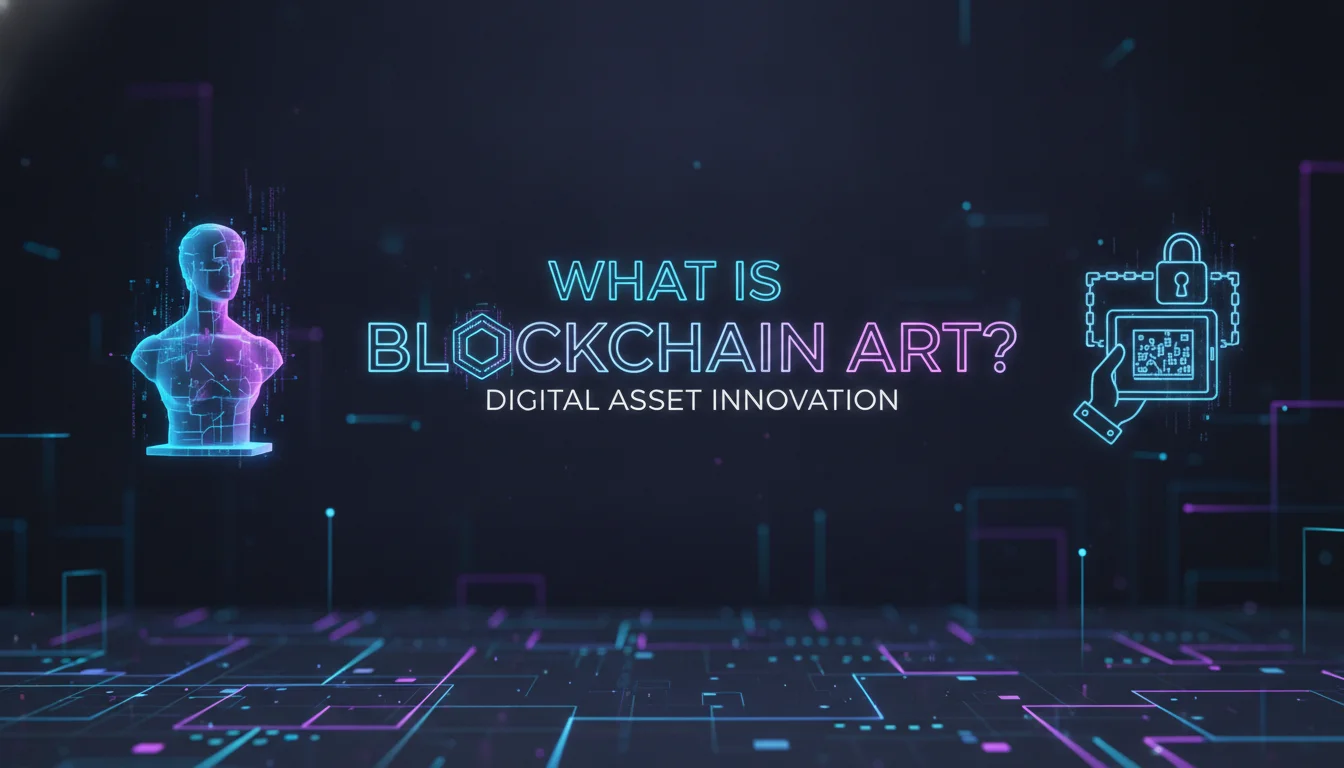
this type of art is a broad category covering any artwork whose ownership, authenticity, or creation relies on blockchain technology. According to Art Basel, blockchain has become part of artists’ practice both as subject and medium. The category covers bitcoin graffiti art, tokenized digital paintings, algorithmically generated works, and physical artworks linked to tamper-resistant certificates.
A blockchain is a public, decentralized list of records linked and secured using cryptography. Because no centralized version of the information exists for a hacker to access or corrupt, blockchain is considered by many to be a highly secure way to transfer digital data. This technical foundation is what lets this kind of art carry a unique, auditable provenance trail.
From Provenance to Native Digital Media
Some blockchain projects use the technology only to register a physical artwork or verify its history. Others are native to the chain: the token is the artwork, or the artwork gets generated algorithmically at the moment of purchase. Robert Norton, CEO of Verisart, framed the practical question for sellers as two issues: is the artwork real, and do I have the authority to sell it to you? art can address both questions through timestamps on transactions and cryptographic signatures.
The entry of CryptoKitties demonstrated that this type of art could function as a game, not just a static asset. Players purchase, collect, breed, and sell virtual cats, creating an entirely new class of digital collectible that sits outside the traditional gallery system.
Blockchain Art vs Crypto Art
this kind of art and crypto art overlap but aren’t identical. Crypto art typically refers to digital artworks sold as non-fungible tokens (NFTs) and often priced in cryptocurrency. blockchain is a wider term that also includes physical art authentication, fractionalized ownership, and programmable generative systems. Understanding this distinction helps collectors evaluate whether a project uses blockchain for provenance, for market access, or as an artistic medium in itself.
Blockchain as Authentication and Provenance Infrastructure
Why Traditional Authentication Fails
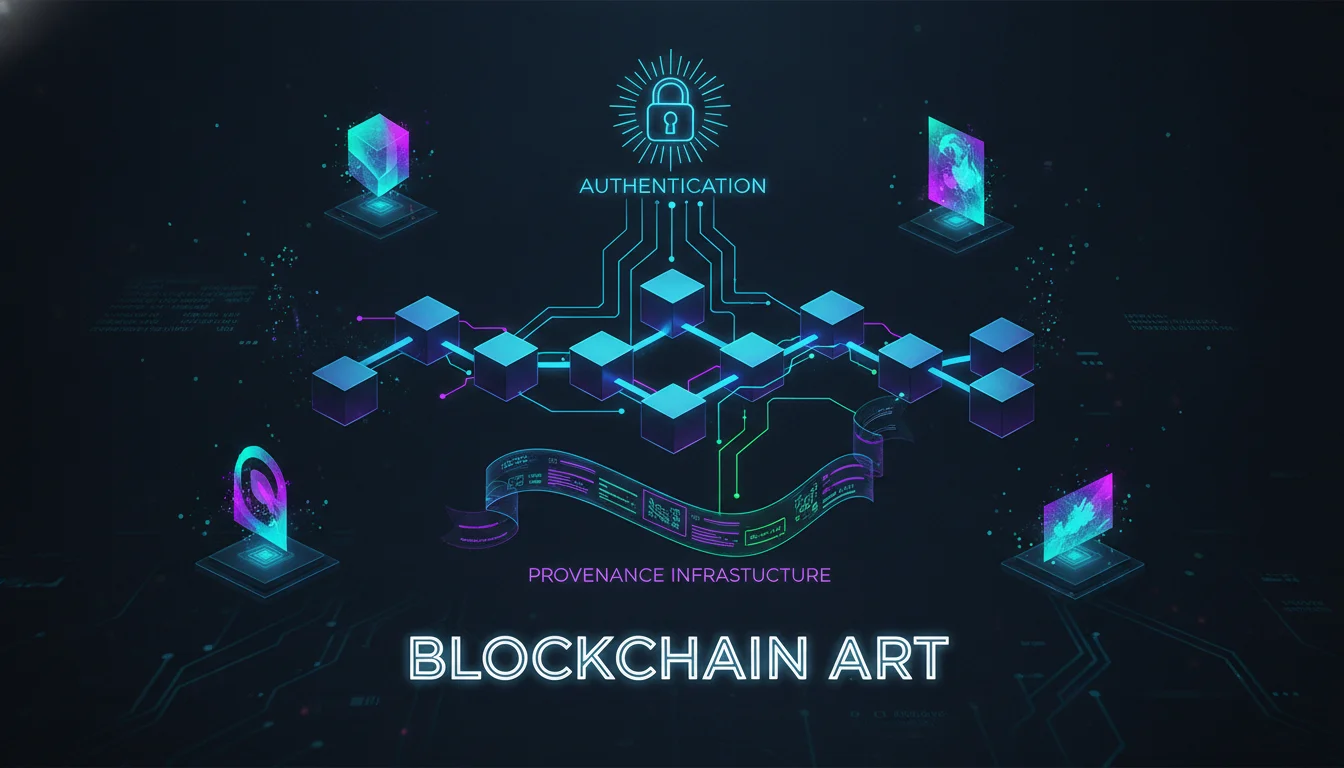
Traditional authentication fails because paper trails and centralized registries are easy to forge or lose over decades of resale. In a 2014 report, the Fine Arts Expert Institute (FAEI) in Geneva stated that over 50% of the artworks it had examined were either forged or misattributed. art changes this equation because it produces a permanent, decentralized record of ownership and transfer. Once a work gets registered, its record serves as a digital certificate of authenticity, cutting down on doubts about origin and giving collectors real transparency.
Smart Contracts and Royalty Enforcement
Smart contracts enforce artist royalties by executing payment terms automatically whenever a resale transaction hits the blockchain. Smart contracts are self-executing agreements with the terms written directly into code. In this type of art, they enable royalty mechanisms that pay artists a set percentage each time their work resells on secondary markets. According to SMU Meadows School of the Arts, this creates a more equitable relationship between creators and collectors because artists keep benefiting from the appreciation of their work.
“When you buy an artwork, you’re not clicking to buy the piece, you’re falling in love with it. This is a different kind of transaction, it’s based on relationships.” – Kelani Nichole, founder of TRANSFER, Art Basel Conversations
Early Market Proof: Warhol, Maecenas, and Fractional Ownership
One of the earliest blockchain authentication experiments involved Andy Warhol and the platform Maecenas. MyArtBroker cites this case as an example of successful blockchain authentication in the art market. Maecenas, described by Iberdrola as a pioneer of art auctions via blockchain, lets sellers inventory works while investors buy fragments, lowering the cost of entry and cutting out intermediaries. Fractional ownership is one practical use of this kind of art that would be tough to coordinate with traditional paper documentation.
The Rise of NFT Marketplaces and Trading Platforms
OpenSea and SuperRare as Core Exchanges
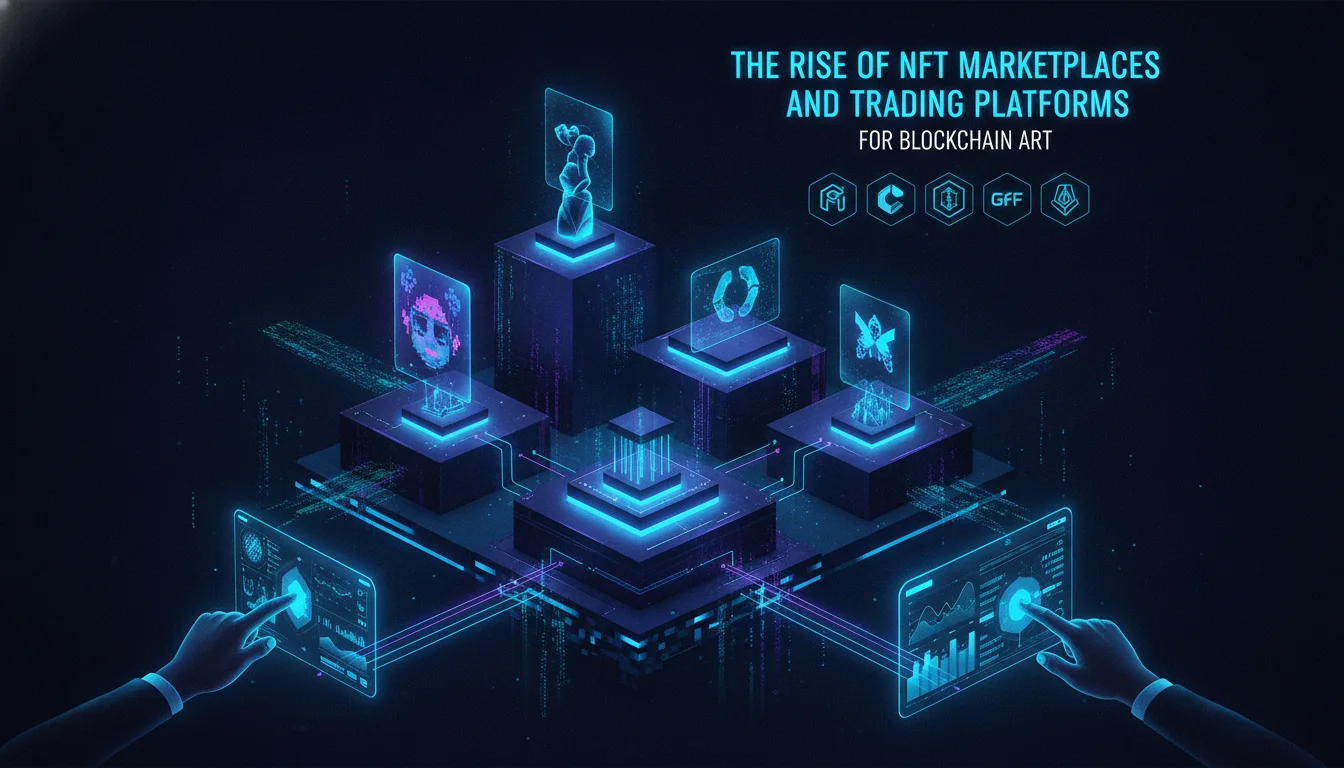
OpenSea and SuperRare function as the two largest venues for trading blockchain on-chain. According to Kate Vass Galerie, these platforms showed a considerable increase in the number of artists featured and artworks traded during the last major expansion. OpenSea is the world’s largest digital marketplace for crypto collectibles and non-fungible tokens, supporting ERC721 and ERC1155 asset standards. SuperRare focuses on unique, single-edition digital artworks created by artists in its network and tokenized as crypto-collectible items.
Kate Vass Galerie describes itself as a portal between traditional and crypto art, and it has curated artists on both OpenSea and SuperRare. The gallery treats blockchain as a tool that helps artists and new collectors while keeping trust, security, uniqueness, and provenance intact.
Specialized Platforms: KnownOrigin, MakersPlace, Async Art, Nifty Gateway
Beyond the two largest marketplaces, several specialized platforms serve different segments of art. KnownOrigin is an artist-driven platform that helps digital creators authenticate, showcase, and sell artwork and collectibles. MakersPlace offers unique digital creations from leading creative minds. Async Art introduced asynchronous art, a movement built around the question of what art looks like when it can be programmed and changed over time. Nifty Gateway became famous partly because its founders were the Winklevoss twins.
How Platform Models Differ
Platforms differ across three dimensions: curation, minting model, and asset type. OpenSea functions as a broad secondary marketplace for multiple token standards, while SuperRare runs a curated single-edition model. KnownOrigin and MakersPlace emphasize artist-driven authenticity and curated drops. Async Art specializes in programmable layers that can change independently. These differences matter because this type of art isn’t one homogeneous market; platform choice affects discoverability, royalties, and collector expectations.
| Platform | Model and Focus | Notable Features |
|---|---|---|
| OpenSea | Broad secondary marketplace | Supports ERC721 and ERC1155; largest crypto collectibles marketplace |
| SuperRare | Curated single-edition digital art | Authenticated artist network; tokenized crypto-collectibles |
| KnownOrigin | Artist-driven digital collectibles | Authentication, showcase, and sale tools for creators |
| MakersPlace | Curated digital creations | Unique drops from creative minds; NFT books |
| Async Art | Programmable layered art | Asynchronous changes; art that evolves over time |
| Nifty Gateway | Curated drops and marketplace | Founded by Winklevoss twins; high-profile releases |
| Art Blocks | Generative on-chain art | Algorithm runs at collection; permanent record |
Generative and Programmable Blockchain Art
Art Blocks and Algorithmic Creation
Art Blocks is a leading platform for generative this kind of art, where each work is created the moment it’s collected. An artist writes the algorithm; the algorithm makes the artwork. Every piece is unique, and the record of it is permanent, per Art Blocks. This model moves beyond tokenizing a finished image and instead makes the act of collection part of the creative process itself.
Programmable Art and Asynchronous Change
Async Art has pushed blockchain toward programmability. Instead of a static file, an artwork can contain multiple layers or states that change based on external data or owner interaction. Plantoids, described by Art Basel as blockchain-based robotic plants that interact with people who donate via Bitcoin and Ethereum, show how blockchain art can combine physical devices, digital ownership, and ongoing participation.
Step-by-Step: How Generative Blockchain Art Is Created
- Artist writes the algorithm. The creative code defines parameters such as color, geometry, and composition.
- A collector triggers the mint. The buyer initiates a transaction on the blockchain, often using cryptocurrency.
- The algorithm generates the artwork. At the moment of collection, the code produces a unique output influenced by transaction data or random seeds.
- The record becomes permanent. The final piece and its metadata get stored on the blockchain as a verifiable token.
Economic and Market Dynamics of Blockchain Art
Market Expansion and Collector Behavior
The blockchain art market expanded rapidly during the pandemic period. According to Iberdrola, an analysis by Markets and Markets projected the broader blockchain market could grow from $4.9 billion in 2021 to $67.4 billion in 2026. In the NFT segment specifically, Art Basel and UBS reported that figures doubled in 2021 to reach $2.6 billion. These numbers cover blockchain and NFT markets broadly rather than art alone, but they help explain the capital that flowed toward blockchain art projects.
Notable Sales and New Collector Profiles
Early blockchain art sales showed how crypto-native collectors differed from traditional art buyers. The Last Bitcoin Supper by French artist Youl sold for nearly USD 3,000 on eBay in 2014. During one Codex Art Auction, exclusive editions sold for up to USD 140,000. Verisart CEO Robert Norton observed that CryptoKitties participants didn’t want to buy traditional art; they were buying a new form of digital collectible. CryptoKitties is a virtual game that lets players purchase, collect, breed, and sell virtual cats.
“So much of the interest in art and blockchain seems to be coming from people who, as far as I can tell, aren’t that interested in art. They are really just interested in the idea of finding another way to make money.” – Simon Denny, artist, Art Basel Conversations
The Financialization Problem
Blockchain’s value in authentication and provenance is clear, but the commodity-driven approach remains controversial for many artists and curators. Kelani Nichole warned that the art world tends to look at another industry and try to apply that industry’s technology solution to art. In her view, buying art isn’t clicking to purchase a piece; it’s falling in love with a work, a transaction rooted in relationships. This tension between cultural value and financial speculation remains a defining feature of blockchain art.
Challenges: Energy, Regulation, and Understanding
What Are the Biggest Challenges Facing Blockchain Art?
The biggest challenges facing blockchain art are environmental cost, regulatory uncertainty, and a steep technical learning curve for newcomers. NFTs carry a negative reputation on the environmental front because of energy-intensive consensus mechanisms that generate carbon emissions. SMU Meadows School of the Arts identifies this as one of the key challenges for blockchain art. The industry is actively exploring solutions, including more energy-efficient consensus mechanisms and Layer 2 scaling approaches, but no single fix has fully resolved the issue.
Legal and Regulatory Uncertainty
As the digital art industry goes through constant shifts, legal and regulatory compliance requires frequent updates too. Issues like taxation of assets and copyright still need clarification for long-term application to digital art practices. Without clear rules, artists and collectors face uncertainty when declaring income, transferring ownership, or enforcing intellectual property across jurisdictions. Open questions include how NFT income should be taxed, whether tokens qualify as securities in certain jurisdictions, and how digital copyright transfers should be recorded. This legal gray zone is one reason blockchain art hasn’t reached mainstream adoption yet.
Technical Complexity and Adoption Gaps
Blockchain in the digital art space is still in an early phase, looking to break into a more mainstream position. Digital artists need to get more comfortable using the technology day to day. Wallet management, gas fees, and smart contract interactions remain technical hurdles that slow wider adoption of blockchain art beyond crypto-native audiences. The user experience gap between traditional online marketplaces and blockchain-based platforms is still significant, and closing it is arguably the sector’s biggest unsolved product problem.
Future Outlook for Blockchain Art
Current Maturity Resembles the Internet in 1993
Blockchain art’s current maturity resembles the internet around 1993: the underlying infrastructure works, but most of the applications that will matter haven’t been built yet. Both artist Simon Denny and Verisart CEO Robert Norton referenced the Art Market 2.0 report, which compares the current status of blockchain in the art world to the internet’s early commercial days. That analogy suggests the plumbing is real even if it isn’t fully realized. Many blockchain art applications may become foundational once user experience improves and standards solidify.
From Speculation to Infrastructure
The most durable blockchain art use cases may not be speculative mints but quiet infrastructure: tamper-resistant certificates, automated royalties, fractionalized ownership, and decentralized storage. The pandemic triggered a systemic shift in the art market, and the internet became the main sales channel, according to the Online Art Trade Report 2021 by Hiscox. Blockchain fits this shift by supplying the trust layer that online sales historically lacked.
What Artists and Collectors Should Watch
Artists should monitor platforms that enforce royalty-based smart contracts and provide transparent provenance records. Collectors should distinguish between a token that points to an off-chain file and a fully on-chain artwork whose code and metadata are immutable. As Coursera notes, NFT art can represent digital drawings, paintings, music, film, poetry, or books, and digital artists earn a median salary of $67,000. This underscores that blockchain art is also an emerging creative profession, not just a collector market.
Pros and Cons of Blockchain Art
Pros
- Permanent, tamper-resistant provenance records that reduce forgery risk compared to paper documentation.
- Automated royalties through smart contracts, giving artists ongoing income from secondary sales.
- Direct artist-to-collector sales that cut out gallery intermediaries and their markups.
- New formats like generative and programmable art that couldn’t exist without on-chain infrastructure.
- Fractional ownership models that lower the entry cost for collecting high-value works.
Cons
- Energy consumption tied to certain consensus mechanisms draws legitimate environmental criticism.
- Regulatory uncertainty around taxation, securities law, and copyright transfer varies by jurisdiction.
- Wallet setup, gas fees, and smart contract interactions still create real friction for non-crypto-native buyers.
- Market speculation can overshadow artistic merit, drawing buyers interested purely in flipping assets.
- Off-chain storage for many