Blockchain technology companies are organizations that build, operate, or deploy decentralized ledger systems for payments, smart contracts, and digital asset infrastructure. They range from exchanges like Coinbase to infrastructure providers like IBM and mining firms like Core Scientific.
Key Takeaways
- technology companies are entities building, maintaining, or utilizing decentralized ledger systems.
- Top firms include Coinbase, Binance, IBM, Ripple, and Core Scientific, spanning exchanges, payments, and mining.
- The global blockchain market is projected to reach roughly $1.4 trillion by 2030, driven by DeFi and enterprise adoption.
- Investors can access blockchain stocks directly (COIN, MSTR), through ETFs, or by holding digital assets.
- Stablecoin regulation (the GENIUS Act) and AI-compute convergence are reshaping the sector heading into 2026.
What Are Blockchain Technology Companies?

A blockchain technology company is an organization that develops, deploys, or leverages decentralized ledger technology to enable secure, transparent, and immutable transactions. These companies span a wide ecosystem, from cryptocurrency exchanges and hardware manufacturers to enterprise software firms and investment vehicles. According to a Builtin industry roundup, the global blockchain market is on track to reach roughly $1.4 trillion by 2030. That’s not a rounding error. It’s a structural shift in how value moves.
The Core Building Blocks
Every blockchain technology company relies on a few fundamental components: a distributed ledger that records transactions across multiple nodes, cryptographic hashing that ensures immutability, and a consensus mechanism (Proof of Work, Proof of Stake, and variants) that validates new blocks. Smart contract functionality, pioneered by Ethereum, lets these companies automate agreements without intermediaries. Many this type of companies also ship developer tools, APIs, and cloud-based services to lower the barrier for enterprise adoption.
“The infrastructure layer of Web3 is where most of the durable value gets captured, not the speculative token layer sitting on top of it.” This is the thesis we operate under at Digital Blockchains, and it shows up in how the strongest companies in this sector allocate capital: toward protocol reliability, not marketing spend.
Types of Blockchain Technology Companies
The sector is broadly categorized into:
- Exchanges and Custodians: Platforms like Coinbase and Binance that facilitate buying, selling, and storing cryptocurrencies.
- Infrastructure Providers: IBM, Ripple, and Chainlink (oracle networks) build the plumbing for blockchain applications.
- Mining and Hardware: Companies like Core Scientific and Nvidia supply the computing power securing networks.
- Fintech and Payments: Block (Square) and PayPal integrate crypto services into traditional finance.
- Enterprise and Consulting: Firms like ConsenSys and R3 offer custom blockchain solutions for supply chain, healthcare, and beyond.
Top Blockchain Technology Companies by Sector
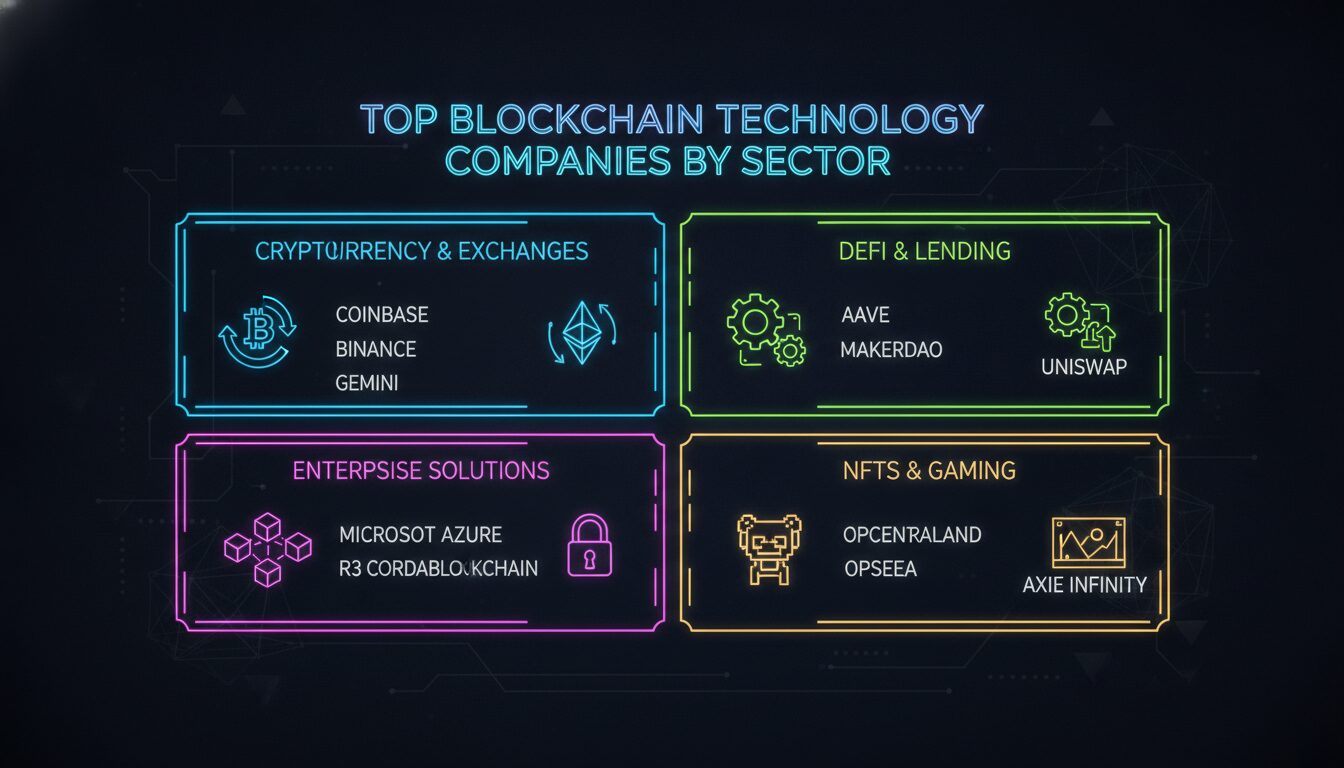
Leading this kind of companies have carved out distinct niches rather than competing head-on. The table below compares key players across exchanges, infrastructure, and mining based on publicly available data as of mid-2026.
| Company | Sector | Key Metric | 2026 Focus |
|---|---|---|---|
| Coinbase | Exchange | $404B in platform assets | Institutional custody, regulatory leadership |
| Binance | Exchange | 190+ cryptocurrencies, 250+ trading pairs | Global expansion, compliance frameworks |
| IBM | Enterprise Blockchain | Hyperledger Fabric deployments | Supply chain, digital identity |
| Core Scientific | Mining/AI | One of North America’s largest Bitcoin miners | High-performance computing, AI hosting |
| Ripple | Payments | Cross-border settlement network | Stablecoin-powered solutions |
Exchanges: The Gateway to Digital Assets
Cryptocurrency exchanges are the most visible blockchain technology, and for good reason: they’re the on-ramp most people actually touch. Coinbase serves over 245,000 ecosystem partners across 100+ countries, while Binance offers access to more than 190 cryptocurrencies with trading fees starting as low as 0.1%. These platforms don’t just facilitate trades. They provide custody, staking services, and institutional-grade APIs that increasingly resemble prime brokerage infrastructure.
Infrastructure and Platform Providers
Companies like IBM and Oracle deliver enterprise-grade blockchain platforms built for compliance-heavy industries. IBM’s blockchain platform, built on Hyperledger Fabric, has been used in food safety tracking initiatives with Walmart and trade finance consortiums like we.trade. Ripple’s XRP Ledger and its stablecoin initiative, meanwhile, are targeting cross-border payments for banks and remittance providers. Per VanEck’s thematic investing research, on-chain settlement of tokenized assets is one of the defining trends heading into 2026.
Mining and Hardware Firms
Bitcoin mining remains capital-intensive but increasingly strategic. Core Scientific, one of the largest publicly traded miners in North America, illustrates the industry’s pivot: it’s now repurposing a portion of its data center capacity for AI and high-performance computing workloads instead of pure hash rate. Nvidia, primarily a GPU manufacturer, plays an adjacent but critical role, selling the processors that power both crypto mining rigs and AI training clusters. It’s worth distinguishing the two revenue streams; they move on different cycles.
How to Evaluate Blockchain Technology Companies
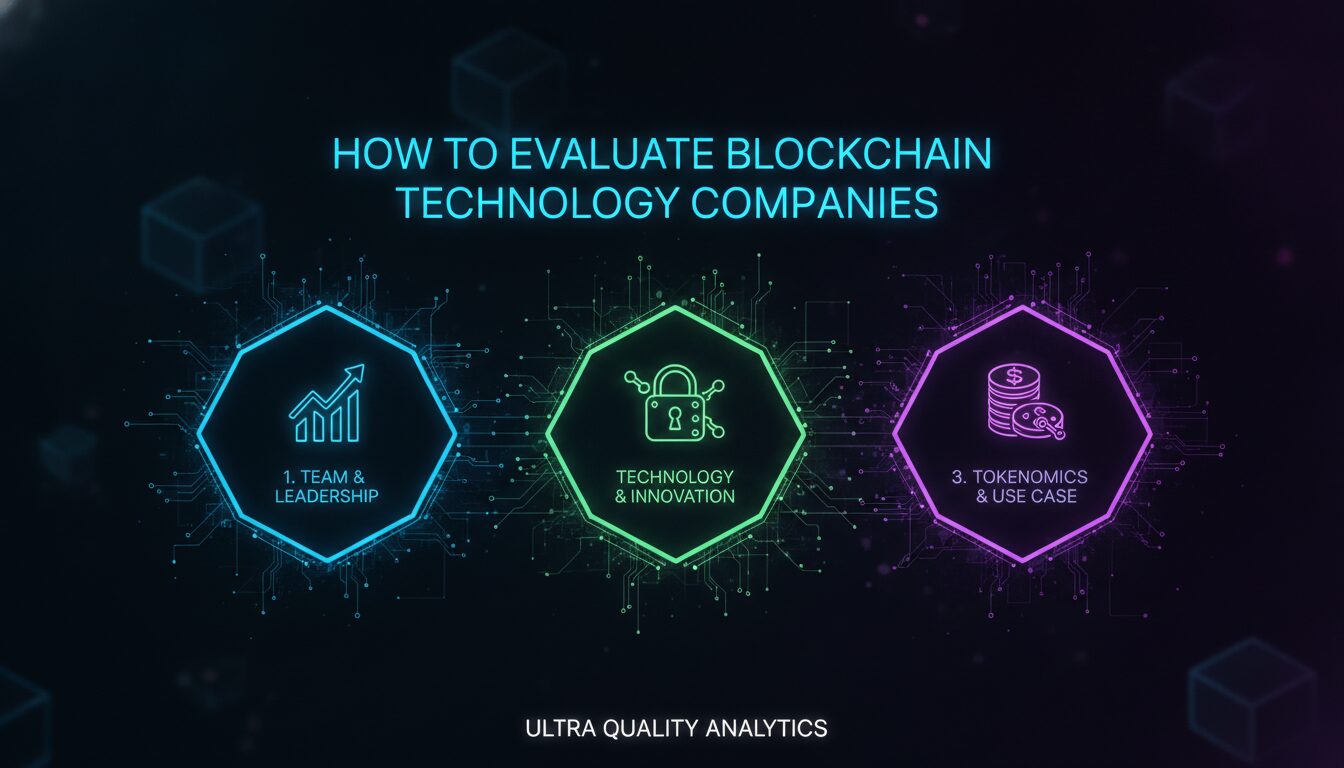
You evaluate technology companies by examining their technology stack, adoption metrics, tokenomics, and regulatory posture in that order. Whether you’re an investor, job seeker, or potential partner, this four-step approach separates viable operators from vaporware.
Step 1: Examine the Technology Stack
Look at the consensus protocol (Proof of Work, Proof of Stake, Delegated Proof of Stake), scalability solutions (layer-2 rollups like Arbitrum), and interoperability features. A company’s GitHub activity, technical documentation, and security audit reports (from firms like CertiK) reveal actual commitment to quality, not just marketing copy.
Step 2: Analyze Real-World Adoption
Metrics like daily active addresses, transaction volume, and dApp deployment count indicate real traction versus paper promises. For enterprise-focused this type of companies, partnerships with Fortune 500 firms and live production deployments (Walmart’s food traceability work on IBM Blockchain, for instance) carry more weight than whitepaper claims.
Step 3: Review Tokenomics and Revenue Streams
For companies with native tokens, assess supply dynamics, staking yields, and governance models. Revenue diversification matters here: Coinbase earns from trading fees, subscription products, and USDC interest income, which reduces its dependence on exchange volume alone.
Step 4: Assess Compliance and Security
Given the 2026 regulatory environment, companies that proactively secure licenses (BitLicense in New York, MiCA in Europe) and run regular security audits reduce existential risk. The GENIUS Act in the U.S. is likely to widen the gap between compliant firms and everyone else.
The Biggest Blockchain Technology Companies by Revenue
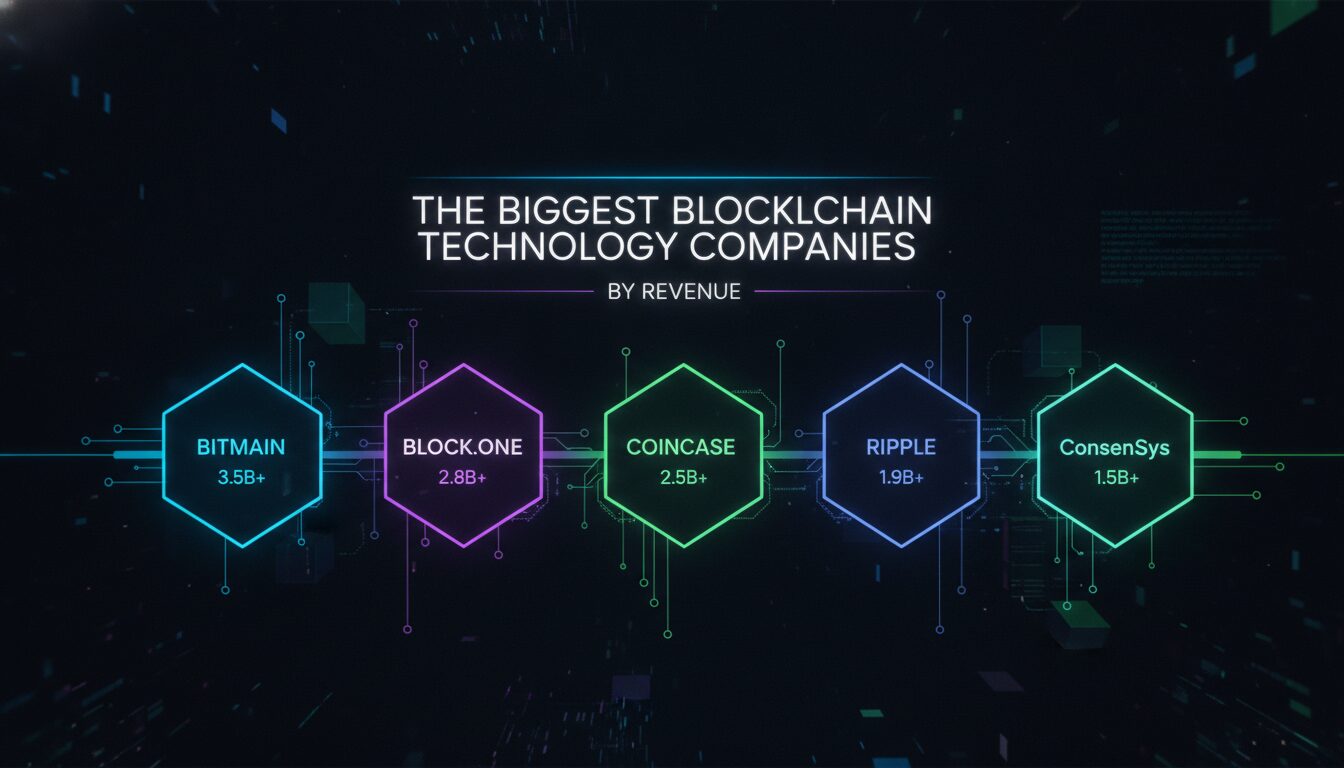
Public financials give a clear lens into which this kind of companies are capturing the most value. Pure-play crypto firms often show volatile earnings tied to market cycles, but diversified tech giants compete in this space too, and their revenue tends to be steadier.
Coinbase: The Publicly Traded Benchmark
As the largest U.S.-based crypto exchange, Coinbase (NASDAQ: COIN) generates billions in quarterly revenue from retail and institutional trading. Its platform holds over $404 billion in assets and functions as a regulated gateway for mainstream investors, per company disclosures. The company’s move into derivatives and international expansion signals ambition to compete more directly with Binance’s global footprint.
Strategy (MicroStrategy): Bitcoin Treasury Approach
Originally a business intelligence firm, Strategy (MSTR) has become synonymous with corporate Bitcoin adoption. It’s the largest publicly known corporate holder of Bitcoin, using its balance sheet aggressively to accumulate the asset. This treasury strategy has turned MSTR into something close to a leveraged proxy for Bitcoin exposure, attracting both equity investors and convertible bond markets.
IBM and Nvidia: Tech Giants in Blockchain
IBM’s blockchain-related consulting, platform licensing, and SaaS revenue sits inside its broader cloud and cognitive software segment rather than as a standalone line item. Nvidia benefits from blockchain indirectly: GPU sales for crypto mining fluctuate with market cycles, but its data center GPU business has grown substantially on AI demand, making it a dual-play on both trends simultaneously.
Blockchain Technology Companies Reshaping Global Finance
Beyond exchanges and mining, a subset of blockchain technology is directly targeting inefficiencies in traditional banking and payments rails.
Ripple: Cross-Border Settlement
Ripple’s product suite, including Ripple Payments and the RLUSD stablecoin, aims to replace parts of the correspondent banking network. Using the XRP Ledger as a bridge currency, transactions can settle in seconds rather than days, according to Ripple’s own published data. The company reports partnerships with financial institutions across dozens of countries, though the pace and depth of these integrations vary by market.
Binance: The Global Exchange Engine
Binance outpaces most competitors in trading volume, handling billions of dollars daily. Its ecosystem includes Binance Smart Chain (BSC), a widely used layer-1 network hosting thousands of dApps, and Binance Pay, a contactless crypto payment gateway. Despite regulatory friction in multiple jurisdictions, Binance has ramped up compliance efforts while maintaining one of the lowest fee structures in the industry.
Galaxy Digital: Institutional Crypto Services
Galaxy Digital, led by Mike Novogratz, provides trading, asset management, and investment banking services tailored to institutional clients. It’s a top holding in the VanEck Digital Transformation ETF (NODE), which reflects its standing as a bellwether for institutional digital asset adoption.
The AI-Blockchain Convergence in 2026
technology companies increasingly bridge decentralized ledgers and AI infrastructure by repurposing mining capacity and compute networks for machine learning workloads. As AI training demands massive, geographically distributed compute, blockchain-adjacent infrastructure is proving to be a legitimate second use case, not just a narrative pivot.
Core Scientific: From Bitcoin Miner to AI Host
Core Scientific’s pivot is emblematic of this trend. After emerging from restructuring, the firm committed a significant portion of its high-density data centers to host GPU clusters for AI training and inference. By reusing existing cooling, power, and fiber infrastructure, the company lowers capex for AI startups while stabilizing its own revenue beyond Bitcoin price swings.
GPU Networks: Decentralizing AI Compute
Projects like Render Network and Akash Network use blockchain protocols to build marketplaces for idle GPU resources. These aren’t traditional companies in the incorporated sense, but they’re backed by foundations and crypto organizations that operate much like this type of companies. Early adoption data from the Render Foundation suggests this model could meaningfully undercut centralized cloud pricing, though independent third-party verification of those cost claims is still limited.
Investing in Blockchain Technology Companies
You can invest in this kind of companies through direct equity, sector ETFs, venture platforms, or native token exposure, each with a different risk profile. In 2026, the range of access points is wider than it’s ever been.
Direct Stocks and ETFs
Publicly traded names like Coinbase (COIN), Robinhood (HOOD), Block (SQ), and Nvidia (NVDA) offer straightforward equity exposure. For diversified baskets, ETFs such as the Global X Blockchain ETF (BKCH) and VanEck Digital Transformation ETF (NODE) hold a mix of crypto-native firms, mining companies, and tech conglomerates. As of mid-2026, BKCH’s top holdings include Core Scientific, Cipher Mining, and Galaxy Digital.
Private Placements and Venture Capital
Accredited investors can participate in early-stage funding rounds of promising blockchain technology through platforms like Republic or AngelList. Major venture firms including a16z Crypto and model continue deploying capital into infrastructure, DeFi, and NFT startups, though these positions are illiquid and carry meaningfully higher risk than public equities.
Token and Staking Exposure
Buying a company’s native token (SOL for Solana Labs, DOT for Parity Technologies) is another route, but it comes with different risk math and needs a tokenomics lens, not an equity lens. Staking these tokens can generate annual yields in the roughly 5-10% range depending on network and lockup terms, but underlying token prices remain volatile.
Messari’s research consistently flags a pattern worth repeating to founders: tokens without a clear value-accrual mechanism tend to underperform their own network’s usage growth. Utility and price don’t automatically move together, and treating them as if they do is one of the most common analytical mistakes we see in this sector.
Careers at Blockchain Technology Companies
technology companies are hiring across a widening set of roles, from smart contract development to compliance and community management. CryptoJobsList, one of the larger Web3 job boards, tracks thousands of active companies posting open roles across the sector.
In-Demand Skills and Roles
Solidity developers, Rust engineers (for Solana and Polkadot ecosystems), and smart contract auditors are among the most sought-after professionals right now. Product managers with DeFi experience and lawyers specialized in digital asset regulation also command premium compensation. Certifications from programs like Moralis Academy or the Certified Blockchain Professional track can improve employability at established this type of companies.
Remote Work and Global Talent Pools
A significant share of these roles are fully remote, which lets global talent participate regardless of location. This opens the field up considerably: the best ideas, not just the best-funded time zones, increasingly drive which projects gain traction.
Future Trends for Blockchain Technology Companies
The next wave of this kind of companies will be shaped by stablecoin regulation, real-world asset tokenization, and layer-2 scaling breakthroughs. As of 2026, all three trends are moving from theoretical to operational.
Mainstream Stablecoin Adoption and the GENIUS Act
The GENIUS Act in the United States aims to establish a clear licensing framework for stablecoin issuers, potentially unlocking wider use for payroll, remittances, and everyday payments. If it moves forward as proposed, compliant blockchain technology like Circle (USDC) and Paxos could see meaningful growth, while unregulated counterparts may face real existential pressure.
Tokenization of Real-World Assets
By 2026, tokenization is moving from proof-of-concept to production. Companies like Ondo Finance and Securitize are working with BlackRock to issue tokenized money market funds, while platforms like Figure Lending have tokenized home equity lines of credit. This trend could eventually bring a substantial share of traditional financial assets on-chain, which would benefit the entire sector of technology companies, not just the token issuers.
Interoperability and Layer-2 Scaling
Fragmentation remains a real hurdle for the industry. Projects like Polkadot and Cosmos focus on cross-chain communication, while Ethereum layer-2 networks (Arbitrum, Optimism, zkSync) continue pushing transaction fees toward sub-cent levels. Companies building bridges and aggregation tools will matter more, not less, as the multi-chain future solidifies.
Pros and Cons of Blockchain Technology Companies as an Investment or Career Path
Pros
- Exposure to a market projected to approach $1.4 trillion by 2030, spanning multiple sub-sectors and revenue models.
- Diverse entry points: public equities, ETFs, tokens, or direct employment, each suited to different risk tolerances.
- Remote-first hiring norms open roles to a global talent pool rather than a single geographic hub.
- Growing regulatory clarity (GENIUS Act, MiCA) is starting to separate durable operators from speculative ones.
Cons
- Revenue and token prices remain highly volatile, tied closely to broader crypto market cycles.
- Regulatory uncertainty still varies significantly by jurisdiction, creating compliance risk for global operators.
- Many smaller projects lack audited security practices, increasing exposure to hacks and exploits.
- Distinguishing genuine technical progress from marketing-driven hype requires real technical diligence.
Frequently Asked Questions
What is a blockchain technology company?
A blockchain technology company is any organization that creates software, hardware, or services based on decentralized ledger technology to enable secure, transparent digital transactions. This spans exchanges, infrastructure providers, mining firms, and enterprise solution vendors.
Which blockchain technology company is the largest?
By trading volume, Binance is generally considered the world’s largest cryptocurrency exchange. By market capitalization among public companies, Coinbase and Strategy are leading contenders, with large tech firms like IBM and Nvidia also heavily involved in blockchain infrastructure.
How can I invest in blockchain technology companies?
You can buy stocks of publicly traded companies like Coinbase (COIN) or Block (SQ), invest in blockchain ETFs such as BKCH or NODE, or purchase digital tokens from blockchain projects directly. Each approach carries a distinct risk and liquidity profile.
What are the main types of blockchain technology companies?
Key categories include cryptocurrency exchanges, infrastructure providers (wallets, nodes, oracles), mining firms, payment processors, enterprise solution vendors, and decentralized application studios.
Are blockchain technology companies only about cryptocurrencies?
No. While cryptocurrencies are the most visible use case, blockchain technology companies also build solutions for supply chain tracking, digital identity, healthcare data exchange, voting systems, and tokenized financial assets.
What trends will impact blockchain technology companies in 2026?
Major trends include stablecoin regulation under the GENIUS Act, tokenization of real-world assets, the convergence of AI and blockchain compute, and layer-2 scaling improvements that reduce transaction costs and support mass adoption.
Evaluating blockchain technology companies from the outside is one thing. Building the tokenomics, smart contracts, and governance structures that make one credible is another. If you’re a serious builder working on protocol infrastructure, token launches, or DAO architecture, apply to the Genesis Cohort at Digital Blockchains. We work with founders who want technical substance over hype.