Key Takeaways
- Swift blockchain news: Swift activated its blockchain-based shared ledger on July 9, 2026, with 17 banks beginning live pilot transactions using tokenized deposits.
- The ledger enables 24/7 cross-border payments and was built in just nine months from design to production, with input from 40+ financial institutions.
- Major participants include HSBC, Citi, BNP Paribas, UBS, Wells Fargo, and others spanning six continents.
- Swift’s approach keeps digital money inside the regulated banking system, using tokenized commercial bank deposits rather than cryptocurrencies or stablecoins.
- The ledger is designed to interoperate with existing Swift rails and future digital asset networks, not replace them.
Swift blockchain news is the story of a 50-year-old financial messaging network activating a permissioned blockchain ledger for live cross-border payments. As of July 2026, 17 global banks are piloting tokenized deposit transactions on this infrastructure, built in nine months with input from 40+ institutions.
Swift Blockchain News: The Ledger Goes Live

On July 9, 2026, Swift announced that its blockchain-based shared ledger had moved from concept to activation in under a year. The announcement immediately captured the attention of the financial world, marking a decisive step toward integrating tokenized assets into mainstream banking. According to Swift’s official press release, the ledger was designed and built with feedback from 40+ financial institutions, reflecting a co-creation approach that accelerates industry adoption.
“With our new ledger capability, we’re extending the trust and stability of established finance into the frontiers of digital money. It allows tokenised value to move across borders with the velocity and flexibility modern commerce expects, while maintaining the same high levels of resiliency, security, and compliance global finance requires.” – Thierry Chilosi, Chief Business Officer, Swift
What Is Swift’s Blockchain Ledger?
Swift’s blockchain-based ledger is a permissioned, shared record of transactions that operates alongside the existing Swift messaging network, not in place of it. It provides a secure orchestration layer for bank-issued tokenized deposits, which are digital representations of commercial bank money. The ledger records, sequences, and validates transactions while enforcing business rules through smart contracts, ensuring compliance and finality. This is not a public blockchain like Ethereum. It is a private, institution-grade ledger built specifically for regulated financial use.
Why This Swift Blockchain News Matters
The significance of this swift blockchain news lies in its pragmatic approach. Rather than disrupting the financial system, Swift is extending it. Banks can now process cross-border payments 24/7, including weekends and holidays, without compromising the compliance, credit, and risk controls embedded in existing payment processing. Traditional correspondent banking often leaves transactions idle during off-hours. Tokenized deposits on the ledger move instantly at any time, with final settlement completed later through conventional systems.
The 17 Pilot Banks and Global Reach

Seventeen financial institutions from six continents are preparing to pilot live transactions on the ledger. This early adopter group demonstrates broad international demand for a regulated, always-on payments infrastructure. The roster is confirmed by Swift’s official announcement and corroborated by CoinDesk’s coverage:
- ANZ
- BNP Paribas
- BNY
- Citi
- DBS
- First Abu Dhabi Bank (FAB)
- FirstRand Bank Limited
- HSBC
- Itaú Unibanco
- Lloyds Bank
- Mashreq
- MUFG Bank
- OCBC
- Standard Chartered
- UBS
- UOB
- Wells Fargo
Diverse Geography and Business Models
The pilot covers North America (Citi, BNY, Wells Fargo), Europe (BNP Paribas, HSBC, UBS, Lloyds, Standard Chartered), Asia-Pacific (ANZ, DBS, MUFG, OCBC, UOB), the Middle East (FAB, Mashreq), Africa (FirstRand), and South America (Itaú Unibanco). This geographic spread underscores the ledger’s design for interoperability across jurisdictions. Lisa Vasic, Managing Director Transaction Banking at ANZ, stated that the initiative “is an important step in advancing real-time, always-on cross-border payment capabilities.” Pierre Fersztand, Global Head of Cash Management at BNP Paribas, called it “a significant milestone in the evolution of cross-border payments.”
How Banks Will Use the Ledger
Initially, the ledger focuses on 24/7 cross-border payments using tokenized deposits. Banks issue digital versions of their customers’ funds on their own internal ledgers, then use Swift’s shared ledger as a universal orchestrator to transfer those tokens between institutions. Final settlement in central bank reserves or via existing correspondent banking networks occurs later, preserving traditional liquidity management and credit risk frameworks. This two-step process, instant token movement followed by batched settlement, combines the speed of blockchain with the safety of fiat settlement layers.
How the Ledger Works: Tokenized Deposits and Settlement
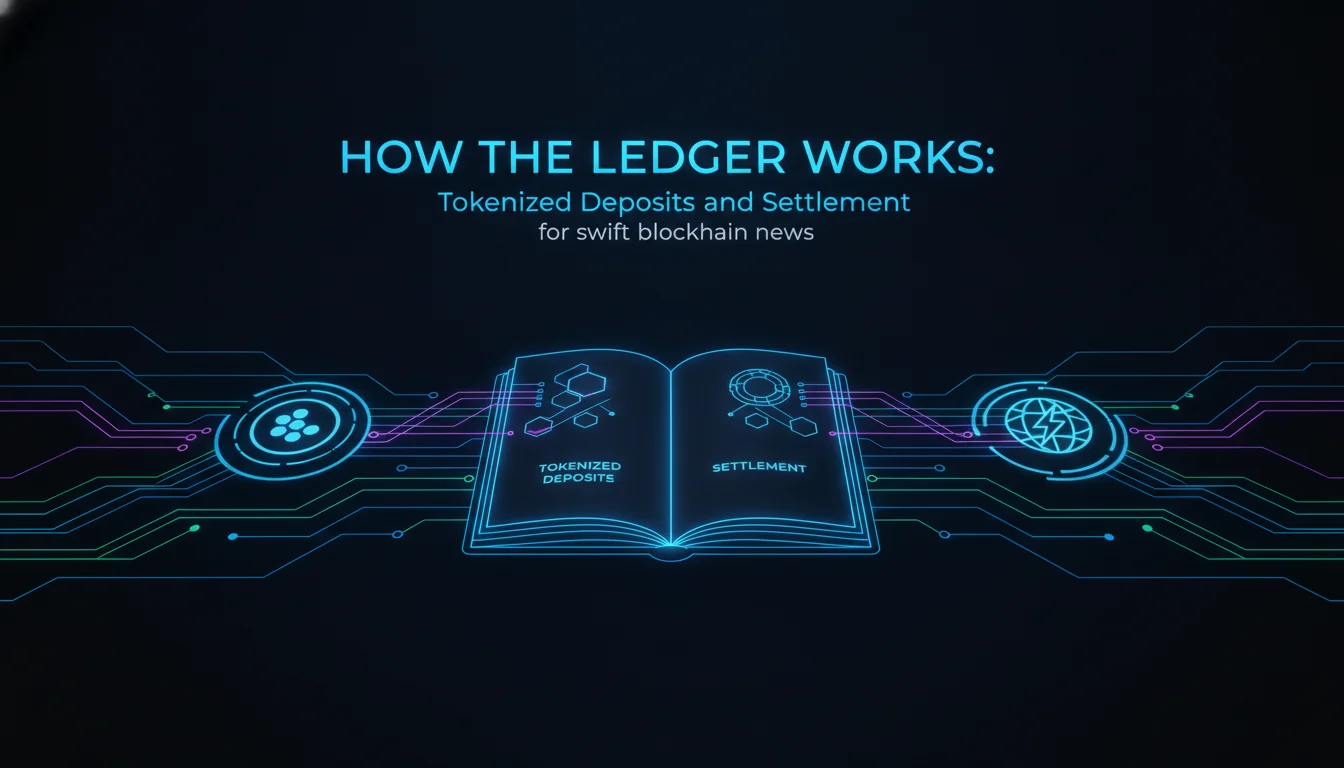
A core innovation of Swift’s approach is the use of tokenized deposits. These are not volatile cryptocurrencies but digital claims on fiat currency held at commercial banks. According to Swift’s product documentation, the ledger does not create new money. It records ownership changes of existing deposits. Smart contracts automate compliance checks, including anti-money laundering (AML) screening and sanctions filtering, ensuring that only authorized transactions proceed. This design mirrors the security model of traditional banking while adding programmability and continuous availability.
Step-by-Step: A Cross-Border Transaction
The following steps illustrate a typical cross-border payment on the new ledger:
- Token issuance: A bank withholds a customer’s deposit and issues an equivalent amount of tokenized deposit on its own ledger, representing a claim on that bank.
- Transfer instruction: The sending bank submits a payment instruction to Swift’s shared ledger, specifying the recipient, amount, and required compliance data.
- Smart contract validation: The ledger’s smart contracts verify compliance, credit limits, and account balances instantly. If valid, the ledger records the transfer of ownership from the sending to the receiving bank’s tokenized deposit pool.
- Immediate availability: The receiving bank credits the beneficiary’s account or its tokenized wallet, making funds available 24/7, often within seconds.
- Final settlement: At predefined intervals, participating banks settle the net positions using central bank reserves or through existing Swift settlement mechanisms, finalizing the obligations.
Liquidity and Risk Management
A key benefit is improved liquidity efficiency. Because the ledger enables near-instant transfer of tokenized deposits, banks can reduce the idle balances they hold in nostro accounts worldwide. The system also supports overnight and weekend movements, allowing corporate treasurers to optimize cash flows without waiting for banking hours. All transactions remain subject to existing prudential regulations, so banks maintain full control over credit and operational risk.
Benefits for Cross-Border Payments
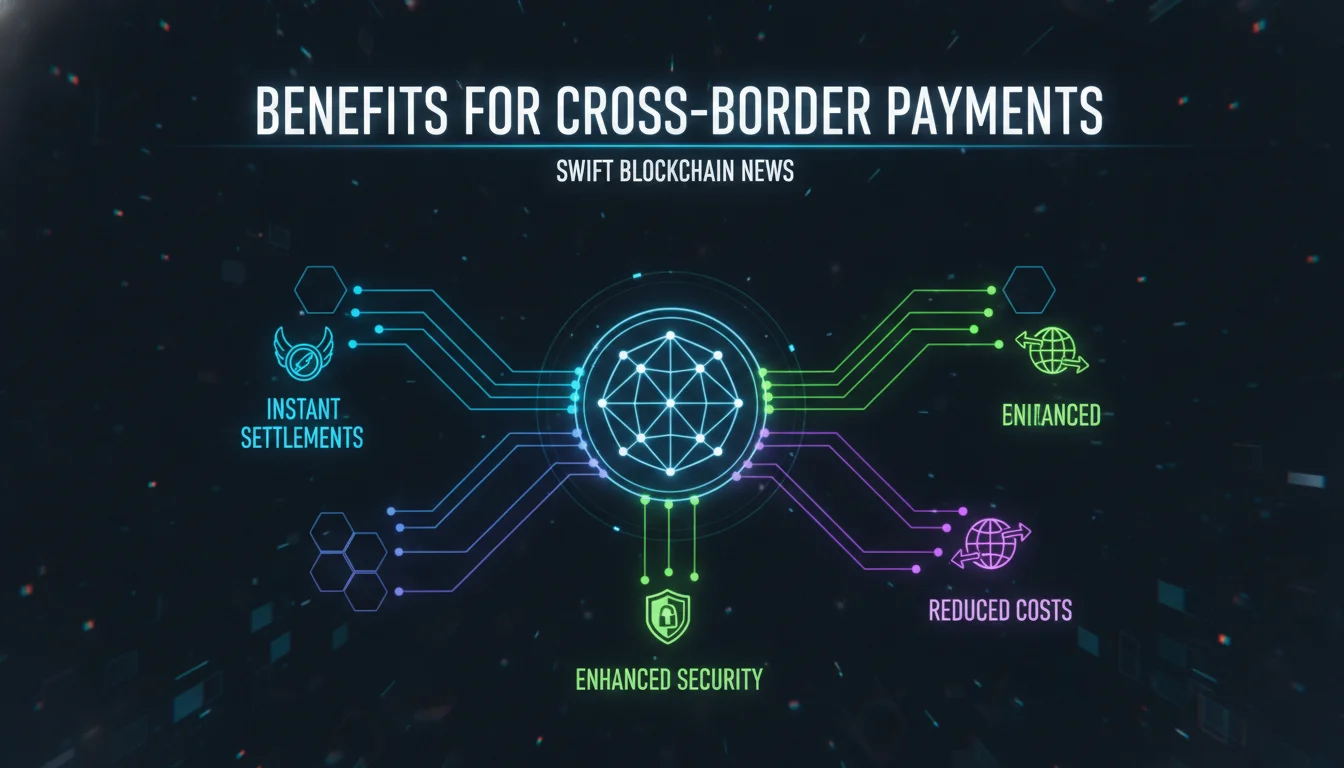
Swift’s blockchain initiative directly addresses the G20 targets for cross-border payments: speed, cost, transparency, and access. According to Swift’s official press release, 75% of payments on its existing network already reach beneficiary banks within 10 minutes, and the new ledger is designed to push that closer to 100% while extending availability to all hours. This swift blockchain news signals a significant upgrade to infrastructure that already moves the equivalent of world GDP every two to three days across more than 200 markets.
Always-On Availability
By decoupling the messaging and settlement timing, the ledger enables payments to be initiated and funds credited at any time, including weekends and public holidays. This matters most for retail remittances, e-commerce, and corporate treasury operations that require real-time liquidity. Swift is also implementing a retail payments framework that ensures upfront fee transparency and full value delivery, simplifying the experience for consumers and small businesses.
Interoperability Without Disruption
Unlike many blockchain projects that require a complete overhaul of back-end systems, Swift’s ledger is built to interoperate with existing banking platforms and payment rails. Banks can continue using their current Swift interfaces while gradually adopting new digital capabilities. This minimizes integration costs and lowers the barrier to entry for institutions of all sizes. The ledger’s architecture also supports future connections to other digital asset networks, enabling movement of tokenized value across diverse ecosystems.
Pros and Cons
Pros
- 24/7 availability: Tokenized deposits can move overnight and on weekends, eliminating the idle periods that plague traditional correspondent banking.
- Regulatory compliance built in: Smart contracts enforce AML, sanctions screening, and credit controls automatically, keeping transactions within existing legal frameworks.
- Low disruption to existing systems: Banks keep their current Swift interfaces and adopt the ledger incrementally, reducing integration risk and cost.
- Trusted network effect: Swift already connects more than 11,500 financial institutions. The ledger inherits that reach from day one.
- Foundation for programmable money: The smart contract layer opens the door to conditional payments, trade finance automation, and future CBDC integration.
Cons
- Permissioned and centrally governed: The ledger is controlled by Swift and its member banks, which contradicts the decentralization principles that define public blockchain networks.
- Limited initial scope: The first use case covers only 24/7 cross-border payments. Broader functionality, including digital securities and trade finance, comes later.
- Final settlement still relies on legacy rails: Token transfers are near-instant, but net settlement still flows through existing correspondent banking and central bank systems.
- Opaque technical architecture: Swift has not publicly disclosed the underlying tech stack or consensus mechanism, making independent security audits difficult.
- Adoption concentration risk: With 17 pilot banks out of 11,500+ Swift members, the network effect of the ledger is still nascent and could stall if adoption slows.
Swift vs. Ripple and Other Blockchain Solutions
No analysis of swift blockchain news is complete without comparing it to existing blockchain-based payment networks like RippleNet and public stablecoins. Swift’s ledger shares the goal of faster, cheaper cross-border payments, but its design philosophy and target audience differ fundamentally from those alternatives.
| Feature | Swift Blockchain Ledger | RippleNet / XRP | Public Stablecoins (e.g., USDC) |
|---|---|---|---|
| Network type | Permissioned, bank-led | Permissioned + public XRP Ledger | Public, open access |
| Settlement asset | Tokenized commercial bank deposits | XRP or fiat-backed IOUs | Fiat-backed stablecoins |
| Final settlement | Linked to central bank reserves | On ledger or via fiat gateways | On-chain only; off-chain redemption |
| Compliance model | Built-in smart contract rules; full AML/KYC | Gateways enforce AML; optional pathfinding | Varies by issuer; often identity-free |
| Interoperability | Integrates with existing Swift rails and future digital assets | Links to traditional banking through ODL | Connects via APIs to exchanges and wallets |
| Adoption | 17 pilot banks; 11,500+ institutions on Swift network | 300+ financial institutions using RippleNet | Broad retail and DeFi usage |
Why Swift’s Approach Appeals to Traditional Banks
For regulated financial institutions, Swift’s ledger offers a familiar governance model. Banks already trust Swift for messaging and standards. Extending that trust to a shared ledger is less disruptive than adopting a foreign asset like XRP. The use of tokenized deposits also keeps money within the regulated banking system, avoiding the counterparty risks associated with non-bank stablecoin issuers. Most large institutions view this as a faster, safer path to blockchain benefits than the alternatives currently available.
Does This Render Ripple or XRP Obsolete?
Not necessarily. Swift and Ripple target different market segments. Swift’s ledger is optimized for large-value institutional payments among banks, while RippleNet also serves smaller financial institutions and payment providers that may not have direct Swift access. XRP’s role as a bridge currency could still be relevant for corridors where liquidity is thin. That said, if Swift’s ledger scales to encompass a significant share of its 11,500+ member network, it may reduce the urgency for large banks to adopt alternative blockchain payment solutions.
What the Crypto Community Is Saying
This swift blockchain news has generated sharp debate across crypto forums and fintech circles. The reactions split cleanly along ideological lines, and both sides make valid points worth examining.
Positive Reception from Banks
The pilot bank roster speaks for itself. Institutions like HSBC, Citi, and BNP Paribas are actively participating, signaling strong institutional appetite. Financial analysts note that Swift’s initiative could accelerate the tokenization of real-world assets, as the same ledger technology can later support digital securities, trade finance, and programmable money. Per CoinDesk’s coverage of the launch, the project gives banks “a shared layer for tokenized deposits issued on their own ledgers,” keeping digital cash within the regulated perimeter.
Skepticism from Crypto Purists
On platforms like Reddit, commenters point out that Swift’s ledger is essentially a centrally governed database using blockchain-like features, which they argue contradicts the principles of open, censorship-resistant finance. Some worry it could undermine the use case for public blockchain networks and their native tokens. Others acknowledge that institutional adoption, even in a private form, validates the underlying technology and may eventually lead to greater connectivity between permissioned and public chains. One Reddit commenter noted that Swift’s system reportedly uses Chainlink’s CCIP for cross-chain interoperability, though Swift has not made any official announcement confirming which external chains, if any, the ledger will connect to.
Future Implications for Digital Finance
Swift has outlined a roadmap that extends far beyond the initial 24/7 payments pilot. The ledger is designed as a foundational layer for a digital payment stack that supports programmable money, agentic commerce (automated machine-to-machine payments), and multi-asset interoperability. As regulated digital currencies like central bank digital currencies (CBDCs) emerge, Swift’s infrastructure could serve as a backbone for cross-border movement of tokenized fiat at scale.
Programmable Money and Smart Contracts
By embedding business logic into the ledger via smart contracts, Swift can enable conditional payments, escrow services, and automated compliance, all while staying within legal frameworks. A trade finance transaction, for example, could automatically release payment upon confirmation of goods delivery, reducing risk and processing time. Such programmability has long been a promise of public blockchains. Swift’s version brings it under the oversight of regulated banks, which is exactly what institutional adoption requires.
Scalability and Open Questions
The success of this initiative depends on how many banks ultimately adopt the ledger and whether Swift can maintain performance at scale. Key open questions include how final settlement will evolve (for example, direct integration with real-time gross settlement systems), how cross-ledger interoperability with external blockchains will be handled, and whether the ledger will eventually support non-bank financial institutions. Swift has indicated that functionality and availability will expand after the controlled go-live phase. Expect further swift blockchain news throughout 2026 and into 2027 as the pilot matures and the ecosystem grows.
What This Means for Web3 Builders
If you’re building on public chains, this swift blockchain news is not a threat. It’s a signal. The fact that Swift, a network trusted by more than 11,500 institutions, is now running smart contracts and tokenized assets on a shared ledger validates the entire design space. Permissioned and public chains are not mutually exclusive. The more institutional infrastructure adopts blockchain primitives, the more pressure builds to connect those systems to public networks over time.
For protocol developers, the interesting question is interoperability. Swift’s ledger is explicitly designed to connect to “existing and emerging systems.” That’s an open door. Builders working on cross-chain messaging, tokenized asset standards, and compliance-aware smart contracts are building exactly the infrastructure that bridges like Swift’s ledger will eventually need. If you want to explore how tokenized assets and institutional-grade smart contracts fit into your protocol architecture, the Digital Blockchains studio works on exactly these problems. You can also read our deeper analysis of tokenomics and protocol design to understand how institutional adoption shapes token architecture decisions.
“Swift’s infrastructure is already trusted to move the equivalent of world GDP every two to three days between more than 200 markets.” – Swift official press release, July 9, 2026
Frequently Asked Questions
Is SWIFT going to use blockchain?
Yes. Swift has already activated a blockchain-based shared ledger that is now live and being piloted by 17 banks for tokenized cross-border payments. The system went into initial use on July 9, 2026, according to Swift’s official announcement.
What blockchain is SWIFT using?
Swift has built its own permissioned, private ledger using blockchain technology. It is not based on any existing public blockchain like Ethereum or Solana. Swift has not publicly disclosed the underlying tech stack or consensus mechanism.
Is SWIFT going with XRP?
There is no indication from official Swift announcements that XRP or RippleNet is involved. Swift’s ledger uses tokenized commercial bank deposits, not a cryptocurrency like XRP, as its settlement asset.
What does SWIFT blockchain mean for XRP?
Swift’s solution may reduce the immediate need for large banks to adopt XRP for cross-border liquidity, since transactions stay within the regulated banking system. XRP could still serve niche corridors or smaller institutions that are not on Swift’s network.
Which banks are involved in SWIFT’s blockchain pilot?
The 17 pilot banks are: ANZ, BNP Paribas, BNY, Citi, DBS, First Abu Dhabi Bank, FirstRand Bank Limited, HSBC, Itaú Unibanco, Lloyds Bank, Mashreq, MUFG Bank, OCBC, Standard Chartered, UBS, UOB, and Wells Fargo. All are confirmed in Swift’s July 9, 2026 press release.
How fast is SWIFT’s blockchain-based payment system?
The new ledger is designed for near-instant transfer of tokenized deposits, available 24/7. On the existing Swift network, 75% of payments already reach beneficiary banks within 10 minutes, and often in seconds. The blockchain ledger is designed to extend that speed to all hours, including weekends and holidays.