Monad blockchain news is the running record of a Layer 1 protocol that launched mainnet in late 2025 with 10,000 TPS, full EVM compatibility, and sub-second finality. Here’s what’s happened and what’s coming.
Key Takeaways
- Monad processes 10,000 transactions per second with 0.6-second finality, making it the fastest EVM-compatible Layer 1 in production.
- The network accumulated over $15 billion in spot trading volume shortly after mainnet launch, led by DEXs including Uniswap and Kuru.
- A major token unlock begins in November 2026, minting 2 billion MON annually as staking rewards, which will expand circulating supply significantly.
- Phantom wallet exited Monad in August 2026; MetaMask responded by covering gas fees for migrating users.
- With a fully diluted valuation near $2.14 billion and active developer programs, Monad is building toward long-term ecosystem depth.
What Is Monad Blockchain?
Monad is a high-performance Layer 1 blockchain built to solve the scalability problem without sacrificing EVM compatibility or decentralization. It achieves 10,000 TPS, near-zero fees, and full Ethereum Virtual Machine bytecode compatibility. The Monad Foundation targets decentralized applications that demand high throughput: exchanges, on-chain games, and real-time financial systems.
A High-Performance Layer 1
Monad addresses blockchain scalability by processing multiple transactions simultaneously through parallel execution, making it orders of magnitude faster than traditional EVM chains. Block times sit at 0.3 seconds with finality at 0.6 seconds, enabling real-time interactions. According to the Monad Foundation website, the network is fully EVM bytecode compatible, so developers can migrate existing Ethereum dApps without rewriting a single line of code. Critically, this performance runs on consumer-grade hardware, which keeps validator participation accessible and supports genuine decentralization.
EVM Compatibility and Developer Benefits
Full EVM compatibility means every Ethereum tool works natively on Monad. Developers deploy Solidity or Vyper contracts and use familiar infrastructure: Hardhat, Truffle, MetaMask, Rabby. This removes the migration friction that has historically kept developers anchored to slower chains. The Ethereum developer community, which numbers in the hundreds of thousands globally, can port existing projects or build new ones on a chain that is 100x to 1000x faster at the execution layer.
Monad Blockchain News: Mainnet Launch and Early Market Response
The Monad mainnet debut in late November 2025 generated immediate market activity and set the tone for everything that followed. Trading volume, price action, and developer interest all spiked within the first 48 hours.
Debut and Initial Trading Volume
According to a Yahoo Finance report by Decrypt, Monad’s native token MON began trading on November 25, 2025, at an opening price of around $0.02. Within two days, the token climbed 47%, driven by speculative demand and high expectations for the network’s throughput claims. Spot markets processed over $15 billion in cumulative trading volume, as noted by the Monad X account. The largest contributors were DEXs including Uniswap and Kuru, which accounted for the bulk of that activity.
Price Volatility and Profit-Taking
The strong open didn’t hold. By November 27, MON had dropped 15% to $0.03 amid profit-taking and concerns over spoofed transactions, as reported by Decrypt. The bid-ask delta at 10% order book depth turned negative, a clear signal of sell pressure. Shivam Thakral, CEO of Indian crypto exchange BuyUCoin, told Decrypt:
“Expectations are still constructive long term: investors are looking for real workloads, genuine developer traction, and ecosystem partners to validate Monad’s high-throughput thesis.”
That framing captures the market’s posture precisely. The speculation phase was fast and sharp; the validation phase is slower and more important.
Monad Blockchain News: Ecosystem Partners and Wallet Changes
Mid-2026 brought significant ecosystem shifts that dominated monad blockchain news. The Phantom wallet departure and MetaMask’s response reshaped the user experience layer for thousands of active addresses on the network.
Phantom Exits Monad Network
On July 26, 2026, CoinMarketCap’s CMC AI reported that Phantom would discontinue its Monad integration, effective August 2026. Phantom cited a strategic refocus on its core networks. For early Monad adopters who had used Phantom as their primary interface, the announcement forced an immediate migration decision. It also exposed a real dependency risk: when a major wallet provider exits, user retention becomes an active problem rather than a passive assumption.
MetaMask Welcomes Migrants
MetaMask moved quickly. On July 25, 2026, the team announced it would cover gas fees for users migrating from Phantom to its EVM-compatible wallet. The timing was deliberate: MetaMask positioned itself as the natural home for Monad users given the chain’s EVM roots. The gas reimbursement program reduced friction at exactly the moment users needed it most. It also reinforced a broader point about Monad’s architecture: because it runs full EVM bytecode compatibility, the entire Ethereum wallet ecosystem is available as a fallback.
Exchange Listings and Trading Milestones
Before the wallet transition, Upbit halted MON trading on July 21, 2026, for a scheduled network upgrade, according to CMC AI. Temporary halts like this are routine for maturing protocols. Separately, on-chain data indicated that Monad’s ecosystem topped $100 million in deposits within two days of mainnet launch. TVL figures cited by analysts reached above $350 million at peak, though these numbers fluctuate with market conditions and should be tracked in real time via tools like DefiLlama rather than treated as static benchmarks.
Technical Architecture: How Monad Achieves 10,000 TPS
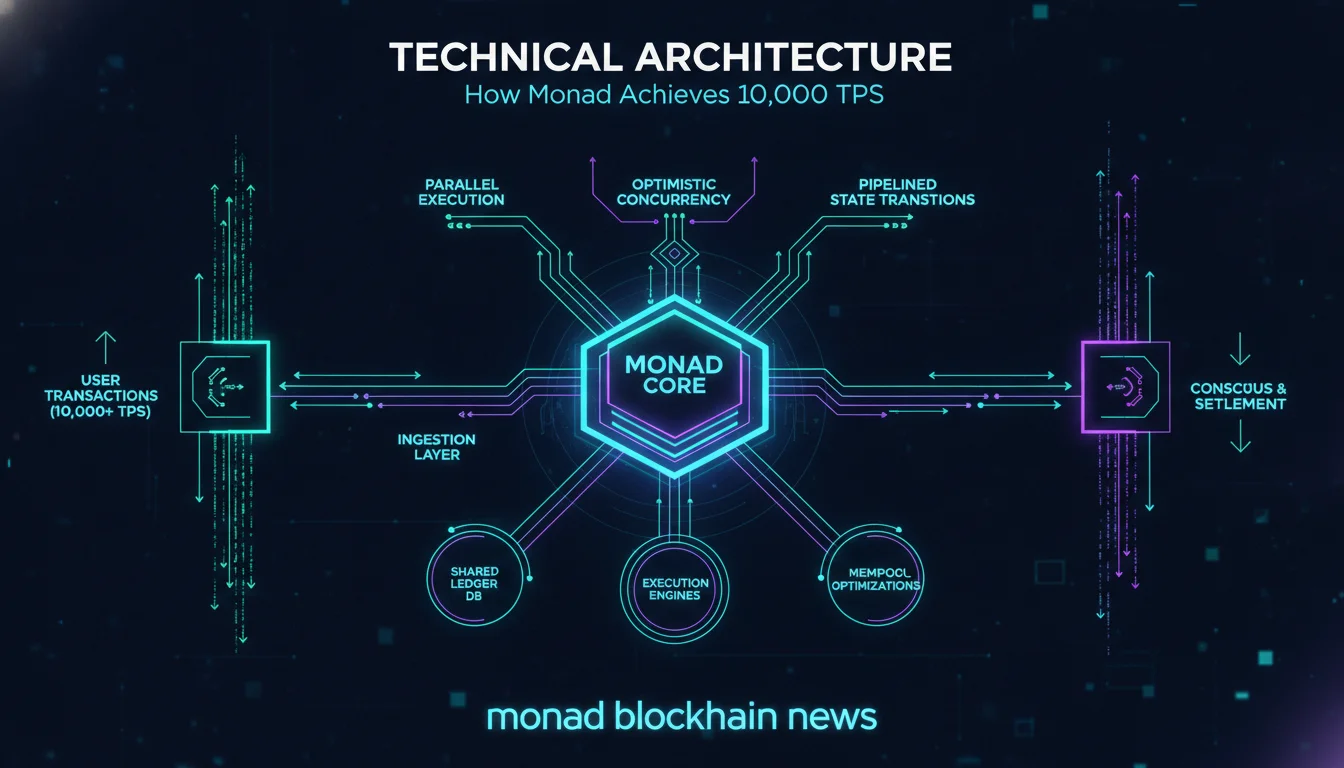
Monad’s performance numbers aren’t marketing copy. They reflect a specific set of architectural decisions that differ meaningfully from both Ethereum and its Layer 2 ecosystem. Understanding the mechanism matters if you’re evaluating whether the throughput claims hold under real load.
| Feature | Monad | Ethereum | Solana |
|---|---|---|---|
| Transactions per second | 10,000 | ~30 | ~65,000 (theoretical) |
| Block time | 0.3 seconds | ~12 seconds | ~0.4 seconds |
| Finality | 0.6 seconds | ~12-24 seconds | ~2-3 seconds |
| EVM compatibility | Full bytecode | Native | Through Neon EVM |
| Validator hardware | Consumer grade | Moderate | High-end |
MonadBFT Consensus Mechanism
MonadBFT is Monad’s custom Byzantine Fault Tolerant consensus algorithm. It produces sub-second block times and single-slot finality. Unlike Ethereum’s proof-of-stake model, which requires multiple block confirmations before a transaction is considered irreversible, MonadBFT finalizes in 0.6 seconds. For high-frequency applications like on-chain order books or real-time settlement systems, that difference between 0.6 seconds and 12-24 seconds is the difference between viable and unusable.
Parallel Execution and Optimistic Concurrency Control
Standard EVM chains process transactions sequentially: one completes before the next begins. Monad breaks that constraint with parallel execution, running multiple transactions simultaneously across independent state paths. It uses optimistic concurrency control to detect and resolve conflicts when two transactions touch the same state. Most transactions don’t conflict, so the optimistic assumption holds the vast majority of the time. The result is 10,000 TPS on hardware that doesn’t require a data center budget to operate.
Pipeline Architecture and Instant Finality
Monad separates transaction processing into distinct pipeline stages: consensus, execution, and commitment. Each stage runs independently and in parallel with the others. While one block is being executed, the next is already going through consensus. This pipelining, combined with MonadBFT’s single-slot finality, is what produces the 0.3-second block time. The ability to sustain this on consumer-grade hardware is what keeps the validator set accessible and the network genuinely decentralized.
How Monad Compares to Ethereum L2 Rollups
A fair comparison requires looking at rollups, not just Ethereum mainnet. Optimistic rollups like Arbitrum and Optimism achieve higher throughput than L1 Ethereum but introduce withdrawal delays of 7 days due to the fraud proof window. ZK rollups like zkSync and StarkNet offer faster finality but add proving overhead and have incomplete EVM equivalence in some implementations. Monad sidesteps these tradeoffs entirely: no withdrawal delays, no proving overhead, full EVM bytecode compatibility, and 0.6-second finality at the base layer. The architectural cost is that Monad is a separate L1 rather than inheriting Ethereum’s security directly. That’s a real tradeoff worth understanding before deploying critical infrastructure.
Monad Tokenomics: Supply, Distribution, and Unlock Schedule
MON token supply dynamics are one of the most-watched aspects of monad blockchain news, particularly with a significant unlock event approaching in late 2026.
Circulating Supply and FDV
According to CoinGecko, the circulating supply of MON sits at approximately 11.825 billion tokens out of a total supply of 100.683 billion. That puts roughly 11.7% of total supply in circulation currently. The fully diluted valuation sits near $2.14 billion. The gap between circulating and total supply is large, and any investor modeling long-term price behavior needs to account for that dilution schedule explicitly rather than anchoring to current market cap figures.
The November 2026 Unlock Event
The most consequential near-term event in monad blockchain news is the start of major token unlocks in November 2026. According to CoinMarketCap, the protocol will begin minting 2 billion new MON tokens annually as staking rewards. That’s a meaningful addition to circulating supply. Whether it creates sustained sell pressure depends on two variables: how much of the newly minted supply gets staked and locked back into the network, and whether transaction volume and TVL growth generate enough demand to absorb it.
Staking Rewards and Inflation
The 2 billion MON annual mint distributes to stakers and validators as network security incentives. Early-phase inflation is a deliberate design choice: it bootstraps validator participation when organic fee revenue isn’t yet sufficient to sustain the network. The risk is straightforward. If staking APR attracts capital but that capital exits as soon as rewards vest, the inflation becomes a net negative for price. Prudent analysis tracks daily active addresses, DEX volumes, and TVL growth as the leading indicators of whether demand is keeping pace with supply expansion.
Monad Blockchain News: Fundraising and Backing
Monad’s institutional backing provides important context for evaluating its long-term runway. The project raised $225 million in a Series A round led by model at a $3 billion valuation. That level of funding from a firm with model’s track record in protocol infrastructure signals serious technical credibility. It also means the team has the capital to sustain development through multiple market cycles without being forced into premature token sales or ecosystem shortcuts.
“Monad is the most ambitious EVM-compatible execution environment we’ve seen. The combination of parallel execution and MonadBFT creates a credible path to institutional-grade throughput without sacrificing decentralization.” – model, Series A investment thesis (paraphrased from public statements)
Pros and Cons
Pros
- 10,000 TPS with 0.6-second finality at the base layer, no rollup overhead required.
- Full EVM bytecode compatibility means zero rewriting for Ethereum developers migrating existing contracts.
- Consumer-grade validator hardware keeps participation accessible and supports genuine decentralization.
- $225 million Series A from model provides multi-year development runway and institutional credibility.
- Active ecosystem programs including Monad Blitz hackathons, Mach Accelerator, and DeltaV for early-stage builders.
Cons
- Only ~11.7% of total supply in circulation, meaning significant dilution is baked into the long-term supply schedule.
- 2 billion MON annual mint starting November 2026 introduces inflation pressure that demand must outpace to sustain price.
- Separate L1 architecture means no direct inheritance of Ethereum’s security or validator set.
- Wallet ecosystem dependency was exposed when Phantom exited in August 2026, forcing rapid user migration.
- Early price volatility, including a 15% drop within 48 hours of launch, reflects speculative rather than utility-driven demand in the early phase.
How to Stay Updated on Monad Blockchain News
Staying current on monad blockchain news requires a mix of official sources, on-chain data tools, and community channels. Each serves a different function in your information stack.
Official Channels and Social Media
The Monad Foundation website is the primary source for protocol documentation, roadmap updates, and event calendars. The project’s X account posts real-time milestones, partnership announcements, and network metrics. The Monad Memo newsletter delivers curated updates directly to subscribers and is worth adding to any serious builder’s reading list. These official channels are your first line of defense against misinformation that circulates in secondary crypto media.
Developer and Community Calls
Monad hosts regular AMAs on Discord and Twitter Spaces. These sessions surface upcoming features and protocol decisions before they appear in mainstream coverage. Recordings are available on YouTube, including the Thinking Crypto podcast with Eunice Giarta, Co-Founder of the Monad Foundation, which covers the technical vision in depth. Community calls consistently provide more signal than aggregated news feeds.
Blockchain Explorers and On-Chain Data
Monadvision and MonadScan provide real-time on-chain data: transaction counts, active addresses, contract deployments, and TVL. DefiLlama tracks cross-protocol TVL comparisons. For anyone following monad blockchain news seriously, on-chain data is the ground truth. It validates or contradicts the narrative before mainstream outlets catch up. DEX aggregators also show volume trends for MON pairs in real time.
Getting Started with Monad: A Step-by-Step Guide
If monad blockchain news has prompted you to participate directly, here’s the practical path from zero to active ecosystem participant.
Step 1: Set Up a Compatible Wallet
Monad is EVM-compatible, so any Ethereum wallet works. MetaMask, Rabby, and Trust Wallet are all solid choices. If you’re migrating from Phantom, MetaMask is currently covering gas fees for the transition. Download your chosen wallet, create a new account or import an existing seed phrase, and add the Monad network RPC. Keep your private keys offline and never share your seed phrase.
Step 2: Acquire MON Tokens
MON is listed on major centralized exchanges including Binance, Coinbase, and Kraken, though regional availability varies. Check the latest monad blockchain news for current listing status before attempting a purchase. You can also swap stablecoins or other tokens for MON on Uniswap or Kuru directly on the Monad network. Transfer MON to your wallet address configured for the Monad network RPC.
Step 3: Participate in the Ecosystem
With tokens in your wallet, you can explore dApps, provide liquidity to DEXs, or stake MON once staking is fully live. Developers can deploy contracts using Hardhat or Foundry with no modifications to their existing Solidity workflow. Follow monad blockchain news to track new project launches and potential airdrop opportunities. The Monad Discord is the fastest way to connect with other builders and find collaboration opportunities before they surface publicly.
Monad Blockchain Community and Global Events
The Monad Foundation runs an active global community program that goes well beyond social media presence. Events, hackathons, and accelerator programs are producing real projects and real developer relationships.
Hackathons and Builder Programs
Monad runs hackathons under the Monad Blitz brand, with events in cities including London and Jakarta. Monad Build Jakarta combines workshops with a hackathon offering $2,000 in prizes. The Mach Accelerator and DeltaV programs support early-stage startups building on Monad with structured mentorship and funding pathways. These programs consistently generate new dApps and attract developers who wouldn’t otherwise encounter the network through organic discovery.
Conferences and Meetups
The team co-locates events with major crypto conferences. On July 29, 2026, the Monad Foundation and Electric Capital hosted a happy hour during SBC in Palo Alto. An August 2026 New York event co-hosted with Rain focused on agentic commerce use cases. These gatherings tend to produce partnership announcements and developer commitments that surface in monad blockchain news within days of the event.
The Monad Memo and Research Forum
The Monad Memo newsletter and the Monad Research Forum serve different audiences. The newsletter is accessible and curated; the Research Forum is technical and detailed, hosting protocol proposals and architectural discussions. Together they ensure that both casual followers and deep contributors have a home in the ecosystem. Remote participation is fully supported, which matters for a protocol that claims global decentralization as a design goal.
Monad Blockchain News: What Lies Ahead
The next 12 months of monad blockchain news will be defined by three variables: how the November 2026 unlock plays out, whether the developer ecosystem produces applications with genuine user retention, and how Monad positions against competing high-performance chains.
Navigating the Token Unlock
The November 2026 unlock is the most immediate test. If staking rewards drive network security and usage metrics trend upward, the inflation is absorbed productively. If sell pressure dominates and daily active addresses stagnate, the price impact will be visible quickly. The leading indicators to watch are DEX volume trends, new contract deployments per week, and the ratio of staked MON to circulating supply. These numbers tell the real story before price does.
Competition and Market Position
Monad competes with Solana, Sui, and Aptos for high-throughput market share. Solana’s theoretical ceiling of ~65,000 TPS is higher, but Monad’s full EVM compatibility gives it direct access to Ethereum’s developer base, which is the largest in the industry. Sui and Aptos offer parallel execution but require developers to learn Move, a non-trivial migration cost. Monad’s bet is that EVM familiarity plus competitive throughput beats raw performance alone. That thesis will be tested as the ecosystem matures through 2026 and into 2027.
Long-Term Vision: Onchain World
Monad’s stated goal is to power the next generation of online financial systems. The “onchain world” framing means high-frequency settlement, real-time gaming economies, and institutional DeFi running at the base layer without rollup complexity. Whether that vision materializes depends on whether the developer programs produce applications that retain users beyond the speculative phase. The narrative in monad blockchain news will shift from token price to protocol utility as that evidence accumulates, or doesn’t.
If you’re building infrastructure, DeFi protocols, or tokenized systems and want to work with a team that takes protocol architecture seriously, apply to the Genesis Cohort at digitalblockchains.com.
Frequently Asked Questions
What is Monad blockchain?
Monad is a high-performance Layer 1 blockchain with full EVM bytecode compatibility, 10,000 TPS, and 0.6-second finality. It runs parallel execution and MonadBFT consensus to achieve throughput that is 100x to 1000x faster than Ethereum mainnet while keeping validator hardware requirements accessible.
When did Monad mainnet launch?
The Monad mainnet launched on November 25, 2025, with MON debuting at around $0.02. The token gained 47% within two days before pulling back 15% by November 27 amid profit-taking and spoofed transaction concerns.
What is the upcoming token unlock for Monad?
Starting November 2026, Monad will mint 2 billion MON tokens annually as staking rewards, increasing circulating supply from its current level of roughly 11.825 billion tokens. This unlock is the most significant near-term tokenomics event and warrants close monitoring of staking participation rates and DEX volume trends.
Where can I buy MON tokens?
MON tokens are available on major centralized exchanges including Binance, Coinbase, and Kraken, as well as on decentralized exchanges like Uniswap and Kuru on the Monad network. Regional availability varies, so check the latest monad blockchain news for current listing status before purchasing.
How does Monad compare to Ethereum?
Monad processes 10,000 TPS versus Ethereum’s roughly 30 TPS, with 0.6-second finality versus 12-24 seconds on Ethereum mainnet. Monad is EVM bytecode compatible, so Ethereum developers can migrate existing Solidity contracts without code changes, making the performance upgrade accessible without a learning curve.
Who is behind Monad blockchain?
Monad is developed by the Monad Foundation, with Eunice Giarta as co-founder. The project raised $225 million in a Series A led by model at a $3 billion valuation, providing substantial runway for protocol development and ecosystem growth.