Tether blockchain is the multi-chain infrastructure that issues and settles USDT, a fiat-backed stablecoin pegged to $1 USD, across more than fourteen protocols including Ethereum, Tron, and Solana.
Key Takeaways
- Tether (USDT) is a fiat-backed stablecoin designed to hold a value of $1 USD, issued by Tether Limited since 2014.
- The tether blockchain ecosystem spans fourteen protocols, including Ethereum (ERC-20), Tron (TRC-20), Solana (SPL), and BNB Smart Chain (BEP-20).
- Reserves stood at $118.4 billion as of August 1, 2024, with $5.3 billion in excess reserves, per Wikipedia’s sourced data.
- KPMG U.S. issued an unqualified audit opinion on Tether International’s 2025 financial statements on August 13, 2026.
- USDT holds roughly 70% market share among stablecoins and surpassed Bitcoin as the most-traded cryptocurrency globally in 2019.
- Tether is expanding beyond stablecoins into asset tokenization, Bitcoin mining, AI GPU infrastructure, and education initiatives.
Understanding the Tether Blockchain
What is a stablecoin?
A stablecoin is a cryptocurrency engineered to hold a steady price relative to a reference asset, most commonly the U.S. dollar. Tether (USDT) is one of the largest stablecoins by market capitalisation. According to CoinTracker, Tether is designed to maintain a stable value by being pegged to a fiat currency, with each token intended to be backed 1:1 by reserves of cash or cash-equivalents. This stability distinguishes USDT from volatile assets like Bitcoin or Ether, whose prices can shift dramatically within hours. Because of the peg, traders use Tether as a safe haven during market downturns and as a bridge between fiat and digital assets.
Tether’s origins and the Omni Layer
Tether launched in 2014 as a blockchain-enabled platform designed to facilitate the use of fiat currencies in a digital manner. The precursor was originally named Realcoin, announced in July 2014. Tether’s first implementation ran on the Bitcoin blockchain using the Mastercoin protocol, which later became the Omni Layer. This allowed Tether tokens to be issued and transferred on top of Bitcoin without altering Bitcoin’s underlying consensus rules. The tether blockchain is therefore not a single chain but an issuance and settlement layer that can operate across multiple host networks. Over time, Tether expanded from Omni to other protocols to meet demand for faster and cheaper transactions.
How tether tokens are issued and redeemed
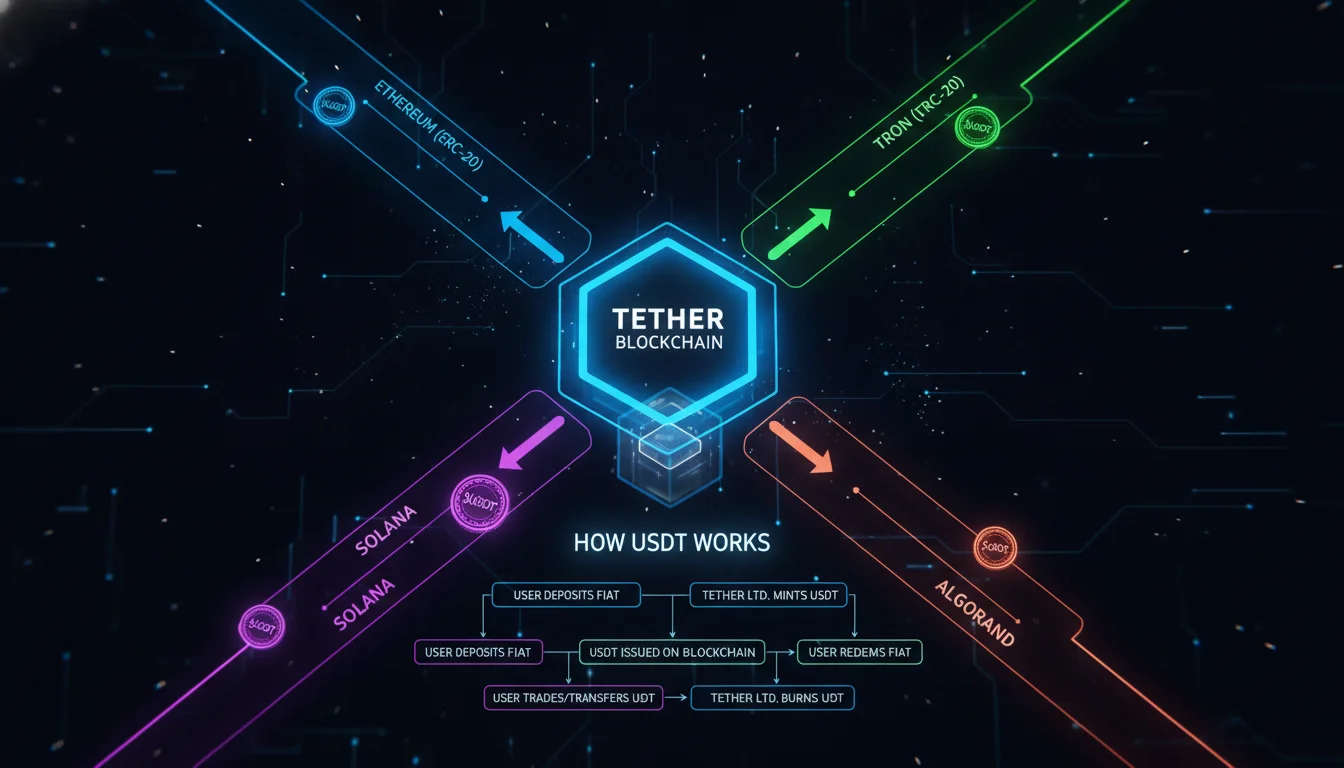
Tether tokens are created when an authorised entity deposits fiat currency into Tether’s reserve. Tether Limited then issues an equivalent amount of USDT, which can be transferred on any supported network. When users redeem USDT, the tokens are burned and the corresponding fiat is returned, keeping circulating supply aligned with reserves. According to Tether’s FAQ, this model has democratised cross-border transactions by giving users the ability to transact with traditional currencies across a blockchain without the volatility typically associated with digital assets. The redeemability mechanism is central to maintaining the dollar peg, though the exact process depends on the network and the user’s verification tier.
Tether’s Multi-Chain Architecture
The shift from Bitcoin to Ethereum
Tether initially operated on the Bitcoin blockchain through the Omni Layer, but Ethereum became the dominant host after Tether issued USDT as an ERC-20 token. An ERC-20 token follows a standard interface for balances, transfers, and approvals on the Ethereum network. The Ethereum version of USDT uses the contract address 0xdac17f958d2ee523a2206206994597c13d831ec7, publicly verifiable on Etherscan. Because Ethereum offers smart contracts and deep DeFi integration, ERC-20 USDT became the default quote asset on many decentralised exchanges and money markets. Ethereum’s congestion and gas fees have pushed some activity to cheaper networks, but the tether blockchain footprint on Ethereum remains substantial for institutional use.
Tron, Solana, and BNB Smart Chain
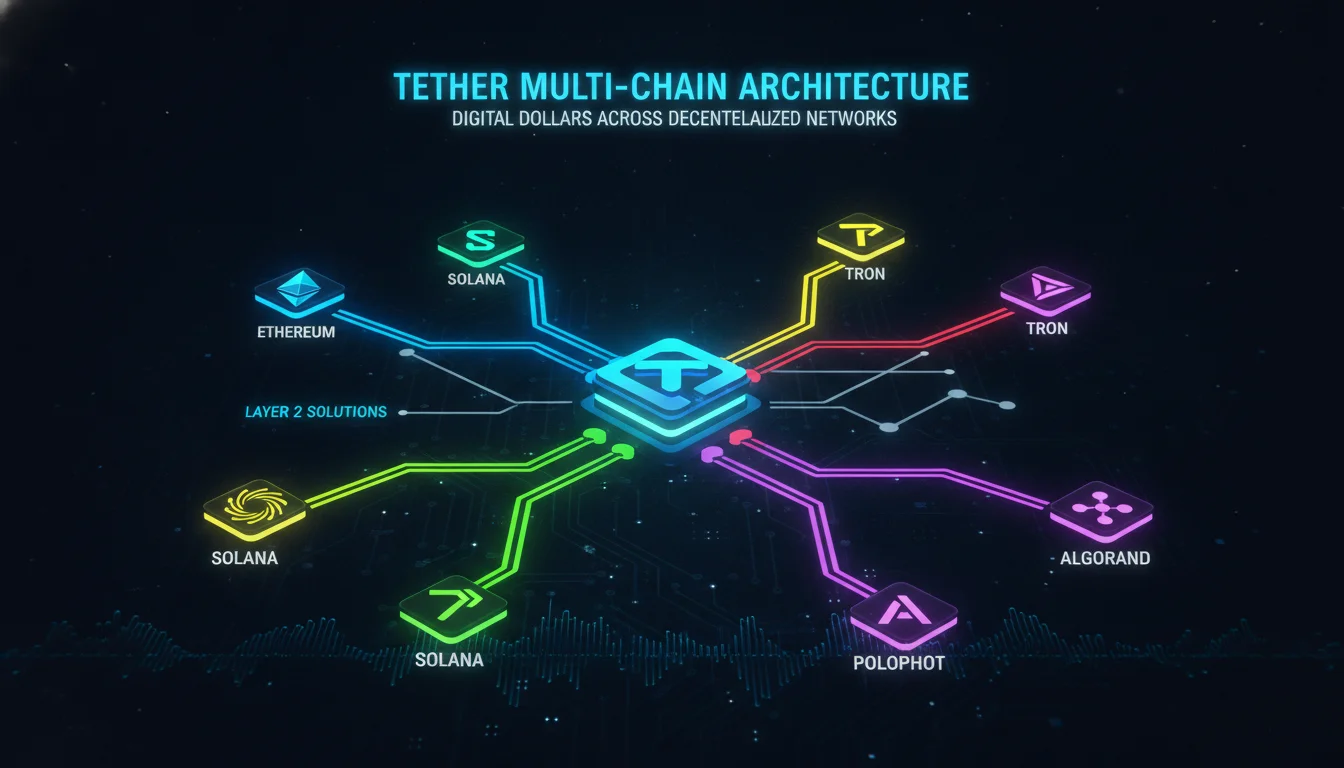
The tether blockchain infrastructure is genuinely multi-chain. According to MetaMask, you can use USDT to trade and transact across blockchain networks such as Ethereum, Solana, and more. Tron uses the TRC-20 token standard, offering lower transaction fees and faster confirmation times, making it popular for high-frequency retail transfers and remittances. Solana supports USDT as an SPL token, benefiting from sub-second block times and minimal costs. BNB Smart Chain hosts BEP-20 USDT, integrated with the broader Binance ecosystem. Each of these chains maintains its own independent ledger tracking USDT balances, with bridges and exchanges handling interoperability between them.
Fourteen protocols and counting
As of January 2024, Tether’s official website lists fourteen protocols and blockchains on which Tether has been minted. The exact count changes as Tether expands or retires support on specific networks. Beyond Ethereum, Tron, Solana, and BNB Smart Chain, USDT is available on Avalanche, Polygon, and Omni, among others. This multi-chain strategy reduces congestion risk and lets users choose the network that best fits their cost, speed, and security requirements. The table below summarises the primary differences among major tether blockchain host chains.
| Blockchain | Token Standard | Key Characteristics | Common Use Cases |
|---|---|---|---|
| Ethereum | ERC-20 | High security, strong DeFi integration, higher network fees | DeFi lending, institutional custody, large transfers |
| Tron | TRC-20 | Low fees, fast confirmations, high retail adoption | Exchange withdrawals, remittances, payments |
| Solana | SPL | Very fast finality, low transaction costs | High-frequency trading, DeFi, gaming |
| BNB Smart Chain | BEP-20 | Compatible with Ethereum tooling, lower fees | Binance ecosystem, DeFi, NFT markets |
| Bitcoin (Omni Layer) | Omni | First tether blockchain implementation, leverages Bitcoin security | Legacy transfers, long-term storage |
How USDT Works Across Supported Networks
ERC-20 USDT on Ethereum
On Ethereum, USDT follows the ERC-20 standard, meaning any Ethereum wallet can hold or send it using a standard interface for balances, transfers, and approvals. The contract address is publicly verifiable on Etherscan, and because Ethereum is the largest smart-contract platform by total value locked, ERC-20 USDT is the default quote asset on many decentralised exchanges and money markets. Using ERC-20 USDT during periods of high network demand can be expensive. For settled large-value transactions, many institutions still prefer Ethereum for its battle-tested security and deep liquidity.
TRC-20 USDT on Tron
Tron’s TRC-20 standard functions similarly to ERC-20 but is optimised for Tron’s delegated proof-of-stake consensus. TRC-20 USDT benefits from lower transaction costs and faster block production than Ethereum. On-chain data referenced by multiple market observers shows Tron has become the most active network for USDT transfer volume in recent years. Centralised exchanges frequently support TRC-20 USDT for deposits and withdrawals because it reduces user friction. The trade-off is that some analysts view Tron as more centralised than Ethereum, but the network remains the workhorse for retail stablecoin transfers globally.
Multi-chain interoperability and bridge risks
Moving USDT from one network to another typically requires a bridge, a centralised exchange, or a cross-chain protocol. Each method exposes the user to smart-contract risk, liquidity constraints, or custodial risk. Sending ERC-20 USDT to a TRC-20 address, for example, results in lost funds unless the sending service supports auto-conversion. Users must always verify the selected network in a wallet or exchange before initiating a transfer. The tether blockchain ecosystem’s multi-chain design is convenient, but it places the burden of network selection squarely on the end user.
Tether Reserves, Audits, and Transparency

Reserve composition and excess reserves
Tether claims that every USDT is backed 1:1 by reserves, which may include cash, cash equivalents, and other assets. According to Wikipedia, as of August 1, 2024, Tether reported $118.4 billion in reserves, including $5.3 billion in excess reserves. In Q2 2024, the company reported a profit of $1.3 billion, contributing to a total profit of $5.2 billion for the first half of the year. Tether Limited also disclosed a net equity of $11.9 billion, and the stablecoin’s market capitalisation exceeded $114 billion at that time. By mid-2026, market capitalisation has grown beyond $180 billion, reflecting continued demand for the tether blockchain’s dollar-pegged token.
KPMG audit and quarterly attestations
Tether has historically published quarterly attestations rather than full financial audits. An attestation is an independent review that verifies the existence of assets backing issued tokens at a specific point in time, but it is narrower than a full audit. On August 13, 2026, Tether announced that KPMG U.S. issued an unqualified audit opinion on Tether International, S.A. de C.V.’s 2025 financial statements. An unqualified opinion is the most positive form of opinion an independent auditor can issue, indicating that the financial statements present fairly, in all material respects, the company’s financial position. This marked a significant step in addressing long-standing transparency concerns. Critics note, however, that an audit of the issuing entity is not the same as real-time proof of reserves for every token on every chain.
“KPMG U.S. issues unqualified audit opinion on Tether’s 2025 financial statements – the most positive form of opinion an independent auditor can issue.” – Tether official announcement, August 13, 2026
Transparency page and on-chain supply data
Tether provides regularly updated information on token circulation and reserves on its official transparency page, including blockchain-level supply data across supported networks. The page shows the amount of USDT authorised but not issued, issued, and held in reserve. According to Tether, “authorised but not issued” means tokens that have been created but not yet released into circulation, a buffer that helps manage redemptions and inventory replenishment. Users can verify the total supply of USDT on any blockchain explorer by checking the relevant contract address. This on-chain data is useful, but it does not by itself prove that off-chain reserves match the on-chain supply at all times.
Why Tether Dominates Stablecoin Markets
Market capitalisation and trading volume
Tether holds roughly 70% of the market share among stablecoins and surpassed Bitcoin to become the most traded cryptocurrency globally in 2019. According to CoinMarketCap, as of mid-August 2026, Tether’s market capitalisation was $182.95 billion, with a 24-hour trading volume of $102.04 billion and a circulating supply of 183.09 billion USDT. These figures place USDT as the third-largest cryptocurrency by market cap, behind only Bitcoin and Ether in most rankings. A volume-to-market-cap ratio above 55% signals extremely high liquidity and turnover relative to supply.
Liquidity and exchange integration
USDT is listed on nearly every major cryptocurrency exchange, including Binance, Coinbase, OKX, Bybit, Gate, and Bitget, among thousands of markets. CoinMarketCap showed more than 44,000 USDT trading pairs at the time of writing, though that number fluctuates daily. This deep integration means traders can enter and exit positions against USDT without relying on fiat banking rails. The tether blockchain ecosystem’s multi-chain support further enhances liquidity because exchanges can offer deposits and withdrawals on the network with the lowest fees. For many market participants, USDT functions as the de facto quote currency for crypto trading.
User base and global adoption
As of July 2024, Tether has more than 350 million users worldwide, according to data cited on Wikipedia. This user base spans retail traders, institutional investors, remittance senders, and DeFi participants. Tether’s official site notes that USD₮ is used by hundreds of millions of users across every continent. The token’s stability makes it a practical on-ramp and off-ramp in regions with volatile local currencies or restricted access to U.S. dollars. Broad adoption reinforces Tether’s network effects: the more exchanges, merchants, and DeFi protocols accept USDT, the more useful the tether blockchain infrastructure becomes.
The Tether Blockchain in Payments, DeFi, and Tokenization
Cross-border payments and merchant adoption
Tether works to disrupt the conventional financial system through a more modern approach to money. As the first blockchain-enabled platform to facilitate the digital use of traditional currencies, the tether blockchain has democratised cross-border transactions. Businesses can accept USDT for goods and services, and individuals can send it globally in minutes with lower friction than traditional correspondent banking. Because USDT is price-stable, merchants avoid the currency risk associated with accepting Bitcoin or Ether. Regulatory uncertainty in some jurisdictions means merchant adoption remains uneven, but the direction of travel is clear.
DeFi lending and liquidity pools
In decentralised finance, USDT serves as a primary collateral asset and liquidity pair. Lending protocols on Ethereum, Solana, and BNB Smart Chain accept USDT for borrowing and lending, allowing users to earn yield or take out loans without selling their stablecoin holdings. Liquidity pools on automated market makers often pair USDT with USDC, DAI, or other stablecoins to facilitate low-slippage trades. According to CoinTracker, Tether is used extensively in DeFi platforms for lending, borrowing, and liquidity pools. The tether blockchain’s compatibility with smart contracts makes this possible, though users must assess smart-contract risk and protocol security before depositing funds.
Hadron tokenization and institutional expansion
Tether has expanded beyond stablecoins into asset tokenization through Hadron by Tether. On August 6, 2026, Hadron announced a strategic collaboration with First Data and BKN301 to deploy Hadron as the core technology platform for tokenizing institutional-grade real estate assets in Saudi Arabia. This initiative shows how the tether blockchain model is evolving to include real-world assets beyond fiat-pegged tokens. Tether also reported a 9.5% increase in Tether Gold (XAU₮) holdings in Q2 2026, reflecting growing demand for fully backed tokenized gold even as gold prices fell during the quarter. These moves position Tether as a broader infrastructure provider, not just a stablecoin issuer.
Tether Beyond Stablecoins: Mining, AI, and Education
Tether’s ambitions extend well beyond the tether blockchain’s stablecoin roots. According to Tether’s official site, the company operates more than 15 active Bitcoin mining sites and runs over 20,000 active AI-dedicated GPUs. Tether also runs an education initiative with more than 19,500 students enrolled. These pillars, which Tether calls its five business verticals, signal a deliberate shift from single-product stablecoin issuer to diversified technology company. For builders and institutional partners, this matters: Tether is accumulating infrastructure that could underpin future protocol integrations and tokenization projects at scale.
Risks, Legal Cases, and Regulatory Status
Regulatory actions and legal cases
Tether has faced legal scrutiny from regulators. The New York Attorney General’s case against iFinex, Tether’s parent company, alleged that Bitfinex and Tether covered up losses and misrepresented reserves. The case was settled without admitting wrongdoing, resulting in transparency requirements and fines. The U.S. Commodity Futures Trading Commission also took action against Tether over claims that it misrepresented the backing of USDT. These cases highlight the regulatory risk associated with stablecoin issuers. In the United States, Tether is legal to hold and trade, but the company is not licensed as a bank, and certain services may be restricted in specific states.
Alleged price manipulation
Tether has faced both academic and journalistic scrutiny over alleged price manipulation. Researchers have examined whether USDT issuance was used to artificially support Bitcoin prices during certain market periods. Tether disputes these characterisations. Wikipedia’s article on Tether documents these allegations in detail, noting that the company has consistently denied coordinated market manipulation. The KPMG audit and more frequent reserve disclosures address some concerns, but independent verification of reserve quality and location remains a subject of debate among analysts.
Reserve transparency criticism
Tether faces ongoing criticism regarding the transparency and verifiability of its stated fiat reserves. Wikipedia notes that Tether has been linked to money laundering and other financial crimes, though the company disputes such characterisations. Critics question whether Tether holds sufficient liquid assets to back every USDT in circulation at all times. Tether’s shift to a full KPMG audit addresses some of these concerns, but the gap between an issuer-level audit and real-time, chain-by-chain proof of reserves remains a legitimate concern for sophisticated users.
Security, liquidity, and compliance controls
Like any blockchain-based asset, USDT is subject to smart-contract and network-security risks. If a host blockchain suffers a consensus failure or a bridge is exploited, USDT balances on that network could be affected. Tether can freeze tokens on some chains via its compliance controls, which it uses when legally required by law enforcement. Tether maintains that it cooperates with authorities and can block addresses on request. These controls are a double-edged feature: they reduce illicit use but also mean USDT is not fully censorship-resistant, which matters for certain DeFi use cases.
“Tether has democratised cross-border transactions across a blockchain by giving customers the ability to transact with traditional currencies without the inherent volatility and complexity typically associated with a digital currency.” – Tether FAQ, tether.to
Pros and Cons
Pros
- Deep liquidity: USDT is listed across more than 44,000 trading pairs on CoinMarketCap, making it the most liquid stablecoin in the market.
- Multi-chain flexibility: The tether blockchain infrastructure spans fourteen protocols, letting users choose the network that best fits their fee and speed requirements.
- Proven reserve backing: As of August 2024, Tether reported $118.4 billion in reserves with $5.3 billion in excess, and completed a full KPMG audit of its 2025 financials.
- Broad DeFi integration: USDT is accepted as collateral and liquidity on lending protocols and automated market makers across Ethereum, Solana, and BNB Smart Chain.
- Global reach: More than 350 million users worldwide as of July 2024, with adoption spanning retail, institutional, and remittance use cases.
Cons
- Centralisation risk: Tether Limited can freeze USDT balances on supported chains, making it less censorship-resistant than fully decentralised assets.
- Reserve opacity: Despite the KPMG audit, real-time, chain-by-chain proof of reserves is not yet available, leaving a verification gap for sophisticated users.
- Regulatory exposure: Tether has faced enforcement actions from the New York Attorney General and the CFTC, and the regulatory environment for stablecoin issuers continues to evolve.
- Bridge risk: Moving USDT across chains requires bridges or centralised exchanges, each introducing smart-contract or custodial risk.
- Manipulation allegations: Academic and journalistic investigations have raised questions about whether USDT issuance has been used to influence crypto market prices.
Step-by-Step: How to Use Tether Across Blockchains
Step 1: Choose a supported blockchain and wallet
First, decide which network fits your needs. Ethereum suits large DeFi deposits and institutional transfers, while Tron is typically cheaper for retail withdrawals. Download a wallet that supports USDT on that network: MetaMask for Ethereum, TronLink for Tron, or Phantom for Solana. Keep your seed phrase offline and never share it. The tether blockchain asset is the same USDT regardless of network, but each chain uses a different contract address and token standard.
Step 2: Acquire USDT and verify the network
Buy USDT on a centralised exchange like Binance, Coinbase, or OKX, or swap for it on a decentralised exchange. When depositing or withdrawing, always verify that the selected network matches the destination address. A common and costly mistake is sending ERC-20 USDT to a TRC-20 address, which results in permanent loss. Compare the recipient address prefix and token standard before confirming. Use the exact network shown by the sending service and double-check the contract address on a block explorer.
Step 3: Transfer, trade, or deploy to DeFi
Once you hold USDT on the chosen network, you can send it to another wallet, trade it for other cryptocurrencies, or deposit it into a DeFi protocol. Moving USDT across chains requires a reputable bridge or exchange that supports cross-chain swaps. Be aware of bridge fees and smart-contract risk. Monitor gas fees and confirmation times. The process for a typical cross-chain migration looks like this:
- Select the destination network (for example, Tron for lower fees).
- Initiate a withdrawal or bridge transaction from the source network.
- Confirm the receiving address and token standard carefully.
- Submit the transaction and wait for finality.
- Verify the USDT balance on the destination chain’s block explorer.
The tether blockchain is a multi-chain stablecoin infrastructure that combines fiat backing, broad network support, and deep liquidity. Its utility spans payments, trading, and DeFi, while its transparency history and legal track record continue to draw scrutiny. Understanding the networks and reserve mechanisms behind USDT is essential for anyone using it seriously in 2026.
If you’re building on stablecoin infrastructure or exploring tokenization at the protocol level, apply to the Genesis Cohort at Digital Blockchains and work with a team that reads the whitepapers and deploys the contracts.
Frequently Asked Questions
Which blockchain does Tether use?
Tether uses multiple blockchains, including Ethereum (ERC-20), Tron (TRC-20), Solana (SPL), BNB Smart Chain (BEP-20), and the Omni Layer on Bitcoin. As of January 2024, Tether’s official website lists fourteen protocols. This multi-chain design lets users choose the network that best matches their fee and speed preferences.
Is Tether legal in the US?
Tether (USDT) is legal to hold, trade, and use in the United States, but Tether Operations Limited is not a licensed bank. Tether has faced enforcement actions from the New York Attorney General and the CFTC. Users should check local regulations before using USDT for specific financial activities.
Why is Tether sometimes banned or restricted?
Tether is not banned outright in most jurisdictions, but some regulators restrict stablecoin use due to concerns about reserve transparency, money-laundering risk, and the absence of banking licenses. Regulators may limit certain services or require exchanges to delist USDT in specific markets. These actions reflect broader uncertainty around stablecoin regulation globally.
Will XRP overtake Tether?
XRP and Tether serve fundamentally different functions. XRP is a bridge currency designed for cross-border payments, while Tether is a dollar-pegged stablecoin used for trading, DeFi, and value storage. Comparing market capitalisation alone is misleading given their distinct use cases. As of mid-August 2026, Tether’s market cap stood at $182.95 billion, per CoinMarketCap data.
What is the tether blockchain price?
USDT is designed to equal $1.00, but its market price fluctuates slightly around that peg. According to CoinMarketCap, USDT traded at $0.9992 on August 20, 2026, with a 24-hour high of $1.00 and a low of $0.9989. These minor deviations are normal for fiat-backed stablecoins and typically resolve quickly through arbitrage.
How do I check Tether reserves?
Tether publishes quarterly attestations and a transparency page showing token circulation and reserve data. On August 13, 2026, KPMG U.S. issued an unqualified audit opinion on Tether’s 2025 financial statements, the most positive form of auditor opinion available. You can also verify the on-chain USDT supply using a blockchain explorer for any supported network by checking the relevant contract address.