Key Takeaways
- Blockchain use cases extend far beyond cryptocurrencies, with proven applications across finance, supply chain, healthcare, and government.
- Decentralization, immutability, and smart contracts enable unprecedented transparency, security, and efficiency in multi-party transactions.
- Real-world deployments like Walmart’s Food Trust and Estonia’s e-Health records demonstrate measurable ROI and enhanced institutional trust.
- Emerging frontiers such as AI data verification and carbon credit tokenization are set to redefine digital authentication and sustainability accounting.
- Layer-2 networks and permissioned chains have largely solved the throughput problem, processing thousands of transactions per second at sub-cent fees.
Blockchain use cases are specific applications of distributed ledger technology that solve real coordination, trust, and transparency problems across industries. As of 2026, deployments span finance, supply chain, healthcare, identity, and government at meaningful scale.
The global blockchain market is projected to reach $943 billion by 2032, growing at a compound annual growth rate of roughly 56%, according to a forecast cited by AIMultiple. That trajectory reflects the expanding scope of use cases well beyond Bitcoin’s 2009 origins. Enterprises and governments are now deploying distributed ledgers to solve structural problems of trust, transparency, and settlement efficiency. This article examines the most impactful this type of cases across every major sector, from decentralized finance to AI data integrity.
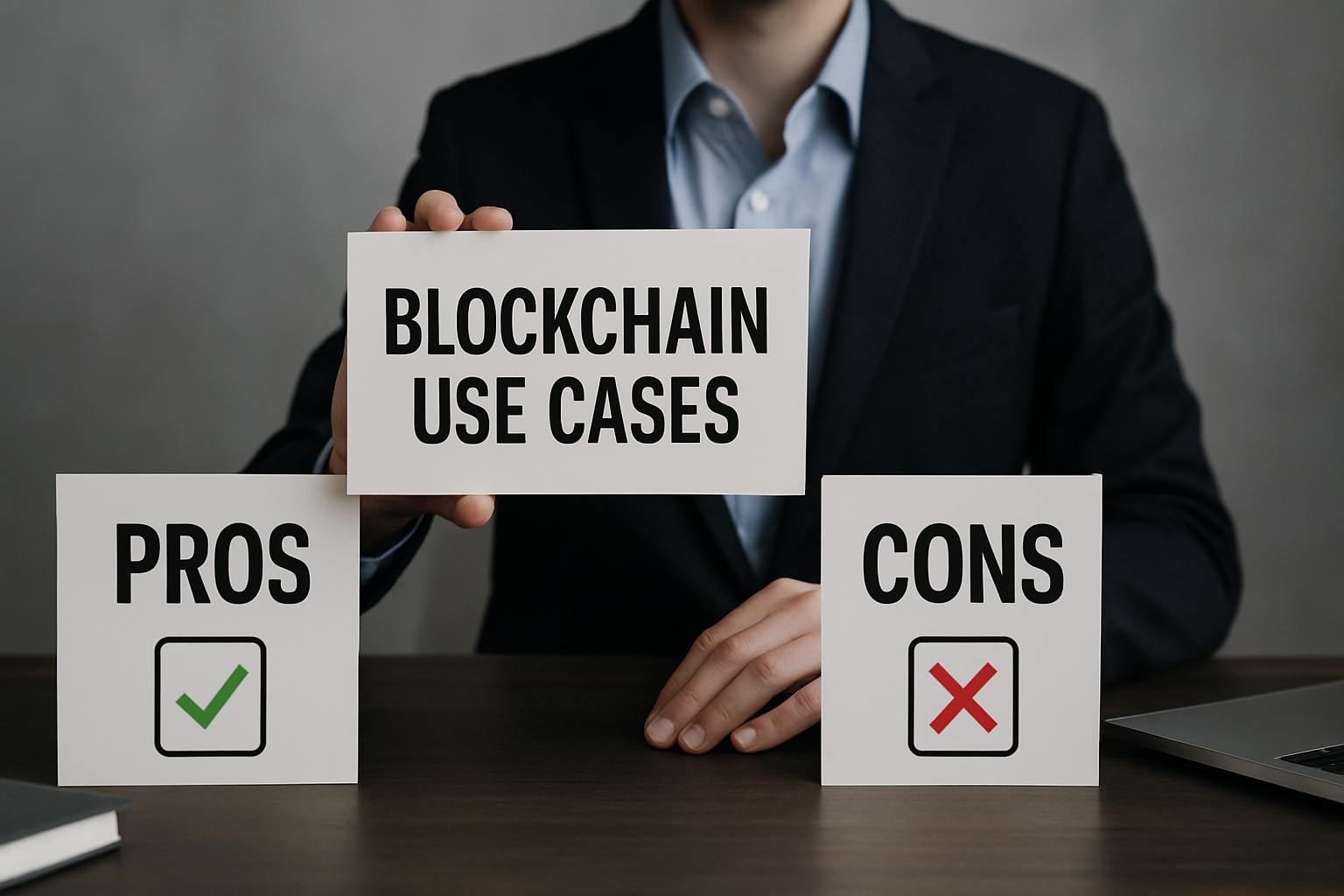
Pros and Cons of Blockchain Use Cases
Pros
- Immutable audit trails eliminate disputes in multi-party workflows, from trade finance to clinical trials.
- Smart contract automation removes intermediaries, cutting settlement times from days to seconds and reducing operational overhead.
- Decentralized architecture removes single points of failure, improving resilience and censorship resistance.
- Tokenization unlocks liquidity in historically illiquid asset classes like real estate, carbon credits, and private credit.
- Transparent provenance builds consumer and regulator confidence in supply chains, pharmaceuticals, and luxury goods.
Cons
- Legacy integration complexity remains a significant barrier. Most enterprises run SAP or Oracle ERP systems that require custom middleware to connect with on-chain data.
- Regulatory uncertainty across jurisdictions creates legal risk, particularly around smart contract enforceability and GDPR’s right to erasure conflicting with immutable ledgers.
- Scalability trade-offs still exist on base-layer public chains, though layer-2 solutions have substantially closed the gap with traditional payment rails.
- Governance complexity in consortium blockchains can slow decision-making and reduce the agility advantage over centralized databases.
Understanding Blockchain Technology‘s Potential

Blockchain technology works by chaining cryptographically linked blocks of transaction data across a distributed peer-to-peer network, making retroactive tampering computationally infeasible. Each block contains a timestamp, transaction data, and a cryptographic hash of the previous block. Participants validate transactions through consensus mechanisms: Proof of Work (PoW), used by Bitcoin, or Proof of Stake (PoS), adopted by Ethereum in 2022. No single entity controls the ledger. That property is what makes every serious blockchain use case tick.
Smart Contracts and Automation
A smart contract is a self-executing program stored on a blockchain that automatically enforces agreement terms when predefined conditions are met. Introduced by Ethereum, smart contracts eliminate intermediaries in complex workflows, from insurance claims to royalty distributions. As the ConsenSys documentation highlights, they enable automation, reduce counterparty risk, and open entirely new revenue models that weren’t economically viable before.
A Comparative Look at Blockchain Use Cases Across Industries
The table below maps the most significant this kind of cases by sector, with real deployments and measurable outcomes.
| Industry | Blockchain Use Case | Benefits | Example | Measurable Impact |
|---|---|---|---|---|
| Financial Services | Cross-border payments | Speed, cost reduction, transparency | Ripple (XRP) | Settlement from days to seconds |
| Supply Chain | Product traceability | Provenance verification, counterfeit reduction | Walmart & IBM Food Trust | Mango traceability from 7 days to 2.2 seconds |
| Healthcare | Electronic health records | Data security, interoperability, patient control | Guardtime & Estonia e-Health | Secures 1 million citizen records |
| Government | Digital identity | Tamper-proof, self-sovereign access | Estonia e-Residency | Over 100,000 e-residents issued |
| Media & Entertainment | Anti-piracy & rights management | Content tracking, royalty automation | Smart contract royalty systems | $71 billion annual piracy loss addressed |
| Energy & Sustainability | Carbon credit tokenization | Transparent offset tracking, reduced fraud | Toucan Protocol, Energy Web Foundation | Automated verification of renewable energy certificates |
Data sourced from AIMultiple, ConsenSys, and Bernard Marr.
Blockchain Use Cases in Finance and Banking

blockchain use in finance are the most mature category, spanning instant payments, decentralized lending, asset tokenization, and central bank digital currencies. The financial industry recognized the technology’s potential early, and the deployments today are operating at production scale.
Cross-Border Payments and Settlements
Correspondent banking networks require multiple intermediary hops, producing settlement delays of 2 to 5 business days and fees ranging from 5% to 20% for certain corridors. Blockchain-based networks like RippleNet compress that to near-instant settlement at a fraction of the cost. Ripple settles transactions in 3 to 5 seconds with fees measured in fractions of a cent. Competing protocols like Stellar target the same remittance corridors. Traditional banks are also joining consortiums like Fnality to build blockchain-based payment infrastructure. According to data from Casper Network, the number of unique blockchain wallet addresses grew from under 100,000 in 2013 to approximately 700,000 by 2022, a signal of how quickly blockchain-based payment adoption has scaled.
Decentralized Finance (DeFi)
DeFi is the ecosystem of financial applications built on permissionless blockchains, primarily Ethereum. Lending platforms like Aave and Compound have processed billions in loans without intermediaries, algorithmically setting interest rates based on supply and demand. Decentralized exchanges like Uniswap use automated market makers to provide liquidity, with daily trading volumes exceeding $1 billion on active days. These use cases in DeFi address financial exclusion for an estimated 1.7 billion unbanked adults worldwide. ConsenSys notes that DeFi is setting new standards for financial access and trust.
CBDCs and Tokenized Real-World Assets
More than 100 countries are researching or developing CBDCs, with active pilots launched by China, Nigeria, and the Bahamas. A CBDC is a digital fiat currency operating on blockchain-inspired infrastructure, designed to improve monetary policy implementation and financial inclusion. Alongside CBDCs, tokenization of real-world assets is unlocking trillions in illiquid asset classes. Platforms like Ondo Finance and Centrifuge tokenize U.S. Treasuries, invoices, and real estate, enabling fractional ownership and 24/7 trading. On-chain settlement reduces counterparty risk and operational overhead compared to traditional T+2 clearing cycles.
Supply Chain Management Blockchain Use Cases
Supply chain this type of cases solve a structural problem: multiple parties across geographies share no common source of truth, creating opacity, fraud, and recall delays. A shared, immutable ledger changes that. The process works in three steps: assign a unique digital identifier to each physical item, record every custody transfer on-chain as it moves through the supply chain, then enable real-time provenance verification by any authorized party.
Provenance Tracking and Food Safety
IBM Food Trust, built on Hyperledger Fabric, allows participants including Walmart, Nestlé, and Carrefour to trace food items in seconds rather than days. Walmart reduced the time to trace mangoes from a farm in Mexico to a U.S. store from nearly 7 days to 2.2 seconds. That capability improves recall efficiency, reduces food waste, and builds consumer confidence. Maersk, the global shipping integrator, has used blockchain to provide end-to-end visibility into container shipments, enabling real-time data sharing with customs authorities and clients.
Anti-Counterfeiting and Ethical Sourcing
Counterfeit products cost the luxury goods industry alone an estimated $30 billion annually. Blockchain platforms like Aura create digital product passports that prove authenticity throughout a product’s lifecycle. The De Beers Tracr initiative has registered over 3 million rough diamonds with granular attributes, assuring buyers of ethical sourcing. In pharmaceuticals, the MediLedger network uses a decentralized approach to comply with the Drug Supply Chain Security Act (DSCSA), allowing manufacturers and distributors to verify drug authenticity without exposing competitive information. According to AIMultiple‘s case study analysis, these this kind of cases improve both patient safety and brand integrity simultaneously.
Trade Finance Documentation
Trade finance remains paper-intensive, with bills of lading, letters of credit, and invoices often taking weeks to process. The Marco Polo Network deployed smart contracts integrated with ERP systems, achieving faster settlement and fewer discrepancies. IBM’s Trust Your Supplier platform claims to cut supplier onboarding time by 70% and verification costs by 50%. These outcomes demonstrate why blockchain use in international trade are attracting serious enterprise investment.
Healthcare Blockchain Use Cases
Healthcare use cases address three structural failures: data silos that prevent care coordination, privacy vulnerabilities in centralized record systems, and counterfeit medications entering the supply chain. Blockchain provides a secure, interoperable layer that all authorized parties can read without any single party controlling.
Patient-Centric Electronic Health Records
In Estonia, the KSI blockchain developed by Guardtime secures the health records of 1 million citizens, as reported by Bernard Marr. Every access event is immutably logged, and patients grant permission via key-based access controls. MIT’s MedRec project prototypes a decentralized patient record system that manages authentication and data sharing across providers. These systems reduce duplication, lower administrative costs, and improve continuity of care across provider networks.
Drug Supply Chain Integrity
Counterfeit drugs cause hundreds of thousands of deaths annually. Blockchain ensures every transfer of a pharmaceutical product is recorded and time-stamped. MediLedger’s pilot with the FDA demonstrated that an industry-owned blockchain can meet DSCSA interoperability requirements, facilitating compliance and potentially saving lives. SimplyVital Health’s ConnectingCare platform uses blockchain to track post-hospital patient progress, with the goal of reducing costly readmission rates.
Clinical Research and Public Health
Blockchain brings transparency to clinical trial data, ensuring protocols are followed and results aren’t selectively reported. The startup Gem collaborated with the CDC to place disease outbreak data on a distributed ledger, enabling faster and more coordinated public health response. These this type of cases improve the integrity of medical research and population health management at scale.
Digital Identity and Government Blockchain Use Cases
Government this kind of cases center on increasing transparency, reducing fraud, and streamlining citizen services through tamper-proof public records and self-sovereign identity systems.
Self-Sovereign Digital Identity
A blockchain-based digital identity system gives individuals control over their personal data, reducing reliance on centralized identity providers that are frequent breach targets. Estonia’s e-Residency program, built on blockchain-backed infrastructure, enables anyone worldwide to obtain a government-issued digital identity, register a company, and access EU banking services remotely. Over 100,000 e-residents have been issued credentials, demonstrating the scalability of blockchain use in identity management at a national level.
Voting and Land Registry Modernization
Blockchain voting pilots have been conducted in West Virginia and Zug, Switzerland, targeting verifiable, tamper-proof election results. Land registries in Sweden, Georgia, and Honduras have experimented with blockchain to prevent fraudulent property claims and streamline title transfers. Immutable public records reduce corruption and increase citizen trust in government institutions.
Government Procurement and Operations
Smart contracts automate payment release upon delivery verification, minimizing disputes and reducing the opportunity for fraud. Dubai’s Blockchain Strategy aimed to migrate all government documents to blockchain, and the city continues expanding its blockchain initiatives across transport, healthcare, and utilities. The public sector savings potential from digitizing procurement on-chain runs into the billions annually.
Media, Entertainment, and Intellectual Property
use cases in media solve a fundamental problem: creators lose control of their work the moment it enters a distribution network, and royalty flows are opaque, slow, and intermediary-heavy.
Royalty Management and Micropayments
Creators often wait months for royalty payments and surrender significant shares to intermediaries. Blockchain enables immediate, transparent payment distribution via smart contracts. Projects like Audius for music and Theta for video streaming demonstrate how blockchain can restructure traditional media economics. The motion picture industry loses an estimated $71 billion annually to piracy, a figure that blockchain-based rights management could substantially reduce, per ConsenSys.
NFTs and the Ownership Economy
Non-fungible tokens introduced verifiable digital scarcity to the internet. Beyond art, NFTs are being used for event ticketing, gaming assets, and virtual real estate. The NBA Top Shot platform generated over $1 billion in secondary market sales, demonstrating real consumer appetite for authenticated digital collectibles. Smart contracts ensure creators earn royalties on every resale, aligning long-term incentives between creators and collectors.
Fighting Piracy with Content Fingerprinting
Blockchain stores hashes of original content, creating a decentralized registry of intellectual property. Services like Custos embed unique fingerprints into media files. When a pirated copy surfaces, the system identifies the source of the leak. These anti-piracy blockchain use cases deter unauthorized distribution and enable automated takedown workflows without relying on centralized platforms.
Insurance, Real Estate, and Sports: Expanding Blockchain Use Cases
Three sectors that competitors consistently highlight deserve direct attention: insurance claims processing, real estate digitization, and sports fan engagement. Each represents a distinct blockchain use case category with active deployments.
Insurance Claims Automation
Insurance claims processing is one of the most friction-heavy workflows in financial services, involving multiple parties, paper documentation, and significant fraud exposure. Smart contracts can automate claims payouts when verifiable trigger conditions are met. A parametric crop insurance contract, for example, automatically pays farmers when on-chain weather oracle data confirms a drought threshold. Etherisc and similar platforms are building this infrastructure on Ethereum, reducing claims processing from weeks to hours and cutting administrative overhead substantially.
Real Estate Tokenization
Real estate is a $300+ trillion global asset class with notoriously low liquidity. Blockchain use cases in real estate include tokenized property ownership, fractional investment through security tokens, and smart contract-based title transfers that eliminate escrow delays. Platforms like RealT tokenize individual properties on Ethereum, allowing investors to hold fractional ownership and receive rental income in stablecoins. Title transfer processes that traditionally take 30 to 60 days can be compressed to hours when both the asset record and the payment settle on-chain simultaneously.
Sports, Esports, and Fan Engagement
Sports organizations are using blockchain to deepen fan relationships through tokenized loyalty programs, verifiable digital collectibles, and governance tokens that give fans a voice in club decisions. Socios.com has issued fan tokens for over 100 sports organizations globally, enabling voting on club decisions and exclusive experiences. Esports platforms are integrating blockchain-based asset ownership so players genuinely own in-game items that can be traded or sold across titles. These blockchain use cases convert passive audiences into economically engaged communities.
Emerging Frontiers: AI Data Integrity, Carbon Credits, and IoT
The next generation of blockchain use cases sits at the intersection of distributed ledgers and other emerging technologies, creating verification layers that neither AI nor IoT can provide on their own.
Verifying AI Training Data Integrity
As AI models influence critical decisions in healthcare, finance, and criminal justice, the provenance and quality of training data become non-negotiable. Blockchain provides an immutable trail of data lineage, logging where each dataset originated, how it was transformed, and who accessed it. Ocean Protocol enables secure, traceable data marketplaces where providers can be confident their data won’t be misused. This intersection of AI and blockchain is attracting serious venture capital, with startups building verifiable AI pipelines that regulators and auditors can inspect.
Tokenizing Carbon Offsets for Climate Accountability
Voluntary carbon markets have been plagued by double-counting and vague offset claims. Blockchain-based carbon registries, such as those developed by the Energy Web Foundation and Toucan Protocol, tokenize verified carbon credits and make them interoperable across platforms. Smart contracts automatically retire credits when a company claims them, providing an auditable, transparent record. This ensures corporate net-zero pledges are backed by real emissions reductions rather than accounting maneuvers. Peer-to-peer energy trading platforms like Power Ledger extend these blockchain use cases further, enabling prosumers to sell excess solar power directly to neighbors and optimize grid resources.
Securing the Internet of Things
The proliferation of IoT devices creates massive security vulnerabilities: billions of endpoints, minimal authentication, and centralized control surfaces that are attractive attack targets. Blockchain authenticates devices, authorizes data exchanges, and enables automated microtransactions between machines. A connected electric vehicle could autonomously negotiate and pay for charging using a blockchain wallet. Projects like IOTA and IoTeX are building distributed ledger technologies tailored specifically for IoT constraints. The TransactiveGrid project in Brooklyn demonstrated peer-to-peer solar energy trading between residents, proving the concept of decentralized resource coordination at a neighborhood scale.
Overcoming Enterprise Blockchain Adoption Challenges
Enterprise blockchain adoption faces three consistent barriers: scalability, regulatory uncertainty, and legacy integration. Understanding each is essential before committing to a deployment architecture.
Scalability and Performance
Public blockchains historically processed only 15 to 45 transactions per second, compared to Visa’s roughly 24,000 TPS. Layer-2 rollups like Arbitrum and Optimism now achieve thousands of TPS with near-instant finality and fees below $0.01. The Ethereum Dencun upgrade in 2024 further reduced layer-2 data costs through blob transactions. Permissioned networks like Hyperledger Fabric handle enterprise throughput out of the box. Interoperability between different blockchain networks remains a work in progress, but protocols like Chainlink CCIP and Polkadot’s parachain architecture are making meaningful progress.
Regulatory and Legal Uncertainty
Blockchain applications must navigate an evolving regulatory environment. The EU’s Markets in Crypto-Assets (MiCA) regulation provides a comprehensive framework for crypto-assets in Europe, while the U.S. continues a more fragmented approach. Legal questions around smart contract enforceability and GDPR’s right to erasure conflict with immutable ledgers, requiring creative solutions like off-chain data storage with on-chain hashes. Despite these hurdles, regulatory progress is accelerating institutional adoption rather than blocking it.
Integration with Legacy Infrastructure
Most enterprises run SAP, Oracle, or custom ERP systems. Integrating blockchain requires middleware connecting on-chain and off-chain data sources. Chainlink’s decentralized oracle network feeds external data into smart contracts reliably. Successful blockchain implementations typically start with a narrow, well-defined use case like invoice reconciliation before expanding to end-to-end processes. As APIs and integration tooling mature, the friction of adoption decreases substantially. For a deeper look at how enterprise deployments are structured, see our breakdown of smart contract development best practices and our guide to tokenomics design for real-world assets.
“The blockchain use cases that survive the next decade won’t be the ones with the most sophisticated cryptography. They’ll be the ones that solve a coordination problem no existing institution was willing to fix.” – Amin Ferdowsi, Digital Blockchains
“On-chain data doesn’t lie. Every transaction, every state change, every access event is permanently queryable. That’s not a feature – it’s a new accountability primitive.” – ConsenSys developer documentation, 2024
The Future of Blockchain Use Cases
Blockchain use cases have matured from speculative ideas into proven enterprise solutions. Reducing cross-border payment times from days to seconds, ensuring the integrity of medical records, authenticating luxury goods, and automating royalty distributions are no longer pilots. They’re production systems. As AI, IoT, and regulatory frameworks continue to evolve, new blockchain use cases will emerge: verifiable AI training pipelines, automated carbon markets, machine-to-machine payments, and tokenized real-world assets at institutional scale. The organizations investing in understanding and implementing these use cases today will be positioned to lead the decentralized economy of 2030. If you’re building in this space, apply to the Genesis Cohort at Digital Blockchains and build alongside a team that deploys these systems for real.
Frequently Asked Questions
What are blockchain use cases?
Blockchain use cases are specific applications of distributed ledger technology that solve real coordination, trust, or transparency problems. Examples include cross-border payments, supply chain traceability, electronic health records, digital identity, and carbon credit tokenization. Each use case defines who participates in the network, what problem the immutable ledger solves, and what measurable benefit it delivers over existing alternatives.
What are the most common blockchain use cases?
The most common blockchain use cases include financial services (payments, DeFi, CBDCs), supply chain management (traceability, anti-counterfeiting), healthcare (medical records, drug tracking), government (digital identity, land registries), and media (royalties, NFTs). As of 2026, real estate tokenization and insurance claims automation are the fastest-growing emerging categories.
How is blockchain used in finance?
Blockchain enables faster, cheaper cross-border payments, decentralized lending and borrowing through DeFi protocols, tokenization of assets like Treasuries and real estate, and the development of Central Bank Digital Currencies. It reduces settlement times from days to seconds and increases transparency across every step of the transaction lifecycle.
How do blockchain use cases improve supply chain management?
Blockchain provides an immutable record of every step a product takes from raw material to consumer. This verifies authenticity, reduces counterfeits, ensures ethical sourcing, and speeds up product recalls. Walmart reduced traceability time for mangoes from 7 days to 2.2 seconds using IBM Food Trust on Hyperledger Fabric.
Can blockchain improve healthcare data security?
Yes. Blockchain enables secure, interoperable electronic health records where patients control access permissions. Every access event is logged and cannot be altered retroactively. Estonia’s e-Health system uses Guardtime’s KSI blockchain to protect 1 million citizen records, ensuring data integrity and privacy at national scale.
What are the main disadvantages of blockchain?
Blockchain faces challenges including scalability limitations on base-layer public chains, regulatory uncertainty across jurisdictions, integration complexity with legacy ERP systems, and data privacy tensions under laws like GDPR. Proof-of-stake consensus and layer-2 rollups have substantially addressed the energy and throughput concerns, but governance complexity in consortium networks remains a real operational challenge.