Key Takeaways
- IBM Blockchain is an enterprise-grade platform for building and governing permissioned networks, not a public cryptocurrency chain.
- The platform runs on Hyperledger Fabric, an open-source modular framework from the Linux Foundation built for scalability and privacy.
- It gives developers tools for building, deploying, and managing smart contracts (called chaincode) and enterprise dApps with strong access controls.
- Core benefits include greater trust between known parties, tighter security, better traceability, and automated settlement through smart contracts.
- According to a Statista report cited by IBM, the broader blockchain market is forecast to grow by nearly $1 trillion by 2032, with a 56.1% CAGR since 2021.
- IBM is now pairing blockchain with AI to establish data and model provenance, a theme it pushed hard at Think 2026.
IBM Blockchain is an enterprise platform that lets organizations build, run, and govern permissioned distributed ledger networks. It’s built on Hyperledger Fabric and designed for regulated industries that need privacy, auditability, and known participants.
What Is IBM Blockchain?
A Shared, Immutable Ledger for Business
Blockchain is a shared, immutable digital ledger that records transactions and tracks assets across a business network, according to IBM’s own technology documentation. It gives every participant a single source of truth instead of siloed databases that need constant reconciliation. IBM applies this idea specifically to enterprise environments, where trust among known participants matters more than anonymity. Unlike public chains, this approach centers on permissioned networks where only vetted members can validate transactions.
The Role of Hyperledger Fabric
The platform is built on Hyperledger Fabric, an open-source project maintained by the Linux Foundation. Fabric is a modular blockchain framework built for enterprise use, with pluggable components for consensus, identity management, and smart contract execution. That modularity lets organizations tailor the network to their specific industry instead of forcing a one-size-fits-all setup. On-chain collaboration data from IBM shows over 120,000 organizations and 15,000 engineers actively contributing to Hyperledger Fabric, which has made it something close to the default standard for enterprise deployments.
How It Differs from Public Blockchains
Public blockchains like Ethereum are permissionless: anyone can join anonymously and participate. IBM’s platform takes the opposite approach. Every participant is known and vetted before they get network access. That design gives teams tighter control over data privacy, compliance, and governance. Transactions are still recorded immutably, but visibility into that data can be restricted to relevant parties only. This makes the model well-suited to finance, supply chain, and healthcare, where regulatory obligations demand confidentiality rather than full transparency.
The IBM Blockchain Platform
Platform Components and Capabilities
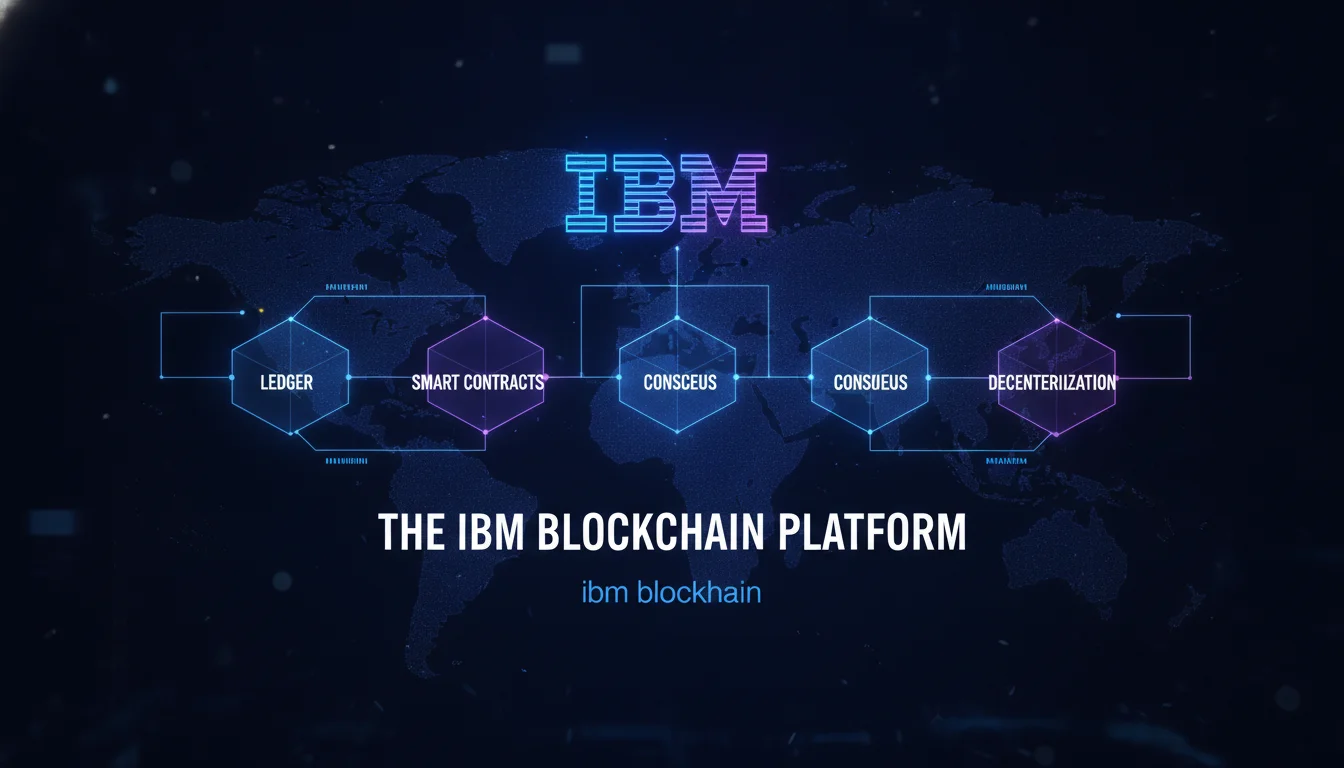
The platform is a full suite for creating, testing, deploying, and managing a blockchain network from a single console. It ships with a visual interface for network governance, smart contract tooling, and connectors into existing enterprise systems. Developers write chaincode in familiar languages like JavaScript and Go, and the platform supports deployment across on-premises infrastructure, IBM Cloud, or third-party clouds.
Deployment Options for Flexibility
One real strength here is deployment flexibility. Teams can run their network as a managed service on IBM Cloud, or deploy it on any private, public, or hybrid cloud infrastructure they already operate. That flexibility helps businesses meet security and regulatory requirements while keeping control over where their data actually lives. The platform also supports Kubernetes-based deployments for teams that need to scale nodes independently.
Integration with Existing Systems
Integration is handled through REST APIs and event-driven architecture, which lets enterprises connect a blockchain network to existing ERPs, CRMs, and databases without ripping out legacy infrastructure. IBM also offers advisory and consulting services for teams that want help designing a network architecture aligned to specific compliance or governance goals. That’s a meaningful difference from a lot of do-it-yourself blockchain tooling, where the integration work falls entirely on the internal dev team.
Hyperledger Fabric: The Foundation of IBM Blockchain
What makes Hyperledger Fabric different?
Hyperledger Fabric is different because its architecture is modular by design, letting enterprises swap consensus and membership components instead of accepting a fixed protocol. It supports confidential transactions through channels, which restrict specific data to a subset of network members instead of broadcasting it to everyone. Fabric’s execute-order-validate architecture also separates transaction execution from consensus ordering, which improves throughput compared to sequential validation models used elsewhere.
Consensus Mechanism and Privacy
Unlike proof-of-work chains, Fabric-based networks choose a consensus mechanism that fits their actual trust model. Options range from crash fault-tolerant (CFT) to byzantine fault-tolerant (BFT) algorithms, depending on how much adversarial risk the network needs to tolerate. Privacy is enforced through membership services and private data collections, so sensitive records stay restricted instead of getting broadcast network-wide.
Smart Contracts and Chaincode
Smart contracts on this platform are called chaincode, and they encode the business logic that network participants have already agreed on. Chaincode is written in general-purpose languages like Go, Node.js, and Java, which lowers the learning curve for enterprise developers who don’t want to pick up a new domain-specific language. Once deployed, chaincode runs inside an isolated Docker container, separated from the rest of the network. Transactions it triggers get ordered, validated, and appended to the ledger, building an immutable audit trail as they go.
“Hyperledger Fabric… has become the unofficial standard for enterprise blockchain platforms,” according to IBM’s own technical documentation, which credits the framework’s pluggable architecture and consensus model for the traction it has picked up across industries.
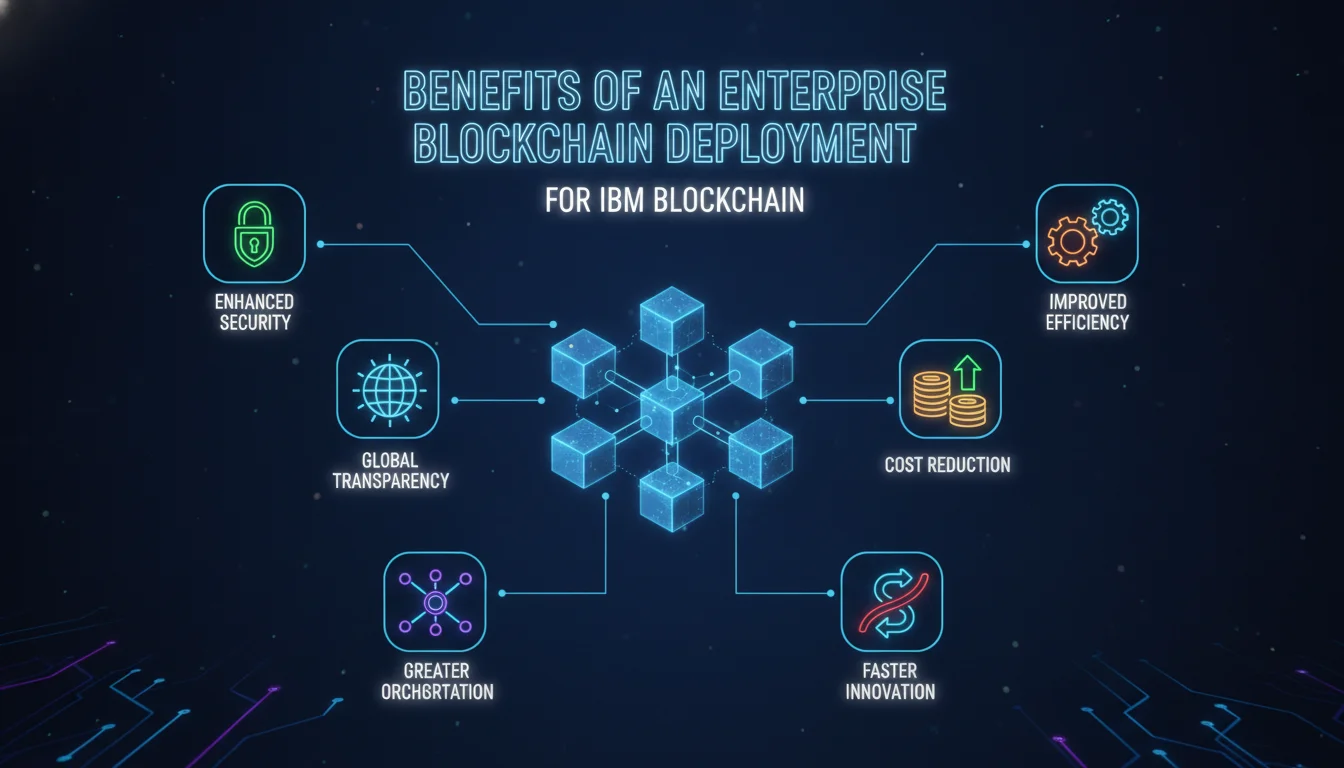
Benefits of an Enterprise Blockchain Deployment
Enhanced Security
Security here goes beyond what a traditional database offers. Every transaction has to be validated by consensus among network members, and once it’s written, that data can’t be altered or deleted, not even by a system administrator. Cryptographic techniques protect the integrity and confidentiality of records, while permissioned access blocks unauthorized participation entirely. Those combined controls make the platform viable for sensitive assets and regulatory reporting workloads.
Greater Transparency and Traceability
A shared ledger gives full visibility into the provenance and movement of assets across a supply chain or transaction flow. Every entry is time-stamped and linked to prior records, building an audit trail that can be verified in real time rather than reconstructed after the fact. In supply chain deployments, this lets businesses trace products from origin to consumer, verifying sourcing claims and cutting down on fraud.
Operational Efficiency and Cost Reduction
Removing intermediaries and automating processes through smart contracts cuts operational overhead in a measurable way. Reconciliation work shrinks because every party is reading from the same synchronized ledger instead of maintaining separate records. Smart contracts fire automatically once conditions are met, cutting manual steps and speeding up settlement. That efficiency gain shows up most clearly in cross-border payments and trade finance, where reconciliation delays have historically been expensive.
Comparison of IBM Blockchain with Other Solutions
| Feature | IBM Blockchain (Hyperledger Fabric) | Public Ethereum | Other Enterprise Platforms (e.g., R3 Corda) |
|---|---|---|---|
| Network Type | Permissioned | Permissionless | Permissioned |
| Consensus | Pluggable (CFT, BFT) | Proof-of-Stake | Notary nodes |
| Privacy | Channels, private data collections | Transparent by default | Point-to-point transactions |
| Smart Contracts | Chaincode in Go, Node.js, Java | Solidity | Kotlin, Java |
| Use Cases | Supply chain, finance, healthcare | DeFi, NFTs | Trade finance, insurance |
As the table shows, this platform sets itself apart through its permissioned nature and enterprise-friendly tooling. Public chains offer more openness, but they typically lack the privacy and governance controls that regulated industries need to actually go live.
Pros and Cons of IBM Blockchain
Pros
- Enterprise-grade security and privacy controls built into the architecture
- Built on mature, open-source Hyperledger Fabric with a large contributor base
- Flexible deployment options across cloud, on-prem, and hybrid infrastructure
- Strong integration with IBM’s broader consulting and cloud ecosystem
- Proven track record in real-world enterprise deployments across several industries
Cons
- Not built for fully decentralized, trustless environments the way public chains are
- Requires real technical expertise to set up, tune, and maintain properly
- Licensing and support costs can be steep for smaller organizations
- The permissioned model trades away some degree of decentralization by design
- Limited public network effects compared to a chain like Ethereum
IBM Blockchain and the AI Revolution
How does blockchain help build trust in AI?
Blockchain builds trust in AI by creating a tamper-proof record of data provenance and model lineage, which lets enterprises verify what data trained a model and how it has changed over time. IBM has leaned into this convergence publicly. At the Think 2026 conference, CEO Arvind Krishna framed the pitch around governance parity between AI systems and traditional critical infrastructure.
“We are enabling enterprises to manage their AI-driven system with the same level of rigor, governance, and scale deployed for their most critical infrastructure.” – Arvind Krishna, IBM CEO, Think 2026
IBM’s Think 2026 Announcements
According to Yahoo Finance, IBM expanded its product lineup at Think 2026, with a clear focus on connecting AI and blockchain capabilities. The company also unveiled expanded capabilities for its IBM Confluent platform aimed at bringing real-time data into AI operations. Using the ledger to create an immutable record of AI model data addresses concerns around data integrity and regulatory compliance, and it signals a strategic direction where IBM treats trust infrastructure as the connective layer between its AI and blockchain product lines.
Real-World Use Cases
Supply Chain Management
Enterprise blockchain deployments have been used to improve supply chain transparency across food, retail, and manufacturing. IBM Food Trust, for instance, uses this approach to trace food products from farm to store, which shortens contamination response investigations considerably compared to manual paper trails. Manufacturers apply the same model to authenticate components and verify ethical sourcing claims from suppliers.
Financial Services
In finance, this platform gets used for cross-border payments, trade finance, and KYC compliance workflows. Banks benefit from faster settlement, reduced fraud exposure, and lower reconciliation costs when every counterparty reads from the same ledger. IBM’s work with financial market infrastructure players points to real traction in this sector, though buyers should evaluate specific integration requirements before committing.
Healthcare and Identity Management
Healthcare providers use this technology to secure patient data and manage consent across multiple care providers. The platform lets patients control who can access their medical records while preserving data integrity across the network. IBM has also worked on digital identity solutions using Hyperledger Aries, an open-source toolkit for decentralized identity and verifiable credentials, giving users more direct control over their personal information.
Getting Started with IBM Blockchain
Learning Resources and Developer Tools
IBM publishes documentation and tutorials on its IBM Developer blockchain page, ranging from quick-start guides to full learning paths. Beginners can build a first network using the IBM Blockchain Platform Extension for VS Code. The developer hub also links out to sample applications and open-source interoperability projects like Hyperledger Cacti, which connects networks built on different distributed ledger technologies.
Certification and Training Programs
Professionals can validate their skills through IBM’s certification tracks, including the IBM Blockchain Foundation Developer credential, which covers core concepts, chaincode development, and network deployment. Structured courses on platforms like Coursera and edX also offer a more guided path if you’re coming from a traditional enterprise software background rather than a crypto-native one.
Deploy Your First Network in Four Steps
- Set up the platform: Create an IBM Cloud account and provision a blockchain service instance.
- Build a network: Use the platform console to define your organization, peers, and ordering nodes.
- Develop smart contracts: Write chaincode in your preferred language and test it using the online editor or VS Code extension.
- Deploy and govern: Push chaincode to your peers, create channels, and invite participants to join the network.
If you’re evaluating enterprise blockchain infrastructure against a broader Web3 build, whether that’s a permissioned consortium chain or a public protocol with a token model, the architecture decisions up front matter more than the tooling you pick later. At Digital Blockchains, we work through those tradeoffs with teams building protocol infrastructure and tokenomics from the ground up. If you’re building something serious in this space, apply to the Genesis Cohort at digitalblockchains.com.
Frequently Asked Questions
Which blockchain does IBM use?
IBM’s enterprise platform primarily runs on Hyperledger Fabric, an open-source enterprise-grade framework hosted by the Linux Foundation. It also contributes to related Hyperledger projects and supports interoperability through initiatives like Hyperledger Cacti.
What is IBM Blockchain in simple terms?
It’s a set of tools and services that help businesses create private, secure digital ledgers. Multiple companies can share tamper-proof records without relying on a central authority to referee transactions.
What are the 4 types of blockchain?
The four main types are public, private, consortium, and hybrid blockchains. IBM’s platform is typically deployed as a consortium or private blockchain, where participation is restricted to approved members only.
Is IBM Blockchain free to use?
IBM offers free trials and developer editions for learning purposes, but production deployments require a paid subscription. Pricing depends on network size, resource allocation, and support level.
How does IBM Blockchain differ from Ethereum?
Both are blockchain technologies, but this platform is permissioned and built for enterprise use cases with strong privacy controls, whereas Ethereum is a public, permissionless network built primarily for decentralized applications and cryptocurrencies.
Can IBM Blockchain be used for cryptocurrency?
It can support digital assets on a technical level, but it isn’t designed for public cryptocurrencies. The primary focus stays on enterprise applications like supply chain tracking and financial settlement among known, vetted parties.