Key Takeaways
- Blockchain security services are specialized offerings that protect decentralized networks, smart contracts, and digital assets through audits, monitoring, and incident response.
- In 2025, DeFi hacks caused $3.4 billion in losses, according to Bit-Sentinel, with roughly 28% tied directly to smart contract bugs.
- Enterprises and Web3 projects lean on a mix of code audits, penetration testing, real-time threat monitoring, and crypto forensics to cut risk.
- Leading blockchain security service providers like Hacken, Kudelski Security, and Petronella Technology Group combine deep Web3 expertise with enterprise-grade methodologies.
- Regulatory frameworks such as MiCA and DORA are pushing demand for blockchain security services that also prove compliance.
- Bug bounty programs are becoming a distinct, ongoing layer of blockchain security services rather than a one-time add-on.
Blockchain security services are specialized audits, monitoring, and incident response offerings that protect decentralized networks, smart contracts, and digital assets from exploits and compliance failures.
The decentralized ecosystem faces a threat landscape that keeps getting worse, not better. According to Chainalysis, over $2 billion was lost to blockchain-related breaches and exploits in 2023 alone. Traditional cybersecurity approaches fall short against the attack vectors unique to immutable ledgers and composable DeFi protocols. This is exactly where security services step in: deep technical audits, real-time threat monitoring, and forensic capabilities built for Web3 environments, not bolted onto it.
What Are Blockchain Security Services?

this type of services are a specialized branch of cybersecurity focused on protecting distributed ledger technologies (DLTs) and the applications built on top of them. Unlike conventional IT security, which centers on perimeter defense, blockchain security is atomic. It’s embedded into every transaction and every smart contract function call. These services address risks like smart contract vulnerabilities, private key theft, consensus attacks, and fraud across public and private chains.
As defined by the Identity Management Institute, blockchain security services are specialized offerings that enhance the security and integrity of blockchain networks and applications. They typically include audits, penetration testing, compliance assessments, and continuous monitoring. Many are consumed through a Blockchain Security as a Service (BSaaS) model, where organizations outsource security work to third-party experts instead of hiring in-house.
Core Components of Blockchain Security
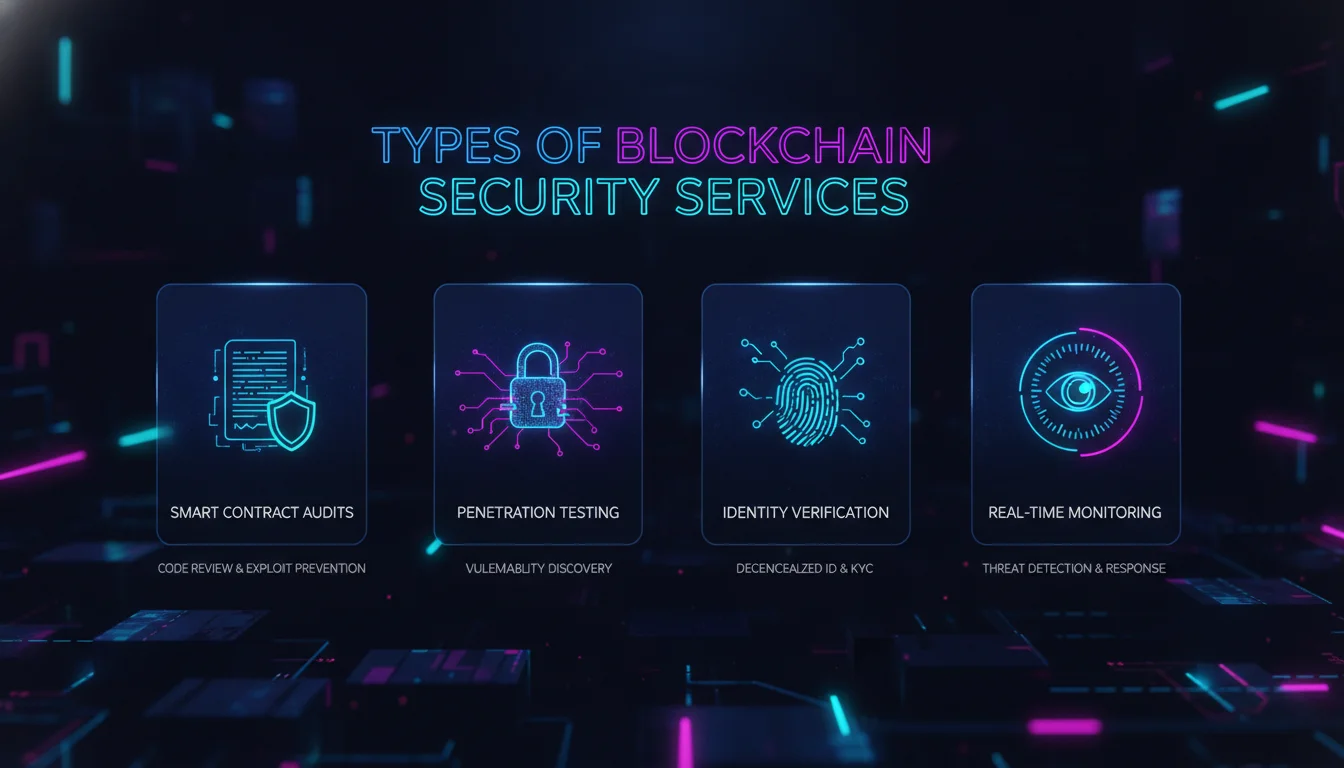
- Smart Contract Audits: Line-by-line review of on-chain code to catch logic flaws, reentrancy vulnerabilities, and access control issues before deployment.
- Penetration Testing: Simulated attacks across the full stack, web, mobile, APIs, cloud, and infrastructure, to find exploitable weaknesses automated scanners miss.
- Real-Time Monitoring: Continuous surveillance of on-chain activity to flag and halt suspicious transactions using AI-driven alerting and automated pause mechanisms.
- Incident Response & Forensics: Rapid containment, evidence preservation, and wallet tracing when a breach happens, often involving court-recognized digital forensic examiners.
- Compliance & Proof of Reserves: Demonstrating to regulators and users that assets are fully collateralized and controls meet standards like ISO 27001, CCSS, and MiCA.
The Evolution from Traditional Cybersecurity
Traditional cybersecurity defends network perimeters and endpoints. Blockchain flips that model: code is law, and transactions are final. A bug in a smart contract can’t be patched like a server; it permanently exposes funds until the contract is redeployed or paused. This immutability demands a shift-left security approach, catching vulnerabilities early in the development lifecycle through rigorous review and formal verification. The composability of DeFi, where protocols depend on one another, means a single weak integration can cascade into systemic risk. That’s why full-scope assessments matter more here than almost anywhere else in tech.
Blockchain Security as a Service (BSaaS)
BSaaS is a delivery model where organizations outsource their blockchain security needs to specialized providers. Instead of building an in-house team with rare, expensive expertise, companies tap into on-demand audits, monitoring platforms, and incident response retainers. This model appeals to startups and enterprises scaling into Web3 because it turns capital expense into operating expense while keeping access to current threat intelligence. Hacken, for instance, has delivered 2,096 public security assessments and verified more than $430 billion in assets across Proof of Reserves audits, according to figures published on its site, illustrating the scale at which BSaaS providers now operate.
“Blockchain has a reputation for being a secure technology. In reality, it can only facilitate secure, trusting relationships if the protocols, architecture, and integrations are robust and safe.” – Kudelski Security, Blockchain Security Assessment overview
Why Blockchain Security Services Are Critical in 2026
The Rising Cost of Exploits and Vulnerabilities
Blockchain security services matter because exploit losses keep climbing year over year, not shrinking. In 2025, Bit-Sentinel reported $3.4 billion lost to DeFi hacks, with roughly 28% of incidents tracing back to smart contract bugs. Even large, well-funded projects aren’t immune. Those figures also don’t capture the full cost: eroded user trust, regulatory fines, and drawn-out litigation. Proactive blockchain security services shrink the attack surface by finding and fixing weaknesses before anyone can exploit them.
Unique Blockchain Threat Vectors
- Smart Contract Vulnerabilities: Reentrancy, integer overflows, and front-running can drain millions in seconds. Immutable deployments mean bugs persist unless upgrade mechanisms are built in from day one.
- Flash Loan Attacks: Atomic transactions let attackers borrow huge sums without collateral, manipulate price oracles, and profit within a single block.
- Private Key Compromise: Weak key management or phishing leads directly to asset theft. Once a key is stolen, funds can be swept out irreversibly.
- Bridge Exploits: Cross-chain bridges hold massive liquidity and are frequent targets. A single bug in a bridge contract or validator set can produce nine-figure losses.
- Consensus Attacks: A 51% attack lets an actor control the majority of network hashpower or stake, enabling double-spending and transaction reordering. It’s economically prohibitive on Bitcoin or Ethereum given their size, but smaller proof-of-work and proof-of-stake chains with thin validator sets remain genuinely exposed. Reviewing validator concentration and slashing conditions is now a standard part of consensus-layer risk assessments.
Regulatory Pressures and Compliance Mandates
Regulators worldwide are tightening oversight of digital assets, and that’s reshaping what blockchain security services need to deliver. The EU’s Markets in Crypto-Assets (MiCA) framework and the Digital Operational Resilience Act (DORA) require crypto service providers to implement real security controls and prove compliance through audits. In the U.S., state money-transmitter licenses and FinCEN guidance impose similar obligations. Blockchain security services are no longer a nice-to-have; they’re a prerequisite for licensing, banking partnerships, and institutional capital. Hacken, for example, provided the security and compliance evidence that helped Bybit secure a MiCAR license.
Types of Blockchain Security Services
Smart Contract Audits and Code Reviews
A smart contract audit is a detailed examination of contract source code to detect vulnerabilities, logical errors, and deviations from intended behavior. Auditors combine automated analysis with manual line-by-line review, producing a report with findings ranked by severity: critical, high, medium, low. Providers like Kudelski Security and Hacken have vetted contracts for networks including Base, Mina, and the European Blockchain Services Infrastructure (EBSI). A thorough audit should cover reentrancy, arithmetic issues, access control, gas optimization, and compliance with standards like ERC-20 and ERC-721.
Penetration Testing and Red Teaming
Beyond the contract layer, the full infrastructure supporting a blockchain application is a potential entry point. Penetration testing simulates real-world attacks against web interfaces, APIs, cloud instances, and network configurations. Red team engagements go further, emulating a motivated, multi-stage adversary to test detection and response capabilities. Kroll notes that cryptocurrency exchanges are prime targets, and only adversarial simulation actually verifies whether a security program works under pressure.
Real-Time Threat Monitoring and Incident Response
Once a protocol goes live, continuous monitoring becomes non-negotiable. Platforms like Hacken’s Extractor use AI to analyze on-chain transactions in real time, automatically pausing contracts when suspicious patterns show up. Incident response retainers run in parallel, so if a breach happens, forensic experts can jump in immediately to contain damage, preserve evidence, and trace stolen funds. Petronella Technology Group keeps a forensics desk active around the clock for victims of crypto fraud, pig-butchering scams, or exchange hacks.
Crypto Forensics and Asset Tracing
When funds are stolen, specialized forensics firms trace them across wallets, mixers, and exchanges using blockchain analytics tools. This capability matters for law enforcement, attorneys, and victims seeking recovery. Petronella Technology Group, with a North Carolina Licensed Digital Forensic Examiner on staff, pairs on-chain tracing with off-chain investigation to identify where stolen assets end up and produce court-ready reports. Their casework spans SIM-swap thefts, ransomware payments, and fake investment platform scams.
Compliance and Regulatory Audits
Compliance for blockchain entities goes beyond code review. It covers governance, operational security, data protection, and financial reporting. Blockchain security services in this category map controls to frameworks such as ISO 27001, SOC 2, and the CryptoCurrency Security Standard (CCSS). They also handle Proof of Reserves (PoR) audits, where cryptographic proofs demonstrate that an exchange or custodian holds enough assets to cover customer balances. Hacken’s PoR engagements alone have verified over $430 billion in assets, boosting transparency for users who otherwise have to take an exchange’s word for it.
Bug Bounty Programs as a Distinct Layer
Bug bounties are their own service category now, not just an audit afterthought. Rather than relying solely on a single firm’s engineers, protocols open their code to a distributed pool of independent researchers who get paid only for verified findings. Hacken’s HackenProof program, for example, taps a community of roughly 45,000 researchers on this model. This crowdsourced layer catches edge cases that a fixed audit team, working under deadline pressure, might miss, and it gives protocols an ongoing incentive structure rather than a one-time check.
How Enterprise-Grade Blockchain Security Services Work

Step 1: Scope the Architecture and Threat Model
Every serious engagement starts with a scoping call to map the system’s architecture, use case, and compliance requirements. Auditors chart the tech stack: blockchain platform (Ethereum, Solana, Hyperledger, etc.), smart contract languages (Solidity, Rust, Move), off-chain components, and external integrations. This phase identifies critical assets and the threat model, which sets the foundation for a tailored assessment.
Step 2: Run Automated and Manual Code Analysis
Security engineers deploy static analysis tools like Slither, Mythril, and proprietary AI-assisted scanners to flag common vulnerabilities. Automated tools alone miss complex logic bugs and business-logic errors, though. Manual review by senior engineers with deep blockchain expertise is not optional at this stage. Auditors walk the code path by path, verifying that every function behaves as specified under every condition. This dual approach is standard practice at firms like Hacken, which has uncovered 33,330 vulnerabilities across thousands of engagements to date.
// Example: reentrancy guard pattern auditors check for
function withdraw(uint256 amount) external nonReentrant {
 require(balances[msg.sender] >= amount, "Insufficient balance");
 balances[msg.sender] -= amount; // state updated BEFORE external call
 (bool success, ) = msg.sender.call{value: amount}("");
 require(success, "Transfer failed");
}
Step 3: Simulate Full-Scope Attack Campaigns
For high-value protocols, a red team simulates a full-scope attack. Penetration testers try to breach the network, exploit API endpoints, bypass authentication, and compromise private keys. The goal is to find out what an advanced persistent threat could actually pull off. Kroll’s cryptocurrency red team services focus on real-world attack chains that bypass traditional defenses, producing concrete evidence of where a security posture falls short.
Step 4: Remediate Findings and Retest
A report with findings and prioritized recommendations gets delivered. The development team fixes the issues, and the security provider retests to confirm every critical and high-severity item has been properly closed. A retest pass certificate or a clean report is often shared with regulators, investors, and the community as proof of due diligence. Continuous security then continues through bug bounty programs, periodic reassessments, and real-time monitoring, not a one-and-done audit stamp.
Leading Blockchain Security Service Providers
Overview of Notable Firms
- Hacken (Estonia, since 2017): End-to-end security and compliance partner. 2,096 public audits delivered, ISO 27001 certified, co-authoring DLT security standards with regulators. Part of Mastercard’s Crypto Partner Program.
- Kudelski Security (Switzerland, global): A division of Kudelski Group, known for deep cryptography expertise. Provides blockchain risk assessments, shift-left security, and custom threat modeling for enterprises and governments.
- Petronella Technology Group (USA, since 2002): Combines decades of cybersecurity work with MIT-certified AI and blockchain skills. Offers smart contract audits, crypto forensics, and incident response led by a licensed digital forensic examiner.
- Kroll (USA, global): A corporate investigations and risk consulting firm providing cryptocurrency penetration testing, red teaming, and incident response. Serves crypto exchanges, custodians, and VASPs.
- Bit-Sentinel (USA): Focused on smart contract audits and DeFi protocol security. Uses a decentralized network of security researchers to reduce exploit risk before and after launch.
Comparison Table of Key Providers
| Provider | Key Services | Unique Differentiators | Notable Clients / Accreditations |
|---|---|---|---|
| Hacken | Smart contract audits, pen-testing, real-time monitoring, PoR, compliance (MiCA, ISO 27001) | ISO 27001 certified; AI-powered Extractor for on-chain threat detection; part of Mastercard Crypto Partner Program | Bybit, OKX, Base Chain, European Blockchain Services Infrastructure (EBSI) |
| Kudelski Security | Blockchain risk assessment, secure-by-design advisory, threat modeling, code review | Decades of cryptography heritage from Kudelski Group; tailored security strategies for enterprise; shift-left methodology | Government entities, layer-1 protocols, and financial institutions (names not publicly disclosed per practice) |
| Petronella Technology Group | Smart contract audits, crypto forensics, wallet investigations, incident response | MIT-certified AI and Blockchain founder; Hyperledger certified; licensed digital forensic examiner (NC DFE #604180); 24/7 forensics desk | Attorney-referred fraud cases, law enforcement agencies, Web3 startups |
| Kroll | Penetration testing, red teaming, incident response, digital forensics | Global risk consulting brand with end-to-end investigation capabilities; proactive defense and asset tracing for crypto exchanges | Leading crypto exchanges, custodians, and VASPs |
| Bit-Sentinel | Smart contract audits, DeFi protocol security, pre-launch and ongoing assessments | Decentralized community of researchers; focus on early-stage vulnerabilities and remediations | Emerging DeFi projects across Ethereum, BNB Chain, and Solana |
Choosing the Right Blockchain Security Partner
Evaluating Expertise and Credentials
The right blockchain security partner has a verifiable track record, published audit reports, and recognized certifications, not just a slick landing page. Look for firms with ISO 27001, OSCP, or CISSP credentials on staff, and senior engineers who have found or fixed vulnerabilities in major protocols. Petronella Technology Group’s founder, for instance, holds MIT-Certified credentials in AI and Blockchain, is Hyperledger Certified, and has authored fourteen books on cybersecurity, which signals real depth rather than marketing gloss. Hacken’s leadership actively participates in shaping global DLT security standards, another sign the firm operates at the front of the field rather than following it.
Assessing Methodology and Technology Stack
A mature blockchain security service follows a defined, repeatable methodology instead of a checklist run by junior staff. Ask potential partners: Do they rely only on automated scanners, or combine them with manual analysis? Do they retest once fixes ship? Do they offer post-review monitoring? Providers that layer in AI-driven threat detection, like Hacken’s Extractor, add real-time protection that matters a lot for protocols managing high transaction volume and large treasuries.
Considering Post-Engagement Support and Community Trust
Security isn’t a one-and-done exercise, and the best blockchain security services reflect that. Top providers build long-term partnerships: retainer-based monitoring, bug bounty management, and ongoing compliance support as the ecosystem changes. Community perception matters too. Firms that publish transparent audit reports and maintain relationships with major exchanges and regulators earn more trust than ones that don’t. Hacken, for example, keeps a public repository of audit reports anyone can review, and its inclusion in Mastercard’s Crypto Partner Program is a meaningful industry signal.
Pros and Cons of Outsourcing Blockchain Security Services
Pros
- Access to specialized expertise that’s genuinely rare and expensive to hire in-house.
- Faster time-to-market since you’re not building a security team from scratch before launch.
- Published audit reports and third-party validation build credibility with investors, regulators, and users.
- Ongoing monitoring and retainer models catch issues that a one-time internal review would miss.
Cons
- Costs can run high for comprehensive engagements, especially red teaming and continuous monitoring retainers.
- An audit is a point-in-time assessment; new code changes or integrations after the audit reopen risk.
- Quality varies significantly across providers, and a rushed or shallow audit can create false confidence.
- External teams need time to ramp up on your architecture, which can slow down urgent engagements.
The Future of Blockchain Security Services
AI and Machine Learning in Proactive Defense
AI is reshaping blockchain security services by shrinking the gap between breach and containment. As attacks grow more sophisticated, defensive tools have to keep pace. AI is increasingly used to analyze transaction patterns, flag likely exploits, and automate detection. Hacken’s Extractor already uses AI to auto-pause contracts under attack, and that pattern will spread. Machine learning models trained on labeled on-chain data can spot anomalous behavior far faster than a human analyst staring at a dashboard.
Standardization and Regulatory Harmonization
Fragmented regulation is a real headache for global blockchain projects, but that’s slowly changing. Frameworks like MiCA and DORA in Europe, alongside guidance from the Financial Action Task Force (FATF), are driving convergence across jurisdictions. Blockchain security services will increasingly standardize their reporting to meet these overlapping requirements, which should make cross-border operations smoother. Industry groups where Hacken participates, co-creating DLT security-compliance standards with regulators, are central to this maturing process.
The Convergence of Off-Chain and On-Chain Security
As of 2026, the line between blockchain security and traditional cybersecurity keeps blurring. A DeFi protocol’s security posture depends not just on its smart contracts but on its Web2 infrastructure, API gateways, and employee access controls. Full-scope providers that audit both on-chain code and off-chain systems, like Petronella Technology Group, which pairs CMMC compliance work with smart contract reviews, are best positioned to deliver end-to-end resilience. This convergence is also driving demand for unified risk dashboards that correlate on-chain events with network logs and user activity in one view.
Certifications Buyers Should Recognize
Certification programs are becoming a shorthand for vetting blockchain security services before you even get on a call. ISO 27001 signals a formal information security management system. OSCP and CISSP credentials on an engineering team indicate hands-on offensive security skill and broad security management knowledge, respectively. The CryptoCurrency Security Standard (CCSS) is specific to crypto custody and wallet operations. None of these alone guarantee quality work, but their absence is a real warning sign when you’re evaluating a vendor for a six or seven-figure treasury.
“A bug in a smart contract is not a defect to be patched in next week’s release; it is a window through which value can leave the contract permanently in the time it takes the next block to confirm.” – Petronella Technology Group, on blockchain security fundamentals
At Digital Blockchains, we think about security the same way we think about tokenomics and protocol design: as something you architect for from day one, not something you bolt on after a launch goes sideways. If you’re building a protocol, a DAO treasury, or a token launch and want security baked into the architecture from the start, apply to the Genesis Cohort at digitalblockchains.com. We work with serious builders who want to get this right the first time.
Frequently Asked Questions
What are blockchain security services?
Blockchain security services are professional offerings that assess, monitor, and strengthen the security of blockchain networks, smart contracts, and related infrastructure. They include audits, penetration testing, compliance assessments, and incident response designed to protect against exploits and fraud.
Is blockchain 100% safe?
No. The underlying cryptography and consensus mechanisms are robust, but vulnerabilities in smart contracts, applications, and human processes create real attack vectors. Regular security audits and ongoing monitoring are essential to reduce that risk.
How much does a blockchain security audit cost?
Costs vary widely based on complexity and scope. A basic smart contract audit for a simple token can start in the low thousands of dollars, while comprehensive DeFi protocol audits with red teaming can run well into six figures. Most providers offer fixed-price quotes after an initial scoping call.
What is Blockchain Security as a Service (BSaaS)?
BSaaS is a model where a third-party provider delivers ongoing security work for blockchain systems on a subscription or retainer basis. It lets organizations access expert skills and tooling without building an in-house team from scratch.
How do I choose a blockchain security company?
Look for a proven track record, transparent audit reports, recognized certifications like ISO 27001 or OSCP, and expertise specific to your blockchain platform. Also consider whether they offer post-audit support and have earned genuine community trust rather than just marketing claims.
What are the most common blockchain threats?
Common threats include smart contract exploits like reentrancy and flash loan attacks, private key theft, bridge hacks, oracle manipulation, and phishing. Because blockchains are immutable, swift detection and response matter more here than in traditional IT security.