The top 10 AI crypto coins are Bittensor (TAO), NEAR Protocol (NEAR), Internet Computer (ICP), Render (RENDER), Filecoin (FIL), Injective (INJ), Virtuals Protocol (VIRTUAL), Fetch.ai (FET), Kaito (KAITO), and The Graph (GRT), ranked by market cap as of July 2026.
Key Takeaways
- Bittensor (TAO) leads the crypto coins with a market cap of approximately $2.15 billion, powered by a proof-of-intelligence mechanism that rewards quality model contributions.
- The AI crypto sector carries a combined market cap of over $21.3 billion, per CoinGecko data, reflecting sustained capital allocation into decentralized AI infrastructure.
- These projects span distinct layers of the AI stack: compute (Render, Gensyn), storage (Filecoin), agents (Virtuals, Fetch.ai), data indexing (The Graph), and information intelligence (Kaito).
- Token utility is the key differentiator: coins where the token is required to access or provide the core service tend to have more durable demand than pure governance tokens.
- Emerging projects like Unibase (UB) and Kite (KITE) are building foundational infrastructure for AI agent coordination and autonomous payments, attracting serious capital in 2026.
- All AI crypto assets carry significant risk: evaluate development activity, token unlock schedules, and real-world adoption before allocating capital.
The AI crypto sector has grown to a combined market cap of over $21.3 billion, per CoinGecko. These projects use blockchain to power decentralized AI services, from compute and storage to agent economies. This article ranks the this type of coins by market cap and breaks down what each one actually does.
What Are AI Crypto Coins?
AI crypto coins are digital assets that integrate artificial intelligence technologies directly into blockchain networks. They use machine learning algorithms, decentralized data processing, and smart contracts to automate tasks, improve security, and deliver AI-driven services at the protocol level. Unlike standard cryptocurrencies, these tokens typically represent access to AI models, compute power, or data marketplaces – the token is the economic primitive of the network itself.
The Intersection of AI and Blockchain
The convergence here isn’t cosmetic. Blockchain solves a real problem for AI: coordination and incentive alignment across untrusted participants. A decentralized GPU network needs a token to pay node operators. A model marketplace needs a token to reward quality contributions. Without the cryptographic layer, you just have another centralized cloud provider with a whitepaper.
Why AI Coins Are Gaining Traction in 2026
Capital is flowing into infrastructure-heavy projects tied to real AI demand rather than pure narrative speculation. According to CoinGecko, the AI crypto category market cap sits at over $21.3 billion as of July 2026. The most interesting projects now occupy distinct layers of the stack: decentralized compute, AI agent infrastructure, privacy-preserving AI, expert data labeling, and AI-native payment rails. That specialization is a maturity signal worth paying attention to.
Top 10 AI Crypto Coins by Market Cap (July 2026)
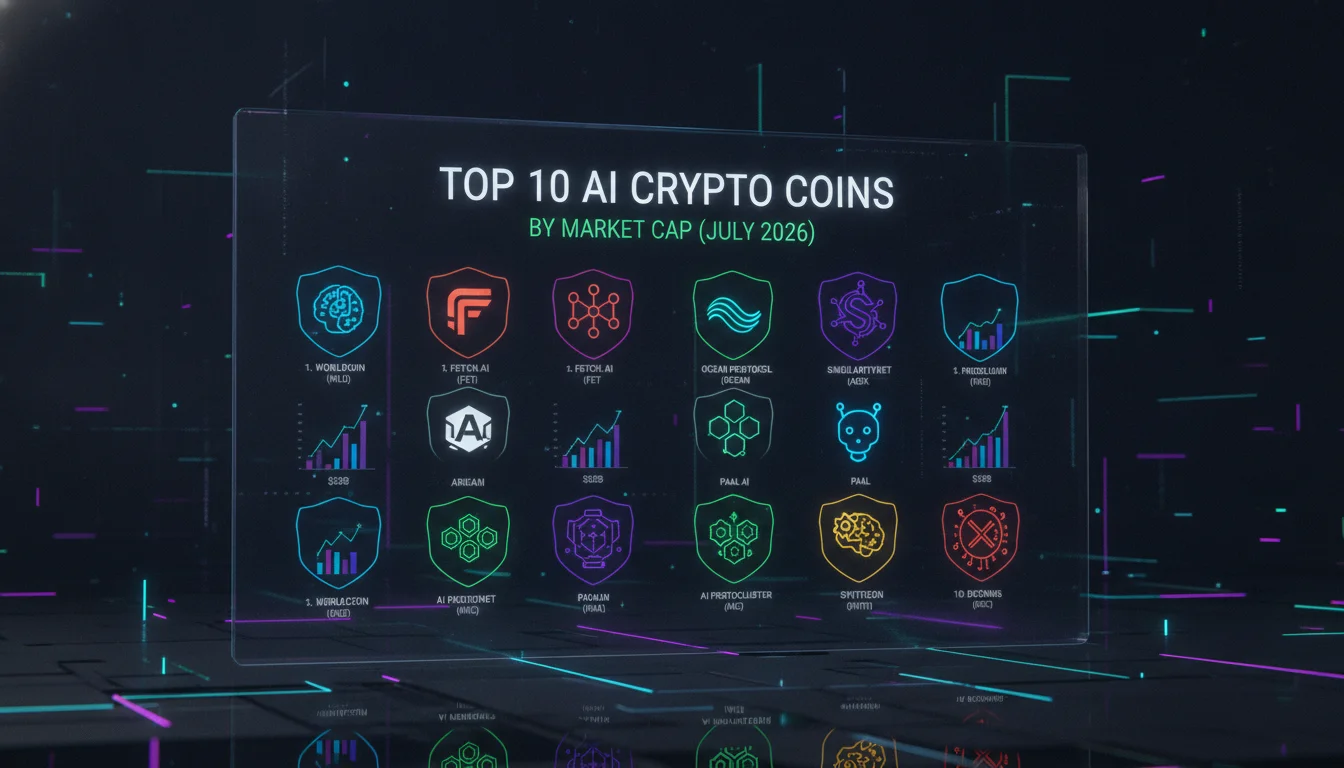
| Coin | Ticker | Market Cap (July 2026) | Primary Function |
|---|---|---|---|
| Bittensor | TAO | $2.15B | Decentralized machine learning network |
| NEAR Protocol | NEAR | $2.11B | L1 blockchain with AI integration |
| Internet Computer | ICP | $1.16B | Smart contract platform for AI dapps |
| Render | RENDER | $730M | Decentralized GPU rendering network |
| Filecoin | FIL | $553M | Decentralized storage for AI data |
| Injective | INJ | $465M | DeFi with AI-enhanced trading |
| Virtuals Protocol | VIRTUAL | $371M | AI agent economy and co-ownership |
| Fetch.ai | FET | $310M | Autonomous AI agents for economic tasks |
| Kaito | KAITO | $294M | AI-powered InfoFi platform |
| The Graph | GRT | $164M | Decentralized indexing protocol for AI queries |
1. Bittensor (TAO): Decentralized Machine Learning
Bittensor is the largest of the this kind of crypto coins by market cap, sitting at approximately $2.15 billion with TAO trading near $192.80 as of July 2026, according to CoinMarketCap. It’s an open-source protocol that builds a decentralized machine learning network where participants train and deploy AI models in exchange for TAO rewards. The network’s proof-of-intelligence mechanism is the key architectural differentiator: validators score model outputs, and only high-quality contributions earn meaningful token rewards. This creates a market for intelligence rather than just compute cycles. The subnet architecture allows specialized AI tasks to run in parallel across the network, each with its own incentive structure.
2. NEAR Protocol (NEAR): AI-Integrated Layer 1
NEAR is a layer-1 blockchain with a sharded architecture optimized for scalability, and it’s increasingly the foundation for AI-driven dApps and agent frameworks. With a market cap of $2.11 billion and a price of $1.62, NEAR ranks second among the the 10 ai crypto coins. Its account abstraction model and low transaction costs make it practical for AI agents that need to execute many small transactions autonomously. Developer activity on NEAR has remained strong, with multiple AI agent frameworks building natively on the protocol.
3. Internet Computer (ICP): Scalable AI Smart Contracts
Internet Computer enables smart contracts to run at web speed, making it viable for AI-powered applications that require high throughput and low latency. With a market cap of $1.16 billion and a price of $2.09, ICP is notable for its ability to host AI models directly on-chain. The network processes AI inference tasks without centralized servers, offering a genuinely decentralized alternative to cloud-hosted model APIs. For developers building AI dApps that need verifiable, censorship-resistant inference, ICP’s architecture is worth studying seriously.
4. Render (RENDER): GPU Rendering for AI Graphics
Render distributes GPU processing tasks across a global network of node operators, connecting idle GPU capacity with demand from AI-generated graphics, 3D rendering, and metaverse applications. Its market cap stands at $730 million with RENDER trading at $1.40. As AI-generated visual content scales, the demand for cost-effective distributed GPU compute scales with it. Render sits at that intersection, and its token is the direct payment mechanism between creators and node operators – clean utility with a clear economic loop.
5. Filecoin (FIL): Decentralized Storage for AI Data
Filecoin is a peer-to-peer storage network where users rent out unused hard drive space, creating a decentralized alternative to AWS S3 or Google Cloud Storage. For AI applications, decentralized storage is critical infrastructure: training datasets can run into terabytes, and centralized storage creates single points of failure and censorship risk. FIL has a market cap of $553 million and trades at $0.683. Its inclusion in the AI and big data category on CoinMarketCap reflects its role as foundational data infrastructure rather than a pure AI play.
6. Injective (INJ): AI-Enhanced DeFi
Injective is a decentralized exchange protocol that integrates AI for optimized trading strategies and on-chain financial products. With a market cap of $465 million and INJ trading at $4.65, it represents the convergence of AI and DeFi at the protocol level. The platform supports AI-powered bots for market making and arbitrage, and its fully on-chain order book architecture makes it a natural fit for algorithmic trading strategies that require transparent, verifiable execution.
7. Virtuals Protocol (VIRTUAL): AI Agent Economy
Virtuals Protocol enables co-ownership of AI agents through tokenization, letting users invest in and govern agents that operate across games, social platforms, and virtual environments. Its market cap is $371 million, with VIRTUAL trading at $0.5644. The AI agent narrative accelerated sharply through 2025 and into 2026, and Virtuals was one of the first protocols to build a structured economic model around agent ownership rather than just agent deployment. That early positioning matters in a sector where network effects compound quickly.
8. Fetch.ai (FET): Autonomous Agent Networks
Fetch.ai is a decentralized network where autonomous agents perform economic tasks including data delivery, IoT coordination, and DeFi trading. FET has a market cap of $310 million with the token trading at $0.1386. Fetch.ai was among the earliest AI-focused blockchains, and it remains a top 10 AI crypto coin by market cap. The project operates under the Artificial Superintelligence Alliance umbrella, which also includes SingularityNET and Ocean Protocol, creating a broader ecosystem for decentralized AI services.
9. Kaito (KAITO): InfoFi and AI-Driven Insights
Kaito provides AI-powered analytics and search for crypto information, rewarding users for quality data contributions through its InfoFi model. With a market cap of $294 million and KAITO trading at $1.22, it occupies a distinct niche among the coins: the data intelligence layer. Rather than compute or storage, Kaito focuses on information quality and signal extraction. It uses AI to rank and verify information, aligning incentives so that accurate, high-value data gets surfaced and rewarded.
10. The Graph (GRT): Indexing for AI Queries
The Graph is a decentralized indexing protocol that enables efficient querying of blockchain data. AI applications frequently require fast, structured access to on-chain data, making GRT essential infrastructure for any AI agent or dApp that needs to read blockchain state at scale. Market cap: $164 million, with GRT trading at $0.01508. The Graph powers data retrieval for a large portion of the DeFi ecosystem, and as AI agents become more prevalent on-chain, its indexing layer becomes more critical, not less.
Pros and Cons of Investing in Top 10 AI Crypto Coins
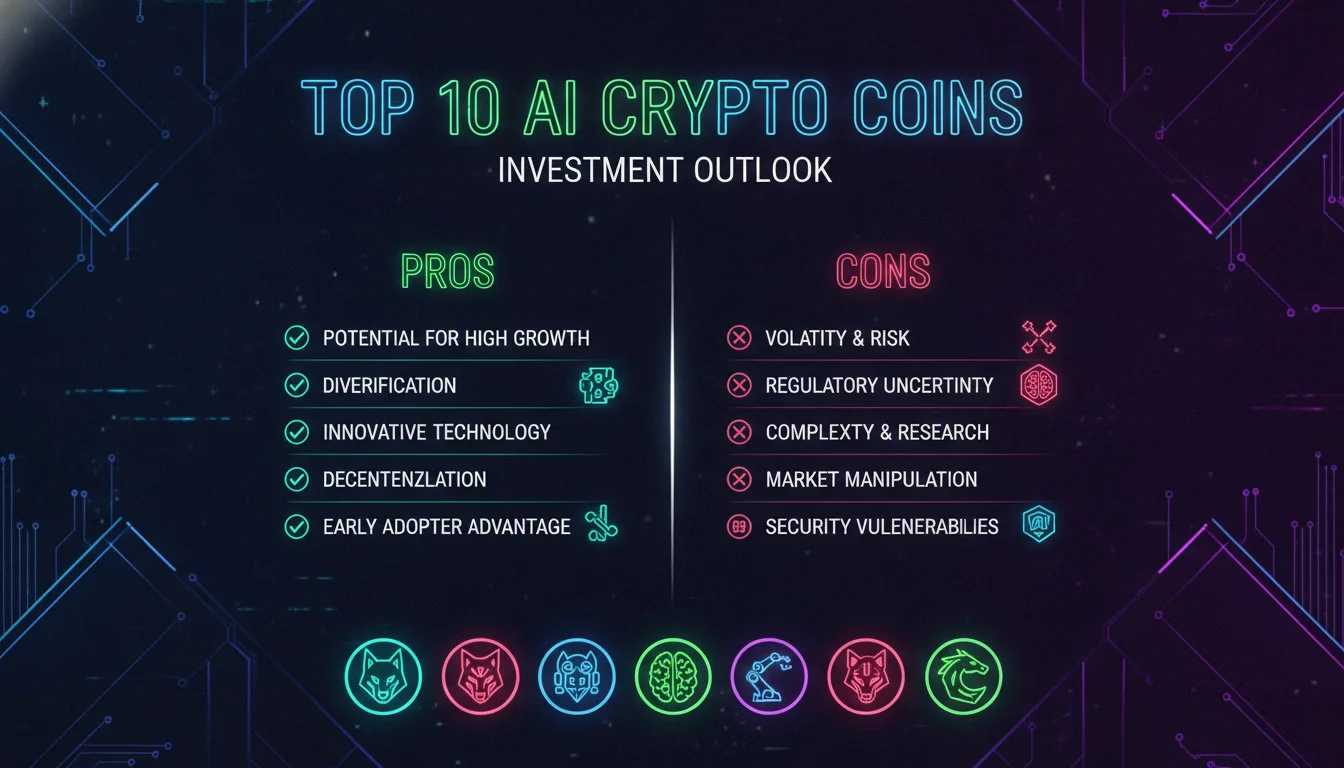
Pros
- Real infrastructure demand: The best projects in this list solve genuine coordination problems for AI systems, giving their tokens durable utility beyond speculation.
- Sector tailwinds: Both AI and blockchain adoption are accelerating in 2026, and projects at their intersection benefit from both narratives simultaneously.
- Diverse exposure: The top 10 span compute, storage, agents, DeFi, and data indexing, allowing targeted allocation across the AI stack.
- Open-source development: Most of these protocols are open-source, enabling community audits, forks, and composability that centralized AI platforms cannot match.
- Liquidity: Projects like Bittensor, NEAR, and ICP carry multi-billion dollar market caps, providing meaningful liquidity compared to micro-cap AI tokens.
Cons
- High volatility: Even the largest AI crypto coins experience significant price swings that can exceed broader crypto market moves.
- Token unlock risk: Many projects have substantial locked supply with vesting schedules that create persistent dilution pressure as unlocks begin.
- Speculative narratives: Not every project claiming AI integration has meaningful on-chain AI activity. Marketing often outpaces technical reality.
- Regulatory uncertainty: AI crypto sits at the intersection of two heavily scrutinized sectors. Regulatory developments in either AI governance or crypto markets can affect valuations quickly.
- Competition from centralized AI: Projects must continuously demonstrate that decentralization adds real value versus simply using AWS and a token.
How to Evaluate the Top 10 AI Crypto Coins
Market Cap and Liquidity
Market cap is the first filter, not the final one. Larger market caps indicate higher liquidity and more established networks, which matters for position sizing and exit planning. Bittensor and NEAR carry multi-billion dollar market caps, making them relatively more liquid than smaller-cap coins like The Graph. But market cap alone tells you nothing about whether the token is actually necessary for the network to function.
Token Utility and Use Case
The critical question is whether the token plays a direct, non-optional role in the AI ecosystem. TAO rewards model training contributions. RENDER pays node operators for GPU compute. KAITO incentivizes quality data sharing. Coins where the token is the only way to access or provide the core service tend to have more sustainable demand than tokens that are primarily governance instruments. Read the tokenomics section of the whitepaper before reading anything else.
Development Activity and Partnerships
Check GitHub commit frequency, developer documentation quality, and the specificity of real-world integrations. NEAR Protocol has partnered with multiple AI agent frameworks. Fetch.ai continues expanding its autonomous agent network under the Artificial Superintelligence Alliance. Active, consistent development signals long-term commitment from the team. A protocol that hasn’t shipped a meaningful update in six months is a red flag regardless of its market cap ranking.
Token Unlock Schedules
This is the most underrated risk factor in the top 10 AI crypto coins list. A project can have excellent fundamentals and still underperform if large team, advisor, or treasury allocations are scheduled to unlock. Always check the vesting schedule against the current circulating supply. Significant unlocks hitting the market can suppress price even during strong sector momentum.
Emerging AI Crypto Coins to Watch
Beyond the top 10 AI crypto coins by market cap, several emerging projects are building foundational infrastructure that could matter significantly over the next 12 to 24 months.
Unibase (UB): AI Agent Memory Layer
Unibase is building a decentralized memory layer for AI agents, enabling persistent long-term memory and cross-platform agent coordination. According to Mudrex, UB had a market cap of approximately $273 million in early July 2026, with 2.5 billion tokens in circulation from a 10 billion total supply. It integrates with agent frameworks including ElizaOS, MCP, and HyperGPT, positioning it as critical infrastructure for the agentic AI wave. One important caveat: a large portion of total supply remains locked, with team and advisor allocations subject to vesting schedules that represent ongoing dilution risk.
Gensyn (AI): Decentralized AI Compute
Gensyn aims to create an open infrastructure layer for AI compute and data exchange, connecting the compute, data, and information that AI systems need to operate and learn. Backed by a16z, the project is still early but has generated serious interest for its approach to decentralized AI training. Per Mudrex, it operates as a globally accessible AI network designed to reduce the cost and centralization of model training infrastructure.
Kite (KITE): AI-Native Layer 1 for Agent Payments
Kite is an AI-native Layer 1 blockchain built specifically for autonomous agent payments. With a live mainnet and a market cap that placed it in the top-100 AI tokens on CoinMarketCap as of July 2026, KITE addresses a real gap: most existing blockchains weren’t designed for the high-frequency, low-value transactions that AI agents generate at scale. An AI agent executing hundreds of micro-transactions per hour needs a chain optimized for that pattern, not one designed for human-speed DeFi.
Perle (PRL): AI Training Data Marketplace
Perle offers a marketplace for expert-verified AI training data on Solana, addressing the growing demand for high-quality labeled datasets. With $17.5 million in institutional backing per Mudrex, PRL represents the data provenance layer of the AI stack. On-chain data provenance for training sets is an underappreciated problem: as AI-generated content floods the internet, the value of verifiably human-expert-labeled data increases.
Golem (GLM): Decentralized Computing Marketplace
Golem is one of the longer-standing decentralized computing projects, operating as a peer-to-peer marketplace for AI workloads and general compute tasks. GLM has a market cap in the $90 million range per CoinGecko data, with its full token supply in circulation, eliminating unlock risk. The project has active enterprise pilots and represents the established end of the decentralized compute spectrum, contrasting with newer entrants like Gensyn that are still building out their networks.
“The most interesting AI crypto projects in 2026 sit across different layers of the stack: decentralized compute, AI agent infrastructure, privacy-preserving AI, expert data labeling, and AI-native payment rails. The sector has evolved far beyond simple AI tokens.” – Mudrex Research, July 2026
Regulatory Outlook for AI Crypto Coins
AI crypto sits at the intersection of two heavily scrutinized sectors, and that creates compounding regulatory risk. Governments are actively developing frameworks for both AI governance and digital assets in 2026, and projects in this category face potential oversight from both directions simultaneously.
The key regulatory questions for the top 10 AI crypto coins center on token classification (utility vs. security), data privacy compliance for AI training data stored on-chain, and liability for autonomous agent actions. Projects that have structured their token economics around genuine utility rather than investment returns are better positioned for regulatory clarity. The Graph’s indexing service model and Render’s GPU marketplace model are examples of token designs that map cleanly to service utility rather than speculative investment.
Investors should monitor regulatory developments in the EU AI Act, US digital asset legislation, and jurisdiction-specific guidance on autonomous agent liability. These frameworks will shape which projects can operate at scale in regulated markets.
“AI crypto coins combine blockchain technology with artificial intelligence to enhance platform efficiency, data analytics, and decision-making. These tokens power AI-driven projects that use algorithms and models to automate and optimize various industries.” – Kraken, AI Crypto Category Overview
Why the Top 10 AI Crypto Coins Matter in 2026
The top 10 AI crypto coins represent a diverse set of solutions addressing compute, storage, agents, and data intelligence across the full AI infrastructure stack. As AI integrates deeper into Web3 protocols, these projects are positioned to benefit from increased adoption. That said, the sector remains speculative, and the distance between a compelling whitepaper and a functioning network with real usage is still significant for many projects.
The most defensible positions in this space belong to projects where the token is genuinely required for the network to function, where development activity is consistent and public, and where the team has demonstrated the ability to ship. Use the top 10 AI crypto coins list as a starting point for research, not a buy list.
If you’re building at the intersection of AI and blockchain infrastructure, apply to the Genesis Cohort at Digital Blockchains to work with a team that takes protocol design seriously.
Frequently Asked Questions
Which is the best AI crypto coin?
Bittensor (TAO) is frequently cited as the leading AI crypto coin due to its large market cap of approximately $2.15 billion and its proof-of-intelligence mechanism that creates a genuine market for AI model quality. However, the best choice depends on your specific thesis: NEAR Protocol offers broader ecosystem exposure, while Render provides direct exposure to decentralized GPU compute demand.
Which AI coin will boom in 2026?
No one can predict price movements with certainty, but projects with strong infrastructure fundamentals and growing real-world usage are better positioned for sustained growth. Virtuals Protocol and Kaito have shown significant momentum in 2026, while emerging projects like Unibase and Kite are attracting capital as the AI agent infrastructure narrative matures.
What crypto has 1000x potential?
Small-cap AI infrastructure coins like early-stage compute networks or data provenance projects carry the highest theoretical upside, but also the highest probability of failure. Most projects with extreme return potential are pre-revenue, have significant token unlock risk, and depend on technological breakthroughs that haven’t been demonstrated at scale. Size positions accordingly.
What is the best crypto to buy right now for AI exposure?
For balanced exposure to the top 10 AI crypto coins, Bittensor (TAO) and NEAR Protocol offer the largest market caps and most established ecosystems. For higher-risk, higher-upside exposure, Virtuals Protocol (VIRTUAL) and Kaito (KAITO) represent the AI agent and data intelligence layers respectively. Always diversify across the stack rather than concentrating in a single project.
How do I invest in AI crypto coins?
Most top 10 AI crypto coins are available on major exchanges including Binance, Coinbase, and Kraken. After purchasing, store tokens in a non-custodial wallet rather than leaving them on an exchange. For smaller-cap emerging projects like Unibase or Kite, you may need to use decentralized exchanges and verify contract addresses directly from official project documentation before transacting.
Are AI crypto coins a good long-term investment?
AI crypto coins could benefit from the simultaneous growth of both AI adoption and blockchain infrastructure, but they carry significant risk. Long-term success depends on real-world adoption, sustainable tokenomics, and the ability to compete with well-funded centralized alternatives. Treat this sector as high-risk allocation within a diversified portfolio, and never invest more than you can afford to lose entirely.