Key Takeaways
- SCM blockchain creates an immutable, shared ledger that records every transaction and movement of goods, from raw materials to end consumers.
- It enhances traceability, reduces counterfeiting (which costs over 2% of global GDP according to PwC), and automates compliance through smart contracts.
- Real-world deployments in food safety, pharmaceuticals, and luxury goods already demonstrate ROI via faster recalls and improved consumer trust.
- Challenges remain: integration with legacy ERP systems, stakeholder onboarding, and scalability, but new protocols and consortia are bridging these gaps.
- Adopting supply chain blockchain can cut administrative costs by digitizing paperwork, which today accounts for up to half of container shipping expenses.
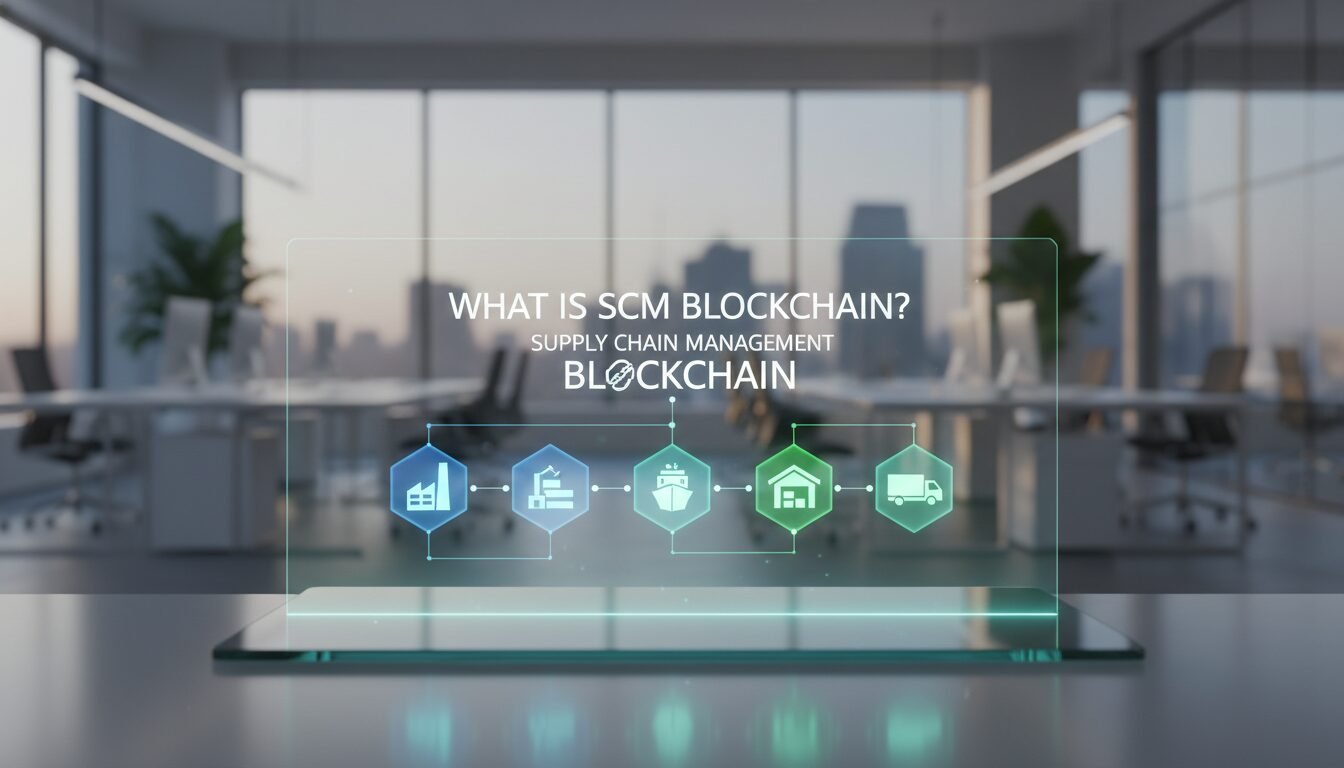
SCM blockchain is a decentralized ledger that records every supply chain transaction with cryptographic proof. This creates an immutable audit trail visible to all authorized participants, eliminating data silos and enabling instant product tracking from origin to delivery.
What Is SCM Blockchain?
The Mechanics of a Decentralized Supply Chain Ledger
At its core, SCM blockchain distributes identical copies of transaction records across multiple nodes rather than storing data in a single database. Each new event, whether a shipment departure, temperature reading, or customs clearance, gets grouped into a block. Once the network validates that block through consensus, it’s cryptographically linked to the previous one, forming an append-only chain. This design makes retroactive alteration practically impossible, because any change would require recalculating all subsequent blocks and be immediately visible to the entire network.
Permissioned blockchains dominate supply chain implementations. In this model, only approved organizations can run nodes or access data. A retailer, logistics provider, and supplier might all join a consortium. Every time a product changes hands, the event is recorded with a timestamp, location, and relevant metadata (batch number, quality certificate, etc.). Because the data is encrypted and distributed, no single party can forge or delete records without alerting others. This creates an audit trail that satisfies both internal compliance teams and external regulators.
Why Traditional Systems Fall Short
Legacy supply chain tools, centralized ERPs, spreadsheets, and EDI messages, suffer from three fundamental problems. First, they create data silos: each company maintains its own version of events, leading to reconciliation delays and disputes. Second, they lack a verifiable timeline; paper documents or emailed PDFs can be lost, altered, or forged. Third, they provide limited real-time visibility, often forcing managers to call or email for shipment status updates.
SCM blockchain replaces fragmented records with a unified, cryptographically sealed ledger. All stakeholders view the same data simultaneously. When a shipment passes through a checkpoint, a smart contract can automatically trigger a payment or compliance alert. The result is a dramatic reduction in manual coordination, faster exception handling, and an end to “invoice ping-pong” that plagues global trade. According to Deloitte, companies that adopt blockchain for supply chains can “improve both transparency and traceability as well as reduce administrative costs.”
Top Benefits of Implementing a Supply Chain Blockchain
End-to-End Traceability and Product Provenance
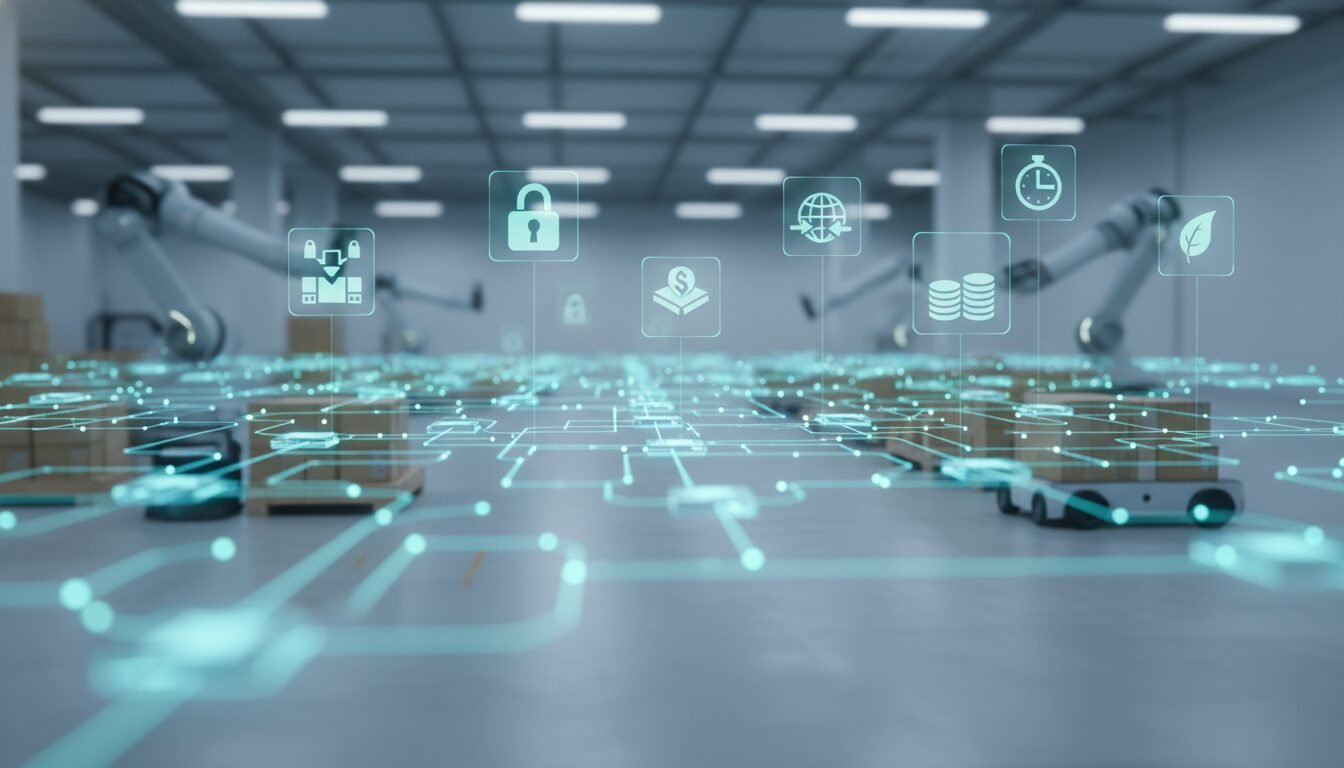
The most cited advantage of blockchain supply chains is the ability to trace any item back to its source in seconds. For food products, this means a retailer can pinpoint exactly which farm a contaminated batch of lettuce came from, limiting recalls and protecting public health. Research shows that seafood is mislabeled frequently; a blockchain system would require each fish to be recorded at catch, processing, and distribution, making fraudulent substitution nearly impossible. Similarly, luxury brands use SCM blockchain to prove authenticity, a digital certificate travels with the item, accessible to consumers via a QR code.
Fraud Prevention and Counterfeit Deterrence
Counterfeiting drains more than 2% of global economic output, per PwC research. Industries like pharmaceuticals, electronics, and high-end apparel are particularly vulnerable. By registering each unit on a blockchain, manufacturers create a digital twin that follows the physical good. Any attempt to introduce a fake product into the channel will fail because it lacks the corresponding on-chain record. Smart contracts can also enforce business rules: for example, a shipment of vaccines that exceeds a safe temperature range automatically triggers a quality hold, preventing compromised doses from reaching patients.
Cost Efficiency and Working Capital Optimization
Paper-based processes add enormous friction to global trade. In the container shipping industry, paperwork can account for half of total transport costs. Digitizing bills of lading, letters of credit, and certificates of origin on a supply chain blockchain slashes document handling time and reduces discrepancies. Smart contracts enable automatic payment when a shipment reaches a predefined milestone, say, a port arrival, eliminating manual invoicing and accelerating cash flow for suppliers. Research shows that after the pandemic, supply chain visibility jumped to the number-one priority for executives, reflecting the high cost of blind spots.
How SCM Blockchain Works in Practice
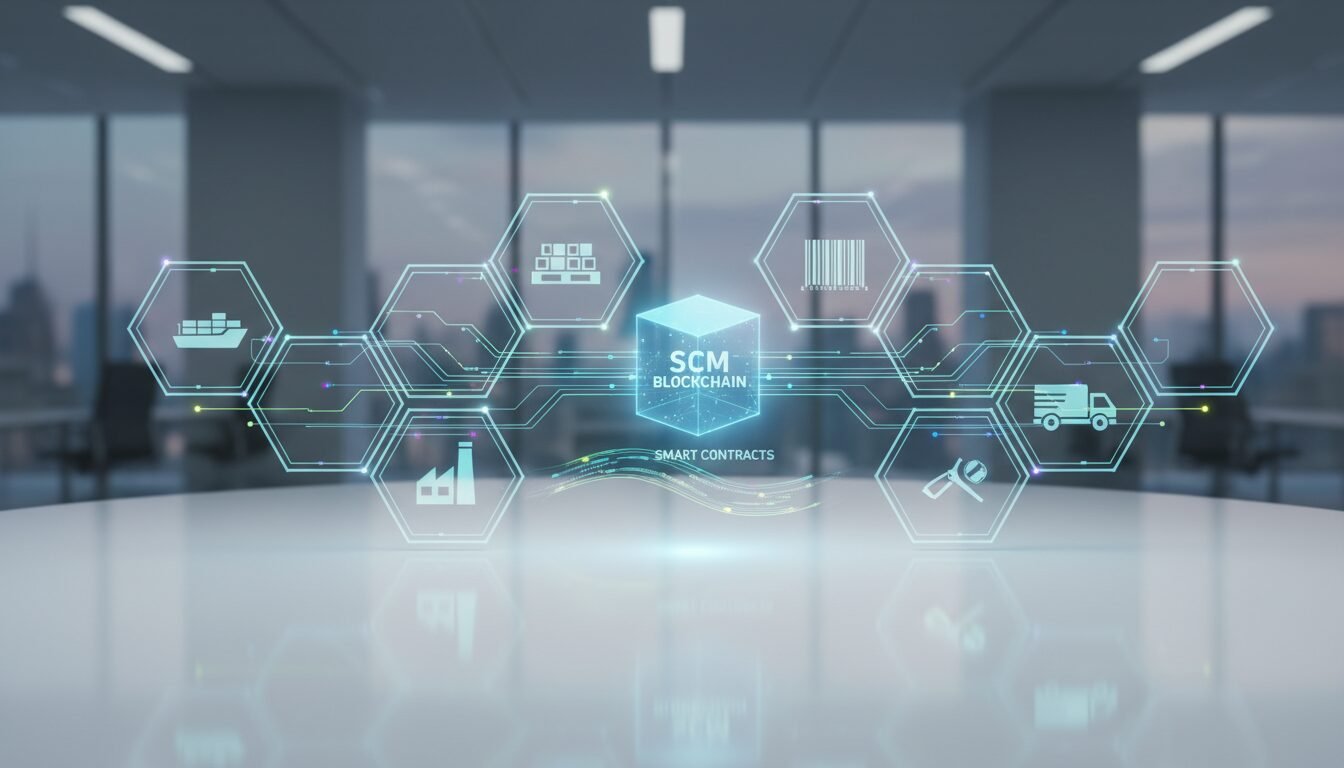
Step-by-Step: A Product’s Journey on the Blockchain
To understand how blockchain supply chains function, follow the journey of a single product, for instance, a crate of organic mangos exported from Ecuador to a supermarket in Germany:
- Origin and harvesting – The grower records harvest date, location, and organic certification on the blockchain. A unique ID (e.g., GS1 barcode) is assigned.
- Shipping and logistics – When the crate is loaded onto a truck, the logistics provider scans the ID. The event, timestamp, geolocation, carrier, is committed to a new block. IoT sensors continuously upload temperature data to the blockchain, ensuring cold chain integrity.
- Customs and clearance – The customs authority inspects the shipment and adds a digital clearance stamp. The blockchain verifies that the certificate of origin matches the cargo, reducing delay.
- Warehousing – At the distribution center, the receipt scan updates the inventory record. A smart contract calculates the current stock level and, if it drops below a threshold, issues a purchase order to the supplier automatically.
- Retail and consumer – The supermarket scans the crate upon shelf placement. A consumer scans a QR code on the packaging with a smartphone and sees the entire history: farm location, harvest date, transport conditions, and organic certification.
At every step, the data is visible to all authorized parties, grower, exporter, carrier, customs, importer, retailer, without a central coordinator. This drastically cuts the time required to trace a recall item from days to seconds.
Smart Contracts and Automated Compliance
Smart contracts are self-executing programs stored on the blockchain. They encode business logic that triggers actions when predefined conditions are met. For example, a payment can be released immediately when a shipment arrives at its destination port, as long as the IoT data confirms the cold chain was maintained. Similarly, regulatory reporting becomes automatic: the system can generate a compliance dossier (e.g., for FDA or EUDR regulations) whenever a new shipment clears customs. Blockchain supply chain traceability platforms highlight that such automation bridges the gap left by traditional ERP systems, enabling data-backed regulatory compliance with minimal manual effort.
Real-World Blockchain Applications in Supply Chains
 Blockchain Applications in Supply Chains – scm blockchain | Digital Blockchains” class=”wp-image-386″ loading=”lazy” width=”1792″ height=”1024″ />
Food Safety and Origin Transparency
Walmart’s collaboration with IBM Food Trust demonstrates practical implementation. Using Hyperledger Fabric, Walmart can trace the origin of mangoes in seconds instead of the previous seven days. In the event of contamination, precise lot identification prevents broad, costly recalls. Beyond retailers, seafood distributors are partnering with blockchain startups to verify that tuna is caught legally and sustainably. Consumers scan a code and see the vessel, catch method, and landing port. This visibility is transforming consumer trust in an industry plagued by illegal fishing and mislabeling.
Pharmaceutical and Cold Chain Integrity
The Drug Supply Chain Security Act (DSCSA) in the U.S. mandates an electronic, interoperable system to track prescription drugs. Several pharma consortia are using SCM blockchain to meet these requirements. Each unit is serialized, and every change of custody is logged. If a batch is stolen or counterfeited, the blockchain makes it easy to isolate affected items. IoT integrations monitor temperature-sensitive biologics, and a smart contract can invalidate a product that strayed outside acceptable limits, protecting patients and reducing liability.
Luxury Goods and Counterfeit Prevention
LVMH, the owner of Louis Vuitton and Bulgari, co-developed the Aura Blockchain Consortium with other luxury groups. Each item receives a digital certificate that proves authenticity and ownership. When a handbag is resold, the certificate transfers to the new owner, creating a tamper-proof provenance trail. Insurance companies also benefit: an accurate, real-time record of high-value items simplifies premium calculations and theft recovery.
Challenges in Adopting SCM Blockchain
Integration with Legacy Systems
Most large enterprises run SAP, Oracle ERP, or custom platforms that are decades old. Connecting these systems to a blockchain network requires middleware that can translate EDI or XML messages into on-chain transactions. Oracle’s own blockchain offering provides prebuilt integration adapters, but mid-sized firms often lack the IT resources to implement them. Without seamless integration, the blockchain remains an isolated pilot, unable to replace or improve existing processes.
Stakeholder Alignment and Governance
A supply chain blockchain consortium involves many independent parties, suppliers, manufacturers, carriers, insurers, banks. Agreeing on a common data standard, access permissions, and governance rules is a significant hurdle. Smaller suppliers, especially in developing regions, may lack the digital literacy or trust to participate. The success of initiatives like TradeLens (despite its eventual shutdown) showed that even with strong backers, industry-wide alignment takes years. Lessons from those efforts emphasize the need for neutral governance bodies and gradual onboarding with user-friendly interfaces.
Scalability and Privacy Concerns
Public blockchains like Ethereum process only 15–30 transactions per second, far below the throughput required for high-volume supply chains. Permissioned alternatives like Hyperledger Fabric or Quorum achieve hundreds to thousands of TPS, but still must be architected carefully. Additionally, while data immutability is a strength, it can conflict with privacy regulations such as GDPR, which requires the ability to delete personal data. Solutions like zero-knowledge proofs and off-chain storage are emerging, but they add complexity.
Comparing SCM Blockchain to Traditional Supply Chain Tools
| Feature | Traditional ERP/EDI System | SCM Blockchain |
|---|---|---|
| Data Ownership | Centralized; each party owns separate silo | Distributed; all parties share a single version of truth |
| Immutability | Records can be altered or deleted | Cryptographically sealed; tampering is evident |
| Real‑time Visibility | Periodic updates via EDI or manual entry | Near‑instant updates across all nodes |
| Trust Model | Relies on intermediaries and audits | Trustless; reliance on consensus and cryptography |
| Dispute Resolution | Time‑consuming reconciliation processes | Automated via smart contracts and shared records |
| Fraud Prevention | Vulnerable to counterfeiting and duplicate invoices | Strong deterrence through provenance tracking and digital twins |
| Implementation Cost | Mature, well‑understood integration | Higher initial setup and stakeholder coordination |
Pros and Cons
Pros
- Immutable audit trail prevents data tampering and fraud
- Real-time visibility across all supply chain participants
- Automated compliance and payment through smart contracts
- Instant traceability reduces recall costs and response time
- Eliminates data silos and reconciliation disputes
Cons
- Complex integration with existing ERP and legacy systems
- Requires alignment and cooperation from multiple stakeholders
- Higher upfront implementation costs and technical expertise
- Scalability limitations on public blockchain networks
- Privacy compliance challenges with immutable data
The Role of SCM Blockchain in ESG and Sustainability
Tracking Scope 3 Emissions and Carbon Footprint
Companies in resource-intensive industries are turning to blockchain to control Scope 3 emissions, the indirect carbon outputs that occur in a company’s value chain. By recording energy consumption, transport modes, and raw material origins on a supply chain blockchain, firms can calculate the carbon footprint of each product with far greater accuracy than traditional estimation methods. This data can then be shared with regulators, investors, or platforms like CDP (Carbon Disclosure Project) for verified reporting. Smart contracts can even link preferential financing rates to carbon savings, incentivizing greener choices at every tier of the supply network.
Ethical Sourcing and Labor Rights Verification
Mica mining for cosmetics and electronics often involves child labor in illegal operations. A blockchain-based supply chain can require certified ethical mines to register each shipment, attaching digital certificates that confirm compliance with labor standards. Such traceability, combined with public promise of transparency, puts pressure on unethical actors. Retailers can then prove their products are conflict-free, appealing to increasingly conscientious consumers and meeting emerging due‑diligence regulations like the EU Conflict Minerals Regulation.
SCM Blockchain for Small and Medium Businesses
Lowering the Barrier with Consortia and SaaS Platforms
Large enterprises like IBM and Oracle dominate mindshare, but SCM blockchain is becoming accessible to SMEs through industry consortia and software‑as‑a‑service (SaaS) gateways. For example, a coffee cooperative in Colombia can join a blockchain network via a web portal without running its own node. APIs connect the cooperative’s simple inventory system to the chain, allowing craft roasters in Europe to verify bean origins. Platforms specifically aim at marginalized suppliers, giving them a verifiable economic identity that can unlock trade finance and better contract terms.
Case Study: A Regional Food Hub Adopts Blockchain on a Budget
A consortium of 15 small organic farms in Italy partnered with a local blockchain startup to create a “farm‑to‑fork” traceability app. They used the Ethereum Goerli testnet initially, then migrated to a private Quorum instance hosted via Microsoft Azure Blockchain Tokens. Costs ran under €5,000 per farm per year, funded through a government rural‑digitization grant. Within six months, the hub’s retail partners reported a 12% increase in sales attributed to the QR‑code transparency feature, and audit preparation time dropped by 40%.
Future Trends in Supply Chain Blockchain Technology
Convergence with AI and IoT
The next frontier is the fusion of SCM blockchain with artificial intelligence and the Internet of Things. IoT devices generate enormous streams of logistic data; blockchain certifies the integrity of that data. AI algorithms then analyze the on‑chain data to predict demand spikes, optimize routing, and detect anomalies. For instance, a machine‑learning model trained on blockchain‑verified shipping times can forecast port congestion and automatically reroute cargo via smart contracts. This integration moves the supply chain from reactive to predictive management.
Tokenization of Supply Chain Assets
Tokenization, representing physical assets as digital tokens on a blockchain, is gaining traction in trade finance and inventory management. A warehouse receipt for 10,000 barrels of oil can be issued as a token, which can then be used as collateral for a loan, split among investors, or instantly transferred upon sale. This creates liquidity for assets that are typically slow‑moving. These digital representations, when combined with real‑time location data, make it possible to secure high‑value shipments with “smart escrow” that releases payment only upon confirmed delivery, reducing risk for all parties.
“Using blockchain can improve both supply chain transparency and traceability as well as reduce administrative costs.” , Deloitte, Blockchain Supply Chain Innovation
“In the container industry, paperwork can account for half the cost of transport. The implementation of public, private, and hybrid blockchains will bring traceability, transparency, and accountability to the movement of goods.” , Consensys, Blockchain in Supply Chain Management
Frequently Asked Questions
What is scm blockchain and how does it work?
SCM blockchain is a distributed ledger system that records every transaction and movement within a supply chain. It creates an immutable, shared record visible to all authorized participants, ensuring data integrity and real‑time tracking without a central authority.
How does blockchain improve supply chain traceability?
Each product is assigned a digital identity at origin, and every subsequent event (shipment, inspection, sale) is appended to the chain. Because records cannot be altered, anyone can instantly trace an item’s complete journey, isolating problems like contamination or counterfeits in seconds.
What are the main challenges in implementing scm blockchain?
Key hurdles include integrating with legacy ERP systems, aligning multiple stakeholders on governance and data standards, and ensuring the network can handle high transaction volumes. Privacy laws like GDPR also require careful design to balance immutability with the right to deletion.
Which industries benefit most from blockchain supply chain management?
Food and agriculture, pharmaceuticals, luxury goods, and shipping/logistics see the greatest impact because they have complex, multi‑party chains and high stakes in counterfeiting, safety, and compliance. Automotive and electronics sectors are also adopting it for parts provenance and warranty management.
Is scm blockchain only for large enterprises?
No. While early adopters were large consortia, SaaS platforms and public blockchain testnets now allow small and medium businesses to join at low cost. Industry collaborations and government grants further reduce the entry barrier for SMEs, especially in agricultural cooperatives and local food hubs.
How do smart contracts work in supply chains?
Smart contracts are self‑executing code on the blockchain. They automatically enforce agreements, for example, releasing payment when a temperature‑controlled shipment arrives without deviation, or triggering a reorder when inventory drops below a threshold, saving time and reducing disputes.
Ready to implement blockchain in your supply chain? Apply to the Genesis Cohort at Digital Blockchains and build with industry-leading protocol expertise.