Key Takeaways
- Sui’s object-centric data model eliminates global state bottlenecks that plague traditional blockchains
- Move programming language provides memory safety guarantees impossible in Solidity
- Parallel transaction execution achieves sub-second finality for non-conflicting operations
- Narwhal & Bullshark consensus separates data availability from ordering for better throughput
- Gas fee structure rewards efficient object usage patterns
Object-Centric Architecture: Beyond Account Models
Most developers think in accounts and balances because that’s what Ethereum taught us. But sui blockchain throws that mental model out the window.
Independent Object Execution
Every asset on Sui exists as an independent object with its own version history. When you transfer a token, you’re not updating a global ledger entry , you’re transferring ownership of a specific object. This sounds academic until you realize the performance implications.
Consider a DEX swap on Ethereum: the transaction must touch multiple account states, creating dependencies that force sequential processing. On Sui, if Alice swaps USDC for SUI while Bob trades different tokens entirely, both transactions execute in parallel because they operate on distinct objects.
Version Control for Digital Assets
Each object carries a version number that increments with every modification. This creates a natural ordering mechanism without requiring global consensus on every state change. Smart contracts can reference specific object versions, enabling time-travel queries and more sophisticated financial instruments.
The version system also enables optimistic execution patterns. Validators can speculatively process transactions and roll back only if conflicts emerge, rather than pessimistically serializing everything.
Ownership Transfer Mechanics
Object ownership transfers happen atomically without touching unrelated state. This is fundamentally different from account-based systems where every transaction potentially affects global state roots. The result? Transactions that don’t conflict can achieve finality in under 400ms.
Move Language: Memory Safety Meets DeFi
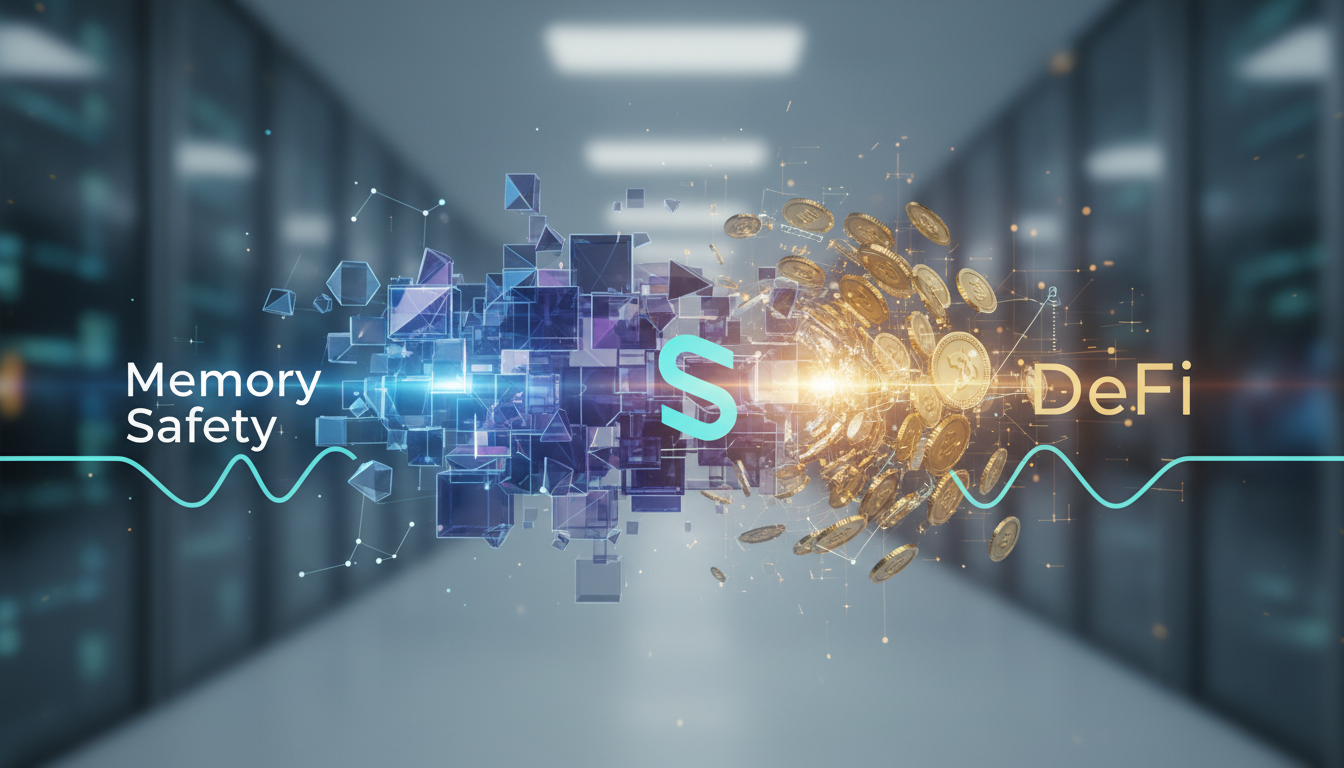
Solidity developers spend sleepless nights worrying about reentrancy attacks, integer overflows, and gas optimization. Move eliminates entire categories of these vulnerabilities by design.
Linear Type System Benefits
Move’s linear type system ensures resources can’t be duplicated or destroyed accidentally. In practical terms, this means you can’t accidentally mint infinite tokens or lose assets in smart contract bugs. Every resource has exactly one owner at any point in time.
This isn’t just theoretical safety , it’s measurable risk reduction. The majority of DeFi exploits stem from state management errors that Move’s type system prevents at compile time. No more “oops, we drained the treasury” moments.
Resource-Oriented Programming
Traditional smart contracts manipulate abstract state variables. Move programs manipulate concrete resources that behave like physical objects. You can’t copy a Move resource any more than you can photocopy a gold coin.
This model shift makes financial logic more intuitive. A lending protocol doesn’t update balance mappings , it literally moves collateral objects into escrow and mints debt tokens. The code reads like the business logic it represents.
Bytecode Verification Advantages
Move bytecode includes formal verification hints that validators can check before execution. This catches bugs that would slip through Solidity’s compiler and only surface during runtime , often catastrophically.
The verification system also enables more aggressive optimizations. Since the type system guarantees certain invariants, the runtime can skip safety checks that other VMs must perform on every operation.
Consensus Innovation: Narwhal & Bullshark Close look

Most blockchains treat consensus as a monolithic problem: agree on transaction ordering and execute sequentially. Sui’s consensus architecture separates concerns for better performance.
Data Availability Layer
Narwhal handles data availability separately from ordering. Validators can download and verify transaction data in parallel while the ordering layer (Bullshark) determines sequence. This separation prevents data bottlenecks from slowing consensus.
The architecture also improves censorship resistance. Since data availability is handled separately, it’s harder for malicious validators to selectively exclude transactions. They’d need to control both layers simultaneously.
Parallel Ordering Mechanisms
Bullshark orders transactions using a DAG-based approach rather than linear chains. Transactions that don’t conflict can be ordered in parallel branches, then merged deterministically. This eliminates the artificial serialization that limits other consensus mechanisms.
The DAG structure also provides natural checkpointing. Validators can prune old transaction data while maintaining cryptographic proofs of historical state, reducing storage requirements without sacrificing security.
Byzantine Fault Tolerance
The consensus mechanism tolerates up to one-third malicious validators , standard for BFT systems. But Sui’s object-centric model reduces the attack surface. Malicious validators can’t corrupt unrelated objects, limiting the blast radius of any compromise.
Recovery from Byzantine faults is also faster because validators only need to re-sync affected objects rather than entire global state. This compartmentalization makes the network more resilient to both attacks and operational failures.
Performance Benchmarks: Real-World Throughput Analysis

Theoretical performance means nothing if it doesn’t translate to production workloads. Let’s examine how sui blockchain performs under realistic conditions.
Transaction Throughput Metrics
Sui consistently processes over 120,000 transactions per second in controlled testing environments. More importantly, throughput scales linearly with validator count , add more validators, get proportionally more capacity.
The key insight is that throughput depends on transaction complexity and object conflicts. Simple transfers achieve maximum throughput because they rarely conflict. Complex DeFi operations that touch shared objects naturally serialize, but still outperform traditional blockchains.
“We’ve seen Sui handle 297,000 TPS in synthetic benchmarks, but real applications rarely need that level of throughput. The more important metric is consistent sub-second finality for typical DeFi operations.” , Performance analysis from independent blockchain research
Finality Time Comparisons
Transaction finality on Sui averages 380ms for non-conflicting operations. Conflicting transactions that require global ordering take roughly 2.5 seconds , still faster than most Layer 1 alternatives.
The finality model is also more predictable than probabilistic systems. Once a transaction achieves finality on Sui, it’s cryptographically final. No waiting for additional confirmations or worrying about chain reorganizations.
Gas Fee Structure Analysis
Sui’s gas model rewards efficient programming patterns. Operations on owned objects cost less than operations on shared objects, incentivizing developers to minimize state conflicts. This creates a natural economic pressure toward better scalability.
Gas fees also scale with computational complexity rather than network congestion. A simple transfer costs the same whether the network is idle or saturated, providing predictable costs for applications.
DeFi Protocol Integration Patterns
The object-centric model changes how DeFi protocols should be architected. Traditional patterns don’t always translate directly.
Liquidity Pool Implementations
AMM pools on Sui can be implemented as shared objects that multiple users can interact with simultaneously. The consensus layer handles ordering conflicts while allowing parallel access to different pools.
More sophisticated designs split pools into multiple objects , one for reserves, another for LP tokens, separate objects for fee collection. This granular approach reduces conflicts and improves throughput for high-frequency trading.
Lending Protocol Architecture
Lending protocols benefit enormously from Move’s resource model. Collateral exists as actual objects that move into protocol custody, not abstract balance updates. This makes liquidation logic more transparent and reduces smart contract risk.
The object model also enables more sophisticated collateral types. NFTs, LP tokens, and other complex assets can serve as collateral without wrapper contracts or special handling. They’re just objects with different types.
Cross-Protocol Composability
Protocol composability works differently when assets are objects rather than account balances. Flash loans become object borrows with automatic return enforcement. Yield farming strategies can operate on actual token objects rather than abstract shares.
This composability is also safer because Move’s type system prevents many common integration bugs. You can’t accidentally send the wrong token type or forget to check return values , the compiler catches these errors.
Developer Experience: Building on Sui vs Alternatives
Technical superiority means nothing if developers can’t build effectively. How does the Sui development experience compare to established alternatives?
Move Learning Curve Assessment
Developers coming from Solidity face a significant model shift. The object-oriented model and resource types require rethinking basic patterns. However, most developers report higher confidence in their code once they adapt to Move’s constraints.
The learning curve is steeper initially but pays dividends in reduced debugging time. Move’s compiler catches entire categories of bugs that would require extensive testing to find in Solidity. This shifts development time from debugging to feature implementation.
Tooling Ecosystem Maturity
Sui’s development tools lag behind Ethereum’s mature ecosystem but are rapidly improving. The Move analyzer provides excellent IDE integration, and the testing framework enables complete unit and integration testing.
The biggest gap is in deployment and monitoring tools. Ethereum has years of tooling development, while Sui developers often build custom solutions. This situation is improving as the ecosystem matures and third-party tools emerge.
Migration Considerations
Porting existing Solidity contracts to Move isn’t straightforward translation , it requires architectural rethinking. However, the performance and safety benefits often justify the effort for high-value applications.
The migration process typically involves redesigning state management around objects rather than mappings, then using Move’s safety features to simplify complex logic. The result is often cleaner, more maintainable code.
Network Economics and Tokenomics Structure
Understanding sui blockchain requires analyzing its economic incentives and how they align with long-term sustainability.
SUI Token Utility Analysis
SUI serves multiple functions: gas payments, staking rewards, and governance participation. The token design creates natural demand through network usage while providing security through staking incentives.
Gas fees are paid in SUI and burned, creating deflationary pressure during high network activity. This mechanism aligns token value with network adoption , more usage means higher token value, which attracts more validators and improves security.
Validator Economics Model
Validators earn rewards through transaction fees and staking rewards. The economic model incentivizes honest behavior while penalizing malicious actions through slashing mechanisms.
The validator set is permissionless but economically gated. Running a validator requires significant SUI stake, ensuring validators have skin in the game. This creates a natural balance between decentralization and security.
Long-term Sustainability Factors
Sui’s economic model must balance several competing pressures: keeping transaction costs low for users, providing adequate validator rewards, and maintaining token value for stakeholders.
The key insight is that Sui’s superior performance allows for lower per-transaction fees while maintaining validator profitability through higher transaction volume. This creates a virtuous cycle where better performance drives adoption, which improves economics for all participants.
Sui Blockchain: Advantages and Limitations
Advantages:
- Object-centric model eliminates many scalability bottlenecks
- Move language provides superior memory safety
- Parallel execution achieves sub-second finality
- Gas costs are predictable and scale with computation
- Strong theoretical foundations in distributed systems
Limitations:
- Steep learning curve for developers familiar with account-based models
- Limited ecosystem maturity compared to established chains
- Complex mental model may slow initial adoption
- Tooling ecosystem still developing
- Unproven performance under extreme network stress
Future Protocol Development and Roadmap
Blockchain protocols succeed through continuous evolution. Where is Sui heading, and what challenges lie ahead?
Planned Technical Improvements
The Sui roadmap focuses on three main areas: further performance optimization, enhanced developer tools, and expanded interoperability features. Performance improvements target even lower latency and higher throughput through consensus optimizations.
Developer experience improvements include better debugging tools, more complete documentation, and simplified deployment processes. The goal is reducing the barrier to entry for developers while maintaining the safety benefits of Move.
Ecosystem Growth Initiatives
Sui Foundation actively supports ecosystem development through grants, hackathons, and developer education programs. The focus is on attracting high-quality projects rather than maximizing raw numbers.
Key growth areas include DeFi infrastructure, gaming applications, and institutional tools. Each vertical has unique requirements that Sui’s architecture can address better than traditional blockchains.
Interoperability Roadmap
Cross-chain interoperability remains a key challenge for all blockchain networks. Sui is developing native bridging solutions that use its object model for safer cross-chain asset transfers.
The approach focuses on cryptographic verification rather than trusted intermediaries. This maintains Sui’s security properties while enabling smooth interaction with other blockchain networks.
Ready to explore what’s possible with object-centric blockchain architecture? The model shift from accounts to objects opens new possibilities for DeFi, gaming, and institutional applications that weren’t feasible on traditional chains.
Apply to the Genesis Cohort at digitalblockchains.com and join builders who understand that the next generation of blockchain applications requires next-generation infrastructure.