Key Takeaways
- Blockchain energy solutions enable decentralized trading and immutable tracking of electricity from source to consumption.
- The global blockchain in energy market is projected to surge from $3.1 billion in 2024 to over $90 billion by 2034.
- Peer-to-peer trading, renewable energy certificates (RECs), and carbon credit tokenization are leading applications.
- Top providers include Power Ledger, Energy Web Foundation, IBM, and the Blockchain for Energy (B4E) consortium.
- Integration with AI and IoT is driving real-time emissions monitoring and automated grid management.
- Standardization and regulatory frameworks remain key challenges for industry-wide adoption.
Blockchain energy solutions are decentralized platforms that use distributed ledger technology to record, verify, and automate energy transactions without intermediaries. They enable secure peer-to-peer energy trading, transparent tracking of renewable sources, and efficient carbon credit markets.
What Are Blockchain Energy Solutions?
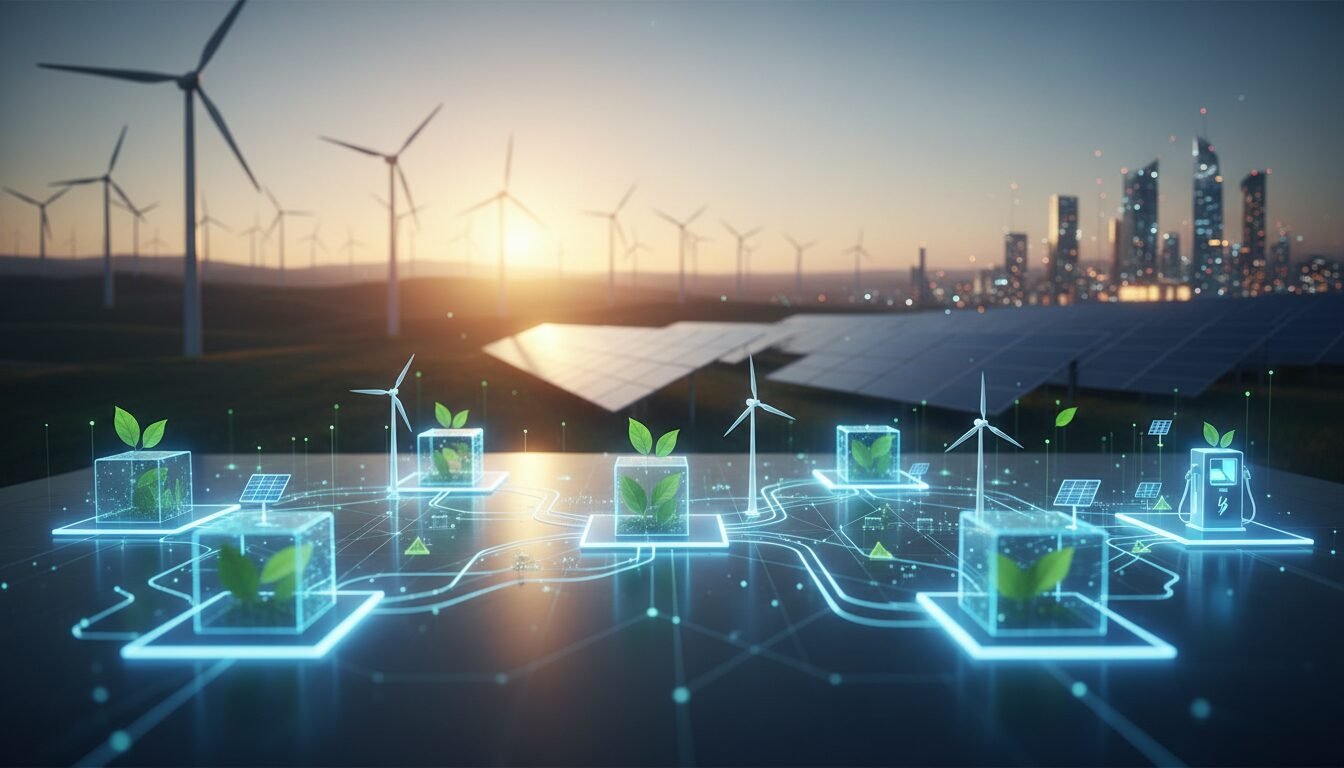
Blockchain energy solutions transform how we produce, trade, and certify electricity through immutable distributed ledgers. A blockchain is a chain of data blocks cryptographically linked, where each transaction is validated by a distributed network of nodes, making retroactive alteration virtually impossible. This technology is especially valuable in energy because it can coordinate millions of decentralized devices, solar panels, batteries, EV chargers, without a central authority.
Why the Energy Industry Needs Decentralized Systems
Traditional power grids were built for one-way flows: large plants to consumers. Today, with rooftop solar and storage, consumers become prosumers. The old infrastructure cannot efficiently handle multi-directional flows, origin tracking, or instant settlements. According to the European Commission’s Joint Research Centre (JRC) report on blockchain for the energy transition, these solutions can provide the transparency and security needed to accelerate the energy transition, reducing costs and enabling new markets for distributed energy resources.
Core Components: Distributed Ledger and Smart Contracts
A blockchain energy platform typically contains two essential elements: a distributed ledger shared across participants, and smart contracts, self-executing code that triggers actions when conditions are met. For example, a smart contract can automatically settle payment when a certain amount of electricity has been delivered, eliminating manual billing and reducing administrative costs by roughly 15–25%.
Key Applications in the Energy Sector

Peer‑to‑Peer Energy Trading
Peer‑to‑peer (P2P) trading allows solar panel owners to sell excess electricity directly to neighbors, bypassing utilities and lowering costs. Australian company Power Ledger has pioneered this model. In a pilot in Uttar Pradesh, India, P2P trading reduced electricity prices for consumers by 43% compared to retail tariffs, leading the state government to mandate P2P trading for all utilities. As of 2024, Power Ledger has facilitated over 1.67 GWh of energy trading across ten countries.
How P2P trading works on a blockchain:
- Step 1: A prosumer’s smart meter records excess generation data and sends it to the platform.
- Step 2: The data is hashed and recorded as a block on the blockchain, time‑stamped and immutable.
- Step 3: Smart contracts match buyers and sellers based on price, distance, and energy source preferences.
- Step 4: Settlement occurs automatically via cryptocurrency or tokenized fiat once delivery is confirmed.
Renewable Energy Certificates (RECs)
RECs certify that a megawatt‑hour of electricity was generated from a renewable source. Traditional REC markets are plagued by double‑counting and fraud. Blockchain tokenizes each certificate, making it unique and traceable. Platforms like Energy Web use blockchain to ensure that every REC is verifiably linked to actual production data. This eliminates the possibility of selling the same green credit twice and dramatically simplifies auditing.
Carbon Credit Trading
Carbon markets are essential for emissions reduction but suffer from opacity and high transaction costs. Blockchain energy solutions such as KlimaDAO tokenize carbon credits, making them tradeable on decentralized exchanges. The Blockchain for Energy (B4E) consortium launched B4ECarbon, a digital measurement, reporting, and verification (dMRV) platform built on Hedera. It combines IoT sensors, AI analytics, and blockchain to produce verifiable emissions claims that can be tokenized and traded, with over $50 million in projected on‑chain value creation for 2025.
Smart Grid Management and Distributed Energy Resources
As thousands of distributed energy resources (DERs), rooftop solar, batteries, EVs, connect to the grid, real‑time coordination becomes critical. These solutions can manage resources via automated smart contracts. For instance, the Combinder project uses AI agents on a blockchain‑based nano‑grid to decide when HVAC systems should run, based on real‑time energy prices and supply‑demand forecasts, improving grid stability and reducing peak loads.
Top Blockchain Energy Providers and Platforms

| Company | Founded | Key Solution | Blockchain Platform | Notable Achievement |
|---|---|---|---|---|
| Power Ledger | 2016 | P2P energy trading, REC trading (TraceX) | Solana | 43% consumer price reduction in Uttar Pradesh pilot; 1.67 GWh traded |
| Energy Web Foundation | 2019 | Decentralized REC registry, digital identity for energy assets | Energy Web Chain | Over 100 energy sector partners; reference standard for REC tokenization |
| Blockchain for Energy (B4E) | 2023 | B4ECarbon dMRV platform, emissions tracking | Hedera | $50M+ projected on‑chain value; consortium members with $1T+ collective market cap |
| IBM | 1911 | Supply chain tracking, REC management | Hyperledger Fabric | Partnering with utilities for transparent energy attribute certificates |
Power Ledger: Pioneering P2P Trading
Power Ledger’s migration from Ethereum to Solana allowed it to process over 50,000 transactions per second with minimal energy consumption. Its products, uGrid for commercial buildings, xGrid for residential, and TraceX for RECs, are deployed in Thailand, India, Austria, and France. At Chiang Mai University in Thailand, 142 buildings trade energy on its platform, achieving 30% renewable energy autonomy with 12 MW of solar and 1.2 MWh of battery storage.
Energy Web Foundation: Building a Decentralized Operating System for Energy
Energy Web develops open‑source tools for energy companies to build blockchain energy solutions. Its Energy Web Chain is an enterprise blockchain specifically designed for the energy sector, hosting over 100 applications. The platform’s digital identity protocol allows every asset, wind farm, battery, EV charger, to have a decentralized identifier (DID), enabling seamless and trusted data exchange.
Blockchain for Energy (B4E): Consortium‑Driven Emissions Transparency
B4E is a non‑profit consortium of global energy companies that collaborates on blockchain standards. Its B4ECarbon platform, built on Hedera with Hedera Guardian, integrates IoT sensors for real‑time emissions monitoring and AI for forecasting. CEO Rebecca Hofmann states that the platform is “committed to raising industry standards, eliminating greenwashing risks, and delivering trusted sustainability outcomes.”
“Blockchain technology has dramatically transformed the way we do business. The energy industry is currently facing burdensome administrative barriers, sustained lack of business innovation, and inefficient processes… Blockchain For Energy is a collaborative effort to explore this technology’s potential by leveraging learnings to drive industry adoption and promote opportunities to optimize costs, increase efficiencies, and unlock new business models.” – Rebecca Hofmann, CEO, Blockchain for Energy
IBM Blockchain for Energy
IBM uses its Hyperledger Fabric framework to help utilities trace energy attributes and manage RECs. By linking energy provenance data to a blockchain, IBM solutions improve the credibility of green claims for corporate power purchase agreements (PPAs).
Integrating AI and IoT with Blockchain for Smarter Energy Systems
Real‑Time Emissions Monitoring with IoT
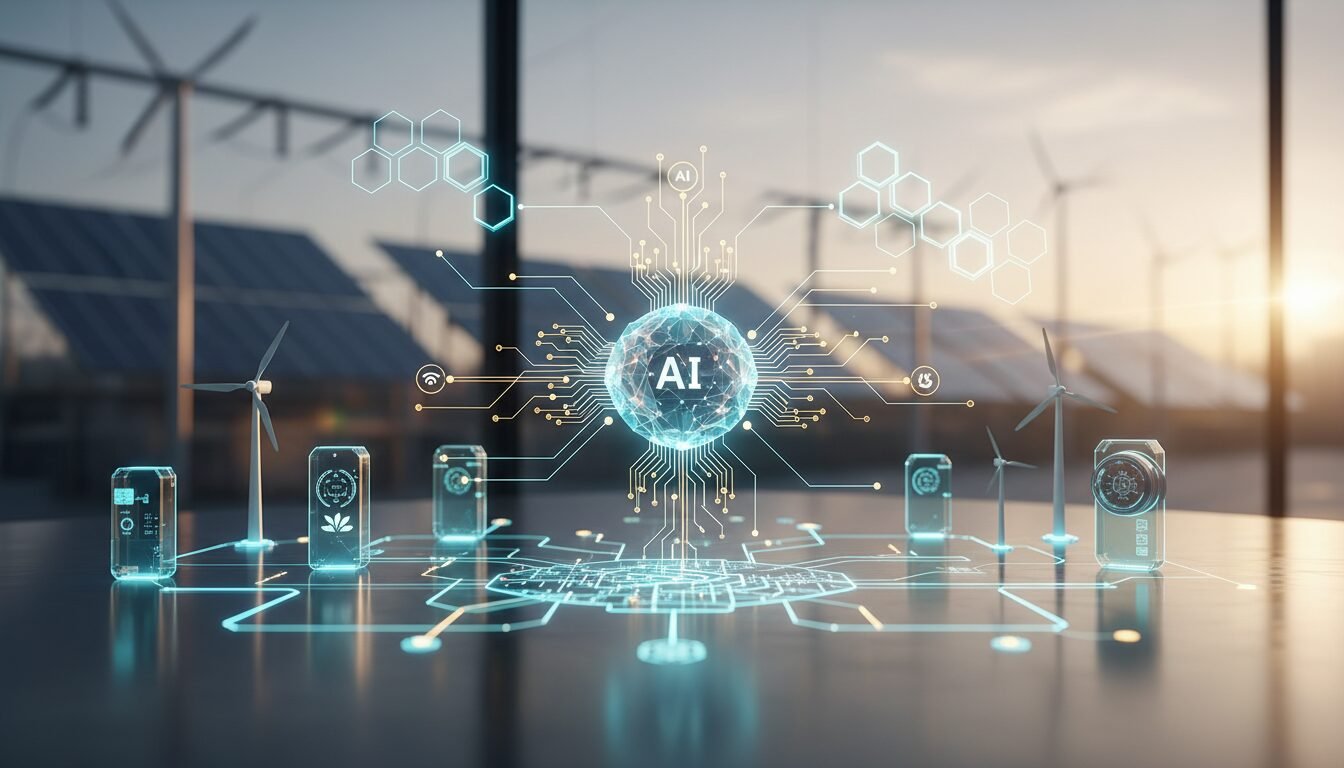
Blockchain alone cannot guarantee that the data written to it is correct. That’s where IoT sensors come in. In B4E’s B4ECarbon system, IoT devices installed at wellheads, pipelines, and refineries continuously feed operational data directly to the blockchain. AI models then forecast emissions trends and verify anomalies, creating a tamper‑proof audit trail from source to report.
AI‑Driven Microgrid Optimization
AI agents can autonomously manage distributed energy resources based on blockchain‑recorded rules. The Combinder‑peaq‑Nevermined‑Olas project uses decentralized AI agents that decide when to turn HVAC systems on or off, store excess solar power, or sell it back to the grid. The blockchain layer provides an immutable record of every action, enabling transparent billing and settlement in micro‑communities.
Consensus Mechanisms and Technical Architecture
Proof-of-Stake vs. Proof-of-Work for Energy Applications
Most blockchain energy solutions favor Proof-of-Stake (PoS) consensus over Proof-of-Work (PoW) due to energy efficiency concerns. PoS networks like Solana (used by Power Ledger) consume roughly 99.9% less energy than Bitcoin’s PoW network. For energy applications requiring high transaction throughput and low environmental impact, PoS is the clear choice. Energy Web Chain uses a modified PoS called Proof-of-Authority, where known validators process transactions, further reducing energy consumption while maintaining security.
Layer-2 Scaling Solutions
As blockchain energy solutions scale to handle millions of smart meters and IoT devices, layer-2 solutions become essential. Polygon and Arbitrum offer rollup technologies that bundle thousands of transactions into a single on-chain commitment, reducing costs and increasing speed. These scaling solutions enable blockchain energy solutions to process real-time grid data without network congestion.
Pros and Cons
Pros
- Transparency: Immutable records provide verifiable proof of energy origin and environmental attributes
- Cost Reduction: Automated settlements and eliminated intermediaries reduce transaction costs by 15-25%
- Decentralization: Enables peer-to-peer trading without utility company intermediaries
- Fraud Prevention: Cryptographic security prevents double-counting of RECs and carbon credits
- Real-time Settlement: Smart contracts enable instant payment upon energy delivery
Cons
- Scalability Limitations: Current blockchain networks struggle with millions of simultaneous transactions
- Regulatory Uncertainty: Fragmented policies across jurisdictions slow adoption
- Technical Complexity: Requires significant infrastructure upgrades and technical expertise
- Energy Consumption: Some blockchain networks (Bitcoin) consume substantial electricity themselves
- Interoperability Challenges: Different blockchain platforms don’t easily communicate with each other
Regulatory and Greenwashing Challenges
Standardizing Emissions Reporting
A major barrier to adoption is the lack of uniform standards. B4E aligns its platform with the InterWork Alliance’s standards for tokenized environmental assets. Similarly, the Hedera Guardian framework provides a policy‑driven workflow for dMRV that can adapt to different regulatory regimes. These efforts aim to replace fragmented, company‑specific reporting with a single source of truth.
“Together with Hedera, we are committed to advancing emissions reporting standards and providing transparent, verifiable data that regulators and markets can trust.” – Blockchain for Energy, in its case study
Eliminating Greenwashing Through Immutable Proof
Greenwashing occurs when companies overstate their environmental efforts. Immutable blockchain records make it possible to prove the origin of every kilowatt‑hour or carbon offset. ACCIONA Energy, a Spanish renewable leader, uses blockchain to certify the origin and storage of its renewable energy in real time, giving customers indisputable evidence of green consumption.
Benefits of Blockchain Energy Solutions
Cost Reduction and Efficiency
By removing intermediaries, automating settlements, and streamlining auditing, these solutions can lower transaction costs and speed up market operations. In Europe, the EU’s JRC study estimates that blockchain could reduce annual grid operating costs by up to 10% in distributed energy scenarios.
Enhanced Transparency and Consumer Empowerment
Blockchain gives consumers exact visibility into where their energy comes from. Retailers like ekWateur in France, through a partnership with Power Ledger, now allow customers to choose their preferred energy mix, solar, wind, or hydro, and verify it on‑chain. This level of transparency was impossible with legacy systems.
New Revenue Streams for Prosumers
Tokenization allows households to monetize not just excess electricity but also environmental attributes. A homeowner with a solar array can sell both the electricity (via P2P) and the associated RECs or carbon offsets, increasing returns on investment.
Future Outlook for Blockchain Energy Solutions
Layer‑2 Scaling and Interoperability
As blockchain networks mature, layer‑2 solutions like rollups will allow energy platforms to scale to millions of transactions per second while keeping costs near zero. Interoperability protocols (e.g., IBC, CCIP) will connect isolated energy blockchains, forming a global, transparent market for electrons and environmental assets. The market is projected to surpass $90 billion by 2034, according to Energies Media, driven by these technical advances.
Integration with EV Charging and Smart Cities
Electric vehicles are mobile batteries. Blockchain can turn EV charging into a completely automated, bidirectional value exchange: when a car charges at a public station, its digital wallet pays based on real‑time grid load and renewable availability. In smart cities, buildings, streetlights, and transport will all interact through blockchain‑enabled energy ledgers, optimizing consumption district‑wide.
Conclusion
Blockchain energy solutions are reshaping the way we generate, trade, and certify electricity. From a $3.1 billion market in 2024 to a projected $90 billion by 2034, the technology is moving from pilot projects to full‑scale commercial deployment. While challenges around regulation and scalability remain, the convergence of AI, IoT, and standards‑based blockchains is creating an infrastructure that is transparent, efficient, and fraud‑resistant. For utilities, regulators, and consumers alike, adopting these solutions today means participating in a cleaner, more resilient energy economy tomorrow.
Ready to build the next generation of energy infrastructure? Apply to the Genesis Cohort at digitalblockchains.com and join the builders creating transparent, decentralized energy markets.
Frequently Asked Questions
What is blockchain in energy?
Blockchain in energy is the application of distributed ledger technology to manage energy transactions, track renewable sources, and automate market processes without central authorities.
How does blockchain improve renewable energy trading?
It enables transparent peer‑to‑peer trades, prevents double‑counting of certificates, and automates payments, making markets faster and more trustworthy.
What are the top blockchain energy platforms?
Power Ledger, Energy Web Foundation, Blockchain for Energy (B4E), and IBM are among the leading platforms, each specializing in areas like P2P trading, RECs, and emissions tracking.
What is the biggest problem with blockchain in energy?
Scalability and regulatory fragmentation present the biggest hurdles; blockchains must handle high transaction volumes, and policies across jurisdictions are not yet aligned.
How does blockchain reduce greenwashing?
By recording every energy attribute on an immutable ledger, blockchain makes it impossible to falsify claims about renewable sourcing or carbon offsets, providing verifiable proof to consumers and regulators.
What is the future of blockchain in energy?
Greater adoption of layer‑2 scaling, AI integration, and smart city applications will make blockchain a core infrastructure for decentralized and sustainable energy systems globally.