Digital identity blockchain systems give individuals permanent control over their personal data through decentralized identifiers and verifiable credentials, removing central points of failure and enabling true self-sovereign identity.
Key Takeaways
- Over 1 billion people lack official identification, blockchain can give them portable, self-owned credentials
- Decentralized identifiers (DIDs) replace usernames and passwords with cryptographic keys you control
- Verifiable credentials let you prove age, citizenship, or employment without exposing raw data
- Zero-knowledge proofs enable privacy by sharing only the minimum needed for verification
- The identity and access management market reached $14.82 billion by 2021 as demand for secure digital ID soars
- Real deployments in banking, healthcare, and IoT are cutting verification costs by 15-25%
What Is a Digital Identity Blockchain?

A digital identity blockchain is a system where users self-manage their credentials using decentralized identifiers (DIDs) stored on a distributed ledger. Instead of relying on a single provider like a social login or government database, the identity is broken into tamper-proof, cryptographic attestations. The blockchain acts as a shared trust layer: it never holds your private data, only the proofs that link to verified claims.
The Shift from Centralized to Decentralized Identity
Traditional identity systems operate like walled gardens. A bank, a university, or a government each issues its own representation of you, forcing you to remember countless passwords and hope they protect their servers. In contrast, blockchain-based systems follow the self-sovereign identity (SSI) model: you own the keys and decide what to share, when, and with whom. Your ID wallet, not a third party, becomes the single source of truth.
Why Blockchain Fits Digital Identity
Blockchain’s immutability ensures credentials cannot be secretly altered or revoked without your consent. Its consensus-driven architecture removes the single point of failure that has led to catastrophic breaches. As Consensys notes, approximately 1.1 billion people worldwide have no legal identity, and even those who do remain vulnerable to data theft because their information sits in central honeypots.
Globally Recognized Standards
The World Wide Web Consortium (W3C) has standardized DIDs and verifiable credentials, enabling any compliant blockchain to interoperate. This means a credential issued on one platform can be verified anywhere, much like a passport is trusted across borders. Real-world initiatives, such as the World Economic Forum’s Digital ID Initiative, are actively aligning policies to make this global vision a reality.
The Growing Crisis of Centralized Identity

Before these systems become the norm, understanding the scale of the current crisis is essential. The flaws in today’s infrastructure affect individuals, companies, and the rapidly expanding Internet of Things.
For Individuals: Fragmentation and Theft
The average consumer juggles 90+ online accounts, each requiring a username and password. These credentials sit on corporate servers that are breached with alarming regularity, over 2.6 billion records were leaked in 2023 alone. Once a Social Security number or biometric template is stolen, replacing it is nearly impossible. According to the World Bank, about 850 million people still have no official ID, locking them out of banking, voting, and employment.
For Companies: Regulatory Risk and Customer Friction
Businesses collect mountains of personal data to verify customers, but each new database creates liability. Stricter privacy laws like GDPR penalize mishandling of personal data, yet the siloed architectures make it hard to delete or update records consistently. This causes attribute drift, where different systems hold conflicting information about the same user, while also inflating operational costs.
For IoT: Identity at Unprecedented Scale
There are already 7 billion internet-connected devices, a number expected to surge to 22 billion by 2025. Most lack robust identity frameworks, making them easy targets for botnets and spoofing attacks. A centralized server cannot securely manage authentication for a fleet that large and diverse; only a lightweight, decentralized identity layer can provide device-to-device trust without creating a single honeypot.
Core Technologies: DIDs, VCs, and Decentralized Wallets

These systems are not monoliths; they are stacks of standards-based tools. Understanding these building blocks clarifies how the system achieves both security and usability.
Decentralized Identifiers (DIDs)
A DID is a globally unique identifier that looks like did:ethr:0x1234.... It is created and controlled entirely by the owner, without any central registrar. The DID document, stored on the blockchain, contains public keys and service endpoints. Only the owner’s private key can update the document, ensuring that no third party can revoke or hijack the identifier.
Verifiable Credentials (VCs)
VCs are equivalents of physical credentials, a driver’s license, a diploma, or a work permit, that derive trust from cryptographic signatures. An issuer (e.g., a university) signs a claim about a holder (e.g., “has a bachelor’s degree”). The holder stores the VC in their wallet and can present it to a verifier who checks the issuer’s public key on the blockchain. Because the blockchain confirms the issuer’s key in real time, the verifier never needs to contact the issuer directly.
Decentralized Identity Wallets
Wallets like the Dock Wallet or Microsoft’s ION-based solutions hold your DIDs and VCs. They are privacy-centric by design: you choose which credential to present, and zero-knowledge proofs can even prove facts (e.g., “I am over 18”) without revealing your exact birth date. The wallet interacts with smart contracts to establish trust, but your raw personal information never leaves the wallet’s secure enclave.
How Digital Identity Verification Works in 3 Steps
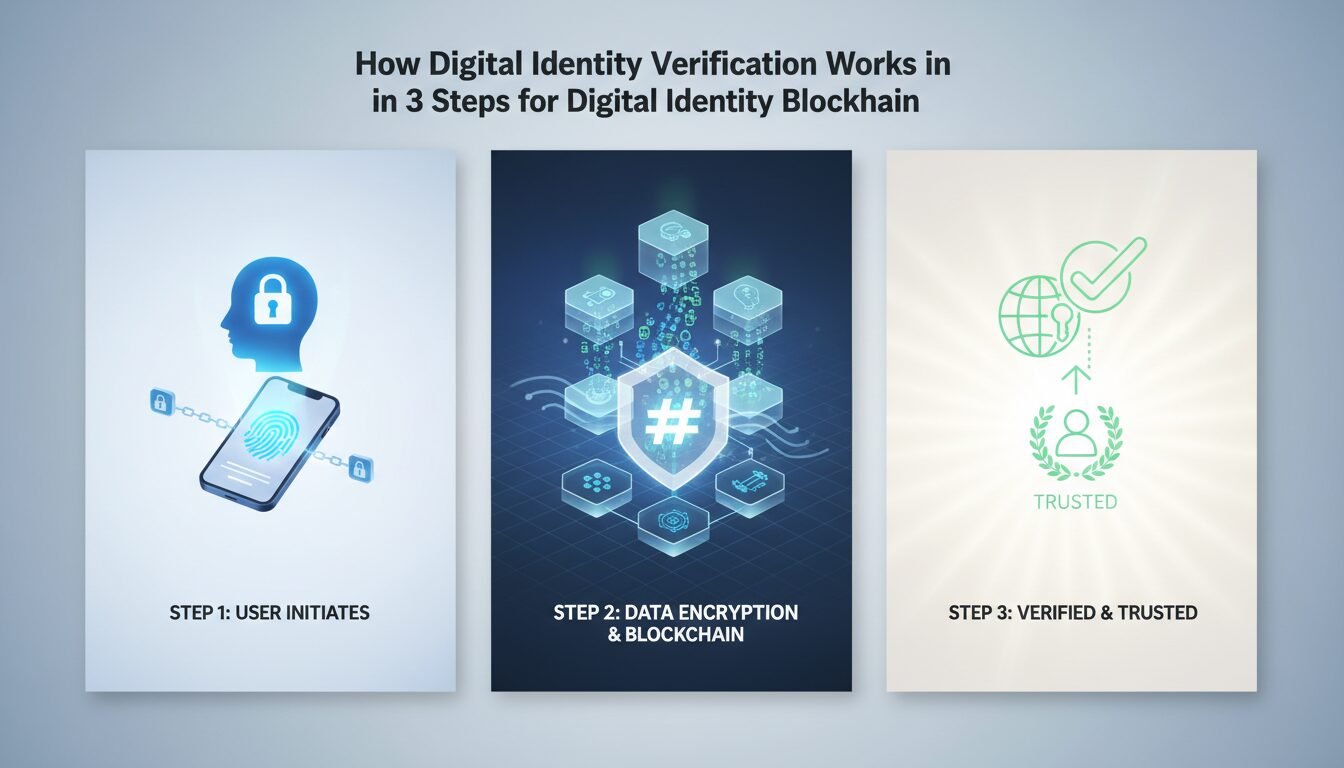
The flow of a typical identity verification looks radically different from the username-password model. Here is the step-by-step sequence.
Step 1: Create Your DID and Anchor It On-Chain
You install a compatible identity wallet and generate a key pair. The wallet registers a new DID on a supported blockchain (Ethereum, Polygon, or a dedicated identity ledger like Hyperledger Indy). This transaction costs a small gas fee and creates an immutable public record that now belongs exclusively to you.
Step 2: Request and Store Verifiable Credentials
You ask a trusted issuer, a bank, government, or employer, to issue a VC to your DID. The issuer signs the credential with their own DID, which is already known on the blockchain. You accept the credential and store it encrypted in your wallet. No third party holds a copy of the raw data; only the issuer’s attestation and your consent make it usable.
Step 3: Share a Proof on Demand
When a service asks for proof (e.g., “verify you are a resident of California”), your wallet generates a zero-knowledge proof or a selective-disclosure presentation. This proof is sent to the verifier, who checks it against the public keys on the blockchain. The process takes milliseconds and reveals nothing beyond the specific fact requested. No password, no centralized login, and no database to breach.
Real-World Applications Across Industries
Across finance, healthcare, supply chain, and civic systems, projects are already live, reducing costs by 15–25% and slashing authentication fraud.
Financial Services and KYC
Banks spend billions on Know Your Customer (KYC) reviews. With a reusable KYC credential stored on a blockchain, a client can pass onboarding once and reuse that verified identity across multiple institutions. The NEC-built system for a major Asian bank cut onboarding time from days to minutes while meeting stringent anti-money-laundering rules.
Healthcare and Credential Verification
During the COVID-19 pandemic, vaccine passports demonstrated the value of a tamper-proof credential. A blockchain-based health ID lets you prove vaccination status or medical license without exposing your full medical history. The Dock network, for instance, enables clinics to issue verifiable health credentials that patients carry in a mobile wallet, eliminating fake certificate proliferation.
IoT and Machine Identity
By 2025, 22 billion connected devices will need to authenticate to gateways, cloud services, and each other. These systems assign each sensor or actuator a DID, enabling automated, cryptographically secure onboarding. This reduces botnet-fueled DDoS attacks and allows manufacturers to revoke compromised device credentials without recalling hardware, a unique angle that traditional PKI cannot achieve at this scale.
E-Government and Voting
Estonia’s e-Residency program is a pioneer, but newer pilots in Zug, Switzerland, and Seoul, South Korea, use blockchain-anchored IDs for tax filing, resident permits, and online voting. Voters receive a unique DID that casts an anonymous ballot, while the blockchain provides a transparent, auditable count. This dual-channel approach preserves privacy and election integrity simultaneously.
Traditional vs. Blockchain Identity: A Side-by-Side Comparison
The table below summarizes the fundamental differences between conventional identity management and a privacy-first blockchain approach.
| Feature | Traditional Identity | Digital Identity Blockchain |
|---|---|---|
| Data Control | Central service provider owns and stores data | User owns keys; data stays in wallet |
| Breach Impact | Single hack exposes millions of records | Only disclosure of one proof; no mass leak possible |
| Interoperability | Fragmented , each app creates a new identity | Universal , one DID works across services |
| Verification Cost | High , manual reviews and third-party checks | Low , cryptographic verification in milliseconds |
| Privacy | Full data typically shared with verifier | Selective disclosure or zero-knowledge proofs |
| Revocation | Slow , issuer must notify all parties | Instant , update DID document on-chain |
Pros and Cons
Pros
- User sovereignty: You control your data and decide what to share
- Reduced breach risk: No central honeypot for attackers to target
- Global interoperability: One identity works across compliant services
- Cost efficiency: Cryptographic verification is faster and cheaper than manual processes
- Privacy preservation: Zero-knowledge proofs share only necessary information
Cons
- Key management burden: Losing your private key means losing access to credentials
- Technical complexity: Requires understanding of wallets, DIDs, and cryptographic concepts
- Limited adoption: Few services currently accept blockchain-based credentials
- Regulatory uncertainty: Legal frameworks are still evolving in many jurisdictions
- Energy consumption: Some blockchain networks have high environmental costs
The Future: Privacy, IoT, and Beyond
The annual growth of the identity and access management market, from $8.09 billion in 2016 to $14.82 billion by 2021 at a 12.9% CAGR, signals an industry hungry for innovation. As these systems mature, three trends will define their trajectory.
Zero-Knowledge Rollups for Scalability and Confidentiality
Public blockchains like Ethereum face throughput limits, but layer-2 ZK-rollups bundle thousands of identity proofs into a single on-chain transaction. This drives verification cost below $0.001 while keeping the underlying data fully private. Several enterprise-grade SSI platforms are already migrating to ZK-rollup infrastructure, making high-volume use cases like transit ticketing or event access economically viable.
Biometric-Bound Credentials
To prevent wallet theft, next-generation wallets bind a credential to a biometric template stored only on the device’s secure enclave. When you present a credential, the wallet first verifies your fingerprint or face locally, then releases the proof. This ensures that even if the wallet file is copied, it is useless without the live biometric that never leaves the device.
Autonomous IoT Identity Threads
As smart cities deploy millions of sensors, these systems will run lightweight identity threads directly on devices via edge-compute nodes. A temperature sensor can issue a verifiable data stream, and an actuator can request it only after mutual DID authentication. This machine-to-machine micro-economy creates a self-auditing, tamper-proof data trail that slashes reconciliation costs for water, power, and traffic systems.
The road ahead demands cooperation between standards bodies, governments, and technology providers. But the tools exist today to give every person and every device a portable, verifiable, and privacy-preserving identity. This is not just incremental, it is the foundational trust layer for Web3.
Ready to build the future of identity? Apply to the Genesis Cohort at Digital Blockchains and help create the infrastructure that puts users back in control of their data.
Frequently Asked Questions
What is digital identity in blockchain?
Digital identity in blockchain refers to a user-owned, decentralized representation of personal credentials that uses DIDs and verifiable credentials to prove who you are without relying on a central authority or exposing unnecessary data.
How does a digital identity blockchain differ from a traditional login?
Traditional logins check a password against a central database. A blockchain-based system verifies a cryptographic proof that you control a specific DID, eliminating stored passwords and making mass data breaches irrelevant.
What is an example of a digital identity blockchain project?
Real-world examples include the Dock network for reusable KYC credentials, NEC’s self-sovereign identity system for banking, and the Zug (Switzerland) blockchain ID for e-government services.
Are digital identity blockchains safe from hackers?
While no system is 100% immune, these systems remove the central honeypot. Attackers would need to compromise each user’s private key individually, a far more difficult and less rewarding endeavor than breaching a single database.
Can I use my blockchain ID on different websites?
Yes. Because the system follows W3C standards (DIDs and VCs), a single ID wallet can authenticate with any service that accepts those standards, much like using the same passport at different airports.
What role does zero-knowledge proof play in digital identity blockchain?
Zero-knowledge proofs let you prove a statement, such as being over 18, without revealing your actual birth date or any other attribute. This minimizes data leakage while still satisfying the verifier’s requirements.