Base blockchain is Coinbase’s Ethereum Layer-2 scaling network built on the OP Stack, offering sub-second transactions at fractions of a cent for global finance, trading, and payments.
Key Takeaways
- blockchain delivers sub-second finality with gas costs below $0.01, making it practical for high-frequency trading and micropayments.
- Built as an Optimistic Rollup on the OP Stack, it inherits Ethereum’s security while processing transactions at a fraction of L1 cost.
- As of mid-2026, Base sustains over 75 transactions per second and has recorded more than 6.86 billion total transactions, per Basescan data.
- The Base App lets users earn up to 3.35% APY on USDC, trade millions of assets, and access onchain social features across 170+ countries.
- Builder Codes (ERC-8021) let developers prove app impact onchain and earn protocol-level revenue, a model no other major L2 currently offers.
- Base does not have a native token. ETH covers gas fees, and there are no current plans for a separate governance token.
What Is Base Blockchain?
The Vision Behind Base
this type of blockchain is an Ethereum Layer-2 scaling solution created by Coinbase, the largest publicly traded crypto exchange in the United States. Launched in 2023, its mission is to bring the next billion users on-chain by providing a fast, low-cost, and secure environment for decentralized applications. Built on the open-source OP Stack, it combines Ethereum’s security with the scalability of optimistic rollups, enabling sub-second transactions at fractions of a cent.
Unlike many L2s that operate as isolated networks, Base positions itself as a bridge, not an island. It connects deeply with Ethereum and other OP Stack chains inside the Superchain ecosystem. According to Base.org, the network is trusted by over 1,000 businesses and serves as infrastructure for global finance, trading, and payments.
How Base Works as a Layer-2
this kind of blockchain uses optimistic rollup technology to batch transactions off-chain and post compressed data to Ethereum mainnet. This approach cuts fees by 10x to 100x compared to Ethereum Layer-1, while the network still benefits from Ethereum’s decentralization and security. A fraud-proof system lets anyone challenge invalid state transitions. With the Base Azul upgrade (April 2026), the network pushed further on performance, security, and developer tooling.
The Technology Powering Base

Optimism’s OP Stack and the Superchain
Base is built on the OP Stack, a modular framework developed by OP Labs for constructing L2 rollup chains. The stack standardizes key components: the execution engine, data availability layer, and cross-chain messaging protocol. Base is a core member of the Superchain, a network of interoperable L2s sharing security, governance, and liquidity. As of 2026, the Superchain includes Optimism, Base, Zora, and several other chains, enabling smooth asset movement and unified user experiences across all of them.
Base Azul and Performance Upgrades
On April 22, 2026, Base introduced Azul, a major protocol upgrade that improves block finality, reduces state bloat, and accelerates smart contract execution. According to the Base blog, Azul makes the network “more secure, more performant, and easier to build on.” This update also prepares the ground for fault proofs and decentralized sequencing, both central to the network’s long-term decentralization roadmap.
Key Features and Capabilities of Base Blockchain

Sub-Second, Low-Cost Transactions
One of the base’s defining features is raw transaction speed paired with minimal cost. Blocks are produced every 2 seconds, and gas fees typically stay below 0.005 Gwei, which translates to fractions of a cent per transaction. According to Basescan, the network sustained over 75 transactions per second in mid-2026, with occasional spikes above 100 TPS. That throughput makes Base practical for high-frequency trading, gaming, and micropayments where Ethereum L1 costs would be prohibitive.
Security and Ethereum Alignment
Base inherits Ethereum’s battle-tested security model through its rollup architecture. All state data is anchored on Ethereum L1, so even in a worst-case failure, users can withdraw funds via the rollup bridge. Coinbase’s security infrastructure extends to Base, including proactive monitoring and a bug bounty program. Full EVM equivalence means developers deploy existing Solidity contracts without modification, which dramatically lowers the barrier to migration from mainnet or other EVM chains.
“Base is designed to be the onchain home for Coinbase products and an open ecosystem where anyone can build. We want to make onchain the new online.” – Base team, Base.org
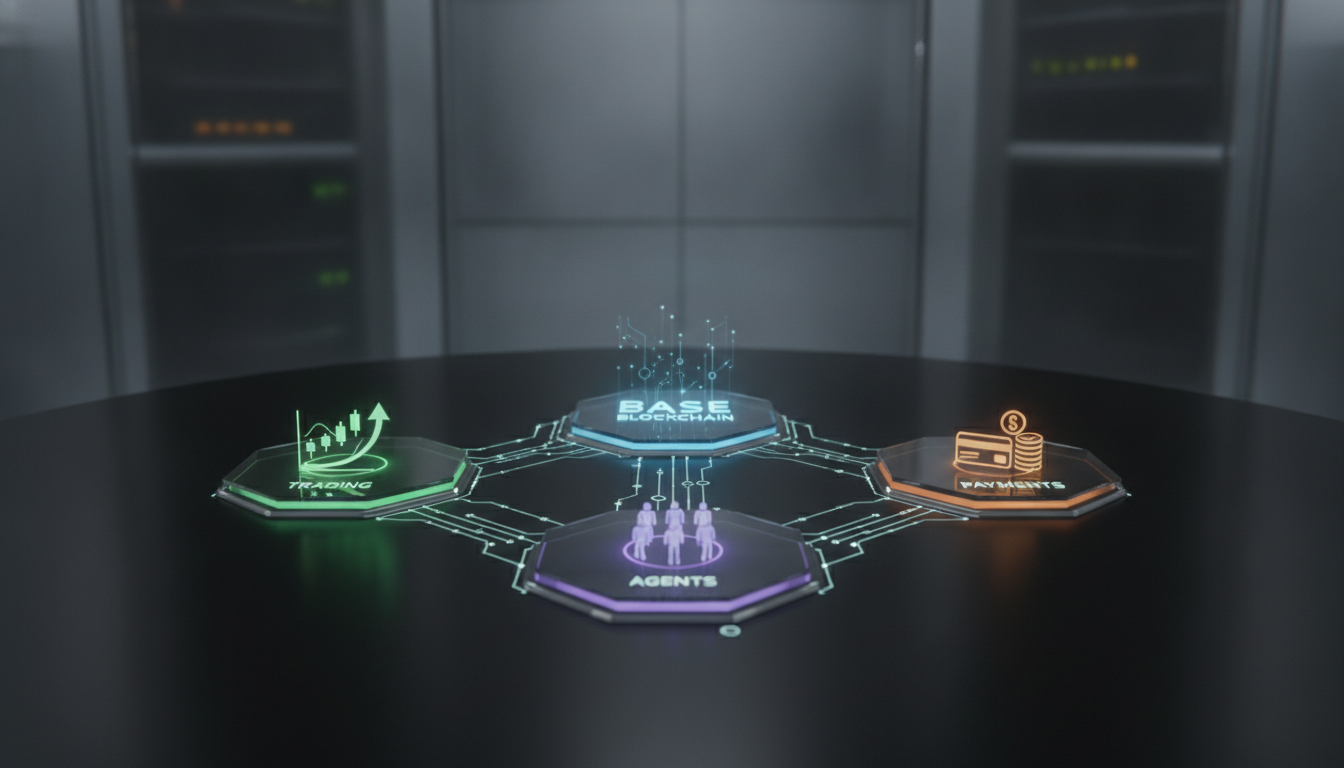
Base Blockchain Ecosystem: Trading, Payments, and Agents
Trading and DeFi on Base
Base has become a serious hub for onchain trading and decentralized finance. Deep liquidity and low fees attract both retail and institutional traders. The Base App lets users trade millions of assets, follow top traders, and surface trending tokens through a social feed where posts carry tradeable value. Leading DeFi protocols including Uniswap, Aave, and Compound have all deployed on the base blockchain, contributing to its growing total value locked. Aerodrome Finance has also emerged as a native DEX with significant liquidity depth on Base specifically.
Global Payments and Stablecoins
Base positions itself as a global payment rail. Instant settlement and near-zero fees make it practical for cross-border remittances and merchant payments. The Coinbase One Card, secured by USDC, uses Base to enable crypto spending with Bitcoin rewards, including 5% Bitcoin back on travel purchases. Users can also send USDC for free inside the Base App’s encrypted messaging, making peer-to-peer payments as frictionless as a text message.
AI Agents and Autonomous Finance
Base MCP (Model Context Protocol) lets developers give AI agents wallets, enabling them to transact autonomously on-chain. Agents can monetize services, fund wallets, and operate within defined spend guardrails. Builder Codes (ERC-8021), introduced on April 15, 2026, let applications prove their transaction impact on-chain and receive protocol-level rewards. This creates a self-sustaining ecosystem of agentic payments that no other major L2 has prioritized at the protocol level.
“Agentic finance is the next frontier. When AI agents can hold wallets, execute trades, and settle payments autonomously, the distinction between software and financial infrastructure collapses.” – Amin Ferdowsi, Digital Blockchains
Base Blockchain Explorer: Basescan Metrics
Real-Time Network Statistics
Basescan, the official block explorer for Base, provides full transparency into network health. As of our data snapshot on July 2, 2026, the explorer reported an ETH price of $1,608.67, gas at 0.005 Gwei, the latest block at 48,080,567, and total transactions at 6.86 billion. Average block time held at exactly 2 seconds, with each block containing hundreds of transactions. This on-chain data confirms the base blockchain’s sustained throughput and cost efficiency at scale.
Tracking Transactions and Blocks
Basescan offers tooling comparable to Etherscan: address lookups, token tracking, internal contract interactions, and L1-to-L2 cross-chain transaction tracing. It also supports EIP-7702 authorizations and verified contract inspection. Developers rely on Basescan’s API for analytics and application monitoring, making it an essential resource for anyone building in the base blockchain ecosystem. If you want a deeper look at how block explorers work across chains, our guide on reading blockchain explorers covers the fundamentals.
Base App: The Everything Onchain Wallet
Trade and Earn with the Base App
The Base App has evolved into a comprehensive onchain super-app. With over 10 million downloads and a 4.1-star rating on Google Play, it supports trading of Bitcoin, Ethereum, Solana, and all Ethereum-compatible assets. Users earn up to 3.35% APY by holding USDC, access DeFi protocols directly, and discover trending assets through a social feed. The app is available in 20 languages across 170+ countries, making it one of the most globally accessible self-custody wallets available today.
Secure Self-Custody and Messaging
Security is non-negotiable here. The Base App is a non-custodial wallet, meaning users control their own keys. It includes cloud backups, passkey support, and phishing protection baked in. End-to-end encrypted messaging lets users chat and send USDC globally at zero cost. AI agent integration enables automated portfolio management directly from the chat interface, blurring the line between a messaging app and a financial terminal.
Comparing Base to Other Layer-2 Blockchains
To understand where the base blockchain stands in the L2 landscape, the table below highlights key differences against Arbitrum One and Optimism.
| Feature | Base Blockchain | Arbitrum One | Optimism |
|---|---|---|---|
| Technology | OP Stack (Optimistic Rollup) | Arbitrum Nitro | OP Stack (Optimistic Rollup) |
| Block Time | 2 seconds | ~0.25 seconds (sub-block) | 2 seconds |
| Gas Model | EIP-1559, low fees | L2 fee + L1 calldata | EIP-1559, low fees |
| Sustained TPS | 75+ observed | Varies (high throughput) | Varies |
| Security Model | Fraud proofs (in progress), Ethereum L1 | Fraud proofs, Ethereum L1 | Fraud proofs, Ethereum L1 |
| Ecosystem Focus | Global finance, trading, agents | DeFi, general purpose | Public goods, governance |
| Developer Incentives | Builder Codes and ERC-8021 | Arbitrum Foundation Grants | RetroPGF |
Base differentiates itself through tight integration with Coinbase’s consumer platform and a clear focus on agentic finance. Neither Arbitrum nor Optimism has made autonomous agent infrastructure a primary protocol-level priority.
Pros and Cons of Base Blockchain
Pros
- Extremely low fees: Gas stays below 0.005 Gwei, making micropayments and high-frequency transactions economically viable.
- Full EVM equivalence: Any Solidity contract deploys on Base without modification, reducing migration friction to near zero.
- Coinbase distribution: Direct integration with the largest US crypto exchange gives Base immediate access to a massive retail and institutional user base.
- Superchain interoperability: Shared security and liquidity with Optimism, Zora, and other OP Stack chains reduces fragmentation.
- Agentic finance infrastructure: Base MCP and ERC-8021 Builder Codes are purpose-built for the AI agent economy, ahead of competing L2s.
Cons
- Centralized sequencer: Coinbase currently operates the sole sequencer, creating a single point of failure and censorship risk until decentralization ships.
- No native token: The absence of a governance token limits direct community ownership and on-chain governance participation compared to Arbitrum (ARB) or Optimism (OP).
- Fraud proofs still in progress: Full fault-proof decentralization is on the roadmap but not yet live, meaning the security model is not yet fully trustless.
- Optimistic rollup withdrawal delay: Standard withdrawals to Ethereum L1 take up to 7 days without using a third-party bridge, which is a friction point for users moving large amounts.
How to Get Started with Base Blockchain
Step 1: Set Up a Base-Compatible Wallet
To interact with the base blockchain, you need a compatible wallet. The official Base App is the most direct option, offering a self-custody experience out of the box. Alternatively, MetaMask and Rabby can be configured by adding the Base network RPC with chain ID 8453. Once set up, fund the wallet with ETH for gas and any tokens you plan to use.
Step 2: Bridge Assets to Base
Acquire ETH on Ethereum mainnet or another supported chain. Then use the official Base Bridge at bridge.base.org or a third-party bridge like Hop or Across to transfer assets. Funds typically appear within minutes. Always verify smart contract addresses through Basescan before interacting with any protocol to avoid phishing contracts.
Step 3: Connect to Base dApps
With a funded wallet on Base, connect to dApps like Aerodrome for decentralized trading, Aave for lending, or the Base App’s built-in DeFi interface. For developers, the Base developer documentation covers contract deployment, RPC endpoints, and the Base Ecosystem Fund for grant applications. If you’re thinking about deploying your own protocol or token on Base, our overview of smart contract architecture is a useful starting point.
Does Base Blockchain Have Mining?
Base does not support traditional proof-of-work mining. As a Layer-2 rollup, it relies on a sequencer (currently operated by Coinbase) to order and batch transactions, not on miners competing to produce blocks. There is no block reward, no mining hardware requirement, and no proof-of-work consensus at the Base layer. The underlying security comes from Ethereum’s proof-of-stake validators, not from Base-specific mining. Coinbase has committed to transitioning the sequencer to a decentralized model over time, but that process is ongoing as of 2026.
Frequently Asked Questions
What is the base blockchain?
Base blockchain is a Layer-2 Ethereum scaling network developed by Coinbase, built on the OP Stack. It is designed for fast, low-cost transactions and global financial applications, processing over 75 TPS with gas fees below 0.005 Gwei as of mid-2026.
How does base blockchain reduce transaction fees?
It batches multiple transactions off-chain, compresses the data, and posts it to Ethereum L1 as a single proof. This offloads computation and state storage from mainnet, reducing gas costs to fractions of a cent compared to Ethereum L1 fees.
Is there a base blockchain token?
As of 2026, Base does not have a native token. ETH is used for gas fees, and there are no current plans for a separate governance token. Individual ecosystem projects deployed on Base may have their own tokens.
How fast is the base blockchain?
Blocks are produced every 2 seconds, and transactions achieve sub-second pre-confirmations. The network consistently handles over 75 transactions per second, with the Azul upgrade (April 2026) pushing further performance and scalability improvements.
What wallets support base blockchain?
Base is supported by the Base App, MetaMask, Coinbase Wallet, Rabby, and most EVM-compatible wallets. Add the Base network using chain ID 8453 and the public RPC endpoint to get started immediately.
Can I build on base blockchain?
Yes. Any Solidity developer can deploy smart contracts on Base without code changes, thanks to full EVM equivalence. Base offers detailed documentation, RPC infrastructure, and grants through the Base Ecosystem Fund for qualifying projects.
Can I mine base blockchain?
No. Base is a Layer-2 rollup and does not support proof-of-work mining. Transaction ordering is handled by a sequencer operated by Coinbase, with a planned transition to decentralized sequencing. Security derives from Ethereum’s proof-of-stake consensus, not from Base-level mining.