Key Takeaways
- Blockchain courses teach distributed ledger technology, smart contracts, and decentralized systems, opening doors to Web3 and fintech careers.
- Over 200,000 learners have upskilled through platforms like Cyfrin Updraft and Coursera; many courses cost under $100.
- Top certifications from MIT Professional Education, eCornell, and university partners offer CEUs and industry-recognized credentials.
- Free blockchain courses, including Microsoft’s 20-episode series and YouTube lectures by Prof. Gary Gensler, provide solid entry points with zero cost.
- Hands-on labs with Ethereum testnets, wallet setup, and smart contract deployment are critical for practical mastery.
- Enterprise-focused tracks covering Hyperledger Fabric and Corda are increasingly relevant as production deployments scale in 2026.
A blockchain course is a structured educational program that teaches distributed ledger technology, cryptocurrencies, smart contracts, and decentralized systems, equipping learners with the technical and theoretical knowledge to pursue careers in Web3, finance, and tech.
Whether you’re a developer eyeing a transition into smart contract engineering or a business leader assessing enterprise adoption, the right program can demystify concepts like consensus, gas, and tokenization. According to Deloitte’s Global Blockchain Survey, 77% of executives agree they will lose competitive advantage without blockchain adoption, and 53% of C-suite professionals identified it as critical infrastructure by 2020. That urgency has fueled an explosion of online and in-person learning options. This guide compares the best course offerings for 2026, from free YouTube playlists to university-backed certifications, so you can choose the path that fits your career goals.
“Join us on this journey to redefine the business world.” – Dr. Abel Sanchez, Research Scientist, MIT Professional Education
What is a Blockchain Course?

A this type of course is a targeted educational experience, ranging from a 1-hour primer to a 6-month specialization, that covers the architecture, cryptography, and application layers of blockchain networks. Most courses are delivered online through dedicated platforms like Cyfrin Updraft, Coursera, or Udemy, though universities such as MIT and Cornell offer professional certificate programs. The core objective is to move learners from abstract awareness to functional competence: able to explain proof-of-stake, send an Ethereum transaction, or evaluate a DeFi protocol.
Definition and Scope
A this kind of course is not merely a series of videos about Bitcoin. It is a scaffolded curriculum that builds from cryptographic primitives, including hashing and digital signatures, through network theory covering nodes and consensus, to application design spanning smart contracts and dApps. The best programs include hands-on labs where you configure a wallet, interact with testnet tokens, and deploy a simple contract. Microsoft’s Beginner Series to Blockchain, for instance, comprises 20 episodes that walk through everything from Byzantine Generals to Solidity coding with the Truffle Suite.
Who Should Enroll?
Modern blockchain options are tailored to distinct audiences. Technical professionals seeking to move into smart contract development should look for Solidity and Remix IDE exercises. Business executives and product managers benefit from programs that emphasize strategic impact and use-case analysis. MIT Professional Education’s course, for example, targets CTOs, CIOs, and functional managers directly. Even complete beginners are covered: Udemy’s “The Complete Course On Understanding Blockchain Technology“ requires no prerequisites and has enrolled over 47,000 students. Developers, entrepreneurs, and finance professionals all find distinct pathways designed to accelerate their specific learning curves.
Formats and Delivery
Online delivery dominates, spanning self-paced video lectures, live cohort-based workshops, and interactive coding environments. Cyfrin Updraft’s Blockchain Basics packs 6 hours of content into 58 lessons with full transcripts and a Discord community. eCornell’s Blockchain Essentials certificate runs as a 2-month, instructor-paced program requiring 3-5 hours of weekly study. Self-paced MOOCs like the University at Buffalo’s Blockchain Basics specialization on Coursera allow flexible completion over 3-6 months. Regardless of format, a quality program emphasizes active learning: setting up wallets, sending testnet transactions, and writing code to cement understanding.
Why Enroll in a Blockchain Course in 2026?

The demand for blockchain talent has never been higher. Deloitte’s survey data shows 60% of CIOs planned blockchain integration by the end of 2020, and that momentum has only accelerated. In 2026, industries from supply chain to central banking are deploying production-grade networks. An up-to-date course equips you with the practical and strategic knowledge to contribute meaningfully to these deployments.
Accelerate Your Career Transition
Cyfrin Updraft alone has helped over 200,000 students launch or advance Web3 careers; many alumni now work as engineers, auditors, or product managers. A targeted program can shave months off the self-teaching curve by providing curated, sequential learning with verified assessments. Learner ratings reflect that value: the University at Buffalo’s Blockchain Basics specialization holds a 4.6-star rating from over 7,800 reviews, while the University of Michigan’s Blockchain and Cryptocurrency Explained earns 4.7 stars from nearly 1,000 reviews. Completing a certificate also signals commitment to recruiters who increasingly filter for blockchain literacy.
Stay Ahead of Enterprise Adoption
Boardrooms are allocating serious budget to proofs-of-concept. The 77% executive figure from Deloitte signals urgency that has not faded. A this type of course that covers enterprise frameworks, including Hyperledger Fabric, Corda, and enterprise Ethereum, prepares you to lead pilots in identity management, trade finance, and tokenized real-world assets. eCornell’s certificate, for example, culminates in a blockchain application proposal tailored to your own organization, directly bridging learning to business impact.
Build a Foundation for Specialization
Beyond broad introductory offerings, many platforms provide advanced tracks. Cyfrin Updraft’s ecosystem extends into Solidity smart contract development, Foundry, and security auditing. Coursera hosts a Decentralized Finance specialization from Duke University with a 4.8-star rating and over 2,100 reviews. Starting with a foundational this kind of course ensures you grasp consensus mechanisms, transaction lifecycle, and wallet security before moving into niche domains like account abstraction via EIP-4337 or ZK-rollups.
What You’ll Learn in a Typical Blockchain Program
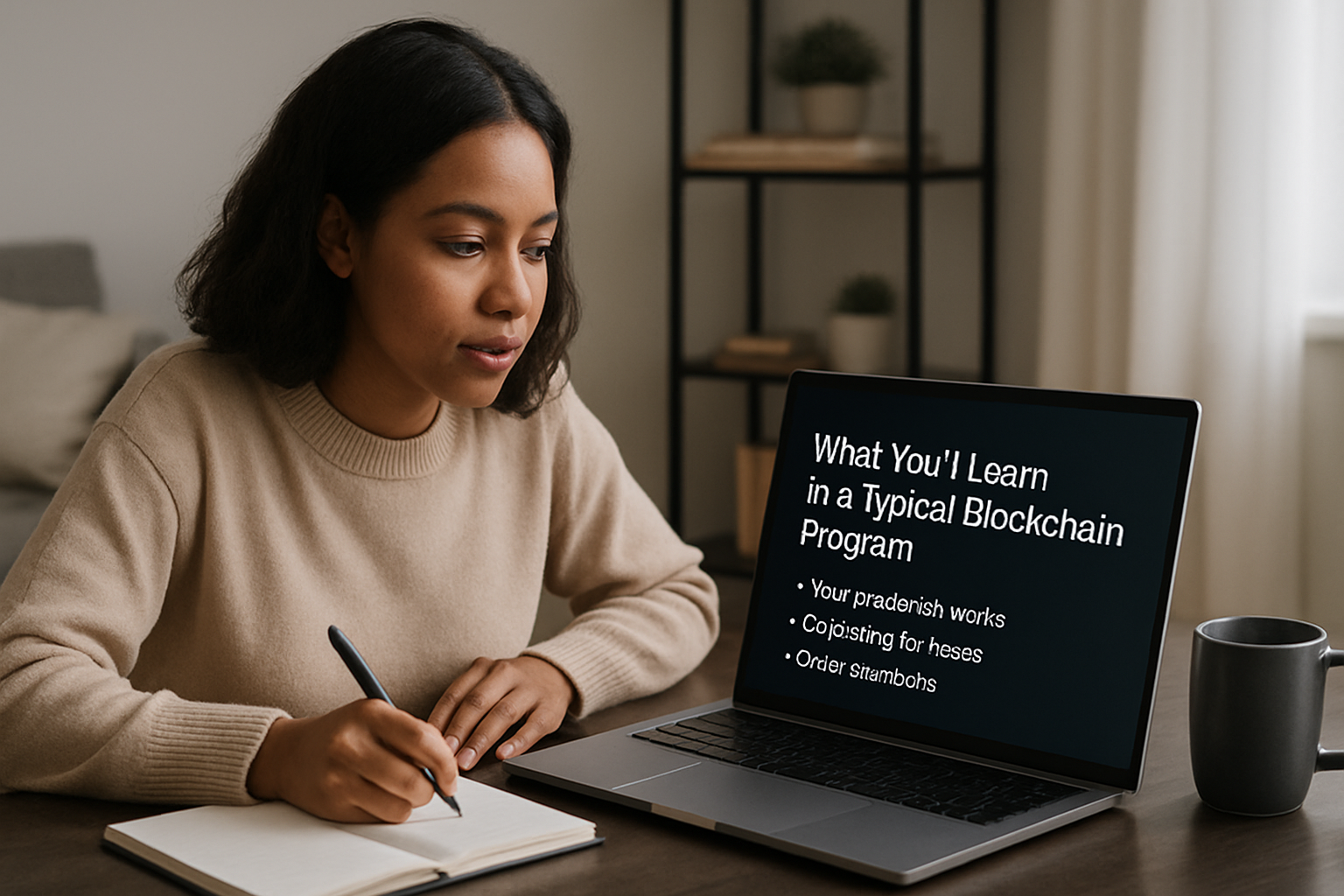
While outlines vary, most comprehensive blockchain syllabi follow a logical progression from cryptography through network operation to application development. Understanding these modules helps you compare offerings and spot gaps before you commit.
Core Technical Modules
- Historical context and decentralization: Why blockchain emerged and the limits of centralized systems.
- Cryptographic primitives: Hashing via SHA-256, public-key infrastructure, and digital signatures.
- Consensus mechanisms: Proof-of-work, proof-of-stake, and Byzantine fault tolerance.
- Network architecture: Nodes, mining, forks, block structure, and transaction lifecycle.
- Ethereum and smart contracts: The EVM, Solidity basics, gas mechanics, and contract deployment.
Cyfrin Updraft’s Blockchain Basics explicitly teaches wallets, gas, and nodes, and includes an introduction to account abstraction alongside attack vectors like MEV and 51% attacks. MIT’s course covers distributed ledgers, encryption, PKIs, hashing, PoW, PoS, and the Ethereum network in comparable depth.
Business and Application Modules
- Cryptocurrencies and digital assets: Bitcoin, Ether, stablecoins, and token standards including ERC-20 and ERC-721.
- Decentralized finance: DEXs, lending protocols, AMMs, and yield strategies.
- Enterprise use cases: Supply chain provenance, real-world asset tokenization, and CBDCs.
- Regulatory and governance considerations: DAOs, legal classification, and compliance frameworks.
Microsoft’s beginner series dedicates episodes to Solidity and OpenZeppelin frameworks, while the INSEAD “Blockchain Revolution” specialization on Coursera, rated 4.7 stars from over 3,100 reviews, emphasizes business models and strategic leadership.
Hands-On Projects and Labs
Any credible blockchain course now includes sandboxed environments. You’ll set up a MetaMask wallet, claim testnet ETH from faucets, send transactions, and interact with a demo dApp. Advanced courses have you code, compile, and deploy a Solidity smart contract using Remix IDE or Truffle Suite. Cyfrin Updraft integrates Foundry for later development tracks. These labs bridge the gap between theory and the real mechanics of on-chain activity, which is where genuine understanding forms.
How to Choose the Right Blockchain Course for Your Goals

With hundreds of options available, selecting a blockchain course requires filtering by career objective, technical depth, time commitment, and credential value. The following framework simplifies that decision.
Step-by-Step Selection Process
- Define your primary goal: Are you a developer wanting to build dApps, a business leader evaluating strategic impact, or an investor understanding tokenomics?
- Match technical depth to role: Developers need Solidity, React, and testing frameworks. Non-developers can focus on fundamentals and use-case analysis.
- Check curriculum freshness: Blockchain evolves fast. Look for courses updated in 2025-2026 that cover EIP-1559, L2 rollups, and account abstraction.
- Validate instructor credentials: Industry practitioners like Patrick Collins at Cyfrin and Dr. Abel Sanchez at MIT carry practical wisdom that academics alone cannot replicate.
- Factor cost against certification value: A free or $15 course may lack a shareable credential. A $3,000+ certificate can open doors in consulting or enterprise roles.
- Read verified learner reviews: Platforms like Coursera and Udemy display verified ratings and completion testimonials that reveal real curriculum quality.
Developer vs. Business Track
For developers, Cyfrin’s Blockchain Basics is often a prerequisite to their Solidity path, which covers Remix, Hardhat, and Foundry in sequence. Microsoft’s series introduces Solidity and Truffle at no cost. Business-focused learners might prefer MIT’s “Disruptive Technology” or INSEAD’s “Blockchain Revolution,” which allocate more time to strategic frameworks and less to coding. Both tracks ultimately converge on a shared understanding of how decentralized systems create new business models.
Evaluating Certification and CEUs
Many professionals pursue a blockchain course specifically for Continuing Education Units or a verified certificate. MIT Professional Education awards CEUs upon completion, with one CEU equaling 10 contact hours. eCornell’s certificate carries brand value for consulting and executive audiences. Coursera specializations provide shareable license links for LinkedIn profiles. When certification matters, prioritize university-backed or accredited programs over self-paced MOOCs without proctored exams.
Enterprise Blockchain: Hyperledger, Corda, and Private Networks
Enterprise blockchain training is a distinct category that public-chain courses often skip entirely. Hyperledger Fabric, maintained by the Linux Foundation, and R3’s Corda are the two dominant frameworks for permissioned networks in financial services, supply chain, and healthcare. A blockchain course targeting enterprise architects should cover channel architecture in Fabric, chaincode development in Go or JavaScript, and the notary model in Corda.
According to the Linux Foundation’s annual report, Hyperledger projects collectively attract contributions from over 300 organizations globally. That adoption scale means enterprise blockchain skills are genuinely marketable, particularly in trade finance and pharmaceutical supply chain roles where regulatory traceability requirements make permissioned ledgers the practical choice over public chains.
If your goal is enterprise consulting or solution architecture, look for programs that include at least one Hyperledger Fabric lab alongside public-chain content. The IBM Blockchain Foundation Developer course on Coursera and the Linux Foundation’s own LFD272 training are two verified options in this space. Pairing either with a public-chain blockchain course gives you the broadest possible coverage for enterprise client work.
“Hyperledger Fabric is the most widely deployed permissioned blockchain framework in enterprise environments, with production use cases spanning trade finance, supply chain, and digital identity.” – Linux Foundation, Hyperledger Project Overview
Top Platforms Offering Blockchain Courses
The table below compares leading blockchain course providers across cost, duration, certification, and unique strengths. Prices and ratings reflect verified 2026 data.
| Provider | Course / Program | Cost | Duration | Certification | Notable Feature |
|---|---|---|---|---|---|
| MIT Professional Education | Blockchain: Disruptive Technology | Varies (self-paced) | Flexible | MIT CEUs & Certificate of Completion | Covers PKI, PoW/PoS, Ethereum, smart contracts; aimed at managers |
| Cyfrin Updraft | Blockchain Basics | Free access | 6 hours / 58 lessons | Certificate of Completion (exam) | Hands-on wallet, testnet, attack vectors, and L2 coverage |
| Coursera (Univ. at Buffalo) | Blockchain Basics Specialization | Free audit / $49/mo | 3-6 months | Yes (shareable) | 4.6 stars from 7,800+ reviews; TDD and cryptography focus |
| Coursera (Univ. of Michigan) | Blockchain & Cryptocurrency Explained | Free audit / $49/mo | 4 weeks | Yes | 4.7 stars; business-oriented, covers market dynamics |
| Udemy (Arjun Reddy) | The Complete Course On Understanding Blockchain | ~$99 (frequent discounts) | 50 min / 16 lectures | Certificate of Completion | 4.5 stars; 47,000+ students; beginner-friendly |
| eCornell | Blockchain Essentials | $3,750 ($2,625 with discount) | 2 months, 3-5 hrs/wk | Cornell Certificate | Culminates in a proposal project for your own organization |
| Microsoft Learn | Beginner’s Series to Blockchain | Free | 20 episodes | None | Solidity, Truffle, and Azure integration |
| YouTube (Prof. Gary Gensler) | MIT Open Course: Blockchain & Money | Free | ~20 hours of lectures | None | Deep academic perspective from a former SEC chair |
For developer-specific tracks, Cyfrin Updraft and Microsoft’s series are the strongest free options covering Solidity and development frameworks. For credential weight, MIT and eCornell lead the field.
Free vs. Paid Blockchain Course Options
Cost is a primary filter, but a free blockchain course can deliver strong fundamentals while paid programs add structure, mentorship, and credentials. Understanding the trade-offs ensures you invest wisely.
Free Blockchain Courses
Microsoft Learn’s 20-episode series, Cyfrin Updraft’s Blockchain Basics free tier, and Prof. Gary Gensler’s MIT blockchain lectures on YouTube provide high-quality content at no cost. These are ideal for explorers and self-motivated learners. The limitation is consistent: they rarely offer personalized support, live labs, or a credential that carries weight on a resume.
Paid Blockchain Courses
Paid options range from a $49/month Coursera subscription to a $3,750 eCornell certificate. They typically feature graded assignments, instructor feedback, and a recognized credential. University partners including MIT, Cornell, and Duke add the prestige of their brand. The University at Buffalo specialization on Coursera has produced thousands of certified graduates with marketable skills in test-driven development for smart contracts. Web3 developers often command salary premiums of 20-50% over traditional software engineering roles in the same region, making a paid blockchain course a defensible investment.
Hybrid and Discounted Access
Many platforms operate a freemium model. You can audit Coursera courses for free and pay only for the certificate. Udemy frequently discounts courses to under $20. Cyfrin Updraft keeps its core courses free but charges for advanced bootcamps and one-on-one mentorship. Before paying for any program, check for promotional codes or employer education stipends that cover upskilling. Many mid-to-large tech companies now include blockchain training in their L&D budgets.
Career Opportunities after a Blockchain Course
Completing a blockchain course opens doors to roles that barely existed five years ago. The on-chain economy now encompasses DeFi protocols managing over $50 billion in total value locked, NFT marketplaces, and institutional tokenization platforms, all of which need skilled talent.
In-Demand Roles
- Blockchain Developer: Writes and audits smart contracts in Solidity, Rust, or Move. Median salaries exceed $120,000 in major tech markets.
- Web3 Product Manager: Bridges user needs and protocol design, with deep understanding of tokenomics and governance.
- DeFi Analyst / Strategist: Evaluates yield strategies, risk exposure, and protocol security using on-chain data from tools like Dune Analytics and DefiLlama.
- Blockchain Consultant: Advises enterprises on adoption, integration, and consortium governance across Hyperledger and enterprise Ethereum deployments.
- Compliance / Legal Specialist: Navigates evolving regulations around crypto assets and smart contracts, a role growing rapidly as regulatory clarity improves globally.
Cyfrin Updraft’s community routinely shares job placements on Discord. A targeted blockchain course provides the portfolio projects and verifiable knowledge that hiring managers expect to see before extending offers.
Salary and Demand Data
LinkedIn’s data consistently ranks blockchain as a top-10 most in-demand hard skill. The U.S. Bureau of Labor Statistics projects 22% growth in computer and information technology occupations through 2030, and blockchain-specialized roles command a clear premium within that category. An entry-level smart contract developer with a solid credential and demonstrable Solidity skills can expect offers $20,000-$30,000 above typical software engineering starting salaries in the same region. Senior auditors and protocol engineers at established DeFi projects frequently earn above $200,000 in total compensation.
Building a Portfolio
The strongest candidates pair their blockchain course certificate with public GitHub repositories, deployed testnet contracts, and bug-bounty participation. Cyfrin Updraft’s curriculum directly prepares learners for its Smart Contract Security course, a path toward auditing roles that regularly post $200,000+ compensation packages. Even a free Coursera specialization can yield a capstone project, such as a decentralized voting dApp, that demonstrably proves ability to employers reviewing your GitHub profile.
If you’re serious about building in Web3, the next step is joining a community of practitioners who are shipping real protocols. At Digital Blockchains, we work with developers and founders at the protocol layer. Apply to the Genesis Cohort and build alongside engineers who deploy smart contracts, design tokenomics, and architect decentralized systems for production environments.
Pros and Cons
Pros
- Structured learning path: A well-designed blockchain course sequences concepts logically, from cryptographic primitives through smart contract deployment, cutting months off self-directed study.
- Verified credentials: University-backed certificates from MIT, Cornell, and Coursera partners carry genuine employer recognition in both Web3 and enterprise contexts.
- Hands-on labs: Quality programs include testnet deployments, wallet configuration, and Solidity exercises that build a demonstrable portfolio.
- Access to community: Platforms like Cyfrin Updraft provide Discord communities where over 200,000 learners share job leads, code reviews, and protocol insights.
- Career ROI: Blockchain developers command salary premiums of 20-50% over traditional software roles, making even a $3,750 eCornell certificate a recoverable investment within months.
Cons
- Rapid curriculum decay: Blockchain evolves fast. A course that doesn’t cover EIP-1559, L2 rollups, or account abstraction may already be outdated by the time you complete it.
- Free courses lack credentials: Microsoft’s series and YouTube lectures provide solid fundamentals but offer no shareable certificate for professional use.
- High cost at the premium tier: eCornell’s $3,750 price point is a real barrier for independent learners without employer sponsorship.
- Variable instructor quality: Not all platforms vet instructors rigorously. A blockchain course from an unknown creator on Udemy may contain outdated or inaccurate technical content.
Frequently Asked Questions
Can I learn blockchain without coding?
Yes. Many beginner blockchain course options require no programming background. MIT Professional Education’s and INSEAD’s programs are designed specifically for managers and strategists. However, to build dApps or audit smart contracts, you will eventually need to learn Solidity or a comparable language like Rust or Move.
Are free blockchain courses worth it?
Free courses like Microsoft’s 20-episode series and Cyfrin Updraft’s Blockchain Basics provide excellent foundational knowledge and genuine hands-on experience. Their main limitation is the absence of an accredited certificate. They are ideal for initial exploration before committing to a paid program.
How long does a typical blockchain course take?
Introductory options can be as short as 50 minutes on Udemy or 6 hours on Cyfrin Updraft. University specializations generally require 3-6 months of part-time study, while professional certificate programs like eCornell’s span 2 months at 3-5 hours per week.
Which blockchain certification is most respected?
Certificates from MIT Professional Education, Cornell via eCornell, and top-tier university Coursera partners carry strong employer recognition in enterprise and consulting contexts. Developer-focused certifications like Cyfrin’s proficiency exam are well-regarded within the Web3 community specifically.
Does a blockchain course guarantee a job?
No course guarantees employment. A well-structured blockchain course combined with portfolio projects, deployed contracts, and community participation significantly strengthens your candidacy. Employers look for demonstrable skills, and many programs now include career resources and hiring partnerships to close that gap.
What is the difference between a blockchain course and a bootcamp?
A blockchain course typically offers flexible, self-paced learning with broader educational scope and lower cost. Bootcamps are intensive, cohort-led programs with stricter schedules and higher price points, often targeting rapid job placement. Choose a course for flexibility and depth; choose a bootcamp for immersive, accelerated training with direct hiring pipelines.