Blockchain app development companies are specialized firms that design, build, and maintain decentralized applications, smart contracts, and distributed ledger systems for businesses across every major industry.
Key Takeaways
- Blockchain app development companies build dApps on networks like Ethereum, Polygon, and Hyperledger; Gartner projects blockchain business value will exceed $3.1 trillion by 2030.
- Leading firms deliver end-to-end services: smart contract development, dApp builds, crypto exchange creation, and enterprise network integration.
- Hourly rates range from $55 for offshore teams to $149+ for top US agencies; fixed project budgets typically start at $50,000.
- Compliance with ISO/IEC 27001, SOC 2, GDPR, and AML is critical in healthcare and fintech deployments.
- Layer-2 solutions like Arbitrum and zkSync can cut transaction fees by up to 90% compared to Ethereum mainnet.
- Tokenized real-world assets are projected to reach a $16 trillion market by 2030, creating a major new service category for blockchain developers.
What Are Blockchain App Development Companies?

Blockchain app development companies are third-party providers that design, build, and maintain decentralized digital ledger systems for businesses. They create smart contracts, decentralized applications (dApps), and complete blockchain ecosystems tailored to specific client goals.
The demand for these firms is accelerating fast. Gartner projects the business value generated by blockchain will exceed $3.1 trillion by 2030, up from roughly $176 billion in 2025. North America already accounts for 46% of global blockchain market growth, and US enterprises are expected to spend $41 billion on blockchain infrastructure by 2025. Those numbers explain why blockchain app development companies are no longer niche service providers. They are a foundation of next-generation IT infrastructure.
Core Competencies of Modern Blockchain Developers
A reliable blockchain development firm combines deep technical skills with strategic business insight. Capabilities span public networks like Ethereum and private Hyperledger frameworks, security-audited smart contracts, and layer-2 integrations for scalability. According to Clutch, roughly 90% of European and US banks are actively researching blockchain integration, a clear signal that decentralized ledger technology is entering mainstream finance. Top firms also stay current with regulatory shifts, ensuring products meet GDPR, HIPAA, and financial compliance standards from day one.
Fields of Specialization
These companies have expanded far beyond simple wallet creation. The best blockchain app development companies now deliver:
- DeFi platforms with lending, staking, and yield farming capabilities
- NFT marketplaces supporting art, gaming, and real-world asset tokenization
- Enterprise blockchain networks that reduce paperwork and transaction processing times by 15-25%, as documented in supply chain pilots
- Metaverse and Web3 environments that merge digital ownership with immersive experiences
Whether it’s a startup launching a token or a Fortune 500 firm automating trade settlement, blockchain app development companies provide the specialized engineering that in-house teams rarely have on staff.
Blockchain Platform Comparison: Ethereum vs. Hyperledger vs. Cosmos
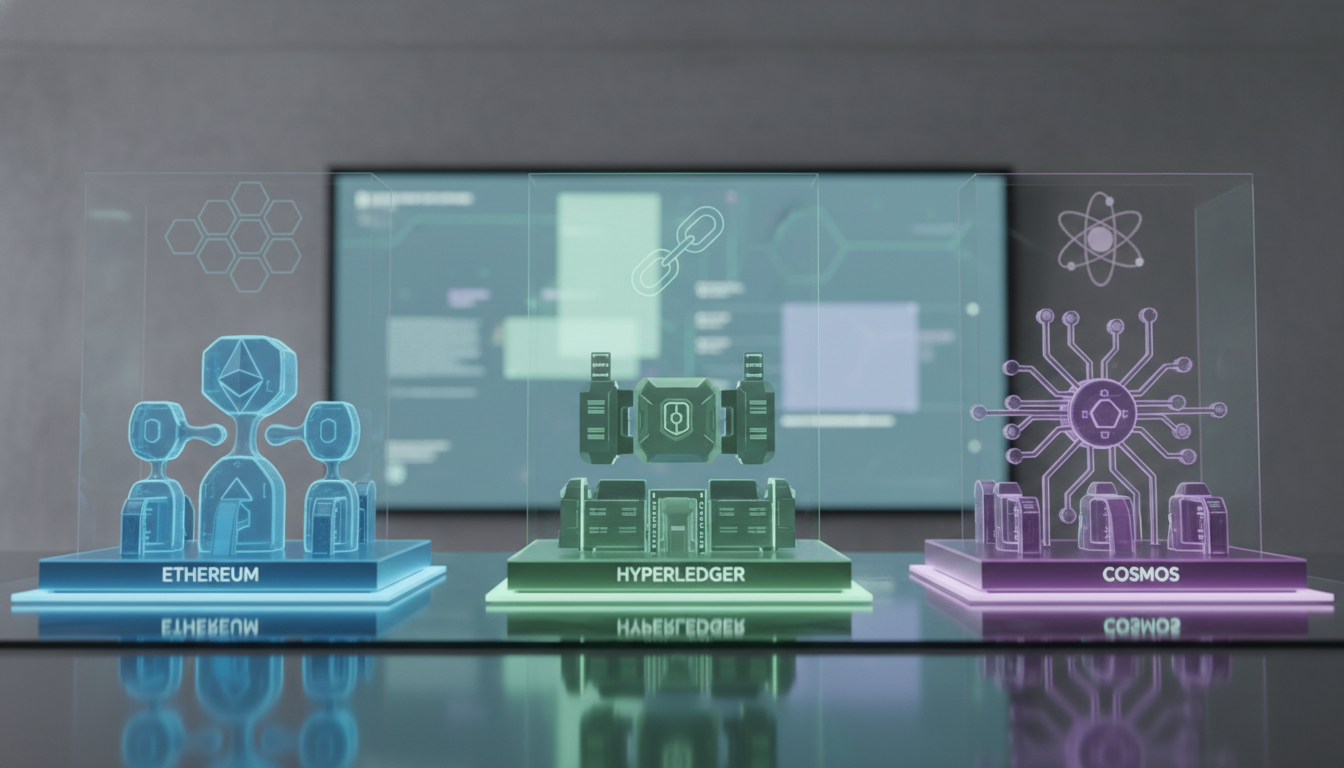
Choosing the right blockchain platform is the single most consequential technical decision your project will make, and the best development firms will push you to make it before writing a single line of code.
Ethereum
Ethereum remains the dominant platform for public dApps and DeFi protocols. Its EVM compatibility means thousands of audited libraries exist, and its developer ecosystem is the largest in the industry. The tradeoff is cost: mainnet gas fees can spike significantly during congestion, which is why most production dApps now deploy on Ethereum layer-2 networks like Arbitrum, Optimism, or zkSync Era. If your project needs composability with existing DeFi protocols and a liquid token market, Ethereum is the default choice.
Hyperledger Fabric
Hyperledger Fabric is the go-to for enterprise permissioned networks. It supports modular consensus, private data channels, and fine-grained access control, making it the preferred stack for inter-bank settlement, healthcare data sharing, and supply chain traceability. There is no native cryptocurrency, which simplifies regulatory positioning for institutional clients. IBM has invested over $200 million in blockchain research with a heavy focus on Hyperledger-based trade finance solutions.
Cosmos
Cosmos takes a different approach: instead of one chain, it provides a framework for building application-specific blockchains (appchains) that communicate via the Inter-Blockchain Communication (IBC) protocol. This is the right choice when you need sovereign control over consensus parameters, custom fee structures, or cross-chain liquidity without relying on Ethereum’s security model. Projects like dYdX migrated to a Cosmos appchain specifically to control throughput and eliminate gas fee unpredictability.
| Platform | Best For | Consensus | Privacy | Typical Dev Cost Premium |
|---|---|---|---|---|
| Ethereum (L2) | Public dApps, DeFi, NFTs | Proof of Stake | Low (public) | Baseline |
| Hyperledger Fabric | Enterprise, permissioned networks | Pluggable (PBFT, Raft) | High (private channels) | +20-40% |
| Cosmos SDK | Appchains, cross-chain protocols | Tendermint BFT | Configurable | +30-50% |
Key Services Offered by Top Blockchain Development Firms

Engaging a professional blockchain development company gives you access to a full lifecycle of services, from architecture design through post-launch security monitoring.
“The firms that consistently deliver are the ones that treat smart contract auditing as a first-class deliverable, not an afterthought. A single reentrancy bug can drain a protocol in minutes.” Common finding across post-mortems published by blockchain security firms including Trail of Bits and OpenZeppelin.
Smart Contract and dApp Development
Smart contract development is the technical foundation of any decentralized application. Blockchain app development companies write, test, and audit code that automatically executes agreements when preset conditions are met. On Ethereum alone, millions of contracts have been deployed across DeFi, NFT, and governance protocols. Firms like Vegavid work across Ethereum, Polygon, and BNB Chain, having delivered over 50 blockchain solutions in finance, logistics, and healthcare. A well-audited smart contract prevents the kind of exploits that have cost the industry billions in cumulative losses.
Here is a minimal ERC-20 token contract as a reference point for what even a “simple” deliverable requires:
// SPDX-License-Identifier: MIT

 }

 }
}
Even this 15-line contract requires decisions about access control, minting authority, and upgrade paths. A production DeFi protocol adds 10-20x that complexity, plus formal verification requirements.
Tokenomics Design
Tokenomics design is a service that separates serious blockchain development firms from code shops. It covers supply schedules, vesting cliffs, emission curves, staking incentives, and governance weight. A poorly designed token model can destroy a technically sound protocol. The best firms run agent-based simulations to stress-test token economics before a single line of contract code is written. Key deliverables include a token allocation table, a vesting schedule (typically 12-48 months for team and investor tranches), and a liquidity bootstrapping plan. For deeper context on how token models affect protocol health, see our analysis of tokenomics design principles.
Enterprise Blockchain and Private Networks
Many enterprises require permissioned networks rather than public chains. Development companies build on Hyperledger Fabric, R3 Corda, or Quorum to maintain privacy and regulatory compliance. Private blockchains enable meaningfully faster reconciliation in inter-bank settlements compared to traditional batch-processing systems. North American banks, which contributed significantly to the 46% regional growth share, favor these custom implementations for their auditability and access control.
Crypto Exchange and Wallet Development
Crypto exchange development is a high-demand service category. A full-stack blockchain app development company can build a centralized or decentralized exchange with order matching, multi-signature wallets, and KYC/AML compliance baked in. According to Interexy, there were over 85 million blockchain wallet users globally at the start of 2023, and that number continues to climb as Web3 adoption expands into emerging markets.
How to Select the Right Blockchain App Development Partner

Choosing among hundreds of blockchain app development companies requires a structured evaluation that examines technical expertise, pricing, compliance posture, and delivery process.
Step-by-Step Selection Framework
- Define Requirements: Determine whether you need a dApp, a private network, a full DeFi ecosystem, or a tokenized asset platform. Scope ambiguity is the leading cause of budget overruns.
- Research Shortlists: Use directories like Clutch, GoodFirms, and DesignRush to filter by hourly rate, location, and verified client reviews. Over 530 blockchain development agencies are listed across these platforms.
- Assess Technical Fit: Confirm experience with your required blockchain stack and request code samples or a proof of concept. Ask specifically about layer-2 experience and cross-chain bridge implementations.
- Verify Compliance: Ensure the firm follows GDPR, HIPAA, or AML standards if your project handles sensitive data or financial instruments. ISO/IEC 27001 and SOC 2 Type II certifications are the baseline for serious firms.
- Negotiate Milestones: Set clear deliverables, acceptance criteria, and IP ownership clauses in the contract. Audit deliverables should be a named milestone, not a line item.
- Pilot Engagement: Start with a small-scope prototype before committing to a full build. A 4-6 week paid discovery sprint reveals communication quality and technical depth faster than any sales call.
Evaluate Technical Breadth and Portfolio
Review the company’s GitHub repositories, case studies, and client testimonials. Ask what networks they specialize in: Ethereum, Solana, Cosmos. Verify whether they have layer-2 scaling experience and cross-chain bridge deployments in production. A firm that has delivered 500+ products, like Goji Labs, brings proven execution. Also verify certifications: many top-tier blockchain app development companies maintain ISO/IEC 27001 and SOC 2 Type II compliance, assuring security best practices are embedded in their process.
Pricing Models and Engagement Options
Cost structures vary significantly by geography and engagement model. US-based agencies commonly charge $100-$149 per hour, while nearshore and offshore teams range from $55-$100 per hour. Fixed-price projects often start at $50,000, as noted by DesignRush. Some blockchain app development companies offer dedicated teams at a monthly retainer of $15,000-$40,000, depending on complexity. Always request a clear breakdown that includes auditing, UI/UX design, and post-launch support to avoid scope creep surprises.
Top Blockchain App Development Companies in the USA
The United States remains the largest market for blockchain innovation, hosting 250+ specialized development studios. Below is a comparison of four highly rated firms based on cost, team size, and specialization.
| Company | Hourly Rate | Team Size | Specialties |
|---|---|---|---|
| Appinventiv | $50 – $99 | 500+ experts | dApps, DeFi, NFT, enterprise |
| Goji Labs | $149 | 50 – 99 | UX-driven dApps, gaming |
| Azumo | $55 | 100 – 249 | AI + blockchain integration |
| Vegavid | $40 – $80 | 40+ | DeFi, NFT, private networks |
Appinventiv has delivered 3,000+ projects and reports an 80% repeat business rate, indicating strong client retention. Goji Labs focuses on design-forward dApps and has helped startups raise over $1 billion in funding across its portfolio. Azumo combines AI expertise with blockchain, a valuable pairing for data-heavy applications where on-chain data needs to interact with off-chain ML pipelines. Vegavid offers cost-efficient solutions with deep cryptography skills, making it a practical choice for mid-market projects with defined scope.
Geographic Development Hubs
Beyond US-based firms, two regions dominate offshore blockchain development. India hosts the largest concentration of blockchain developers globally, with major studios in Bangalore, Hyderabad, and Pune offering rates in the $25-$50 per hour range. Eastern Europe, particularly Ukraine, Poland, and Romania, offers a strong balance of technical depth and timezone overlap with Western clients, with rates typically in the $50-$80 per hour range. Both regions have produced production-grade DeFi protocols and enterprise networks. The tradeoff is communication overhead and IP jurisdiction considerations, which is why the 6-step selection framework above includes a mandatory pilot engagement before full commitment.
Cost of Blockchain App Development in 2026
Development expenses depend on project scope, team location, and technology complexity. Understanding these variables helps you budget realistically and compare proposals from blockchain app development companies without getting lost in line-item noise.
Factors That Influence Pricing
- Network choice: Building on Ethereum mainnet is more expensive than using Polygon or BSC due to gas fee complexity and audit requirements.
- Features: A simple token takes 50-100 development hours; a DeFi exchange may exceed 1,200 hours.
- Security: Smart contract audits add $5,000-$15,000 to a project budget but are non-negotiable for any protocol handling real value.
- Compliance: KYC/AML integration and GDPR-ready architecture require additional development cycles and legal review.
According to Interexy, blockchain investment in on-demand services is growing at roughly 32% annually, with a projected market volume of $11 billion by 2027. This growth has pushed blockchain app development companies to offer flexible pricing models, from $25,000 for an MVP to $250,000+ for a full-scale enterprise platform.
Price Ranges by Project Type
- Smart Contract Development: $2,000-$10,000 for a simple ERC-20 token; $30,000-$80,000 for a complex DeFi protocol.
- dApp Development: $50,000-$150,000 for a consumer-facing app with wallet integration and a basic backend.
- Crypto Exchange: $100,000-$300,000 for a centralized exchange with matching engine, liquidity integration, and admin panel.
- Enterprise Blockchain Network: $200,000-$500,000+ for a permissioned network with custom consensus and multiple node deployment.
These figures align with data from DesignRush, where minimum project budgets for serious engagements typically start at $50,000.
Industry-Specific Blockchain Applications
Different sectors adopt blockchain in distinct ways, and the versatility of blockchain app development companies allows them to serve healthcare, supply chain, and finance with equal technical depth.
Finance and Banking
Banks and fintech startups use blockchain for cross-border payments, asset tokenization, and decentralized lending. IBM has invested over $200 million in blockchain research, with a primary focus on trade finance and identity verification. By integrating private blockchains, financial institutions reduce settlement times from days to minutes and cut operational costs meaningfully. Tokenized real-world assets, from real estate to fine art, are projected to reach a $16 trillion market by 2030, according to industry research cited by multiple protocol teams.
Healthcare and Supply Chain
In healthcare, blockchain secures patient records and enables HIPAA-compliant data sharing between providers without centralizing sensitive data in a single attack surface. For supply chains, tamper-proof ledgers improve traceability and reduce counterfeits. The technology’s immutable audit trails are transforming logistics, with documented implementations yielding a 15-25% reduction in paperwork errors and reconciliation overhead.
AI and Blockchain Convergence
As of 2026, the intersection of AI and blockchain is producing a new class of applications. On-chain AI inference verification, decentralized training data marketplaces, and AI-governed DAO treasuries are moving from research to production. The core value proposition is clear: AI provides pattern recognition and automation, while blockchain provides verifiable execution and tamper-proof audit trails. Firms like Azumo are already building hybrid pipelines where ML models trigger smart contract actions based on off-chain data feeds via oracle networks like Chainlink. This convergence is expected to be one of the fastest-growing service categories for blockchain development firms through 2027.
Future Trends in Blockchain Development
Staying ahead of protocol evolution is essential when engaging blockchain app development companies. Several advancements will define 2026 and beyond.
Layer-2 Scaling and Interoperability
Ethereum’s rollup-centric roadmap has made layer-2 solutions like Optimism, Arbitrum, and zkSync mainstream deployment targets. Development companies are building bridges between chains using Cosmos IBC and Polkadot XCMP to enable cross-chain liquidity. According to Interexy, interoperability is now a primary architectural requirement, with multi-chain dApps becoming the norm. Layer-2 solutions can reduce transaction fees by up to 90% compared to layer-1 Ethereum, which directly affects user acquisition economics for consumer-facing protocols.
“Zero-knowledge proofs are the most significant cryptographic advancement in blockchain since Satoshi’s original proof-of-work design. zkEVMs will make privacy and scalability a default, not a premium feature.” A perspective shared across multiple ZK protocol teams including StarkWare and Polygon Labs in their 2025 developer documentation.
Regulatory Compliance and Asset Tokenization
As governments introduce clearer frameworks, blockchain app development companies must embed compliance at the code level rather than bolting it on post-launch. Tokenized real-world assets are projected to reach a $16 trillion market by 2030. Firms that combine legal due diligence with smart contract automation will be the most valuable partners in this space. Expect more partnerships between blockchain developers and legal firms as the regulatory picture solidifies across the US, EU, and Asia-Pacific jurisdictions.
Pros and Cons of Hiring Blockchain App Development Companies
Hiring a specialized blockchain development firm offers real advantages, but it also comes with tradeoffs worth understanding before you sign a contract.
Pros
- Specialized expertise: Access to engineers who have deployed production smart contracts, run security audits, and built cross-chain bridges. This depth takes years to build in-house.
- Faster time to market: Established firms have reusable components, audited libraries, and tested deployment pipelines. A dApp MVP that might take an in-house team 9 months can ship in 3-4 months with the right partner.
- Built-in security practices: Top firms treat auditing as a deliverable, not an afterthought. ISO/IEC 27001 and SOC 2 certifications signal that security is embedded in their process.
- Regulatory navigation: Experienced firms have handled GDPR, HIPAA, and KYC/AML integrations across multiple jurisdictions, reducing your legal exposure.
- Flexible engagement models: From fixed-price MVPs starting at $25,000 to dedicated team retainers at $15,000-$40,000 per month, you can match spend to project stage.
Cons
- Cost: Quality blockchain development is expensive. US-based firms charge $100-$149 per hour, and a production-grade DeFi protocol can easily exceed $200,000 in total development cost.
- Knowledge transfer risk: If the engagement ends without proper documentation and handoff, your team may struggle to maintain or upgrade the codebase independently.
- Vendor dependency: Relying on a single firm for architecture, development, and auditing creates concentration risk. Separate your audit vendor from your development vendor.
- Scope creep: Blockchain projects are notorious for expanding scope as new protocol capabilities become available. Fixed-price contracts require extremely tight specifications.
- Quality variance: The market includes firms ranging from world-class to barely functional. Without a rigorous vetting process, the 530+ agencies listed on review platforms can be overwhelming to evaluate.
Conclusion
The blockchain industry is maturing fast, and partnering with the right development firm can be the difference between a failed proof-of-concept and a category-defining protocol. By defining your needs upfront, scrutinizing technical expertise, and aligning with industry-compliant blockchain app development companies, you position your project to capitalize on a market that’s already reshaping global finance, logistics, and digital identity.
Whether you choose a boutique studio or a full-service firm like Appinventiv, prioritize transparency, security, and a demonstrated track record of delivering on-time, on-budget solutions. For teams ready to build something serious, explore how we approach protocol infrastructure and tokenomics at Digital Blockchains, or apply to the Genesis Cohort to build alongside practitioners who read whitepapers for breakfast.
Frequently Asked Questions
What exactly does a blockchain app development company do?
A blockchain app development company designs, codes, and deploys decentralized applications and smart contracts on networks like Ethereum or Hyperledger. These firms also provide consulting, tokenomics design, security auditing, and ongoing maintenance to ensure scalability and compliance.
How much does it cost to hire a blockchain app development company?
Costs vary by scope and team location. A simple smart contract may cost $2,000-$10,000, while a full dApp ranges from $50,000 to $150,000. Hourly rates for US-based firms average $100-$149, while offshore teams charge $55-$100 per hour.
How do I choose the best blockchain development company for my startup?
Look for proven experience in your industry, strong verified reviews on platforms like Clutch or GoodFirms, and hands-on expertise in the blockchain stack you intend to use. Always run a paid pilot engagement before committing to a full build contract.
What are the benefits of blockchain app development for businesses?
Blockchain enhances data immutability, reduces fraud through transparency, automates trust with smart contracts, and can lower transaction costs meaningfully. Enterprises gain a competitive edge by streamlining supplier agreements and producing tamper-proof compliance audit trails.
Do blockchain development companies handle regulatory compliance?
Yes, the top firms embed standards like GDPR, HIPAA, and KYC/AML into the architecture from the start. They also conduct smart contract audits and maintain ISO/IEC 27001 certification to meet legal requirements in finance and healthcare.
What is the average timeline for a blockchain app project?
A basic dApp MVP can be built in 3-4 months, while a complex DeFi platform or enterprise network may take 8-12 months. Timeline depends on feature complexity, team size, and external audit schedules.