Blockchain in supply chain is a distributed ledger technology that records every transaction immutably across a shared network, enabling end-to-end traceability, fraud reduction, and smart contract automation from raw material to final delivery.
Key Takeaways
- supply chain provides a tamper-evident, shared ledger that enhances transparency and reduces fraud across every node in the network.
- Smart contracts automate payments and compliance checks, cutting administrative overhead and eliminating manual invoicing cycles.
- Integration with IoT sensors enables real-time tracking of goods, from cold-chain condition monitoring to provenance verification at origin.
- Tokenization of physical assets opens new avenues for supply chain financing, turning inventory into liquid, tradeable collateral.
- Regulatory mandates like the EU Deforestation Regulation (EUDR) are accelerating blockchain adoption for ESG and sustainability reporting.
- Permissioned platforms like Hyperledger Fabric and R3 Corda dominate enterprise deployments because they balance openness with commercial privacy requirements.
What Is Blockchain in Supply Chain?
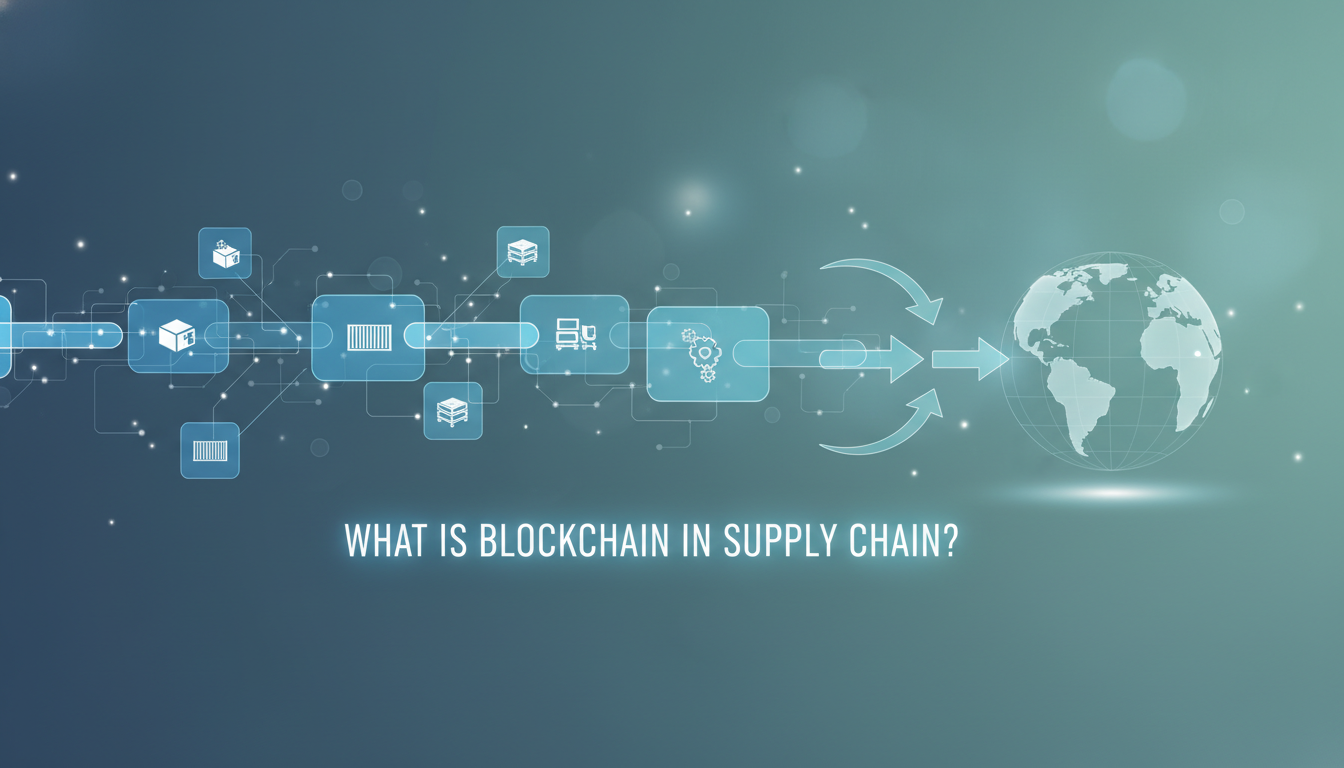
this type of chain is the application of distributed ledger technology (DLT) to record and verify every event along a product’s journey, from raw material extraction to final delivery. Unlike traditional centralized databases, blockchain stores data in cryptographically linked blocks distributed across multiple nodes. Once recorded, the data cannot be altered, making the ledger tamper-evident. In a supply chain context, this creates a single shared source of truth that all authorized participants can trust, even when they don’t trust one another. Permissioned blockchains are the standard choice here, requiring network membership that balances openness with the privacy needs of commercial operations.
The Basics of Distributed Ledger Technology
A distributed ledger is a database replicated across many locations and participants simultaneously. Each transaction, whether a transfer of goods, a quality inspection, or a payment, gets packaged into a block, timestamped, and appended to the chain. Consensus mechanisms like Practical Byzantine Fault Tolerance (PBFT) or Proof of Authority (PoA) ensure all nodes agree on a block’s validity before it’s committed. This architecture eliminates the need for a central authority and produces a verifiable audit trail. The network is also resilient: if one node fails, the remaining nodes maintain the complete, current ledger state.
Why Permissioned Blockchains Fit Supply Chains
Public blockchains are open to anyone, but supply chains demand controlled access. A permissioned blockchain restricts participation to known entities: manufacturers, logistics providers, retailers, and regulators, each with defined roles and data visibility rights. This protects sensitive business information like pricing and contract terms while still delivering the trust and immutability of a distributed ledger. Enterprise deployments commonly use Hyperledger Fabric or R3 Corda, both built from the ground up for this kind of multi-party commercial environment.
Key Drivers Behind Blockchain Adoption in Supply Chains

The COVID-19 pandemic exposed deep fragilities in global supply networks, shifting priorities from pure efficiency to resilience and visibility. According to an Ernst and Young study cited by BanQu, supply chain visibility rose from a top-three concern in 2020 to the number-one priority for professionals by 2022. This urgency, combined with mounting regulatory and consumer pressure, has accelerated adoption across industries. Three strategic drivers stand out: predictive risk management, ESG traceability, and trust-building in multi-stakeholder networks.
Predictive Risk Management and Supply Chain Resilience
Modern supply chains face disruptions from geopolitical conflicts, cyberattacks, extreme weather, and supplier bankruptcies. Blockchain’s real-time data capture lets companies detect anomalies early: a shipment deviating from its route, a temperature excursion in cold storage, a customs delay at a specific port. By analyzing historical on-chain data, machine learning models can predict stockout risks or port bottlenecks before they materialize. This shifts the operating model from reactive mitigation to proactive prevention, which is precisely why this kind of supply chain has become a resilience tool, not just a transparency one.
ESG Tracking and Scope 3 Emissions
ESG reporting has become a boardroom imperative, and Scope 3 emissions, those occurring in a company’s value chain outside its direct control, are the hardest to measure credibly. the in supply chain offers an auditable trail of carbon data at every node. Each participant in the supply network can record energy consumption or recycled content on the ledger, and a smart contract can calculate the cumulative carbon footprint automatically. Deloitte highlights how resource-intensive industries are using blockchain to gain control over Scope 3 emissions, enabling credible sustainability claims that satisfy both regulators and institutional investors.
Enhancing Trust Among Multi-Stakeholder Networks
Global supply chains link dozens of independent entities with divergent interests. Information asymmetry leads to disputes, payment delays, and a steady erosion of trust. A shared, immutable ledger provides a single version of the truth: every participant sees the same data in near-real time. This transparency reduces the trust gap without requiring heavy legal contracts or expensive third-party audits. Blockchain in supply chain acts as neutral infrastructure for collaboration, enabling faster onboarding of new partners and more fluid cross-border trade.
How Blockchain Enhances Transparency and Traceability

Real-Time Tracking Across the Product Lifecycle
Transparency means knowing exactly where a product is, under what conditions it was handled, and who touched it at every step. IoT sensors, including GPS trackers, RFID tags, and temperature loggers, feed data directly to the blockchain. As goods move from origin to destination, each scan or sensor reading creates an indelible record. This approach shines in scenarios requiring proof of provenance: verifying that conflict-free minerals were mined in a certified region, that organic cotton was grown under fair-trade conditions, or that a vaccine vial stayed within the required 2-8°C range throughout transit. This granular, tamper-proof history simplifies recalls too. Instead of broad-spectrum product pulls, companies can pinpoint the exact batch affected, reducing waste and cost significantly.
Traditional vs. Blockchain-Based Supply Chain Traceability
The table below contrasts conventional traceability methods with blockchain-enabled approaches, showing why the technology represents a genuine step change for supply chain operations.
| Feature | Traditional Supply Chain | Blockchain-Enabled Supply Chain |
|---|---|---|
| Data Storage | Siloed, often paper-based or centralized ERP | Distributed, shared ledger across all nodes |
| Immutability | Editable, risk of fraud | Tamper-evident; no single party can alter records |
| Trust Model | Third-party audits, manual reconciliation | Consensus-based; data is inherently trusted |
| Real-Time Visibility | Fragmented, delayed updates | Real-time, end-to-end visibility for all permissioned members |
| Recall Efficiency | Broad, days to weeks | Targeted, near-instant identification of affected items |
| Cost of Disputes | High; relies on invoices and legal processes | Low; smart contracts automate settlement |
The Role of Smart Contracts in Supply Chain Automation

Smart contracts are self-executing code stored on a blockchain that automatically enforce agreed-upon terms when predefined conditions are met. In a supply chain, this could mean releasing payment to a carrier the moment a temperature-sensitive shipment is confirmed in range, or triggering a re-order when inventory drops below a threshold. By removing manual intervention, smart contracts reduce cycle times, eliminate paperwork, and lower administrative costs. IBM and Deloitte both underscore this automation layer as one of the highest-ROI components of any blockchain in supply chain deployment.
Automating Payments and Compliance
Cross-border trade still relies heavily on letters of credit, documents that can take 5-10 business days to verify and clear. Smart contracts, coupled with tokenized fiat currencies or stablecoins, enable near-instant settlement upon proof of delivery. This accelerates cash flow for suppliers and eliminates non-payment risk. Compliance with trade regulations, such as customs declarations or product certifications, can be embedded directly into the contract logic. If a shipment lacks the required digital certification from an accredited testing lab, the smart contract simply refuses to execute payment, enforcing standards automatically without human review.
Reducing Paperwork and Administrative Costs
A single container shipment can generate up to 200 physical documents. Blockchain digitizes this paper trail into an immutable record, and smart workflows replace manual checks. According to IBM, IoT-enabled supply chain improvements could add between USD 4 trillion and USD 11 trillion to global GDP by 2025. Administrative cost reduction in trade finance alone, often estimated at 15-25% for digitized workflows, makes a compelling business case for any CFO evaluating the technology.
“Blockchain creates a shared, immutable record of transactions that all parties in a supply chain can trust. This eliminates the need for reconciliation between multiple ledgers and reduces the risk of fraud and errors.” – IBM Institute for Business Value, Blockchain for Supply Chain
IoT and Blockchain: A Powerful Combination for Real-Time Data
From Sensors to Ledger: How It Works
IoT devices are the eyes and ears of any serious blockchain in supply chain deployment. Temperature loggers, accelerometers, and GPS trackers generate continuous data streams. These readings are aggregated, encrypted, and stored on-chain, creating a verifiable record of a product’s condition throughout its journey. For pharmaceuticals, this means proving cold-chain integrity was maintained at every handoff. For perishable foods, it demonstrates freshness and safety to regulators and consumers alike. The combination of IoT and blockchain closes the trust gap between physical events and digital records, which is the core problem that neither technology solves alone.
Market Growth and Economic Impact
The market for blockchain-enabled IoT in supply chains is growing at a significant pace. IBM reports that the blockchain-in-IoT market expanded from USD 30 million in 2018 to USD 113 million, with projections exceeding USD 3 billion by 2024, representing a compound annual growth rate (CAGR) of approximately 93%. This growth reflects a clear recognition: IoT data becomes substantially more valuable when anchored on an immutable ledger, removing doubts about data manipulation and enabling auditable automation at scale.
Tokenization of Physical Assets: A New Frontier in Supply Chain Finance
Tokenization is the process of representing a physical asset, whether a barrel of oil, a shipment of coffee, or a warehouse of steel, as a digital token on a blockchain. Each token is a fractional, traceable ownership certificate. Blockchain in supply chain use of tokenization extends beyond simple tracking. It unlocks liquidity by turning physical goods into tradeable digital assets. Suppliers can tokenize inventory as collateral to access working capital, while buyers can pre-finance orders with greater confidence in the underlying asset’s existence and condition.
What Is Asset Tokenization?
Asset tokenization involves minting a unique digital token linked, via smart contracts and legal agreements, to a real-world asset. The token holds metadata including location, ownership history, and condition data. As the asset moves through the supply chain, the token updates in real time, giving financiers immediate visibility into the collateral they’re backing. This bridges the physical-digital divide and forms the foundation for next-generation supply chain financing models that don’t rely on paper-based instruments.
Improving Liquidity and Financing Opportunities
Traditional supply chain finance relies on letters of credit and invoice factoring, both paper-intensive and slow. With tokenization, a financier can instantly verify the existence, location, and quality of collateral on the blockchain, reducing risk and enabling faster loan decisions. For smaller suppliers, this democratizes access to capital that was previously available only to large enterprises with established credit histories. Blockchain in supply chain combined with tokenization can compress the settlement cycle from weeks to minutes, a structural improvement that compounds across thousands of transactions annually.
Pros and Cons of Blockchain in Supply Chain
Pros
- Immutable audit trail: Every transaction is permanently recorded and tamper-evident, reducing fraud and simplifying compliance audits.
- End-to-end traceability: Products can be tracked from raw material origin to final delivery, enabling rapid, targeted recalls and provenance verification.
- Smart contract automation: Payments, compliance checks, and re-orders execute automatically when conditions are met, cutting cycle times and administrative costs by an estimated 15-25% in trade finance workflows.
- ESG credibility: On-chain Scope 3 emissions data provides auditable sustainability reporting that satisfies regulators and institutional investors.
- Improved financing access: Tokenized inventory unlocks working capital for suppliers of all sizes, reducing dependence on slow, paper-based instruments.
Cons
- Scalability limits: Even high-performing permissioned blockchains handle a few thousand transactions per second, which may be insufficient for the largest global logistics networks.
- Legacy integration complexity: Connecting blockchain to existing ERP systems like SAP, Oracle, or Microsoft Dynamics requires custom middleware and APIs, adding cost and project risk.
- Garbage-in, garbage-out: Blockchain cannot fix bad data at the source. If a worker scans the wrong barcode, that error is recorded immutably, making off-chain data validation processes essential.
- Adoption coordination: A traceability chain breaks if even one key supplier refuses to participate, requiring significant governance and incentive alignment work.
- Interoperability gaps: Different blockchain platforms (Ethereum, Hyperledger Fabric, R3 Corda) don’t natively communicate, fragmenting multi-network deployments.
Real-World Applications and Case Studies
Food Safety and Provenance
The food industry was an early adopter of blockchain in supply chain. IBM Food Trust, a consortium-based blockchain, allows retailers like Walmart to trace a package of mangoes from farm to shelf in seconds rather than days. In the event of a foodborne illness outbreak, the precise source can be identified immediately, limiting the scope of recalls and protecting public health. Provenance claims like “wild-caught” or “fair trade” can be independently verified by scanning a QR code on the packaging, giving consumers a transparent view of the product’s full journey.
Pharmaceutical and Vaccine Tracking
The pharmaceutical supply chain faces serious counterfeit drug risks. The World Health Organization has documented the scale of this problem, and blockchain in supply chain offers a credible means to authenticate every pill packet from factory to pharmacy. During the COVID-19 vaccine rollout, multiple initiatives used blockchain to log each dose’s temperature history, preventing spoilage and ensuring only safe vaccines reached patients. This use case demonstrates how immutable records can have direct public health consequences, not just operational efficiency gains.
“The ability to trace products through the supply chain is becoming a regulatory requirement in many industries. Blockchain provides the infrastructure to meet these requirements while simultaneously reducing operational costs.” – Deloitte, Blockchain Supply Chain Innovation
Challenges and Considerations for Implementation
Despite its promise, blockchain in supply chain faces real hurdles that practitioners need to plan for. Scalability remains an issue for high-volume activities: the highest-performing permissioned blockchains can handle a few thousand transactions per second, which may be insufficient for the largest logistics networks. Integration with legacy ERP systems requires middleware and custom APIs, adding cost and complexity. Blockchain is also not a cure-all. Its value depends entirely on the quality of data fed into it. Robust off-chain data validation processes are not optional; they’re a prerequisite for any deployment that needs to hold up under audit.
Stakeholder Adoption and Standardization
A blockchain network is only as strong as its least-connected participant. If one key supplier refuses to join, the traceability chain breaks. Achieving industry-wide adoption requires aligning incentives through consortium governance or regulatory mandates. The absence of universal standards for data formats and cross-chain interoperability between platforms like Ethereum and Hyperledger Fabric fragments the ecosystem further. Organizations like the GS1 Global Standards Initiative are actively developing identifiers for blockchain-based supply chains, but consensus across industries is still evolving as of 2026.
Energy Consumption and the Sustainability Question
Permissioned blockchains used in supply chains rely on consensus mechanisms like PBFT or PoA rather than energy-intensive Proof of Work. This makes their energy footprint substantially lower than public chains like pre-Merge Ethereum or Bitcoin. That said, any organization deploying blockchain for ESG purposes needs to account for the energy consumption of its own nodes and infrastructure. Running a 20-node Hyperledger Fabric network is comparable in energy terms to running a small data center cluster, which is manageable but not invisible in a Scope 2 emissions calculation.
Interoperability Standards: Where GS1 Stands in 2026
GS1, the global standards body behind barcodes and RFID identifiers, has been developing the GS1 Digital Link standard to bridge physical product identifiers with blockchain-based records. As of 2026, GS1 Digital Link adoption is growing in retail and food sectors, enabling QR codes on packaging to resolve directly to on-chain provenance data. The challenge is that different blockchain networks still use incompatible data schemas, meaning a product tracked on IBM Food Trust cannot automatically share its history with a shipment tracked on a Hyperledger Besu network without a purpose-built integration layer.
Frequently Asked Questions
What is the main benefit of using blockchain in supply chain?
The primary benefit is end-to-end transparency backed by an immutable record. All participants share a single, tamper-proof ledger of transactions, which reduces fraud, resolves disputes faster, and cuts administrative overhead across the entire network.
How does smart contract automation work in supply chains?
Smart contracts are pre-programmed conditional logic stored on the blockchain. When a sensor confirms a shipment meets temperature requirements, for example, the contract automatically releases payment, eliminating manual invoicing and approval delays entirely.
Can blockchain in supply chain work without IoT?
Yes, but the full potential is only realized with IoT integration. Blockchain alone records digital transactions accurately, but IoT feeds it real-world physical data about goods in transit, making the ledger a true bridge between physical events and digital records.
What is a permissioned blockchain, and why is it used in supply chains?
A permissioned blockchain restricts network access to known, vetted participants with defined roles. In supply chains, this protects sensitive commercial information like pricing and contract terms while still delivering the transparency and immutability of a distributed ledger.
How does tokenization improve supply chain financing?
Tokenization converts physical goods into digital tokens on the blockchain, which can serve as collateral for loans or be traded directly. It gives financiers real-time visibility into an asset’s location and condition, reducing risk and compressing funding timelines from weeks to minutes.
Blockchain in supply chain is no longer a theoretical concept. It’s a practical toolkit for building resilient, transparent, and efficient global trade networks. As IoT proliferation, tokenization, and regulatory pressures converge through 2026 and beyond, the business case for adoption will only grow stronger. If you’re ready to build on this infrastructure, apply to the Genesis Cohort at Digital Blockchains and work with a team that deploys these systems in production.