Key Takeaways
- A blockchain payment is a direct transfer of value on a decentralized ledger, bypassing traditional intermediaries like banks.
- Settlement happens in minutes rather than days, and costs are typically far lower than conventional cross-border transfers.
- Real-world adoption is accelerating: JPMorgan, Stripe, and Blockchain.com already offer this type of infrastructure at scale.
- Businesses adopt these rails for faster settlement, lower fees, 24/7 availability, and immutable audit trails.
- Challenges remain, including scalability, regulatory complexity, and volatility, but stablecoins are closing the gap.
A blockchain payment is a transaction that moves value directly between parties on a decentralized digital ledger, settling near-instantly without banks or card networks in the middle.
What Are Blockchain Payments?
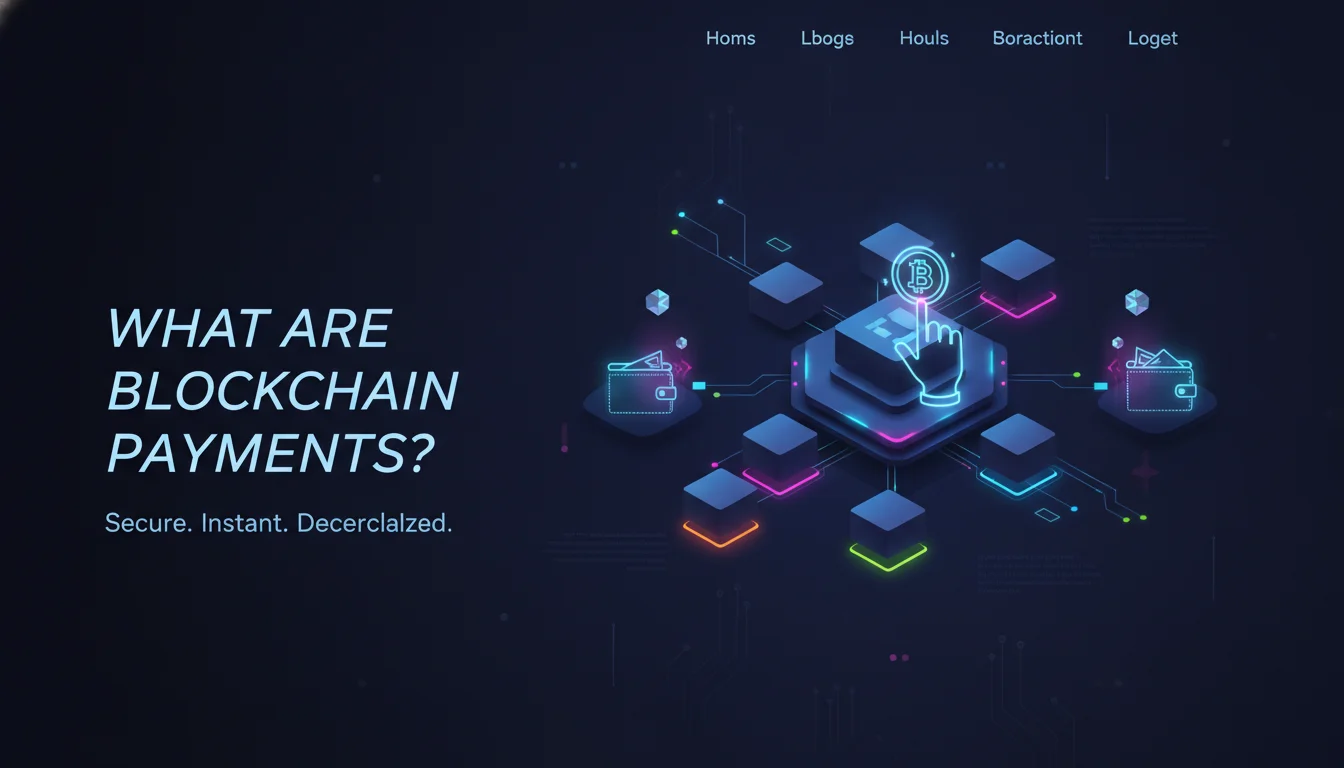
Blockchain payments are a method of transferring funds using distributed ledger technology instead of relying on centralized financial institutions. Unlike traditional systems that depend on clearing houses, correspondent banks, or fixed settlement windows, this approach runs on a peer-to-peer network where every transaction is verified by consensus among participants and recorded permanently on an immutable chain of blocks.
Definition and Core Concepts
The transfer moves value directly from a sender’s digital wallet to a recipient’s public address. The transaction broadcasts to a network of nodes, which validate it using cryptographic proofs. Once confirmed, it becomes part of a block, linked to the previous block, creating an auditable and tamper-resistant history. According to Investopedia, a blockchain is “a decentralized digital database or ledger that securely stores records across a network of computers in a way that is transparent, immutable, and resistant to tampering.”
This architecture removes the need for a central authority. The network processes transfers 24 hours a day, every day of the year, anywhere in the world. Because the ledger is shared, all participants see the same transaction history, which cuts reconciliation effort and reduces the potential for disputes.
How This Differs from Traditional Payments
In a conventional wire transfer, funds pass through up to four intermediary banks, each adding fees, delays, and points of failure. A blockchain-based transfer, by contrast, travels directly from sender to receiver on a single, globally synchronized ledger. BVNK notes that “traditional payment systems depend on clearing houses or settlement windows,” while this alternative “can run continuously, 24 hours a day.”
These transfers aren’t restricted to cryptocurrencies, either. With the rise of fiat-backed stablecoins like USDC or EUROC, businesses can send and receive dollars or euros on-chain, getting the speed of crypto with the stability of traditional currency. This hybrid model is driving enterprise adoption, as detailed in Stripe’s overview of its crypto product suite.
How Do Blockchain Payments Actually Work?
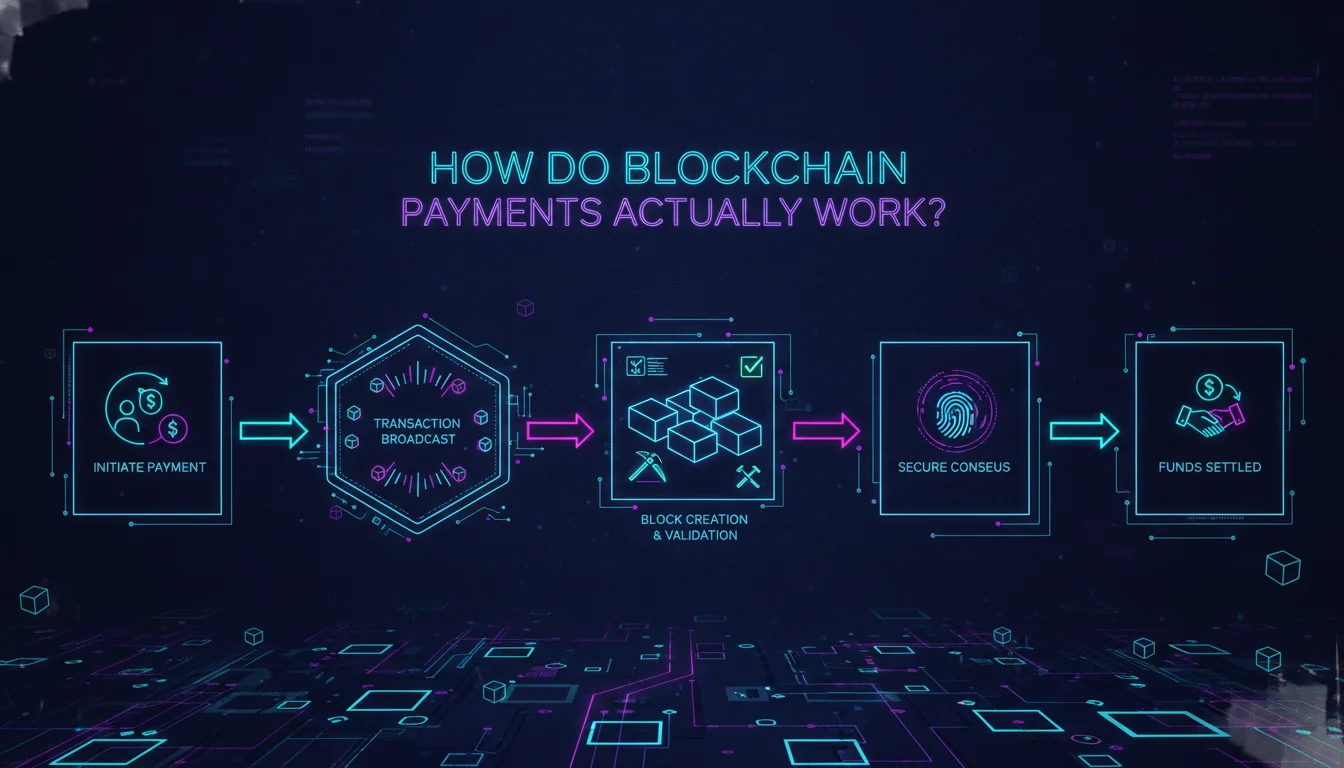
The process is automated, trustless, and cryptographically secure, moving from wallet initiation to final settlement in a handful of steps.
Step 1: Initiate the Transfer
The sender opens their digital wallet, whether a mobile app like Blockchain.com Wallet or a browser extension like MetaMask, and enters the recipient’s public address and the amount. They can denominate the transfer in a cryptocurrency such as Bitcoin or Ether, or in a stablecoin pegged to fiat currency. The wallet displays any network fees (often called “gas fees”) before the user confirms.
Step 2: Broadcast to the Network
Once confirmed, the wallet creates a digitally signed transaction and broadcasts it to the network of nodes. This signature, generated using the sender’s private key, proves ownership of the funds without revealing the key itself.
Step 3: Verify the Transaction
Nodes, computers running the protocol, immediately validate the transaction. They confirm the sender’s address has sufficient balance and that the same funds haven’t been double-spent. Invalid transactions get rejected automatically by the network.
Step 4: Group Transactions into a Block
All valid transactions waiting for processing get bundled into a candidate block. The block contains the transaction data, a timestamp, and a cryptographic hash of the previous block, which forms the “chain.”
Step 5: Confirm Through Consensus
The block gets finalized through a consensus mechanism. In proof-of-work systems like Bitcoin, miners compete to solve a computationally intensive puzzle. In proof-of-stake systems like Ethereum, validators propose and attest to blocks, staking capital to ensure honest behavior. Proof-of-work generally consumes far more energy per transaction than proof-of-stake, which is one reason Ethereum moved away from mining entirely. Once a block is confirmed, reversing it is practically impossible.
Step 6: Record and Settle
The updated ledger propagates across all nodes. Both sender and recipient see the completed transfer in their wallets, often within minutes. Settlement is final: there’s no chargeback risk unless both parties agree to a reversal, a sharp contrast to credit card transactions.
“Blockchain payments have evolved from experimental technology to enterprise infrastructure. In 2025, businesses can use blockchain rails to send, receive, and settle funds globally 24/7, without the delays and fees of cross-border legacy networks.” , BVNK Blog, January 2026
Key Benefits of This Approach
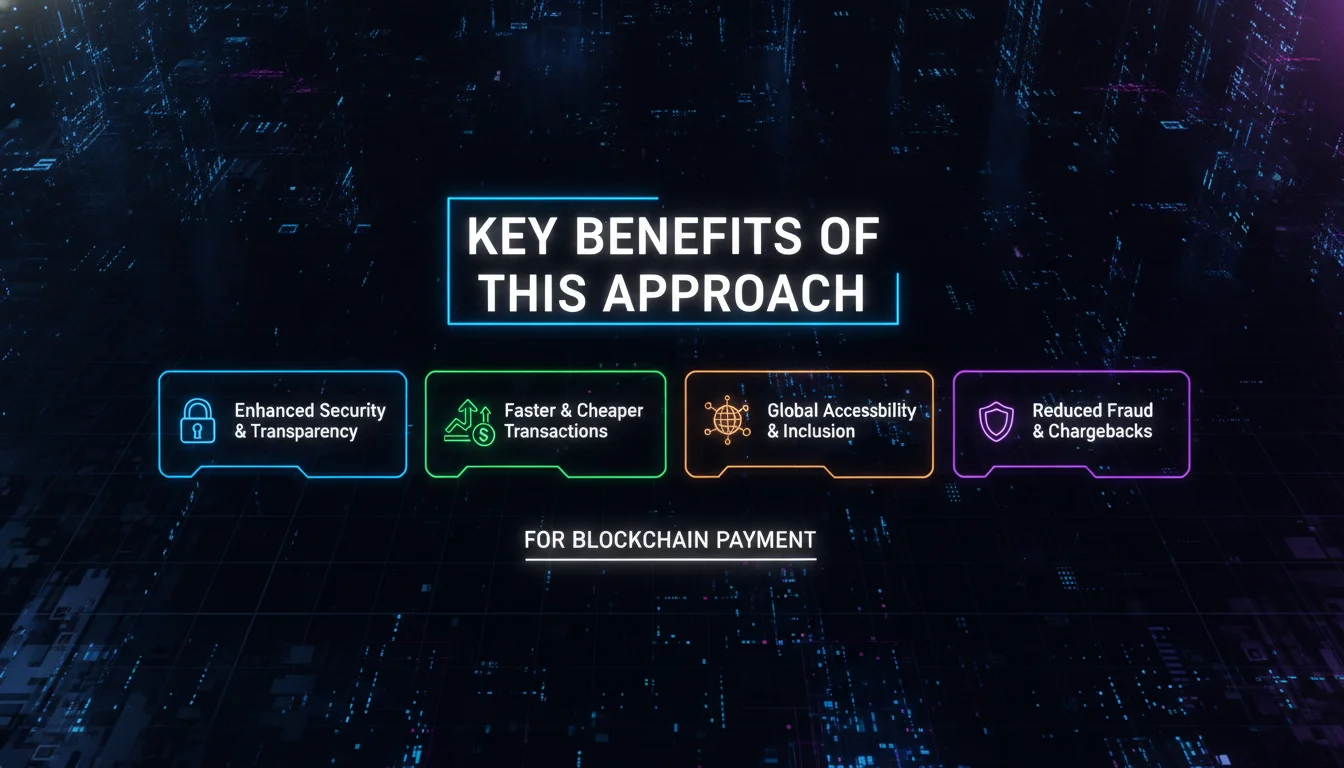
Businesses gain tangible advantages in speed, cost, and transparency when they move settlement onto public ledgers. Here’s why enterprise treasuries and payment providers are making the shift.
Speed and 24/7 Availability
Traditional wire transfers, especially across borders, can take three to five business days to settle because they rely on intermediary banks that operate only during business hours, according to OVHcloud. A ledger-based transfer, in contrast, can settle in minutes, or even seconds on high-throughput networks, anytime, including weekends and holidays. OVHcloud explains that “in an age of real-time apps and always-on services, traditional payments can still move maddeningly slow,” while this alternative moves value with far fewer handoffs.
Lower Transaction Costs
Cross-border transfers through the correspondent banking system often incur intermediary fees, foreign exchange markups, and processing charges. Because these transfers remove the need for a chain of intermediaries, fees can drop substantially. Stablecoin transfers on networks like Solana or Polygon can cost fractions of a cent, making micro-transactions economically viable for the first time.
Transparency and Immutability
Every transfer gets recorded on a public, append-only ledger. Finance teams gain a tamper-proof audit trail, reducing fraud and simplifying reconciliation. Since the records are immutable, regulators and auditors can independently verify activity without relying on a single institution’s database.
What Challenges Do Blockchain Payments Face?
Scalability, regulatory fragmentation, and volatility remain the three biggest obstacles businesses must navigate before adopting this infrastructure at scale.
Scalability and Network Congestion
Early blockchains like Bitcoin and Ethereum could process only a handful of transactions per second, leading to congestion and rising fees during peak demand. Layer-2 solutions such as the Lightning Network for Bitcoin and rollups for Ethereum have meaningfully improved throughput, but mainstream adoption will require continued infrastructure investment. The underlying data model matters too: Bitcoin’s UTXO (unspent transaction output) structure tracks discrete coin fragments, while Ethereum’s account-based model tracks balances the way a traditional ledger does. UTXO systems tend to parallelize better for simple transfers, while account-based models simplify smart contract logic, which is why most payment-focused smart contract platforms lean account-based.
Regulatory Uncertainty
The regulatory picture for cross-border crypto settlement remains fragmented. Some jurisdictions embrace it, such as Switzerland and Singapore, while others impose strict licensing requirements or outright bans. Businesses must secure appropriate money transmitter licenses and comply with Anti-Money Laundering (AML) and Know-Your-Customer (KYC) rules, which can add friction to an otherwise smooth process.
Price Volatility (Outside of Stablecoins)
Cryptocurrencies like Bitcoin are notoriously volatile, making them unsuitable for many business-to-business (B2B) transfers. The response has been the rise of fiat-backed stablecoins, which peg their value to a reference currency to reduce volatility for payments. By using USDC, for example, a company can settle a transaction denominated in dollars, eliminating currency risk. That said, the stablecoin market itself faces increasing regulatory scrutiny, and not every stablecoin holds a perfect peg.
Smart Contract Risk in Payment Rails
Payment protocols that route funds through smart contracts inherit smart contract risk. A bug in an escrow contract, a payment router, or a bridge can freeze or drain funds regardless of how sound the underlying blockchain is. Any business building on programmable payment rails should budget for independent audits and prefer contracts with a track record over novel, unaudited code.
Real-World Applications
From cross-border remittances to merchant settlement, this technology is solving concrete business problems today.
Cross-Border Transfers for Businesses and Individuals
International payments have long been a use case begging for disruption. A freelancer in France receiving payment from a US client, or a doctor in London sending money to the Philippines, traditionally faces multi-day delays and multiple fees. According to Built In, “blockchain has become a preferable way to handle money, largely due to its efficiency … no money transfer waiting periods or unnecessary third-party processing fees.”
Merchant Payments and Stablecoin Settlement
Platforms like Stripe and BVNK now let merchants accept stablecoins and auto-settle to fiat. Stripe’s crypto product suite includes wallets, stablecoin issuing, and card infrastructure, letting online businesses offer crypto options without ever holding volatile assets. BVNK, which recently joined Mastercard’s network, provides embedded stablecoin wallets and cross-border orchestration, letting marketplaces settle sellers in seconds.
Institutional Adoption and Enterprise-Grade Solutions
JPMorgan Chase’s Onyx division, launched in 2020, uses distributed ledger technology to serve financial institutions and fintech companies. The platform handles intraday repo transactions and cross-border settlement at institutional scale, showing that this infrastructure has moved far beyond crypto startups. Blockchain.com Pay, with over 94 million wallets and more than $1 trillion in cumulative transaction volume, offers a white-label integration that lets partners add fiat-to-crypto ramps with a few lines of code.
Top Providers and Platforms
Several companies are leading the push to make this infrastructure accessible to mainstream businesses. The table below compares key offerings.
| Provider | Key Features | Target Users | Stablecoin Support |
|---|---|---|---|
| Blockchain.com Pay | 94M wallets, 1-click KYC, fiat on/off-ramp, anti-fraud systems | Apps, exchanges, enterprises | Yes (USDC, etc.) |
| Stripe Crypto | Wallet infrastructure, stablecoin issuing, card programs, onramp widget | Online merchants, platforms | Yes (USDC, EUROC) |
| BVNK | Stablecoin wallets, cross-border orchestration, Mastercard partnership | Fintechs, marketplaces, payroll | Yes (USDC, USDT) |
| Coinspaid | Payment infrastructure, merchant tools, enterprise gateway | Businesses, iGaming, exchanges | Yes (multiple) |
As we tell founders applying to our studio, the ledger is the easy part. The hard part is compliance architecture, liquidity management, and picking a settlement asset that won’t move 5% while the invoice is in flight.
Pros and Cons
Pros
- Settlement in minutes instead of days, available every hour of the year
- Lower fees than correspondent banking for many cross-border corridors
- Immutable, publicly verifiable audit trail that simplifies reconciliation
- Programmable money via smart contracts enables automated escrow and conditional releases
Cons
- Non-stablecoin volatility makes many crypto assets unsuitable for B2B invoicing
- Regulatory treatment still varies widely by jurisdiction
- Network congestion can spike fees on base-layer chains during peak demand
- Smart contract bugs or bridge exploits can put funds at risk
The Future of Blockchain Payment Infrastructure in 2026 and Beyond
Several trends are converging to push this infrastructure further into mainstream commerce. As of 2026, the shift from pilot programs to production deployment is the defining story.
Growing Enterprise Integration
Enterprises are moving from proofs-of-concept to production. Stripe’s 2026 Sessions conference spotlighted how businesses can “issue stablecoin-backed cards” and “provision services with agents,” signaling that this rail is being woven into everyday commerce. The spread of central bank digital currencies (CBDCs) may further accelerate adoption by providing sovereign-backed digital cash running on similar infrastructure.
Regulatory Evolution
Jurisdictions like the EU, with its Markets in Crypto-Assets (MiCA) regulation, are creating clear frameworks for stablecoin issuers and crypto payment providers. Clarity brings greater institutional confidence, letting adoption scale in a compliant manner. In the US, the push for a stablecoin bill has bipartisan support, which could unlock significant new trading and settlement volume.
Emerging Technologies: AI, DeFi, and Layer-2 Solutions
The intersection of artificial intelligence and programmable money promises to automate treasury management, optimize liquidity across chains, and detect fraud in real time. Decentralized finance protocols are also starting to play a role in payments infrastructure, offering on-chain liquidity pools that let businesses swap between stablecoins or currencies without going through a centralized market maker. Layer-2 scaling solutions continue to improve, with zero-knowledge rollups enabling thousands of transactions per second at marginal cost. These advances will make moving value on-chain feel as routine as sending an email, one of the original promises of the technology.
If you’re building payment infrastructure, tokenized settlement rails, or treasury tooling on top of these primitives, our studio works with teams at exactly this stage. Apply to the Genesis Cohort at digitalblockchains.com to build alongside a team that has shipped protocol infrastructure and tokenomics models from spec to mainnet.
Frequently Asked Questions
Are blockchain payments real?
Yes, this infrastructure is real and used daily at scale. Major institutions like JPMorgan and Stripe process meaningful volume through it, and Blockchain.com alone reports over 90 million wallets.
What is an example of a blockchain transaction?
A typical example is sending USDC stablecoin from one digital wallet to another over the Ethereum network. The transfer settles in minutes, costs cents, and stays visible on a public block explorer.
Which banks use blockchain?
JPMorgan Chase operates the Onyx network for institutional settlement. Other banks, including Goldman Sachs, DBS, and Santander, have piloted or deployed blockchain-based settlement systems.
How can I get my money out of blockchain?
To convert on-chain funds into fiat currency, transfer them to a licensed exchange like Coinbase or a fiat-on-ramp provider like Blockchain.com Pay, then withdraw to your bank account.
Is blockchain real or fake?
Blockchain is a real, functioning technology already processing significant transaction volume for institutions and consumers alike. It’s not a theoretical concept: distributed ledgers back live systems at JPMorgan, Stripe, and dozens of other financial platforms today.