The ltc blockchain is a peer-to-peer distributed ledger that powers Litecoin, a proof-of-work cryptocurrency launched in October 2011 by Charlie Lee as a faster, lower-cost alternative to Bitcoin. Blocks confirm in 2.5 minutes, fees stay under $0.01, and the network has run without interruption since day one.
Key Takeaways
- Litecoin’s network generates a new block every 2.5 minutes, four times faster than Bitcoin’s 10-minute target.
- Average transaction fees sit below $0.01, making it one of the cheapest proof-of-work networks for value transfer.
- Total supply is hard-capped at 84 million LTC, exactly four times Bitcoin’s 21 million limit.
- The network has processed over 350 million transactions with zero recorded downtime since 2011.
- Litecoin uses the Scrypt hashing algorithm, which historically favored GPU and ASIC mining over SHA-256 rigs.
- As of mid-2026, market cap sits near $3.99 billion, placing Litecoin among the top-20 assets by on-chain activity.
What Is the LTC Blockchain?
Litecoin’s distributed ledger is a UTXO-based chain derived from Bitcoin Core’s codebase, with deliberate parameter changes that prioritize throughput and accessibility. Charlie Lee forked Bitcoin in 2011 with three primary modifications: the Scrypt proof-of-work function, a 2.5-minute block target, and an 84 million coin supply ceiling. Those three decisions still define the network’s character today.
The chain uses the same UTXO accounting model as Bitcoin, so every unspent output is explicitly tracked on-chain. This makes transaction verification straightforward and keeps the security model battle-tested. According to the Litecoin whitepaper and protocol documentation, the Scrypt algorithm was chosen specifically to reduce the advantage of custom ASIC hardware at launch, though Scrypt ASICs did eventually emerge by 2013-2014.
If you want to understand how UTXO chains differ from account-based models like Ethereum, our breakdown of smart contract architecture covers the tradeoffs in detail.
Key Features of the LTC Blockchain

1. Speed and Efficiency
Block generation averages 2.5 minutes, giving Litecoin roughly 4x the raw throughput of Bitcoin at the base layer. For a user sending a payment, that means a first confirmation arrives in under 3 minutes under normal network conditions, compared to waiting 10-plus minutes on Bitcoin. For merchants requiring 2-3 confirmations before releasing goods, that difference is meaningful: roughly 5-7 minutes on Litecoin versus 20-30 minutes on Bitcoin.
2. Low Transaction Costs
Fees on the network consistently stay below $0.01 per transaction. That cost structure makes Litecoin viable for microtransactions and cross-border remittances where traditional rails charge 3-7% of transfer value. On-chain data from block explorers like Blockchair confirms this fee profile has held even during periods of elevated transaction volume.
3. Scalability and Supply Design
The 84 million coin cap is not arbitrary. It is exactly 4x Bitcoin’s supply, which aligns with the 4x faster block rate. Halving events occur every 840,000 blocks (roughly every 4 years), mirroring Bitcoin’s deflationary schedule. As of May 2026, the network processes an average of 300,000 transactions per day, a volume that the base-layer block size handles without significant mempool congestion.
4. SegWit and the Lightning Network
Litecoin activated Segregated Witness (SegWit) in May 2017, several months before Bitcoin. That early adoption served as a live testbed for the upgrade. SegWit separates signature data from transaction data, effectively increasing block capacity without a hard fork. The Lightning Network is also compatible with Litecoin, enabling payment channels that settle off-chain and finalize on-chain, pushing theoretical throughput well beyond base-layer limits.
LTC Blockchain Architecture Deep Dive

Understanding the protocol layer separates informed users from everyone else. Here is how the core components fit together.
Scrypt Proof-of-Work
Scrypt is a memory-hard hashing function. Where SHA-256 (Bitcoin’s algorithm) is compute-bound and scales efficiently on custom silicon, Scrypt requires significant RAM bandwidth per hash attempt. The original intent was to keep mining accessible to consumer hardware. In practice, Scrypt ASICs now dominate Litecoin mining, but the algorithm still produces a different hardware ecosystem than Bitcoin, with separate mining pools and dedicated rigs.
The current network hashrate stands at approximately 3.27 TH/s (terahashes per second under Scrypt measurement). That figure reflects the combined computational power securing the chain against 51% attacks. A successful 51% attack would require an attacker to control more than half that hashrate, which at current hardware costs represents a significant capital barrier.
Block Structure
Each Litecoin block contains a header and a transaction list. The header includes:
- Version: protocol version number
- Previous block hash: cryptographic link to the prior block
- Merkle root: hash of all transactions in the block
- Timestamp: Unix time of block creation
- Bits: compact representation of the current difficulty target
- Nonce: the value miners iterate to find a valid hash
This structure is nearly identical to Bitcoin’s, which means tooling, libraries, and developer knowledge transfer directly between the two chains.
Difficulty Adjustment
The network recalculates mining difficulty every 2016 blocks, targeting a consistent 2.5-minute block time. If blocks arrive faster than target (more hashrate joined), difficulty rises. If blocks slow down (miners left), difficulty drops. This self-correcting mechanism keeps confirmation times stable regardless of mining participation levels.
Transaction Metrics on the LTC Blockchain
Current Network Statistics
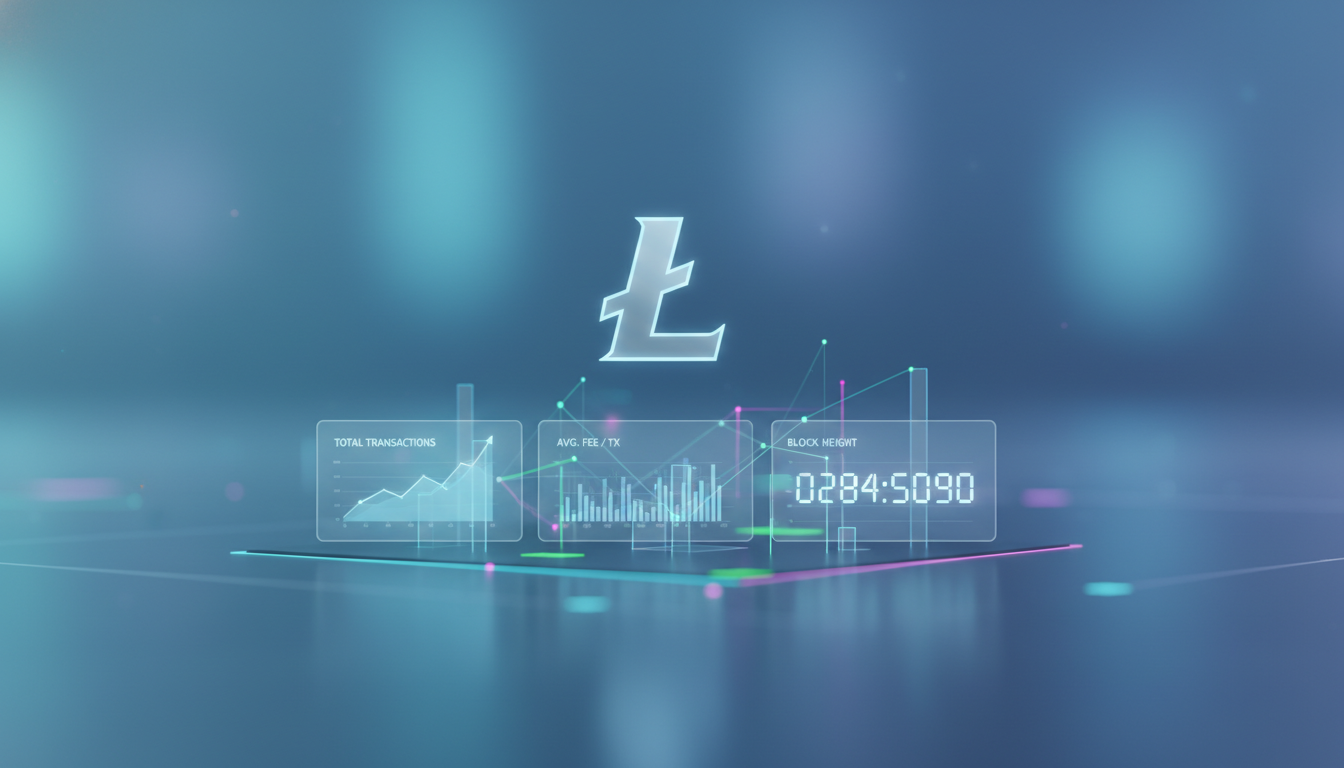
As of May 2026, the network carries a market cap near $3.99 billion, with LTC trading around $51.35. The hashrate of approximately 3.27 TH/s (Scrypt) reflects active miner participation and a healthy security budget relative to block rewards.
Recent Transaction Data
In a typical 24-hour window, the chain records roughly 246,000 transactions, with average fees near 1 lit/vB (litoshi per virtual byte). That fee density keeps the network economically accessible for small transfers. Block explorers including Blockchair and LitecoinSpace provide real-time mempool data for anyone tracking confirmation queues.
Historical Performance
Since launch in 2011, the network has processed over 350 million transactions without a single recorded outage. That 15-year uptime record is a meaningful data point. Most payment infrastructure in traditional finance cannot match it. The chain’s simplicity, a deliberate design choice, contributes directly to this reliability.
Mining the LTC Blockchain
Litecoin mining is the process of competing to produce valid blocks using Scrypt proof-of-work, earning newly minted LTC plus transaction fees as reward.
Mining Hardware
Scrypt ASIC miners from manufacturers like Bitmain (Antminer L-series) and MicroBT dominate the current mining landscape. Consumer GPU mining of Litecoin is no longer economically viable at scale given the efficiency gap between GPUs and dedicated ASICs. A modern Scrypt ASIC delivers hashrates in the range of 1-9 GH/s depending on the model, with power consumption between 1,200-3,500 watts.
Block Rewards and Halving Schedule
The current block reward is 6.25 LTC per block, following the halving that occurred in August 2023. The next halving is projected for approximately 2027, at which point the reward drops to 3.125 LTC. With roughly 576 blocks per day (24 hours / 2.5 minutes), the network currently issues approximately 3,600 new LTC daily. That issuance rate continues declining on the halving schedule until the final coin is mined, estimated around 2142.
Mining Pools
Solo mining Litecoin is statistically impractical for individual operators given the total network hashrate. Most miners join pools such as ViaBTC, F2Pool, or Litecoinpool.org, which aggregate hashrate and distribute rewards proportionally. Pool fees typically run 1-2% of earnings.
Comparison: LTC Blockchain vs. BTC and ETH
| Feature | LTC Blockchain | BTC Blockchain | ETH Blockchain |
|---|---|---|---|
| Block Generation Time | 2.5 minutes | 10 minutes | 12-14 seconds |
| Average Transaction Fee | Under $0.01 | $0.50+ | Variable (EIP-1559) |
| Max Supply | 84 million LTC | 21 million BTC | No hard cap |
| Consensus Mechanism | Proof of Work (Scrypt) | Proof of Work (SHA-256) | Proof of Stake |
| SegWit Support | Yes (since May 2017) | Yes (since Aug 2017) | N/A |
| Lightning Network | Compatible | Native | N/A |
| Launch Year | 2011 | 2009 | 2015 |
Pros and Cons
Pros
- Fast confirmations: 2.5-minute blocks make Litecoin practical for point-of-sale and time-sensitive transfers.
- Near-zero fees: Sub-$0.01 costs open the door for microtransactions and remittances that traditional payment rails cannot serve profitably.
- Proven uptime: Over 15 years of uninterrupted operation is a track record few networks can match.
- SegWit-ready: Early SegWit adoption means the chain benefits from increased effective block capacity and Lightning Network compatibility.
- Bitcoin code lineage: Developers familiar with Bitcoin Core can audit and contribute to Litecoin with minimal ramp-up time.
- Predictable supply schedule: The 84 million cap and halving cadence give miners and holders a clear issuance model.
Cons
- Limited smart contract support: Unlike Ethereum or newer L1s, Litecoin does not natively support complex programmable logic, limiting DeFi integration.
- ASIC-dominated mining: The original goal of accessible mining has given way to industrial-scale ASIC operations, concentrating hashrate.
- Narrative competition: Bitcoin occupies the “digital gold” story; Ethereum owns programmability. Litecoin’s positioning as “digital silver” faces ongoing pressure from faster, cheaper alternatives like Solana and newer payment-focused chains.
- DeFi ecosystem is nascent: Wrapped LTC (WLTC) exists on Ethereum, but native DeFi activity on the Litecoin chain itself remains limited compared to EVM-compatible networks.
- Developer activity: Core protocol commits are less frequent than on Bitcoin or Ethereum, which can slow feature delivery.
Use Cases of the LTC Blockchain
1. Everyday Payments
Sub-$0.01 fees and 2.5-minute confirmations make Litecoin genuinely usable for retail payments. A coffee purchase confirmed in under 3 minutes at a fraction of a cent in fees is a real-world value proposition, not a theoretical one. The Litecoin Foundation actively maintains a merchant directory and provides integration resources for businesses.
2. Cross-Border Remittances
Traditional remittance corridors charge 3-7% per transfer according to World Bank data. Sending LTC across borders costs under $0.01 regardless of transfer size, and the recipient can access funds within minutes. For families in high-remittance corridors, that cost difference compounds significantly over time.
3. Merchant Adoption
Payment processors including BitPay and NOWPayments support Litecoin, giving merchants a straightforward path to accepting LTC without managing private keys directly. The Litecoin Foundation’s merchant adoption program provides onboarding support and co-marketing resources.
4. Test Network for Bitcoin Upgrades
Historically, Litecoin has served as a live proving ground for Bitcoin protocol upgrades. SegWit activated on Litecoin first. Atomic swaps between LTC and BTC were demonstrated in 2017, validating the technology before broader deployment. This role gives Litecoin a unique position in the Bitcoin ecosystem beyond simple value transfer.
Future Developments in the LTC Blockchain
Privacy Enhancements
The Litecoin development team has explored MimbleWimble Extension Blocks (MWEB), which activated on mainnet in May 2022. MWEB adds optional confidential transactions, allowing users to obscure transfer amounts while keeping the base layer transparent for those who prefer it. This opt-in privacy model attempts to satisfy both regulatory requirements and user demand for financial privacy.
DeFi Integration Pathways
As decentralized finance infrastructure matures, wrapped versions of LTC on EVM chains (primarily Ethereum and BNB Chain) allow Litecoin holders to participate in lending, borrowing, and liquidity provision without selling their LTC. Native DeFi on Litecoin itself remains limited, but cross-chain bridge development continues. Our analysis of tokenomics design covers how asset bridging affects supply dynamics on the source chain.
Lightning Network Expansion
Lightning Network node count and channel capacity on Litecoin have grown steadily, though the network remains smaller than Bitcoin’s Lightning implementation. As routing liquidity improves, sub-second, sub-cent payments become practical for high-frequency use cases like gaming micropayments and streaming money applications.
“Litecoin was designed to complement Bitcoin, not compete with it. The faster block time and Scrypt algorithm were deliberate choices to serve different transaction profiles.” – Charlie Lee, Litecoin creator, in early protocol documentation and public statements.
“On-chain data consistently shows Litecoin maintaining one of the lowest median transaction fees among proof-of-work networks, a structural advantage that holds regardless of LTC price movements.” – Blockchair network analytics, 2025-2026 data.
Frequently Asked Questions
What is the LTC blockchain?
The LTC blockchain is the distributed ledger technology powering Litecoin, a proof-of-work cryptocurrency launched in 2011. It uses the Scrypt hashing algorithm, generates blocks every 2.5 minutes, and has a hard supply cap of 84 million coins.
How fast are transactions on the LTC blockchain?
Transactions receive their first confirmation in approximately 2.5 minutes under normal network conditions. Most merchants and exchanges require 2-6 confirmations, meaning practical finality arrives in 5-15 minutes, still significantly faster than Bitcoin’s equivalent wait.
What are the transaction fees on the LTC blockchain?
Fees consistently stay below $0.01 per transaction, confirmed by on-chain data from block explorers including Blockchair and LitecoinSpace. This cost structure holds even during periods of elevated daily transaction volume around 246,000-300,000 transactions.
What is the maximum supply of Litecoin?
The maximum supply is hard-capped at 84 million LTC, four times Bitcoin’s 21 million limit. New coins enter circulation through block rewards, currently 6.25 LTC per block, declining on a halving schedule approximately every 4 years.
How does Litecoin mining work?
Miners compete to solve Scrypt proof-of-work puzzles, with the winner earning the block reward plus transaction fees. The network adjusts mining difficulty every 2016 blocks to maintain the 2.5-minute block target. Most miners operate through pools like ViaBTC or F2Pool rather than mining solo.
Is the LTC blockchain secure?
The network’s security comes from its proof-of-work consensus and a hashrate of approximately 3.27 TH/s (Scrypt). Over 15 years of uninterrupted operation with zero recorded downtime supports its security track record. A successful attack would require controlling more than half the current hashrate, representing a substantial capital cost.