Blockchain accounting software is a specialized financial tool that automates the ingestion, classification, and reporting of digital asset transactions across multiple chains and exchanges. It connects on-chain activity to standard accounting systems for audit-ready records.
Key Takeaways
- Blockchain accounting software automates transaction recording and reconciliation, bridging on-chain activity with traditional ledgers.
- Leading solutions like Bitwave, Cryptio, and CoinTracker integrate with ERPs such as QuickBooks and NetSuite for audit-ready financials.
- Critical evaluation criteria include multi-chain ingestion, cost basis tracking, and support for GAAP/IFRS standards.
- Implementation requires careful planning due to complex data normalization and varying regulatory requirements across jurisdictions.
- The market is evolving fast, with specialized tools emerging for DeFi, tokenized assets, and Solana validator operations.
- As of 2026, top platforms handle volumes exceeding 1 million transactions per year, making manual methods operationally impossible at scale.
What Is Blockchain Accounting Software?

Blockchain accounting software is a purpose-built financial system that ingests raw on-chain data, classifies transactions by type, calculates cost basis, and generates journal entries for standard general ledgers. It fills the gap that conventional accounting packages cannot.
The Core Functions of Blockchain Accounting Software
At its foundation, blockchain accounting software performs four critical jobs: data ingestion from wallets, blockchains, and exchanges; transaction classification into types like trades, transfers, rewards, or fees; cost basis calculation using methods like FIFO or specific identification; and journal entry generation that posts directly to general ledgers like QuickBooks or NetSuite. Tools missing any of these functions are portfolio trackers, not accounting systems.
For enterprises handling activity across 50 or more blockchains and protocols, this automation is essential. Without it, finance teams face error-prone manual entry for thousands of transactions every month.
Why Traditional Accounting Software Fails with Digital Assets
Conventional accounting packages like Xero or Sage Intacct were designed for fiat currencies and simple asset classes. They lack native support for blockchain’s unique data structures: wallet addresses, transaction hashes, smart contract interactions, and token standards like ERC-20. Forcing crypto data into these systems creates gaps in audit trails, incorrect valuations, and compliance risks under both GAAP and IFRS. The mismatch isn’t a configuration problem. It’s an architectural one.
How Blockchain Accounting Software Works
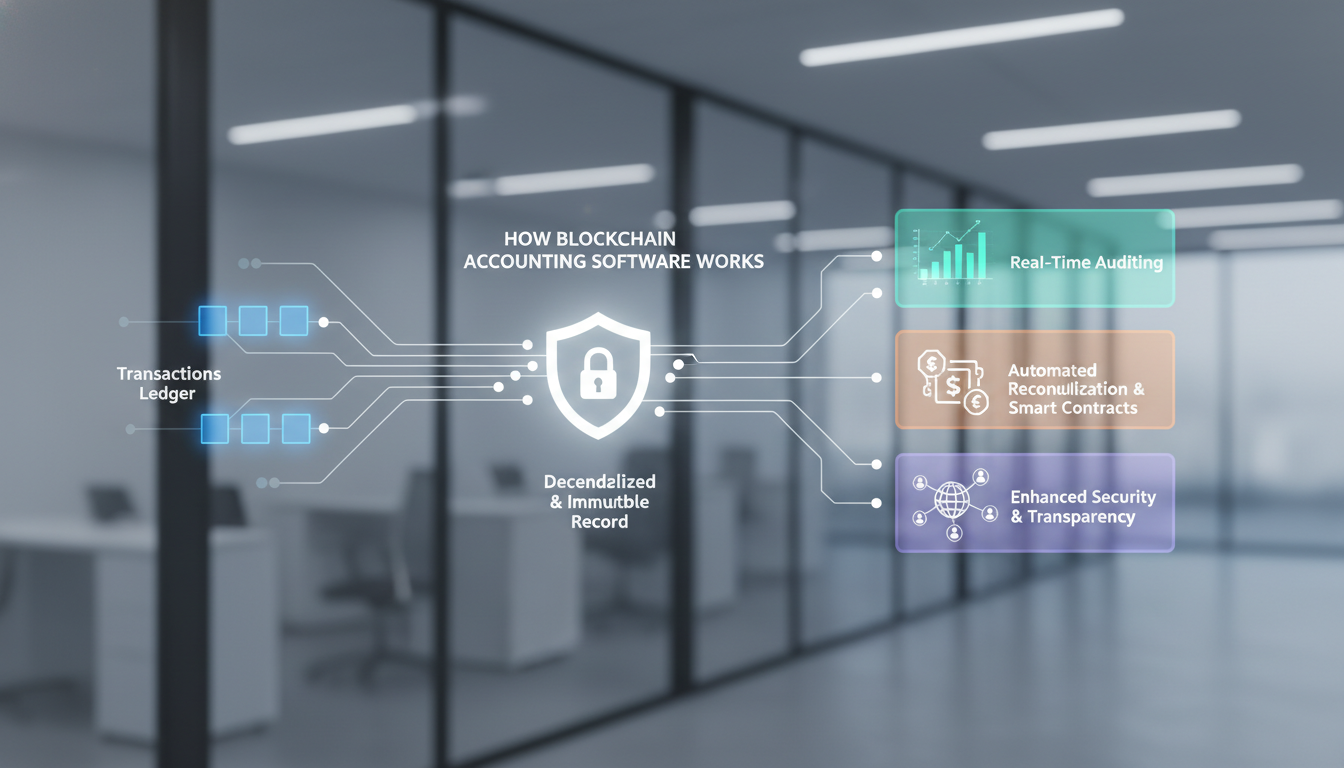
The workflow moves raw on-chain data through a structured pipeline before it ever touches your general ledger. Each stage removes ambiguity and adds accounting-grade structure.
Step-by-Step Process: From On-Chain Data to General Ledger
- Ingestion: The software connects to blockchains like Ethereum and Solana via nodes or APIs and pulls raw transaction data. It also imports from exchanges like Coinbase and custodians like Fireblocks.
- Normalization: Raw data is transformed into a standardized format, mapping wallet addresses to entities and token amounts to a single unit of account. This step eliminates double-counting from internal transfers.
- Classification: A rules engine tags each transaction as a sale, swap, staking reward, airdrop, or gas fee, based on on-chain evidence and user-defined logic.
- Cost Basis Assignment: The software applies the chosen accounting method (FIFO, HIFO, or specific identification) across all wallets and exchanges to calculate unrealized and realized gains and losses.
- Valuation: It fetches fair market values from integrated price oracles, enabling mark-to-market reporting at period end.
- Journal Entry Creation: Debits and credits are generated in the format required by the target ERP and populate clearing accounts where needed.
- Reconciliation: The system compares on-chain balances with internal records and flags discrepancies for review.
This end-to-end workflow can process over 1 million transactions annually for high-volume enterprises, cutting month-end close times substantially.
Key Features to Evaluate in Blockchain Accounting Software

Not every platform that calls itself blockchain accounting software delivers the same depth. These are the features that separate enterprise-grade tools from glorified spreadsheet replacements.
Audit-Ready Reporting and Compliance
True audit readiness means every output traces back to source transactions, with clear classification logic and valuation inputs documented at each step. Look for SOC 1 and SOC 2 Type 1 and Type 2 certifications, like those held by Cryptio, and built-in support for GAAP and IFRS impairment and fair value accounting. Compliance with evolving frameworks like the EU’s MiCA regulation adds another layer of complexity that your platform needs to handle automatically, not manually.
“Platforms such as Bitwave are emerging to provide a connection between blockchain-based technologies and traditional finance.” Industry observers, noting the sector’s structural shift toward institutional-grade tooling.
Integration with Existing ERPs and Financial Systems
Deep integration with tools like QuickBooks, NetSuite, Xero, and Workday is non-negotiable for any finance team running a real close process. Bitwave offers out-of-the-box connections to these ERPs, while CoinTracker Enterprise syncs with 500+ wallets and exchanges. A robust API matters too, especially for organizations running proprietary treasury systems that no off-the-shelf connector will cover.
Scalability and Multi-Chain Support
The software must scale with your transaction volume and chain diversity. CoinTracker Enterprise handles volumes up to 1 million crypto transactions per year. Multi-chain coverage varies considerably: Cryptio supports over 150 blockchains, exchanges, and custodians, while other platforms cover 50 to 80 chains. Prioritize platforms that ingest data from the specific chains and DeFi protocols your organization actually uses, not just the ones that look good in a marketing deck.
Tax Form Integration and Regulatory Reporting
As of 2026, US-based organizations need to account for emerging requirements like the 1099-DA reporting standard for digital asset brokers. Enterprise platforms are beginning to build native support for these forms, reducing the manual work of reconciling accounting records with tax filings. If your firm operates across multiple jurisdictions, verify that your chosen platform handles country-specific reporting requirements, not just US tax forms.
Pros and Cons of Blockchain Accounting Software

Blockchain accounting software solves real problems, but it introduces new ones. Here’s an honest assessment before you commit to a platform.
Pros
- Eliminates manual reconciliation for high-volume transaction environments where spreadsheets fail completely.
- Audit-ready outputs with immutable classification logs and valuation source trails reduce audit preparation time significantly.
- Multi-chain coverage across 50 to 150+ networks means a single platform can handle your entire digital asset portfolio.
- ERP integration with QuickBooks, NetSuite, and Xero keeps your existing financial workflows intact.
- Real-time cost basis tracking enables proactive tax loss harvesting and portfolio rebalancing before quarter-end.
Cons
- Implementation complexity is real. Custom integrations with legacy ERPs can take several months and require specialized consultants.
- DeFi support is uneven across platforms. Basic tools handle simple trades but struggle with liquidity provision, yield farming, and protocol-level events.
- Enterprise pricing starts at several thousand dollars per month, which is prohibitive for smaller organizations with limited crypto activity.
- No universal data standard exists for DeFi event interpretation, creating inconsistencies when switching vendors or consolidating across tools.
- Regulatory lag means platforms must constantly update to keep pace with frameworks like MiCA and evolving IRS guidance.
Comparison of Top Blockchain Accounting Software Solutions in 2026
The table below compares leading providers across critical dimensions for enterprise finance teams. Each platform has a distinct strength, and the right choice depends on your chain mix, transaction volume, and audit requirements.
| Feature | Bitwave | Cryptio | SoftLedger | CoinTracker Enterprise | NODE40 |
|---|---|---|---|---|---|
| Blockchains/Integrations | 50+ | 150+ | All major chains | 500+ wallets/exchanges | Solana-focused, multi-chain |
| ERP Integrations | QuickBooks, NetSuite, Sage, Xero, Workday | NetSuite, custom API | QuickBooks, Xero, API | QuickBooks, NetSuite, Xero | Custom exports |
| Cost Basis Methods | FIFO, HIFO, spec ID | FIFO, spec ID | FIFO, weighted avg, spec ID | FIFO, HIFO | Spec ID, FIFO |
| DeFi Support | Basic | Advanced (protocol-level) | Limited | Basic | Advanced (Solana DeFi) |
| Audit Readiness | GAAP/IFRS, custom reporting | SOC 1&2 Type 1&2, GAAP/IFRS | Real-time GL with audit trail | GAAP/IFRS, FMV tracking | Reconciliation-oriented reports |
| Best For | High-volume corporates | Institutions, complex DeFi | Firms needing native crypto GL | Mid-to-large enterprises | Solana validators, funds |
Enterprise-Grade Solutions: Bitwave, Cryptio, and CoinTracker
Bitwave excels with a powerful rules engine and customizable integrations trusted by high-volume corporate treasury teams. Cryptio differentiates through its broadest blockchain coverage and deep DeFi data normalization, particularly for tokenized assets. According to Cryptio’s published case studies, the platform has scaled client environments from 12 tokens to over 5,000 across 9 blockchains, with transaction volumes reaching 4 million per month. CoinTracker Enterprise is valued for its massive integration library and accessible interface, though its DeFi support is less granular than Cryptio’s.
Specialized Tools for Solana and DeFi: NODE40
For organizations operating deep in the Solana ecosystem, NODE40 provides exceptional granularity: stake accounts, rewards, vote costs, and validator performance are all handled natively. Its reports are designed to withstand audit scrutiny, with a strong emphasis on transaction provenance and reconciliation. If your treasury runs Solana validators or participates heavily in Solana DeFi, no other platform comes close on specificity.
“Cryptio provides independent oversight of token supply and lifecycle activity, including minting, burning, and wallet-level movements, enabling reconciliation between on-chain issuance and internal records.” Sidra Pervaiz, SVP Accounting, as featured on Cryptio’s platform documentation.
General Ledger-First Approach: SoftLedger
SoftLedger is the first general ledger accounting software with a native module for crypto assets. It treats digital assets as first-class accounting entities, automatically tracking cost basis across transfers and generating real-time, consolidated reports in fiat or crypto. This makes it the right choice for organizations that want crypto accounting embedded directly into their core financial system rather than bolted on through a third-party integration.
Benefits of Implementing Blockchain Accounting Software
The operational case for blockchain accounting software is straightforward once you’ve tried to reconcile 100,000+ monthly transactions in a spreadsheet.
Improved Accuracy and Reduced Manual Errors
Manual crypto accounting produces misclassified transactions and valuation errors at scale. Automation addresses this directly. For a firm processing 4 million monthly transactions, as documented in Cryptio’s scaling case studies, manual methods aren’t just inefficient. They’re operationally impossible. Finance teams adopting these platforms consistently report dramatic reductions in reconciliation time and near-elimination of spreadsheet-based mistakes.
Real-Time Financial Insights and Cost Basis Tracking
With mark-to-market valuations and continuous cost basis updates, finance leaders gain instant visibility into gains and losses. This enables proactive decisions: harvesting tax losses before year-end, rebalancing portfolios before quarter close, or flagging unrealized exposure before it becomes a board-level conversation. SoftLedger provides real-time realized and unrealized gain/loss reporting across all assets as a core feature, not an add-on.
Challenges and Limitations of Blockchain Accounting
Blockchain accounting software is not a plug-and-play solution. The platforms are sophisticated, and so are the problems they’re solving.
Integration Complexity with Legacy Systems
Despite robust APIs, integrating blockchain data with older ERPs is resource-intensive. Custom development and implementation support are often required, with projects running several months and requiring consultants who understand both blockchain data structures and ERP configuration. Budget for this. Teams that don’t are consistently surprised by the timeline.
Scalability and Standardization Issues
While top platforms handle high volumes, the industry still lacks universal standards for data formatting and DeFi event interpretation. This creates inconsistencies when switching vendors or consolidating reports across multiple tools. Compliance with evolving regulations like the EU’s MiCA adds ongoing complexity that requires platform updates, not just configuration changes.
How to Choose the Right Blockchain Accounting Software for Your Business
The right blockchain accounting software depends on three variables: your transaction volume, your chain mix, and your audit requirements. Get those three inputs right and the shortlist writes itself.
Assessing Your Volume and Asset Diversity
Start by estimating your monthly transaction count and the number of blockchains you interact with. Enterprises processing over 100,000 transactions monthly need platforms like Bitwave or CoinTracker Enterprise. If your activity is concentrated in Solana DeFi, NODE40’s specialized reporting becomes critical. Mid-market firms with simpler portfolios may find SoftLedger’s native GL approach more cost-effective than a dedicated subledger tool.
The Importance of Audit Evidence and Workpapers
Not all platforms provide the same depth of audit evidence. For firms facing regular audits, prioritize solutions that offer immutable classification logs, valuation source trails, and reconciliation workpapers. Cryptio and NODE40 both explicitly highlight these capabilities. This transparency reduces audit preparation time and costs in ways that are difficult to quantify in advance but immediately obvious during your first audit cycle.
The Future of Blockchain Accounting Software
The next 3 to 5 years will reshape what blockchain accounting software can do, driven by AI classification, tokenized asset growth, and tightening regulatory requirements globally.
The Role of AI and Automation in Accounting
Artificial intelligence will increasingly auto-classify complex DeFi transactions and surface cost basis optimization strategies. Several platforms already use machine learning to flag anomalous on-chain activity. This capability will become table stakes by 2028, not a differentiator. The firms that build AI-assisted classification into their workflows now will have a meaningful head start on audit efficiency.
Convergence with Tokenized Assets and DeFi
As tokenized securities, stablecoins, and real-world assets grow, with the tokenized asset market projected to reach $16 trillion by 2030 according to industry estimates, accounting software must evolve to handle token minting, burning, and regulatory reporting for these instruments. Cryptio’s tokenization compliance module is an early mover in this space, offering independent oversight of token supply and lifecycle activity across minting, burning, and wallet-level movements. Loan management features for tokenized credit instruments are also emerging as a distinct capability category worth tracking.
For teams building token infrastructure or launching digital asset products, understanding the accounting layer is as important as the smart contract layer. Our work at Digital Blockchains on protocol infrastructure and tokenomics consistently surfaces accounting architecture as a critical design decision, not an afterthought. If you’re structuring a token launch or DAO treasury, the choice of accounting tooling affects your audit posture from day one. See how we approach this in our studio process.
Frequently Asked Questions
What is blockchain accounting software?
Blockchain accounting software is a financial system that automates the ingestion, classification, valuation, and reconciliation of digital asset transactions for financial reporting. It integrates with traditional ledgers like QuickBooks or NetSuite to produce audit-ready records that conventional accounting packages cannot generate from raw on-chain data.
How does blockchain accounting software differ from crypto tax software?
Crypto tax software focuses on calculating capital gains for annual tax filings. Blockchain accounting software provides full subledger functionality, including journal entries, continuous cost basis tracking, and audit-ready financial statements that support ongoing financial reporting, not just year-end tax calculations.
Can blockchain accounting software handle DeFi transactions?
Advanced platforms like Cryptio and NODE40 interpret complex DeFi events including liquidity provision, staking, and yield farming at the protocol level. Not all tools offer this depth. Check for explicit support of the specific protocols your organization uses before committing to a platform.
Is blockchain accounting software expensive?
Enterprise-level solutions typically start at several thousand dollars per month, while mid-tier options may cost a few hundred dollars depending on transaction volume and feature set. The return on investment from error reduction, faster close cycles, and reduced audit preparation costs generally justifies the spend for organizations processing more than a few thousand transactions monthly.
What are the top blockchain accounting software solutions in 2026?
Leading options include Bitwave, Cryptio, SoftLedger, CoinTracker Enterprise, and NODE40. Bitwave suits high-volume corporates, Cryptio excels for institutions with complex DeFi exposure, SoftLedger is ideal for firms wanting a native crypto general ledger, CoinTracker Enterprise works well for mid-to-large enterprises, and NODE40 is the specialist choice for Solana validators and funds.
Can small businesses use blockchain accounting software?
Some platforms offer plans accessible to small businesses and startups, but organizations with minimal crypto activity may find simpler portfolio trackers sufficient for their current needs. As digital asset use grows across business operations, even smaller firms are adopting tools like CoinTracker for basic accounting functions. The threshold for needing a full accounting platform is roughly 1,000 or more transactions per month.
Ready to build with proper financial infrastructure from the start? Apply to the Genesis Cohort at digitalblockchains.com and work with a team that treats tokenomics and accounting architecture as first-class engineering problems.