Key Takeaways
- Blockchain applications development combines distributed ledger technology, smart contracts, and decentralized architectures to build secure, transparent software solutions.
- Gartner projects blockchain’s business value-add will exceed $3.1 trillion by 2030, with DeFi and supply chain leading adoption.
- The development process demands careful platform selection, rigorous security auditing, and a clear use case before a single line of code is written.
- Public blockchains (Ethereum) offer openness and composability, while private blockchains (Hyperledger Fabric) suit enterprise consortia that need access controls.
- As of 2026, AI integration and cross-platform wallet support are becoming real differentiators in production-grade blockchain systems.
- Security audits should consume at least 10-15% of total project budget. The cost of skipping one is measured in millions.
Blockchain applications development is the end-to-end engineering of software that uses distributed ledger technology to record, verify, and execute transactions without a central authority. It covers dApps, smart contracts, and enterprise systems built on public or permissioned networks.
What Is Blockchain Applications Development?

Blockchain applications development is the full-stack discipline of designing, coding, auditing, and deploying software on distributed ledger infrastructure. A blockchain application records data across a network of nodes, making that data immutable, transparent, and resistant to tampering. Unlike traditional apps that rely on a central server, these systems distribute trust through consensus mechanisms like Proof of Stake or Proof of Work, removing any single point of failure.
According to the AWS Blockchain overview, a blockchain creates an unalterable ledger for tracking orders, payments, and transactions. That auditability is precisely why industries from trade finance to pharmaceutical supply chains are adopting it at scale.
“The business value-add of blockchain will grow to slightly more than $176 billion by 2025 and then exceed $3.1 trillion by 2030.” Gartner
Core Components
Distributed ledger technology is the foundation. Every participant holds a copy of the ledger, and transactions are grouped into cryptographically linked blocks. Smart contracts are self-executing programs that enforce predefined rules automatically, cutting out intermediaries. Ethereum’s ERC-20 standard, for example, defines a common interface for fungible tokens and powers thousands of digital assets deployed on the network today.
Consensus mechanisms ensure all nodes agree on the ledger’s current state. Ethereum’s shift to Proof of Stake reduced its energy consumption by over 99%, as documented in Ethereum’s official documentation. The global blockchain technology market was valued at $31.28 billion in 2024 and is forecast to reach $1,431.54 billion by 2030, per PixelPlex.
How It Differs from Traditional App Development
In traditional development, a single entity controls the database. That’s a single point of failure, and it’s also a single point of trust that users must accept on faith. Blockchain applications development distributes data across nodes, replacing institutional trust with cryptographic proof. Transaction fees (gas) replace server hosting costs, and once deployed, smart contract code is immutable unless an upgrade mechanism was explicitly built in. According to Coursera, the median blockchain developer salary in the U.S. sits at $136,000 per year, which reflects the specialized expertise this discipline demands.
Pros and Cons of Blockchain Applications Development
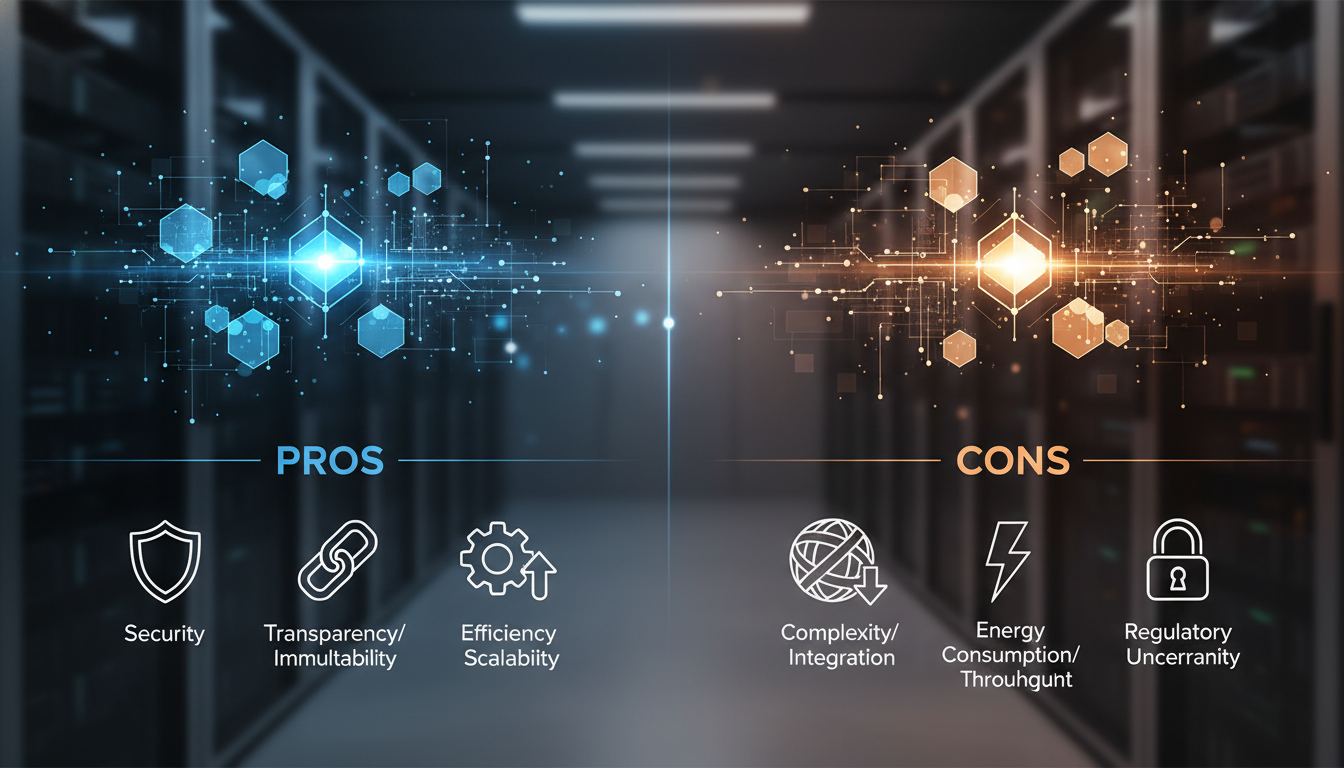
Blockchain applications development offers real architectural advantages, but it also introduces constraints that traditional software doesn’t. Understanding both sides is essential before committing to a decentralized architecture.
Pros
- Immutability and auditability: Every transaction is permanently recorded and verifiable by any participant, making fraud significantly harder to execute without detection.
- Elimination of intermediaries: Smart contracts automate enforcement of business logic, reducing reliance on banks, brokers, or clearinghouses and cutting associated fees.
- Composability: On public chains like Ethereum, protocols can interact with each other directly. DeFi’s entire ecosystem is built on this property.
- Global accessibility: Anyone with an internet connection and a wallet can interact with a public blockchain application, removing geographic and institutional barriers.
- Transparent governance: DAOs allow token holders to vote on protocol changes, distributing decision-making power across the community rather than concentrating it in a single entity.
Cons
- Immutability cuts both ways: A bug in a deployed smart contract cannot be patched without a pre-built upgrade mechanism. The DAO hack of 2016 drained roughly $60 million before a hard fork could respond.
- Scalability constraints: Public blockchains process far fewer transactions per second than centralized databases. Ethereum’s base layer handles roughly 15-30 TPS without Layer-2 support.
- Gas fee volatility: During peak congestion, Ethereum gas fees for a single swap can exceed $100, creating unpredictable user experience costs.
- Regulatory uncertainty: Frameworks like the EU’s MiCA and U.S. SEC guidance are still evolving, adding compliance complexity to every blockchain applications development project.
- Steep learning curve: Solidity, Rust, and on-chain security patterns are not skills most developers carry. Hiring or training takes time and budget.
Key Platforms for Blockchain Applications

Selecting the right blockchain platform is one of the most consequential decisions in any blockchain applications development project. Each platform makes different trade-offs across consensus design, transaction throughput, and ecosystem maturity.
Ethereum and EVM-Compatible Chains
Ethereum remains the most widely adopted platform for decentralized applications, hosting over 4,000 dApps as of early 2026. Its Ethereum Virtual Machine (EVM) executes smart contracts written in Solidity, and the tooling ecosystem (Hardhat, Foundry, OpenZeppelin) is the most mature in the industry. EVM-compatible chains like Binance Smart Chain and Polygon offer lower transaction costs and faster finality while preserving compatibility with Ethereum’s developer tooling. PixelPlex notes that Ethereum launched in 2015, introducing programmability that went well beyond Bitcoin’s value-transfer model.
Alternative Blockchains
For projects requiring higher throughput, Solana uses a Proof of History mechanism that timestamps transactions before they enter consensus, enabling thousands of transactions per second. Polkadot’s relay chain connects specialized parachains, letting customized blockchains interoperate without bridging hacks. Hyperledger Fabric, a permissioned ledger maintained by the Linux Foundation, is purpose-built for enterprise consortia where data privacy and controlled access are non-negotiable. North America contributed 46% of global blockchain market growth, driven largely by enterprise adoption of private ledger solutions, according to BlockchainAppsDeveloper.
Consensus Algorithms Compared: PoW vs. PoS vs. PoH
Consensus is the engine that makes a distributed ledger trustworthy. Choosing the wrong one for your use case creates performance or security problems that are expensive to fix post-launch.
| Mechanism | How It Works | Energy Use | Throughput | Used By |
|---|---|---|---|---|
| Proof of Work (PoW) | Miners compete to solve cryptographic puzzles | Very high | Low (7-15 TPS) | Bitcoin |
| Proof of Stake (PoS) | Validators stake tokens as collateral to propose blocks | Low (99%+ reduction vs PoW) | Medium to high | Ethereum, Cardano |
| Proof of History (PoH) | Cryptographic timestamps order events before consensus | Low | Very high (50,000+ TPS theoretical) | Solana |
| Practical Byzantine Fault Tolerance (PBFT) | Nodes vote in rounds; requires known validator set | Very low | High with small validator sets | Hyperledger Fabric |
Choosing Between Public and Private Blockchains
| Feature | Public Blockchain | Private Blockchain |
|---|---|---|
| Transparency | All transactions visible to anyone | Visibility restricted to authorized entities |
| Governance | Decentralized, community-driven | Centralized governance by a consortium |
| Speed | Lower throughput due to global consensus | Higher throughput with fewer nodes |
| Cost | Public gas fees per transaction | Lower operational costs |
| Use Cases | Cryptocurrencies, open dApps, DeFi | Supply chain, banking, healthcare consortia |
The U.S. is expected to spend $41 billion on blockchain solutions by 2025, per BlockchainAppsDeveloper, signaling strong investment across both public and private blockchain initiatives.
The Blockchain Applications Development Process

Building a blockchain application demands a structured methodology that accounts for the unique risks of decentralized systems. The process typically follows these six steps:
- Step 1: Discovery and Use Case Definition. Clarify the business problem and determine whether blockchain genuinely adds value. A supply chain traceability app benefits from immutable records. A simple internal logging system probably doesn’t need a distributed ledger at all.
- Step 2: Platform Selection. Evaluate throughput requirements, privacy needs, and consensus preferences, then match them to a platform like Ethereum, Hyperledger Fabric, or Solana. Assess SDK maturity and available developer tooling before committing.
- Step 3: Architecture and Smart Contract Design. Define the data model, consensus rules, and contract logic. Solidity handles EVM chains; Rust targets Solana and Near. Off-chain data feeds via oracles like Chainlink must be planned at this stage, not bolted on later.
- Step 4: Development and Iterative Testing. Write and unit-test smart contracts using frameworks like Hardhat or Foundry. Simulate the blockchain environment locally before deploying to public testnets like Sepolia or Goerli.
- Step 5: Security Auditing. Engage specialized firms to audit smart contract code and overall architecture. According to Hashlock, reentrancy and integer overflow vulnerabilities have caused millions in losses. Audits are not optional.
- Step 6: Deployment and Monitoring. Deploy to mainnet with proxy contracts for upgradeability. Monitor gas usage, user activity, and on-chain analytics continuously post-launch.
“80% of surveyed asset and wealth managers acknowledge that disruptive technologies, including blockchain, fuel revenue growth.” PwC
That figure reframes blockchain applications development from a cost center into a revenue driver. The organizations treating it as infrastructure investment are the ones capturing market share.
Discovery and Consulting
The initial phase often involves blockchain consulting to assess technical and business feasibility. Appinventiv recommends thorough competitor and market analysis to ensure the blockchain use case aligns with real business goals before architecture decisions are made. McKinsey estimates the tokenized market capitalization across asset classes could reach roughly $2 trillion by 2030, which underscores why early strategic planning matters enormously.
Testing and Quality Assurance
Testing blockchain applications requires validating consensus logic, transaction ordering, and behavior under network congestion. Libraries like Web3.js and ethers.js facilitate automated test suites. Hashlock emphasizes that comprehensive test coverage, including fuzzing and invariant testing, is critical before any mainnet deployment. Skipping this step is how protocols lose eight-figure sums in a single transaction.
Types of Blockchain Applications
The spectrum of blockchain applications development spans fully decentralized dApps to hybrid systems that combine on-chain settlement with centralized user interfaces. Knowing the distinctions helps you pick the right architecture from the start.
dApps vs. Blockchain Applications
A decentralized application (dApp) runs entirely on a peer-to-peer network. Its backend logic lives in smart contracts, and governance is typically handled by a DAO. A blockchain application, by contrast, may use distributed ledger technology for specific functions, like recording payment settlements, while keeping centralized user authentication. Riseup Labs notes that dApps require gas fees for every state change, which directly affects user experience design decisions.
Enterprise and Private Blockchains
Enterprise solutions like Hyperledger Fabric and R3 Corda offer permissioned networks built for supply chain traceability, trade finance, and healthcare records. These platforms enable controlled data sharing among known participants while meeting regulatory requirements. The blockchain market is projected to reach $943 billion by 2032 at a CAGR of 56.1%, with enterprise adoption of private ledger solutions accounting for a significant portion of that growth.
Cross-Platform Blockchain Development
A growing priority in blockchain applications development is building systems that integrate with mobile and cloud environments without friction. Startup Grind highlights that mobile developers are increasingly embedding blockchain for secure peer-to-peer transactions and data privacy. Cloud providers like AWS and Azure offer Blockchain-as-a-Service (BaaS) to simplify node management, reducing time-to-market by 30-50% for enterprise clients.
Low-Code and No-Code Blockchain Platforms
Not every blockchain project needs a team of senior Solidity engineers. Platforms like Moralis, Alchemy, and Thirdweb provide SDKs and pre-built contract templates that let product teams deploy token contracts, NFT collections, and basic dApps without writing raw Solidity. These tools are accelerating prototyping cycles from months to weeks. The trade-off is reduced customization and, in some cases, dependency on a third-party infrastructure layer. For production systems handling real value, custom-built contracts with full audits remain the standard.
Security and Challenges in Blockchain Applications Development
Security is the foundation of any credible blockchain project. The immutable nature of the ledger means a single vulnerability can cause irreversible losses. In 2025, DeFi protocol exploits resulted in over $1.2 billion in stolen funds, making security audits a mandatory step in the blockchain applications development lifecycle, per Hashlock.
Smart Contract Vulnerabilities
Common attack vectors include reentrancy, where an attacker repeatedly calls a withdrawal function before the balance updates, and integer overflows that allow arithmetic to wrap around to unexpected values. Static analysis tools like Slither and MythX catch many of these bugs before deployment. Formal verification of contract logic is gaining traction among enterprise developers who need mathematical proof of correctness, not just test coverage.
Here’s a minimal reentrancy guard in Solidity that illustrates the fix:
// SPDX-License-Identifier: MIT

 }

 }
}
The state update happens before the external call. That ordering is the entire defense. Most reentrancy exploits succeed because developers get that sequence wrong.
The Importance of Security Audits
Third-party security audits from firms like Hashlock or CertiK provide an independent review of smart contract code and overall system architecture. These audits examine business logic, access controls, and compliance with standards like ERC-20 or ERC-721. Hashlock advises teams to allocate at least 10-15% of total project budget to security testing. That’s not overhead. That’s insurance against losing everything.
Scalability and Regulatory Hurdles
Public blockchains face congestion during peak usage. Ethereum’s base layer processes roughly 15-30 TPS, and gas fees for a single swap can exceed $100 during high-demand periods. Layer-2 solutions address this directly.
Layer-2 Scaling: Optimistic Rollups vs. ZK-Rollups
Both rollup types move computation off the main chain while anchoring security to Ethereum’s base layer. The differences matter for your architecture:
| Property | Optimistic Rollups | ZK-Rollups |
|---|---|---|
| Fraud proof model | Assumes validity; challenges within a dispute window (typically 7 days) | Cryptographic validity proofs submitted with every batch |
| Withdrawal time | 7-day challenge period for full withdrawals | Near-instant finality after proof verification |
| EVM compatibility | High (Optimism, Arbitrum are EVM-equivalent) | Improving rapidly (zkEVM: Polygon zkEVM, zkSync Era) |
| Proof computation cost | Low (no proof generation) | Higher (ZK proof generation is compute-intensive) |
| Best for | General-purpose dApps, DeFi | High-frequency trading, privacy-sensitive applications |
On the regulatory front, the EU’s MiCA framework and evolving U.S. SEC guidance are shaping how tokenized assets must be structured, adding compliance layers to every blockchain applications development project that touches financial instruments.
Regulatory Compliance: MiCA and Beyond
The EU’s Markets in Crypto-Assets (MiCA) regulation, which came into full effect in 2024, establishes licensing requirements for crypto-asset service providers and issuers of asset-referenced tokens. For blockchain applications development teams building in Europe or serving European users, MiCA compliance is now a hard requirement, not a nice-to-have. In the U.S., SEC guidance on whether tokens constitute securities continues to shape token design decisions. Building with legal counsel from day one is cheaper than restructuring a live protocol under regulatory pressure.
Future Trends in Blockchain Applications Development
As of 2026, blockchain applications development is converging with AI, real-world asset tokenization, and cross-platform wallet infrastructure. These aren’t speculative trends. They’re active engineering priorities at major protocols today.
AI and Smart Contract Automation
Machine learning algorithms are being embedded into on-chain systems to enable adaptive logic: dynamic pricing in DeFi protocols, predictive maintenance triggers in supply chain dApps, and autonomous agent execution based on real-time oracle data. BlockchainAppsDeveloper already offers AI development services alongside blockchain infrastructure, pointing to a near-term future where autonomous agents execute on-chain decisions without human intervention. The question isn’t whether AI will intersect with smart contracts. It’s how to audit and constrain that intersection safely.
Cross-Platform Blockchain Solutions
As businesses demand consistent user experiences across devices, tools like WalletConnect and ethers.js enable blockchain applications to run across iOS, Android, and web browsers with unified wallet sessions. This cross-platform approach is lowering the barrier for mainstream adoption. PixelPlex notes that Web3 iOS development is increasingly requested by enterprise clients, blending native mobile performance with blockchain backends.
Tokenization and Real-World Assets
Tokenized money market funds have already surpassed $1 billion in assets under management, and McKinsey estimates the tokenized market could reach roughly $2 trillion by 2030. This trend is pulling blockchain applications development into traditional finance, real estate, and commodities. Each of these sectors requires robust legal frameworks, compliance tooling, and on-chain identity solutions that the industry is still building out. The infrastructure opportunity here is substantial.
Sustainability and Carbon Footprint
Energy consumption is no longer just a PR concern for blockchain projects. Institutional investors and enterprise procurement teams now require environmental impact assessments before committing to infrastructure partnerships. Ethereum’s move to Proof of Stake cut energy use by over 99%. Bitcoin’s Proof of Work remains energy-intensive, though a growing share of mining operations are sourcing renewable energy. For new blockchain applications development projects, choosing a PoS or PBFT-based chain is increasingly the default, both for efficiency and for meeting ESG reporting requirements.
For a deeper look at how tokenomics design intersects with these architectural decisions, see our analysis on the Digital Blockchains blog. If you’re evaluating how to structure a token launch alongside your application, our studio process covers the full lifecycle from protocol design to deployment.
Frequently Asked Questions
What is blockchain applications development?
Blockchain applications development is the process of designing, coding, auditing, and deploying software that uses a decentralized ledger to record transactions immutably. It involves smart contracts, consensus protocols, and often token economics to create systems that operate without a central authority.
How much does it cost to develop a blockchain application?
Costs range from roughly $50,000 for a simple dApp to over $500,000 for enterprise-grade platforms. Key cost drivers include platform choice, team location, smart contract complexity, and the scope of security auditing required before mainnet deployment.
Which blockchain platform is best for enterprise apps?
Hyperledger Fabric and R3 Corda are the leading choices for permissioned enterprise environments, offering privacy controls and pluggable consensus. For public-facing enterprise use cases, Ethereum with Layer-2 scaling via Optimism or Arbitrum is the most common architecture.
What programming languages are used for smart contracts?
Solidity is the dominant language for EVM-compatible blockchains including Ethereum, Polygon, and Binance Smart Chain. Rust is used on Solana and Near Protocol, while Hyperledger Fabric supports chaincode written in Go and JavaScript.
Will AI replace blockchain developers?
AI tools like GitHub Copilot can accelerate Solidity boilerplate, but they cannot replace the security reasoning, protocol design, and adversarial thinking that experienced blockchain developers bring. AI-generated smart contract code still requires expert auditing before deployment, making human expertise more valuable, not less.
Is blockchain development still a good career in 2026?
Yes. With the median U.S. blockchain developer salary at $136,000 per year and demand growing across finance, healthcare, and logistics, the field offers strong career prospects. The supply of qualified developers remains well below demand, per Coursera.
Build With Us
Blockchain applications development done right requires more than a framework and a deployment script. It requires protocol-level thinking, security-first architecture, and tokenomics that hold up under adversarial conditions. If you’re building something serious, apply to the Genesis Cohort at digitalblockchains.com and work with a team that reads whitepapers before writing a single line of production code.