Blockchain consulting is expert guidance on adopting distributed ledger technology, covering strategy, development, security, and compliance. Organizations use it to improve transparency, reduce operational friction, and build new revenue models on decentralized infrastructure.
Key Takeaways
- Blockchain consulting bridges the gap between distributed ledger technology and real business objectives, from feasibility through production.
- Core services span strategy, smart contract development, tokenomics design, security audits, and regulatory compliance.
- The global blockchain market was valued at $7.18 billion in 2022 and is projected to reach $163.83 billion by 2029.
- A Deloitte survey found that 86% of U.S. companies were building or planning blockchain teams as of 2021.
- Three firm types exist: global consultancies, hybrid firms, and specialized boutiques. Each suits a different project profile.
- Choosing the right partner requires matching technical depth, industry experience, and delivery model to your specific goals.
What Is Blockchain Consulting?

Blockchain consulting is the practice of providing specialized advice to organizations seeking to adopt, integrate, or optimize blockchain technology. It’s not general IT advisory work. It demands deep knowledge of decentralized architectures, consensus mechanisms, cryptographic primitives, and token economics, applied to specific business problems.
Definition and Core Concepts
A blockchain consultant acts as a strategic partner, guiding clients from initial feasibility assessments through full-scale implementation. Blockchain itself is a decentralized, immutable database that stores data in cryptographically linked blocks, ensuring transparency and finality without a central authority. Consultants bridge the knowledge gap between that technical reality and business objectives, ensuring solutions actually align with organizational goals rather than chasing technology for its own sake.
As the field has matured, consulting scope has expanded dramatically. EY began offering blockchain-related tax advice to Bitcoin miners in 2012. Today, the same practice leads full-scale digital asset transformations for global enterprises, covering everything from stablecoin treasury strategy to real-world asset tokenization.
The Role of a Blockchain Consultant
A blockchain consultant analyzes business processes, identifies viable use cases, designs solution architectures, and oversees deployment. They also advise on regulatory compliance, cybersecurity posture, and tokenomics. According to Maryville University, consultants help new blockchain firms develop growth strategies and optimize business efficiency through targeted implementations. Day-to-day work ranges from cloud integration and proof-of-concept (PoC) creation to risk management and legal advisory on digital identity frameworks.
Why Businesses Need Blockchain Consulting

Businesses need blockchain consulting because the cost of a wrong architectural decision compounds over time. A poorly chosen consensus mechanism, an under-audited smart contract, or a token model that misaligns incentives can sink a project before it reaches mainnet.
Key Benefits
Engaging blockchain consulting services delivers several concrete advantages. Expert guidance reduces the risk of costly mistakes in a field where protocol-level errors are often irreversible. Consultants provide tailored strategies that compress development timelines and cut operational inefficiencies. They also help organizations achieve compliance with AML and KYC requirements, which is non-negotiable in finance and healthcare.
Beyond risk reduction, blockchain consulting opens new product territory. Tokenization enables fractional ownership of high-value assets. Smart contract automation eliminates intermediaries in settlement workflows. Stablecoin payment rails can cut cross-border transaction costs significantly compared to traditional correspondent banking. These aren’t theoretical benefits. They’re production outcomes that consultants have helped enterprises reach across multiple sectors.
Overcoming Implementation Challenges
Implementing blockchain without expert guidance creates predictable failure modes: scalability bottlenecks, interoperability gaps with legacy systems, and regulatory exposure. A skilled consulting team builds a roadmap that addresses these issues systematically, typically starting with PoC projects to validate assumptions before committing full capital. EY’s blockchain practice, for instance, has helped enterprises move from pilot to production by integrating proprietary APIs and compliance frameworks, reducing the friction of enterprise-grade deployment.
Core Services of Blockchain Consulting
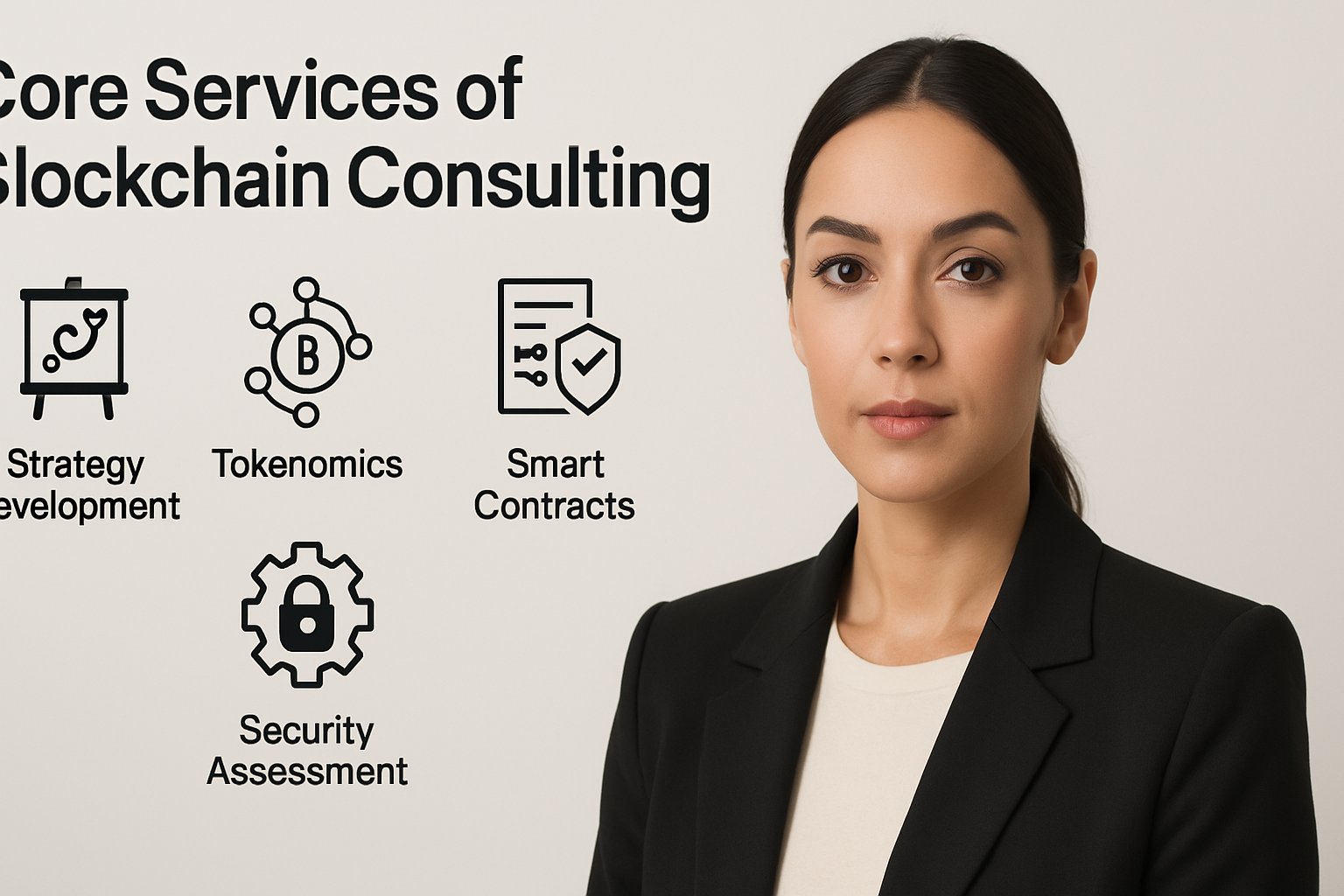
Blockchain consulting covers four primary service areas: strategy and roadmapping, technology enablement, tokenomics design, and security plus compliance. Each phase builds on the last.
Strategy and Roadmapping
Every engagement starts with strategy. Consultants evaluate market entry options, build commercialization plans, and create detailed implementation roadmaps. A critical early decision is whether to build a proprietary chain, deploy on an existing L1 or L2, or integrate with permissioned infrastructure like Hyperledger Fabric. EY’s blockchain practice covers this full spectrum, from stablecoin integration planning to real-world asset tokenization strategy, helping clients answer hard questions about treasury allocation and regulatory positioning before a single line of code is written.
Technology Enablement and Development
Once strategy is locked, consulting firms move into technical implementation. Platform selection is the first technical decision: Ethereum for maximum ecosystem depth and EVM compatibility, Hyperledger Fabric for permissioned enterprise deployments, Solana for high-throughput applications requiring sub-second finality. Each choice carries trade-offs in decentralization, throughput, and developer tooling.
Firms like PixelPlex specialize in building proofs of concept and minimum viable products (MVPs) to demonstrate real-world applicability before full investment. Itransition emphasizes security assessments and economic feasibility evaluations as core components of technical enablement. Both approaches reflect the same principle: validate before you scale.
Platform Comparison: Ethereum vs. Hyperledger vs. Solana
Choosing a blockchain platform is one of the highest-stakes decisions in any consulting engagement. Here’s how the three most common enterprise options compare:
| Platform | Architecture | Throughput | Permissioning | Best For |
|---|---|---|---|---|
| Ethereum (+ L2s) | Public, EVM-based | 15-100 TPS (L1); thousands on L2s like Arbitrum/Optimism | Permissionless | DeFi, NFTs, public token launches, DAO governance |
| Hyperledger Fabric | Permissioned, modular | Hundreds to thousands of TPS depending on config | Fully permissioned | Enterprise supply chain, healthcare records, B2B consortia |
| Solana | Public, Proof of History | Thousands of TPS with sub-second finality | Permissionless | High-frequency trading, gaming, consumer-facing dApps |
The right choice depends on your trust model, regulatory environment, and performance requirements. A blockchain consulting partner should be able to defend that choice with protocol-level reasoning, not vendor preference.
Tokenomics and Tokenization Consulting
Tokenomics design is one of the fastest-growing niches within blockchain consulting. This involves advising on token distribution schedules, utility mechanics, governance rights, vesting structures, and monetization strategies. A poorly designed token model can destroy a project’s incentive structure within months of launch, regardless of how good the underlying technology is.
Consultants help startups and enterprises create fungible tokens, governance tokens, and non-fungible tokens (NFTs) that align with long-term business goals. Specialized firms like PixelPlex offer end-to-end tokenization campaigns, including security token offerings (STOs), ensuring both compliance and market readiness. For a deeper look at token launch mechanics, see our guide on token launch services.
Security and Compliance
Security is where blockchain projects most frequently fail in production. Consultants perform rigorous security assessments covering threat modeling, smart contract vulnerability testing, and identity management architecture. According to EY, robust cybersecurity frameworks are essential to protect digital asset transactions and custody infrastructure. Compliance work runs in parallel: KYC/AML integration, data privacy alignment (GDPR, CCPA), and financial crimes compliance to avoid sanctions exposure.
As of 2026, regulatory frameworks are converging globally. The EU’s Markets in Crypto-Assets (MiCA) regulation establishes clear rules for crypto-asset issuers and service providers across member states. In the U.S., SEC guidance continues to shape how token offerings are structured. A qualified blockchain consulting partner tracks these developments and builds compliance into architecture from day one, not as an afterthought.
Types of Blockchain Consulting Firms

Not all consulting providers operate the same way. SumatoSoft’s 2026 analysis identifies three distinct firm types, each with a different operational philosophy and ideal client profile.
| Type | Operational Philosophy | Technical Depth | Project Velocity | Best Suited For | Example |
|---|---|---|---|---|---|
| Global Consulting Firms | Top-down; risk-managed; integration-focused | Enterprise architecture, system integration, cloud infrastructure | Gradual; phased implementations | Large enterprises, regulated industries | EY |
| Hybrid Consulting Firms | Balanced; consulting plus implementation | Architecture design plus hands-on engineering | Moderate; iterative delivery cycles | Mid-size companies and enterprise product teams | SumatoSoft |
| Specialized Blockchain Boutiques | Bottom-up; agile; performance-optimized | Deep blockchain protocol expertise; smart contracts; tokenization | Rapid sprints; fast MVP delivery | Startups, Web3 platforms, tokenization products | PixelPlex |
Global Consulting Firms
Large consultancies like EY and BCG offer end-to-end services with strong emphasis on compliance, audit, and enterprise governance. They’re ideal for complex, large-scale transformation projects in highly regulated sectors like banking and healthcare. Their global reach and multidisciplinary teams mean every dimension, from tax treatment to cybersecurity architecture, gets covered. The trade-off is velocity: phased implementations at enterprise scale take time.
Hybrid Consulting Firms
Mid-size firms combine strategic consulting with hands-on technical implementation. They offer a balance between high-level vision and practical engineering, making them suitable for organizations that need both strategy and execution without the overhead of a global firm. SumatoSoft, for example, provides architecture design alongside system implementation, operating on iterative delivery cycles that reduce time-to-market for mid-size product teams.
Specialized Blockchain Boutiques
These firms focus exclusively on blockchain and Web3 technologies. Their depth in areas like DeFi protocol design, NFT infrastructure, and smart contract security makes them the natural choice for startups launching dApps or tokenized platforms. PixelPlex is a notable example, offering rapid MVP delivery and specialized tokenomics advisory. Boutiques typically work in agile sprints, delivering functional prototypes within weeks rather than quarters.
Pros and Cons of Hiring a Blockchain Consulting Firm
Blockchain consulting delivers real value, but it’s not the right move for every organization at every stage. Here’s an honest breakdown.
Pros
- Accelerated time-to-market: Expert teams compress development cycles by avoiding common architectural dead ends.
- Risk reduction: Security audits, compliance frameworks, and PoC validation catch expensive mistakes before they reach production.
- Access to specialized skills: Smart contract auditors, tokenomics designers, and DeFi architects are scarce. Consulting firms aggregate that talent.
- Regulatory navigation: Staying current with MiCA, SEC guidance, and AML/KYC requirements is a full-time job. Consultants handle it so your team doesn’t have to.
- Objective perspective: External advisors aren’t attached to internal assumptions. They’ll tell you when blockchain isn’t the right tool for the job.
Cons
- Cost: Boutique firms typically charge $150-$300 per hour. Global consultancies can exceed $500 per hour. Fixed-price PoC projects often start at $20,000 or more.
- Knowledge transfer gaps: If the engagement ends without proper documentation and training, institutional knowledge walks out the door with the consultants.
- Vendor lock-in risk: Some firms build on proprietary frameworks that create long-term dependency on their services.
- Misaligned incentives: Firms paid by the hour have limited financial incentive to move fast. Scope creep is a real risk without clear deliverables.
How to Choose a Blockchain Consulting Partner
Choosing the right blockchain consulting partner comes down to matching the firm’s actual technical depth and delivery model to your specific project requirements, not just their marketing materials.
Key Evaluation Criteria
Work through these steps before signing any engagement:
- Define your objectives: Clearly outline what you want to achieve, whether that’s cost reduction, enhanced security, a new token product, or supply chain traceability.
- Research firm types: Understand the differences between global, hybrid, and boutique firms. Match the firm type to your project scale and timeline.
- Evaluate technical expertise: Look for proven experience with your target blockchain platform (Ethereum, Hyperledger, Solana) and directly relevant use cases. Ask to see code, not just slide decks.
- Review case studies: Real-world delivery history indicates capability. Look for projects similar in scope and industry to yours.
- Assess communication and transparency: A good consulting engagement requires clear reporting, honest status updates, and accessible technical documentation throughout.
Questions to Ask Before Signing
Push any prospective firm on these points:
- Can you show examples of similar projects in our industry, including what went wrong and how you fixed it?
- How do you approach regulatory compliance and security from the architecture level, not just as a final audit?
- What is your typical project timeline, milestone structure, and cost model?
- Do you offer post-implementation support, documentation, and team training?
- Who specifically will work on our project, and what are their credentials?
“The biggest mistake enterprises make is treating blockchain as a database upgrade. It’s a trust infrastructure decision. Get that framing wrong and no amount of consulting will save the project.” – Common observation among senior blockchain architects working in enterprise DLT deployments
Blockchain Consulting: Market Trends and Statistics
The blockchain consulting market is expanding fast, driven by enterprise adoption, regulatory clarity, and the maturation of DeFi and tokenization infrastructure.
Market Growth and Projections
The global blockchain market was valued at $7.18 billion in 2022 and is projected to reach $163.83 billion by 2029, according to industry market research. The U.S. market is expected to grow at a compound annual growth rate (CAGR) of 86.2% from 2023 to 2030. These figures reflect not just technology adoption but the expanding scope of advisory services as enterprises move from experimentation to production-grade deployments. EY’s blockchain practice has tracked this shift directly, growing from Bitcoin tax advisory in 2012 to leading digital asset transformation programs for global financial institutions today.
Industry Adoption Rates
Enterprise adoption is accelerating across sectors. A Deloitte survey found that 86% of U.S. companies were building or planning to build blockchain teams as of 2021. Financial services, healthcare, supply chain, and legal are leading adoption. Blockchain consulting helps these sectors address interoperability with legacy systems and data privacy requirements while capturing the benefits of immutable record-keeping and smart contract automation.
Trends Shaping Blockchain Consulting in 2026
Several forces are reshaping the blockchain consulting market this year. Real-world asset (RWA) tokenization is moving from pilot to production, with tokenized treasury products and private credit instruments now live on public chains. Stablecoin payment infrastructure is expanding as enterprises seek programmable settlement rails. The convergence of AI and blockchain, particularly for verifiable computation and on-chain data provenance, is creating new consulting specializations. Per DeFi metrics tracked on DefiLlama, total value locked across DeFi protocols has demonstrated the scale of capital now operating on decentralized infrastructure, reinforcing enterprise interest in the space.
“Regulatory convergence is the single biggest accelerant for enterprise blockchain adoption right now. MiCA in Europe gives institutions a compliance framework they can actually build on.” – Perspective shared consistently across EY and BCG blockchain practice publications, 2025-2026
Blockchain Consulting for Supply Chain: A Closer Look
Supply chain is one of the most mature and validated use cases for blockchain consulting, with production deployments running across food safety, pharmaceutical traceability, and trade finance.
The core value proposition is straightforward: every participant in a supply chain, from raw material supplier to end retailer, writes to a shared ledger that no single party controls. Disputes over provenance, delivery confirmation, or payment terms get resolved by on-chain data rather than competing spreadsheets. Hyperledger Fabric is the dominant platform for these deployments because its permissioned architecture lets consortium members control data visibility while maintaining a shared source of truth.
A blockchain consulting engagement in supply chain typically spans 3-6 months for a PoC and 12-18 months for a production rollout across a multi-party network. The consulting work includes mapping existing data flows, designing the smart contract logic for automated settlement triggers, and onboarding consortium members with different technical capabilities. Security and data governance frameworks are critical: who can read what, who can write what, and how disputes get escalated off-chain.
Career Path: Becoming a Blockchain Consultant
Becoming a blockchain consultant requires a combination of protocol-level technical knowledge and the business acumen to translate that knowledge into organizational strategy.
Required Skills
The skill set spans both technical and strategic domains:
- Proficiency in blockchain platforms (Ethereum, Hyperledger Fabric, Solana) and their respective developer tooling
- Smart contract development in Solidity (EVM chains) or Rust (Solana, Near)
- Understanding of cryptography, consensus mechanisms, and distributed systems fundamentals
- Business analysis, financial modeling, and strategic planning
- Working knowledge of regulatory environments: KYC, AML, MiCA, SEC frameworks
- Communication, stakeholder management, and project delivery skills
According to Maryville University, blockchain consultants typically hold a bachelor’s degree in computer science or a related field, with many pursuing additional certifications in blockchain development. Work environments range from investment banks and accountancy firms to oil and gas companies and government agencies, reflecting how broadly the technology has penetrated enterprise operations.
Salary and Job Outlook
Demand for blockchain consultants is strong and growing, driven by the market expansion documented above. Salaries are competitive, with experienced consultants commanding six-figure compensation in most major markets. Independent advisors with deep DeFi or tokenomics expertise can charge premium rates. Job opportunities span large tech firms, specialized consultancies, financial institutions, and independent advisory practices. As of 2026, the pipeline of enterprise blockchain projects entering production is creating sustained demand for practitioners who can bridge protocol knowledge and business execution.
Pros and Cons Summary
To recap the core trade-offs before you make a decision:
- Hire a global firm if you’re in a regulated industry, need audit-grade documentation, and have an 18-month+ timeline.
- Hire a hybrid firm if you need both strategy and engineering execution at a mid-market pace.
- Hire a boutique if you’re building a Web3 product, launching a token, or need deep DeFi expertise delivered fast.
- Build in-house only if you already have senior blockchain architects on staff and a clear protocol strategy. Otherwise, the learning curve is expensive.
For more on how Digital Blockchains approaches protocol infrastructure and token launch strategy, explore our studio work and the resources we publish for serious builders.
Frequently Asked Questions
What does a blockchain consultant do?
A blockchain consultant advises businesses on adopting and implementing blockchain technology. They analyze requirements, design solution architectures, develop strategies, and guide integration, security, and compliance work to achieve specific business goals.
How much does blockchain consulting cost?
Costs vary based on project scope and firm type. Boutique firms typically charge $150-$300 per hour, while global consultancies can exceed $500 per hour. Fixed-price PoC projects generally start at $20,000, with full production implementations running significantly higher depending on complexity and team size.
What are the benefits of hiring a blockchain consulting firm?
Hiring experts accelerates implementation, reduces architectural risk, ensures regulatory compliance, and provides access to specialized skills that are scarce in the open market. A good consulting partner also helps you avoid the most common and costly mistakes before they reach production.
Which industries use blockchain consulting services?
Major industries include financial services (payments, asset tokenization, trade finance), healthcare (patient records, clinical trial data), supply chain (provenance tracking, automated settlement), legal (smart contract enforcement), and government (digital identity, public records). Any sector with data integrity requirements and multi-party trust problems is a candidate.
How do I become a blockchain consultant?
Start with a strong foundation in blockchain technology, smart contract development (Solidity for EVM chains, Rust for Solana), and business strategy. A computer science degree combined with certifications from ConsenSys Academy or the Certified Blockchain Consultant program builds credible credentials. Practical experience deploying on testnets and contributing to open-source protocols matters more than credentials alone.
What trends are shaping blockchain consulting in 2026?
The dominant trends are real-world asset tokenization moving to production scale, stablecoin payment infrastructure expanding into enterprise treasury operations, MiCA providing a workable regulatory framework in Europe, and the convergence of AI with blockchain for verifiable computation. Cybersecurity and DeFi integration expertise are the fastest-growing consulting specializations this year.