Key Takeaways
- Blockchain app development services cover the full lifecycle: design, smart contract coding, security auditing, and post-launch maintenance for dApps, DeFi protocols, and enterprise networks.
- According to Gartner, blockchain will add $176 billion in business value by 2025 and exceed $3.1 trillion by 2030.
- Service types range from smart contract development and DeFi platform creation to enterprise blockchain integration and NFT marketplace builds.
- A structured six-stage process, from requirement analysis through deployment and monitoring, reduces risk and compresses time-to-market.
- Project costs span from $30,000 for a basic dApp to over $1 million for a full enterprise network, driven by complexity, team location, and compliance depth.
- Providers with certified developers, live portfolio projects, and formal audit partnerships consistently outperform generalist shops on security and delivery timelines.
Blockchain app development services are the professional offerings that design, build, audit, and maintain decentralized applications, smart contracts, and custom blockchain networks. Distributed ledger technology gives organizations tamper-proof data, automated trust, and new digital business models that traditional software cannot replicate.
What Are Blockchain App Development Services?

development services are end-to-end engineering engagements that take a business requirement and translate it into a secure, production-ready application running on a decentralized ledger. The scope covers initial consultation and feasibility analysis, smart contract coding, user-interface creation, integration with existing systems, and ongoing technical support. Whether a startup needs a proof-of-concept for a DeFi lending protocol or an enterprise demands a Hyperledger-based supply-chain platform, specialized providers handle the full stack.
The Core Components of a Blockchain Application
A blockchain application comprises three layers: the network layer (nodes, consensus protocol), the smart contract layer (business logic executed on-chain), and the application layer (front-end, wallets, APIs). Professional this type of services ensure each layer is architected for scalability, security, and interoperability. Skimping on any one layer creates technical debt that compounds fast once real capital flows through the system.
Why Businesses Seek External Blockchain Development Expertise
In-house blockchain talent remains scarce despite growing Web3 adoption. According to Statista, the number of blockchain wallet users exceeded 85 million by early 2023, yet the developer pool has not kept pace with that demand. Outsourcing this kind of development services gives companies immediate access to certified specialists, proven frameworks, and battle-tested security practices without the overhead of recruiting and training a full internal team.
Types of Blockchain App Development Services
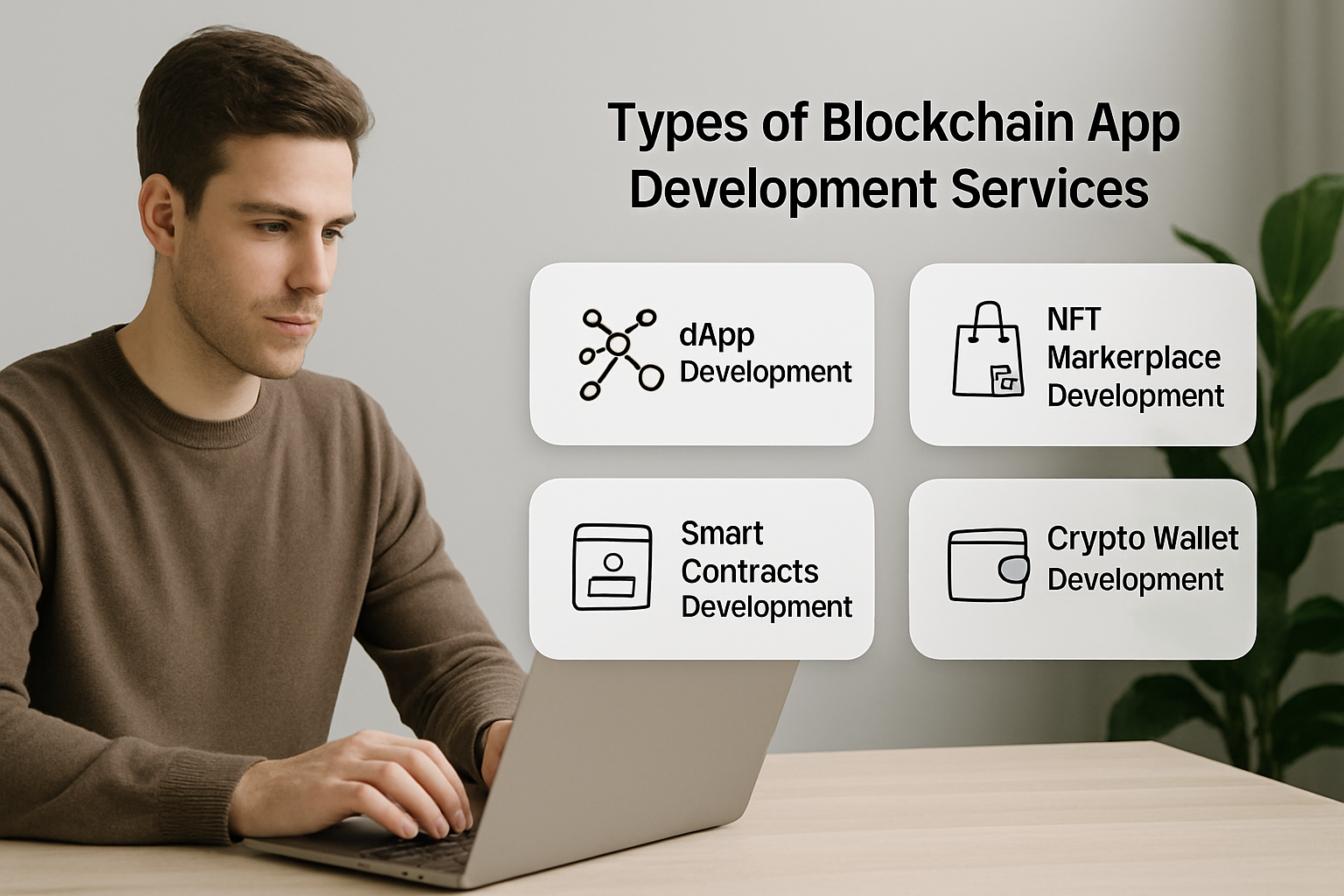
the app development services cover a broad spectrum of technical disciplines. Below are the most common offerings, each tailored to specific industry needs and technical requirements.
Smart Contract Development and Auditing
Smart contracts are self-executing agreements coded in languages such as Solidity or Rust. Smart contract development involves writing, testing, and deploying these programs on a blockchain, while auditing is the line-by-line security review that prevents exploits like reentrancy attacks. Firms like Trail of Bits and Quantstamp provide third-party audits, but many full-stack providers now bundle development with internal testing and formal verification. A single reentrancy bug can drain an entire protocol treasury, so the audit step is never optional.
Here is a minimal Solidity contract with a reentrancy guard as a reference pattern:
// SPDX-License-Identifier: MIT

    }

    }
}
Decentralized Application (dApp) Development
dApps combine on-chain logic with a familiar web or mobile interface. Services span DeFi platforms (lending, DEXs), NFT marketplaces, gaming dApps, and social networks. Appinventiv, with over 1,700 tech experts and more than 3,000 projects completed, illustrates the diversity of dApp categories that mature services now cover across Ethereum, BNB Chain, and Polygon.
Private, Public, and Consortium Blockchain Development
Public blockchains such as Ethereum and Solana are open to anyone. Private blockchains like Hyperledger Fabric restrict access to permissioned participants. Consortium networks are governed by a group of organizations sharing a common ledger. Each demands a different architecture, consensus mechanism, and governance model. Providers such as Unicsoft, which has shipped over 50 dApps and works with more than 40 protocols, demonstrate the technical breadth required to handle all three categories.
“Smart contract development is not just about coding; it’s about building a trust layer for business processes.” – Daniel Yavorovych, Co-Founder and CTO, Dysnix
“The projects that fail are almost always the ones that treat the audit as a formality rather than a core engineering milestone.” – Trail of Bits, Smart Contract Security Guidelines
Key Benefits of Professional Blockchain Application Development

Turning to a dedicated provider rather than assembling an in-house team delivers measurable advantages across speed, cost, and compliance.
Accelerated Time-to-Market
Experienced blockchain teams arrive with pre-built libraries, code generators, and CI/CD pipelines tuned for Web3. Some providers can allocate a dedicated blockchain developer within five business days, enabling projects to move from concept to prototype far faster than building from scratch. In an industry where narrative windows close quickly, DeFi cycles and NFT seasons included, speed is a genuine competitive edge.
Cost Efficiency and Risk Reduction
Senior Solidity developers in North America bill at $150 per hour or more. Engaging a firm that blends on-shore project management with global engineering talent can reduce total spend by 15-25% while maintaining quality. More importantly, audited, battle-tested code prevents the multi-million-dollar exploits that have repeatedly hit DeFi protocols. The cost of a single audit is a small fraction of total project spend, yet it can avert catastrophic losses.
Regulatory Compliance from Day One
Compliance in blockchain means adhering to AML, KYC, GDPR, and industry-specific frameworks like HIPAA or PCI DSS. Professional blockchain app bake compliance into the architecture through encrypted on-chain identity, permissioned transaction monitoring, and document-based access controls, rather than retrofitting it after launch. Appinventiv explicitly lists GDPR, HIPAA, PCI DSS, and SOC 2 Type II among its delivery standards, a signal that compliance is now a baseline expectation, not a premium add-on.
Pros and Cons of Outsourcing Blockchain App Development Services

Outsourcing blockchain app development services is the right call for most organizations, but it comes with trade-offs worth understanding before you sign a contract.
Pros
- Immediate access to certified specialists in Solidity, Rust, Move, and multi-chain tooling without a lengthy hiring process.
- Pre-built security frameworks and audit partnerships with recognized firms like CertiK and Quantstamp reduce exploit risk from day one.
- Faster delivery: experienced teams with reusable components can compress a 12-month build to 6-8 months on comparable scope.
- Built-in compliance knowledge across GDPR, HIPAA, AML/KYC, and SOC 2 Type II, critical for regulated industries.
- Post-launch DevOps and monitoring included in mature engagements, protecting protocol uptime and user funds.
Cons
- Knowledge transfer gaps: proprietary architecture decisions made by an external team can create dependency if internal engineers are not upskilled in parallel.
- Communication overhead across time zones can slow iteration cycles, particularly for agile sprints requiring daily feedback.
- Variable quality floors: the market for blockchain app development services is fragmented, and low-cost providers often skip formal verification and thorough QA.
- Cost unpredictability on time-and-materials engagements when requirements evolve mid-build, which is common in early-stage DeFi projects.
The Blockchain App Development Process: Step-by-Step
A structured methodology separates successful launches from abandoned repositories. Most top-tier providers of blockchain app development services follow a similar six-stage lifecycle.
Step 1: Requirement Analysis and Feasibility Study
The engagement starts with a deep examination of the business problem: What process must become trustless? Where does decentralization add real value? Analysts evaluate technical feasibility, estimate gas costs or resource consumption, and produce a minimum viable product (MVP) scope. Vegavid, for instance, offers blockchain consulting that covers architecture design and tokenomics modeling before a single line of code is written, a practice that prevents expensive pivots later.
Step 2: Architecture Design and Technology Selection
Deciding on a blockchain network is the most impactful choice in the entire project. The team designs node topology, data storage strategy (IPFS, Arweave), and off-chain oracle integration (Chainlink, Pyth). An NFT marketplace might use Solana for its sub-second finality, while a consortium supply-chain app would likely run on Hyperledger Fabric with private channels. The technology selection document should be a deliverable in its own right, not a footnote in a proposal.
Step 3: Smart Contract Development and Unit Testing
Developers write contracts in Solidity, Rust, or Move, using frameworks like Hardhat, Foundry, or Anchor. Each function undergoes unit tests and coverage analysis. Formal verification tools such as Certora Prover are increasingly standard for high-value protocols. The resulting bytecode is deployed to a testnet (Sepolia, Devnet) for integration testing before any mainnet consideration.
Step 4: Front-End and Back-End Development
The off-chain back-end, typically Node.js, Python, or Go, handles indexing via The Graph, off-chain order books, and user authentication. The front-end uses libraries like Ethers.js, Wagmi, or Solana Web3.js to connect to wallets (MetaMask, Phantom) and display real-time transaction states. A smooth UX with gasless transactions, fiat on-ramps, and clear error messages determines adoption more than any other factor after launch.
Step 5: Security Audit and Quality Assurance
An independent audit by a firm like Quantstamp or CertiK is non-negotiable for protocols handling user funds. The audit examines reentrancy, integer overflows, access control flaws, and logic errors. QA engineers run end-to-end tests simultaneously, simulating mainnet conditions, high load, and cross-chain scenarios. Projects that skip this step and go straight to mainnet are not being bold; they are being reckless.
Step 6: Deployment, Monitoring, and Ongoing Support
Mainnet deployment is the beginning, not the end. Mature providers offer 24/7 monitoring, upgradeability through proxy patterns (EIP-1967, EIP-2535), and incident response. Dysnix reports that its infrastructure team saved clients over $20 million in cloud costs by optimizing node deployment and scaling, which demonstrates that post-launch DevOps is as valuable as the initial build.
Core Technologies and Platforms for Blockchain Apps
The choice of tech stack drives performance, cost, and ecosystem compatibility. Providers that excel in blockchain app development services master a multi-chain toolkit rather than betting everything on a single network.
| Platform | Consensus Mechanism | Smart Contract Language | Typical Use Cases | Notable Features |
|---|---|---|---|---|
| Ethereum | Proof-of-Stake (since the Merge) | Solidity, Vyper | DeFi, NFTs, DAOs, enterprise dApps | Largest developer ecosystem, L2 scaling via rollups |
| Hyperledger Fabric | Pluggable (Raft, Kafka) | Chaincode (Go, JavaScript) | Supply chain, healthcare, finance (private/permissioned) | Fine-grained permissions, data privacy through channels |
| Solana | Proof-of-History + Proof-of-Stake | Rust, C, C++ | High-frequency trading, gaming, NFT marketplaces | Sub-second block times, up to 65,000 TPS theoretical |
| Polygon (PoS) | Proof-of-Stake (sidechain) | Solidity (EVM-compatible) | Scalable dApps, DeFi, gaming | Low fees, Ethereum compatibility, fast finality |
| BNB Chain | Proof-of-Staked Authority | Solidity (EVM-compatible) | DeFi, GameFi, token projects | High throughput, large user base, low transaction costs |
Ethereum Layer-2 Solutions and Scaling
As Ethereum’s base layer remains congested, providers now integrate Layer-2 networks like Optimism, Arbitrum, and zkSync Era. As of 2026, many new DeFi projects launch directly on L2s to offer sub-cent transaction fees while inheriting Ethereum’s security guarantees. A strong blockchain app development services partner will evaluate the trade-offs between optimistic and zero-knowledge rollups based on the application’s withdrawal latency and privacy requirements. Per L2Beat, total value locked across Ethereum L2s has grown substantially year-over-year, confirming that L2-first architecture is now a mainstream production choice.
Cross-Chain Interoperability Protocols
Multi-chain apps need bridges or messaging protocols. Wormhole, Chainlink CCIP, and LayerZero are the most widely used options for moving assets and data across chains. A DeFi aggregator might query liquidity on Ethereum, Solana, and BNB Chain simultaneously, returning the best swap route to the user. Top development houses treat cross-chain expertise as a standard competency, not a specialty add-on.
How Much Do Blockchain App Development Services Cost?
Costs for blockchain app development services vary dramatically based on project type, chosen network, team geography, and compliance requirements. The table below offers realistic ranges drawn from market data.
| Project Type | Estimated Cost (USD) | Development Time | Example Inclusions |
|---|---|---|---|
| Simple dApp (crypto wallet, basic NFT minter) | $30,000 – $70,000 | 2–4 months | Smart contract, web front-end, wallet integration |
| Mid-complexity dApp (staking platform, DAO) | $70,000 – $150,000 | 4–7 months | Multiple contracts, governance module, backend, security audit |
| Complex DeFi platform (DEX, lending protocol) | $150,000 – $500,000+ | 7–14 months | Automated market maker, oracle integration, formal verification, ongoing support |
| Enterprise blockchain (private network, supply chain) | $250,000 – $1,000,000+ | 8–16+ months | Hyperledger Fabric setup, chaincode, API layer, identity management, compliance |
Factors That Influence the Final Price
Geographic location of the development team, the number of smart contracts, integration with legacy systems, and the depth of security auditing all affect the bottom line. A fixed-price model works for well-scoped MVPs. A time-and-materials model suits projects with evolving requirements. Many providers now offer hybrid engagements where the core delivery is fixed and subsequent iterations are billed hourly, which balances budget predictability with flexibility.
Hidden Costs and Long-Term Maintenance
Beyond the initial build, projects must budget for gas fees (a complex DeFi transaction on Ethereum mainnet can cost $10–$50 during peak congestion), smart contract upgrades, server infrastructure, and community management. According to Dysnix, clients who invest in robust DevOps and monitoring from day one reduce long-term maintenance costs by up to 30% compared with reactive support models. That figure compounds significantly over a multi-year protocol lifespan.
How to Choose the Right Blockchain Service Provider
Not all blockchain app development services are equal. A systematic evaluation prevents costly missteps and protects your protocol from avoidable security failures.
Checklist for Evaluating a Potential Partner
- Track record: How many dApps have they launched? Are those apps live and handling real volume? Unicsoft showcases 50+ live dApps and reports over $5 billion in collateral managed across projects.
- Technical stack: Do they have certified developers in Solidity, Rust, and Move? Are they proficient across multiple chains? Vegavid maintains 40+ certified developers with expertise across Ethereum, Solana, Polygon, and additional networks.
- Security posture: Do they conduct internal audits? Do they partner with recognized audit firms? Ask for sample audit reports before signing anything.
- Compliance expertise: Have they delivered solutions under GDPR, HIPAA, or AML/KYC frameworks? Appinventiv lists compliance with multiple global standards as a core delivery competency.
- Post-launch support: Is monitoring included? Do they offer incident response SLAs? Dysnix saved clients $20 million in infrastructure costs through proactive monitoring, which illustrates the value of ongoing engagement beyond the initial launch.
Red Flags to Avoid
Beware of firms that promise a one-size-fits-all blockchain, lack transparent billing, or cannot provide verifiable references. A legitimate provider will openly discuss limitations such as gas fee dependencies or regulatory grey areas rather than overselling the technology. If a vendor cannot explain the difference between optimistic and ZK rollups, they should not be building your L2 strategy.
Why the Right Partner Matters for Long-Term Success
Blockchain applications are not fire-and-forget deployments. Protocol upgrades, chain migrations, and evolving regulatory landscapes demand an agile development partner. Choosing a provider with deep ecosystem knowledge, evidenced by contributions to open-source projects, published research, or partnerships with protocols like Chainlink or The Graph, ensures your application stays secure, compliant, and competitive in 2026 and beyond. For a deeper look at how protocol selection affects long-term architecture, see our analysis on smart contract development best practices.
Regulatory Compliance and Security Best Practices
As of 2026, regulators in the United States, Europe, and Asia have tightened rules around crypto assets, DeFi, and data privacy. Professional blockchain app development services now treat compliance as a foundational pillar, not a checklist item appended at the end of a sprint.
Key Compliance Frameworks: GDPR, HIPAA, AML/KYC
AML (Anti-Money Laundering) and KYC (Know Your Customer) are legal requirements for platforms that handle fiat on-ramps or custody digital assets. HIPAA governs healthcare data. GDPR protects EU citizen data. Leading development firms build identity systems that use zero-knowledge proofs or decentralized identifiers (DIDs) to meet these standards without compromising user privacy. The architecture decision, not the compliance checkbox, is what determines whether a protocol survives regulatory scrutiny.
Security Auditing Standards and Bug Bounty Programs
Beyond one-off audits, a mature security practice includes continuous fuzzing, real-time threat monitoring, and bug bounties on platforms like Immunefi. Smart contract development must follow the ConsenSys Smart Contract Best Practices guide and use tools like Slither, MythX, and Echidna. The U.S. NIST blockchain security framework (IR 8202) is now a requirement for many government-adjacent projects, and forward-looking providers align their processes to it proactively.
Real-World Example: Compliance in a DeFi Lending Protocol
Building a lending protocol for the U.S. market requires a permissioned KYC layer that whitelists addresses before they can deposit funds. The smart contract emits compliance events monitored by an off-chain service, ensuring only verified participants interact with the pool. This approach balances the openness of DeFi with the demands of the SEC and FinCEN. It is not a perfect solution, but it is the current practical standard for regulated DeFi.
Future Trends in Blockchain App Development (2026 and Beyond)
The blockchain space is moving fast. Companies that invest in blockchain app development services now position themselves at the front of the next wave of infrastructure innovation.
AI-Powered dApps and Autonomous Agents
Artificial intelligence is merging with blockchain to create autonomous agents that manage portfolios, negotiate trades, and govern DAOs. Providers are already using machine learning to optimize gas fees and detect on-chain anomalies in real time. According to Grand View Research, the overall blockchain sector is projected to grow at a 32% CAGR through the next several years, with AI-integrated dApps representing one of the fastest-growing sub-segments within that forecast.
Institutional-Grade DeFi and Real-World Asset Tokenization
Traditional financial institutions are building permissioned DeFi rails to bring bonds, real estate, and carbon credits on-chain. Unicsoft has delivered a carbon-credit tokenization platform and a diamond fractional-ownership marketplace, both of which required battle-tested custody, regulatory reporting, and a hybrid public/private architecture. These projects represent the direction the entire industry is heading: real assets, real compliance, real accountability.
Blockchain in Healthcare: A Use Case on the Rise
Healthcare blockchain applications are moving beyond pilots. These apps use distributed ledgers to secure patient records, track pharmaceutical supply chains, and manage clinical trial consent. Healthcare blockchain spending in North America is projected to reach $1.6 billion by 2025, according to industry forecasts, underscoring the urgency for development teams with both HIPAA expertise and smart contract depth. Projects in this space combine HIPAA-compliant identity management, off-chain data storage via IPFS, and smart contracts that automate insurance claim adjudication.
Interoperability and the Rise of App-Chain Ecosystems
Cosmos and Polkadot are making application-specific blockchains (app-chains) more accessible. Instead of deploying a smart contract on a shared chain, projects can launch their own sovereign chain with full control over consensus, fees, and governance. This trend demands development partners who understand not only Solidity but also Cosmos SDK, Substrate, and the IBC protocol. The result is a multi-chain future where apps share liquidity and data across sovereign networks without sacrificing security. For context on how tokenomics intersects with app-chain design, our piece on tokenomics design principles covers the governance and incentive layer in detail.
Conclusion
As the data economy moves on-chain, blockchain app development services have become the critical bridge between business ambition and technical reality. Whether launching a simple NFT collection or a multi-billion-dollar DeFi protocol, enterprises and startups alike rely on expert teams to handle complex architecture choices, rigorous security audits, and evolving regulatory frameworks. Selecting a provider with a proven track record, cross-chain mastery, and a security-first mindset is what separates protocols that last from ones that get exploited and abandoned.
If you are serious about building on-chain infrastructure that holds up under real conditions, apply to the Genesis Cohort at Digital Blockchains. We work with a small number of projects each quarter, and the bar is high by design.
Frequently Asked Questions
What is blockchain app development?
Blockchain app development is the process of creating software applications that run on a decentralized, immutable ledger. It includes designing smart contracts, building the user interface, and integrating with blockchain networks to deliver secure, transparent, and tamper-proof functionality.
What are blockchain development services?
Blockchain development services are professional offerings that help businesses plan, build, and maintain blockchain-based solutions. Typical services include smart contract coding, dApp development, blockchain consulting, security auditing, and enterprise network setup.
How much does it cost to develop a blockchain app?
Costs range from $30,000 for a basic wallet or NFT minter to over $1 million for a large-scale enterprise blockchain network. The final price depends on complexity, chosen blockchain, team location, and the depth of security auditing required.
Which blockchain platform is best for my app?
Ethereum offers the largest ecosystem and best tooling, making it ideal for DeFi and NFTs. Hyperledger Fabric suits permissioned enterprise networks, while Solana and Polygon excel in applications requiring high throughput and low fees. A professional blockchain app development services provider can evaluate these trade-offs against your specific requirements.
What is a smart contract audit and why is it necessary?
A smart contract audit is a systematic code review by security experts to identify vulnerabilities such as reentrancy, overflow errors, and logic flaws. It is essential to protect user funds and ensure the contract behaves as intended, preventing the kind of catastrophic exploits that have cost DeFi protocols hundreds of millions of dollars.
How long does it take to build a blockchain app?
An MVP of a simple dApp can be built in 2–4 months, while a complex DeFi platform may require 7–14 months or more. Timelines depend on feature scope, integration complexity, and the rigor of testing and auditing applied before mainnet deployment.