Blockchain ERP is the integration of distributed ledger technology into Enterprise Resource Planning systems to create immutable, transparent, and auditable business processes across organizational boundaries. It extends ERP beyond the firewall.
Key Takeaways
- Blockchain ERP combines distributed ledger capabilities with traditional ERP modules to enforce data integrity at the protocol level.
- Every transaction produces a cryptographically verifiable audit trail, reducing compliance overhead for multi-party operations.
- Smart contracts automate purchase orders, invoice reconciliation, and payment settlement, cutting cycle times from days to minutes.
- Supply chain traceability is the primary adoption driver, with Oracle, SAP, and IBM leading enterprise deployments.
- Integration is achievable via middleware or Blockchain as a Service (BaaS) platforms without replacing existing ERP infrastructure.
- Permissioned networks like Hyperledger Fabric and R3 Corda are the dominant choices for enterprise-grade blockchain ERP projects.
What Is Blockchain ERP?
Blockchain ERP is a system architecture that embeds distributed ledger technology directly into ERP workflows, replacing trust in a central database administrator with cryptographic consensus. The result is a shared, tamper-proof record that every authorized participant can read and verify in real time.
Understanding Blockchain Technology
Blockchain is a distributed ledger that records transactions in a decentralized, cryptographically secured structure. Originating with Bitcoin in 2009, it eliminates the need for a central authority by combining cryptographic hashing with consensus mechanisms. A typical blockchain uses a three-layered architecture: the data layer (where transactions are stored), the network layer (peer-to-peer communication), and the consensus layer (validation rules). These layers work together so that once data is written, it becomes effectively immutable.
The Role of ERP Systems
Enterprise Resource Planning systems manage core business processes, including finance, supply chain, human resources, and manufacturing, inside a unified database. Traditional ERPs rely on centralized models that create data silos and trust gaps between trading partners. Integrating blockchain into an ERP transforms it into a blockchain ERP solution, extending the system’s reach beyond the enterprise to create a shared single source of truth. According to an Infosys white paper on blockchain and ERP integration, modern supply chains are highly disjointed and geographically spread, making end-to-end transparency nearly impossible without a distributed ledger layer.
Core Benefits of Blockchain ERP Systems
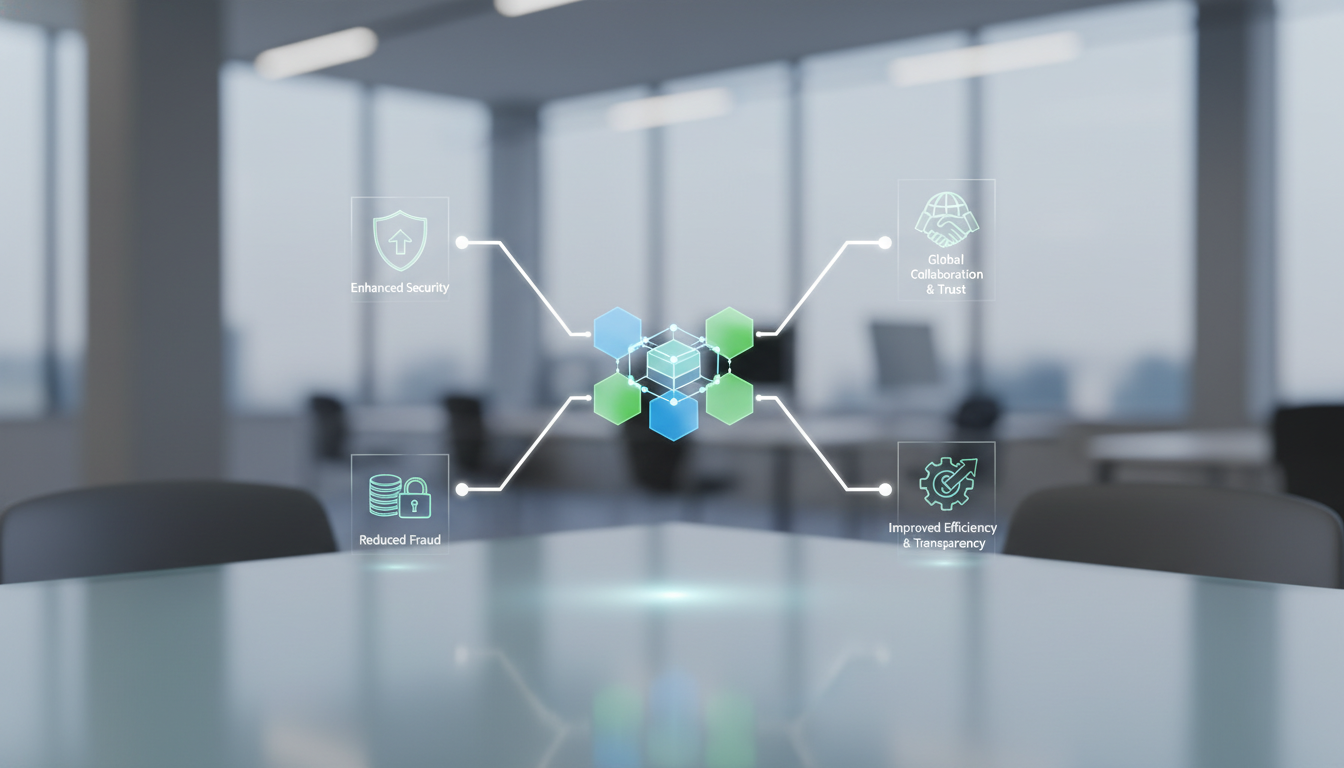
Blockchain ERP delivers measurable operational improvements across three dimensions: data security, cross-partner visibility, and process automation. Each benefit compounds the others.
Immutable Data Security
Blockchain’s cryptographic backbone makes data entered into a blockchain ERP system extremely resistant to tampering. Each transaction is hashed and linked to the previous block, forming an unbroken chain. The Infosys white paper identifies five foundational pillars that support this security model: distribution, encryption, immutability, tokenization, and decentralization. Unauthorized alterations are immediately evident to every node on the network, reducing fraud risk across financial records and proprietary manufacturing data alike.
Real-Time Transparency
End-to-end visibility is one of the most immediate operational gains. In traditional supply chains, information is siloed across dozens of systems, leading to delays and costly reconciliation cycles. A blockchain ERP gives all authorized parties an identical, real-time view of transactions and inventory movements. Deloitte highlights that pre-2020 consumer expectations around two-hour delivery models collapsed during the pandemic precisely because supply chains lacked this kind of structural transparency. Blockchain-enabled ERP systems restore that confidence by offering complete traceability from raw material sourcing to last-mile delivery.
“Using blockchain can improve both supply chain transparency and traceability as well as reduce administrative costs.” — Deloitte
Operational Efficiency via Smart Contracts
Smart contracts are self-executing agreements with terms written directly into code. Within a blockchain ERP, they automate multi-party processes such as purchase order approvals, invoice reconciliation, and payment settlements. This enables 24/7 processing and eliminates human error from routine handoffs. A smart contract can automatically release payment to a supplier the moment an IoT sensor confirms receipt of goods, compressing traditional settlement windows from days to minutes. That kind of responsiveness makes Lean and Just-in-Time planning genuinely achievable at scale.
Blockchain ERP in Supply Chain Management

Supply chain management is where blockchain ERP delivers its clearest return on investment. The combination of immutable records and automated compliance checks solves problems that have resisted conventional ERP approaches for decades.
Provenance Tracking from Source to Shelf
For food, pharmaceuticals, and luxury goods, proving origin is a regulatory and commercial requirement. A blockchain ERP records every custody transfer on an immutable ledger, so a grocery retailer can verify that a shipment of organic produce came from a certified farm within seconds rather than days. The Infosys paper discusses how compliance with standards like Country of Origin (COO) and the Universal Product Code (UPC) becomes automated and trustworthy when backed by blockchain. In pharmaceuticals, where counterfeit drugs cost the industry billions of dollars annually, this level of traceability is not optional.
“The inherent cost involved in managing supply chain intermediaries, their reliability, traceability, and transparency further complicate the supply chain.” — Infosys
Multi-Party Compliance and Auditing
Regulatory audits traditionally require sifting through disparate, siloed systems. With a blockchain ERP, auditors gain a cryptographically verifiable trail of every transaction from day one. Standards such as the United Nations Standard Products and Services Code (UNSPSC) can be encoded into the system, ensuring every item is correctly classified and reported. Since data written to the chain cannot be deleted or altered retroactively, compliance reviews shift from adversarial investigations to straightforward verification exercises. This also makes sustainability claims verifiable: greenwashing allegations can be tested against the on-chain record rather than relying on self-reported data.
Three Growth Areas for ERP-Blockchain Integration

According to the Infosys white paper, three distinct integration paths are driving blockchain ERP adoption across industries. Each suits a different organizational maturity level and risk appetite.
Vertical-Specific ERP-Blockchain Use Cases
The most immediate growth area is embedding blockchain capabilities directly into ERP modules for specific industries. Tracking high-value components in aerospace, verifying ethical sourcing in apparel, or managing cold-chain integrity in food logistics are all examples where a blockchain ERP serves as an operational backbone. Users never leave the familiar ERP interface, but every transaction they record is simultaneously written to a shared, tamper-proof ledger that all supply chain partners can access.
Middleware for Connecting ERP with Blockchain
The second growth area is middleware: software that sits between existing ERP systems and blockchain networks, acting as a translation layer. Middleware takes data from legacy ERP databases, formats it into blockchain transactions, and handles the reverse mapping. This approach avoids a full ERP overhaul. Companies can continue running Oracle or SAP while gradually onboarding partners onto a shared ledger. Most middleware solutions include API gateways that handle identity management and data normalization, keeping integration complexity manageable for IT teams that are not blockchain specialists.
Blockchain as a Service (BaaS)
The third growth area is Blockchain as a Service (BaaS), offered by major cloud providers including Microsoft Azure and IBM Blockchain Platform. BaaS provides pre-built blockchain infrastructure and development tooling, reducing the barrier to entry for blockchain ERP projects significantly. Instead of building a consortium network from scratch, enterprises can provision one in hours rather than months. This acceleration supports rapid prototyping, enabling mid-size manufacturers to pilot serial number tracking on a blockchain ERP without a capital-intensive infrastructure deployment.
Pros and Cons of Blockchain ERP
Blockchain ERP offers genuine architectural advantages over traditional centralized systems, but it also introduces complexity that organizations must plan for honestly.
Pros
- Tamper-proof audit trail: Cryptographic linking of every transaction makes retroactive data manipulation detectable by any network participant.
- Cross-partner transparency: All authorized parties share an identical real-time ledger, eliminating reconciliation disputes that plague multi-party supply chains.
- Smart contract automation: Self-executing contracts reduce settlement times from days to minutes and remove manual handoff errors from routine workflows.
- Standards compatibility: UPC, UNSPSC, and COO codes map directly onto blockchain records, bridging traditional logistics with decentralized provenance tracking.
- Non-disruptive integration: Middleware and BaaS paths allow organizations to add blockchain capabilities without replacing existing Oracle or SAP investments.
Cons
- Throughput constraints: Public proof-of-work networks cannot handle the transaction volumes typical enterprise ERP systems generate, requiring careful network selection.
- Regulatory uncertainty: Legal recognition of smart contracts and the admissibility of blockchain records vary by jurisdiction, complicating cross-border deployments.
- Onboarding friction: Every supply chain partner must adopt compatible standards and tooling, creating a coordination burden that slows initial rollout timelines.
- Immutability as a liability: GDPR’s right to erasure conflicts directly with blockchain’s append-only design, requiring architectural workarounds for EU-facing deployments.
- Energy consumption: Proof-of-work consensus mechanisms carry significant energy overhead. Permissioned networks like Hyperledger Fabric mitigate this, but the choice of consensus mechanism must be deliberate.
Challenges and Considerations for Blockchain ERP
Blockchain ERP adoption faces real technical and regulatory friction that any serious implementation plan must address before the first line of code is written.
Scalability and Performance
Blockchain’s throughput on public, proof-of-work networks is limited by design. A blockchain ERP processing thousands of transactions per second will face latency issues if the underlying network is not chosen carefully. Permissioned blockchains like Hyperledger Fabric and R3 Corda, which are the standard choice for enterprise deployments, achieve significantly higher throughput by restricting validator participation to known, trusted nodes. The 2020 pandemic demonstrated how sudden demand spikes can overwhelm rigid systems, making scalability a first-class architectural requirement rather than an afterthought.
Regulatory and Standardization Hurdles
The legal recognition of smart contracts and the admissibility of blockchain records in court vary by jurisdiction. A blockchain ERP handling cross-border transactions must comply with data residency laws like GDPR in Europe while still maintaining a shared, append-only ledger. These two requirements are structurally in tension. Industry-wide standards for blockchain interoperability are still maturing, which slows adoption at the consortium level. Organizations building serious implementations should engage with bodies like the Enterprise Ethereum Alliance and track evolving frameworks from the International Organization for Standardization (ISO) on distributed ledger technology.
Consensus Mechanism Selection
The choice of consensus mechanism shapes every performance and energy trade-off in a blockchain ERP deployment. Proof of Work (PoW), the original Bitcoin consensus model, provides strong security but consumes substantial computational resources and limits throughput. Proof of Stake (PoS) reduces energy consumption by orders of magnitude while maintaining cryptographic security, making it more practical for enterprise networks. Most permissioned enterprise blockchains use variants like Practical Byzantine Fault Tolerance (PBFT) or Raft, which prioritize speed and finality over open participation. Selecting the wrong mechanism for your transaction volume and regulatory environment is one of the most common and costly architectural mistakes in blockchain ERP projects.
Real-World Adoption and Industry Standards
Blockchain ERP has moved past the proof-of-concept stage. As of 2026, major ERP vendors have shipped production-grade blockchain features, and industry consortiums are publishing interoperability standards that make multi-vendor deployments viable.
Enterprise Giants Leading the Way
Major ERP vendors have recognized the architectural opportunity. Oracle offers blockchain tables in its Autonomous Database, enabling blockchain ERP features like tamper-proof ledgers for financial consolidation. SAP has integrated with Hyperledger Fabric for supply chain track-and-trace workflows, while Microsoft provides BaaS connectors for Dynamics 365. These are not experimental features: they are production capabilities available to enterprise customers today. IBM’s Blockchain Platform, built on Hyperledger Fabric, has been deployed in food safety networks involving dozens of major retailers and suppliers across multiple continents.
Standards Driving Interoperability
Adoption accelerates when organizations agree on shared data standards. UPC for product identification, UNSPSC for commodity coding, and COO for trade compliance are already embedded in most ERP systems. When a blockchain ERP records these same codes on-chain, it bridges traditional logistics data with decentralized provenance records without requiring custom data mapping for every new partner. The Infosys report emphasizes that these codes, recorded immutably, can materially reduce fraud in pharmaceuticals, where counterfeit drugs cost the industry billions of dollars annually and create direct patient safety risks.
Traditional ERP vs. Blockchain ERP: A Comparison
| Feature | Traditional ERP | Blockchain ERP |
|---|---|---|
| Data Control | Centralized database | Decentralized, shared ledger |
| Data Integrity | Editable, reliance on access controls | Immutable, cryptographically verified |
| Transparency | Limited to internal stakeholders | Transparent across an ecosystem of partners |
| Trust Model | Trust in a central authority | Trustless consensus mechanism |
| Process Automation | Workflow-based, often manual handoffs | Smart contract-driven, automated execution |
| Audit Trail | Logs that can be altered by admins | Verifiable, tamper-proof audit trail |
| Batch Processing | Typically updates every few hours | Near real-time settlement |
The Future of Blockchain ERP
The next evolution of blockchain ERP is not incremental. Tokenization, IoT integration, and AI-driven analytics are converging to produce systems that don’t just record what happened but actively respond to it.
Tokenization of Assets and Inventory
Looking ahead, blockchain ERP could enable the tokenization of physical assets at scale. A pallet of inventory represented as a digital token on a blockchain becomes instantly financeable, transferable, or dynamically re-routable through a supply chain without paperwork. This vision merges ERP with Decentralized Finance (DeFi), opening new working capital options for businesses that currently wait 30 to 90 days for invoice settlement. Since 2024, industry observers including Captivea have noted growing interest in traceability solutions that extend beyond simple tracking to include digital twins and tokenized asset representations.
Convergence with IoT and AI
IoT devices feed real-time sensor data directly into a blockchain ERP, ensuring that the inputs triggering smart contracts are trustworthy and tamper-evident. A temperature sensor recording cold-chain integrity cannot be spoofed when its readings are written to an immutable ledger in real time. Combining this with AI-driven analytics creates systems that predict supply disruptions and autonomously re-route shipments, all with a complete on-chain audit trail. As BaaS platforms continue to compress deployment timelines from months to weeks, this convergence of blockchain, IoT, and AI will become standard infrastructure for resilient supply chains by 2030.
If you’re building infrastructure at this intersection, explore how Digital Blockchains approaches protocol-level architecture and tokenomics design for enterprise deployments.
Frequently Asked Questions
What is blockchain ERP?
Blockchain ERP is an Enterprise Resource Planning system that uses distributed ledger technology to record, verify, and share transactions across a decentralized network. It provides immutable records and cryptographically enforced trust among supply chain partners, replacing reliance on a central database administrator.
How does blockchain ERP improve data security?
It uses cryptographic hashing and a distributed consensus mechanism, making retroactive data alteration detectable by every node on the network. Each transaction is linked to the previous block, creating a tamper-proof audit trail that no single administrator can modify unilaterally.
What are the main benefits of integrating blockchain into ERP?
Key benefits include immutable data integrity, real-time transparency across supply chain partners, smart contract automation that compresses settlement from days to minutes, and simplified multi-party auditing. The combination reduces both operational costs and compliance overhead.
Which industries benefit most from blockchain ERP?
Industries with complex, multi-party supply chains see the greatest return. Pharmaceuticals, food and agriculture, aerospace, and luxury goods all benefit from traceability and counterfeit prevention. Any sector where provenance, compliance, or multi-party reconciliation is a recurring cost is a strong candidate.
Is blockchain ERP compatible with existing ERP systems?
Yes. Integration is achievable through middleware layers or Blockchain as a Service (BaaS) platforms that connect legacy systems like Oracle or SAP to blockchain networks without a full replacement. Most enterprise deployments start with a middleware approach to minimize disruption.
What are the challenges of adopting blockchain ERP?
The primary challenges are throughput limitations on certain network types, regulatory uncertainty around smart contract enforceability across jurisdictions, GDPR conflicts with immutable data storage, and the coordination burden of onboarding all supply chain partners to compatible standards.