An LTC blockchain explorer is a web-based tool for searching Litecoin blocks, transactions, addresses, and mempool data in real time. It surfaces fee estimates, network stats, and rich lists so anyone can track payments and audit the Litecoin ledger without running a full node.
Key Takeaways
- An blockchain explorer lets you view block details, transaction status, and address balances on the Litecoin network.
- Top explorers like Litecoin Space, OKLink, and 3xpl offer distinct features including mempool visualization and MWEB support.
- Litecoin’s block time averages 2.6 minutes, and the maximum supply is capped at 84 million LTC.
- Developers can access blockchain data programmatically via JSON and WebSocket APIs for application integration.
- Using a block explorer is free and improves transparency without revealing personal identity.
- Fee rates range from as low as 1 lit/vB for low-priority transactions up to 5,000 lit/vB for rapid confirmation.
What Is an LTC Blockchain Explorer?

An this type of explorer is a web-based interface that lets anyone browse the Litecoin blockchain without running a node. Unlike a private wallet, it displays public on-chain data: blocks, transactions, addresses, and mempool activity, all rendered in a human-readable format. Every Litecoin node maintains a complete copy of the ledger. Explorers index that data and present it through search boxes, charts, and APIs.
Key Features of a Litecoin Explorer
- Block lookup: search by block height or hash to see miner, timestamp, reward (currently 6.25 LTC), and included transactions.
- Transaction tracking: enter an LTC transaction ID to view confirmations, fee rate, inputs/outputs, and USD value.
- Address monitoring: check the balance and full history of any Litecoin address.
- Mempool insight: see unconfirmed transactions, recommended fee rates (as low as 1 lit/vB for low priority), and memory usage.
- Rich lists and charts: top balances, hashrate distribution, and network statistics including difficulty (~107.38 MH) and hashrate (3.27 TH/s).
Why Use an LTC Blockchain Explorer?
Explorers serve multiple audiences. Everyday users verify payments before they reach the required confirmation count. Traders watch large movements: OKLink’s whale-alert feed has tracked single transactions exceeding 34,000 LTC. Miners adjust fee strategies based on mempool congestion. Developers build wallets and analytics tools using explorer APIs. In every case, an this kind of explorer converts raw on-chain data into actionable information.
Pros and Cons of Using an LTC Blockchain Explorer
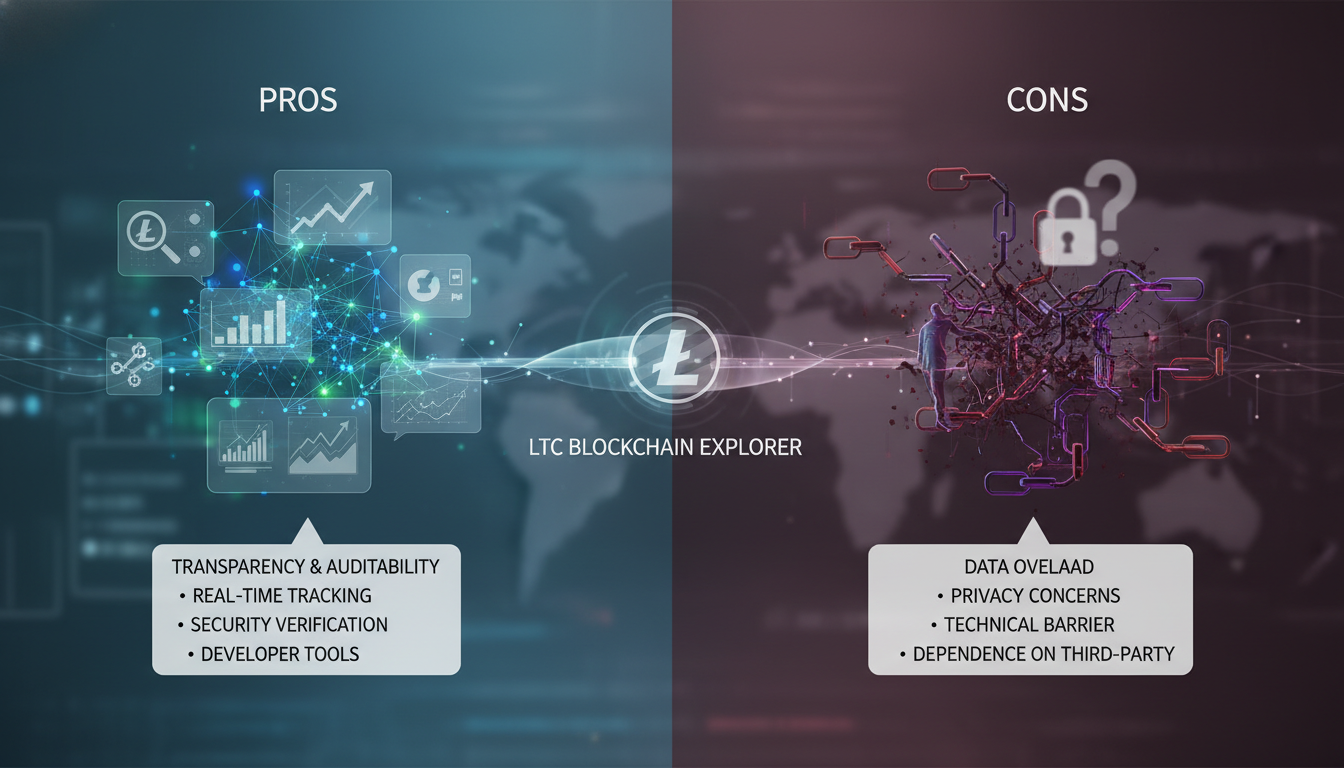
Block explorers are powerful, but they come with real trade-offs worth understanding before you rely on them for critical decisions.
Pros
- Free and permissionless: every major ltc blockchain is publicly accessible with no account required for basic lookups.
- Real-time transparency: confirmations, fee rates, and mempool depth update within seconds of each new block.
- Developer-friendly APIs: REST and WebSocket endpoints from Blockchair, OKLink, and 3xpl reduce the cost of building Litecoin-native applications significantly.
- Multi-format data: most explorers expose raw JSON, CSV exports, and interactive charts in a single interface.
- MWEB visibility: explorers like 3xpl surface MimbleWimble Extension Block data, giving privacy-conscious users on-chain proof of MWEB activity.
Cons
- Privacy exposure: any address you search or share publicly becomes permanently traceable by third parties with the same tool.
- Snapshot data: some metrics (active address counts, 24h volume) reflect a point-in-time snapshot and can lag by several minutes.
- API rate limits: free tiers on Blockchair and OKLink cap request volumes, which constrains high-frequency production applications.
- Limited historical depth: BlockExplorer.one, for example, defaults to the most recent 14 days of transactions; full history requires their paid Address History API.
- No transaction reversal: an explorer confirms what happened on-chain but cannot undo a mistaken send.
How to Use the LTC Blockchain Explorer

Most Litecoin explorers share a similar workflow. Here is a step-by-step guide to get started.
Step 1: Finding a Transaction Hash
- Open your preferred blockchain explorer (e.g., Litecoin Space or Blockchair).
- Copy the transaction ID (TXID) from your wallet or exchange withdrawal page.
- Paste it into the search bar and press Enter.
- The result page shows confirmations, timestamp, amount in LTC and USD, fee rate, and the sending/receiving addresses.
Step 2: Exploring Address Balance and History
- Obtain a Litecoin address (it may start with L, M, ltc1, or ltc1q for newer SegWit formats).
- Enter the address in the explorer’s search field.
- You will see the current balance and a full list of all incoming and outgoing transactions.
- Click any transaction hash to examine that operation in detail.
Step 3: Checking Block Information
- On the explorer homepage, the latest blocks are listed in a live table.
- Click on a block height or hash to open its detail view.
- Key metrics include block size in bytes, transaction count, mining pool (e.g., F2Pool or ViaBTC), and time since creation.
Top LTC Blockchain Explorers in 2026

Several Litecoin explorers stand out this year, each with distinct strengths. The table below compares their core capabilities so you can pick the right tool for your use case.
| Explorer | Mempool Visualization | API Access | MWEB Support | Real-time Stats | Charts & Analytics | Multi-Chain |
|---|---|---|---|---|---|---|
| Litecoin Space | Yes | Yes | Partial | Yes | Yes | No |
| OKLink | Limited | Yes | No | Yes | Yes | Yes |
| 3xpl | Yes | Yes | Yes | Yes | Yes | Yes |
| Blockchair | Yes | Yes | No | Yes | Yes | Yes |
| BlockExplorer.one | No | Yes | No | Yes | No | Yes |
Litecoin Space: Advanced Mempool Visualization
Litecoin Space, launched by the Litecoin Foundation in June 2023, focuses on mempool analysis. It displays real-time fee bands from 1 to 5,000 lit/vB, recent Replace-By-Fee (RBF) transactions, and a memory-usage gauge. The explorer also exposes a developer API for building fee estimators and transaction monitors. For anyone who needs granular mempool depth, this is the most purpose-built this type of explorer available today.
OKLink: Enterprise-Grade Blockchain Search
OKLink’s LTC blockchain explorer targets institutional users. It tracks large transactions via whale alerts and provides an active-address count of roughly 282,537, a 24h on-chain volume figure of approximately 266.91 million LTC, and a halving countdown timer. According to OKLink’s on-chain data, the next supply reduction is roughly 622 days out, a useful signal for traders modeling Litecoin’s disinflationary schedule.
3xpl: Multi-Chain Explorer with Data Services
3xpl covers Litecoin alongside 30+ other blockchains. It uniquely supports MimbleWimble Extension Blocks (MWEB), processing approximately 789 MWEB events in a 24-hour window per 3xpl’s own reporting. Developers benefit from 7 JSON and 5 WebSocket API endpoints, a 395.43 GiB downloadable dataset, and 15 interactive charts. The explorer reports roughly 1,023,328 events per day, about 11.84 events per second, giving a precise view of network throughput.
Blockchair: Fast Multi-Currency Explorer
Blockchair is a veteran multi-chain explorer that indexes Litecoin with sub-second query speeds. Its LTC blockchain explorer offers advanced filtering by amount, date, or address, plus an SQL-like API for complex queries. Though it lacks MWEB parsing, it remains a reliable tool for quick block and transaction lookups across more than 40 blockchains simultaneously.
BlockExplorer.one: Simple Litecoin Block Explorer
BlockExplorer.one provides a no-frills interface. It displays the most recent 14 days of transactions by default; full history requires the paid Address History API. Recommended fee rates (slow, standard, fast) appear in both LTC and USD, helping users choose the right fee for timely confirmation without needing to interpret raw mempool data.
Reading Litecoin Blockchain Explorer Data
Understanding the numbers behind each block and transaction is critical for anyone participating in the Litecoin network.
Understanding Block Details
A typical block on a Litecoin explorer shows:
- Block height: sequential number (e.g., 3,116,403).
- Block hash: unique identifier, often truncated on screen.
- Miner: the pool or entity that solved the block (e.g., F2Pool, ViaBTC, Litecoinpool.org).
- Transaction count: number of payments included, from a handful to over 800.
- Reward: currently 6.25 LTC plus total fees, worth roughly $328 USD at recent prices.
- Age: time since the block was mined, measured in minutes or hours.
Interpreting Mempool and Fee Estimates
The mempool holds unconfirmed transactions waiting for miner inclusion. Litecoin Space shows pending transactions and a minimum fee of 1 lit/vB for low-priority inclusion, with rates scaling up to 5,000 lit/vB for rapid confirmation. The mempool size in bytes and the incoming-transaction chart help you estimate wait time. According to data from Litecoin Space, mempool memory usage rarely approaches the 1 GB ceiling, which keeps fee pressure structurally low compared to higher-throughput chains.
Analyzing Market and Network Statistics
Explorers aggregate global metrics in one place. Litecoin’s market cap sits at roughly $4.06 billion, with a circulating supply of approximately 77.22 million LTC out of a hard cap of 84 million. The network hashrate is 3.27 TH/s, and difficulty adjusts every 2,016 blocks to maintain the 2.6-minute average block time. These stats, sourced from OKLink and BlockExplorer.one, confirm the network’s consistent security profile.
LTC Blockchain Explorer APIs for Developers
For anyone building wallets, analytics dashboards, or trading bots, programmatic access to Litecoin data is non-negotiable.
How to Access Litecoin Blockchain Data Programmatically
Most explorers offer REST APIs with rate-limited free tiers. Blockchair provides SQL-like querying across chains; OKLink delivers structured JSON for blocks, transactions, and addresses; and 3xpl combines JSON with WebSocket streams for real-time updates. After signing up, you receive an API key and can fetch the latest block height or a specific transaction’s confirmations in milliseconds. If you’re building a production application, plan for rate-limit tiers early: free plans on most platforms cap at a few hundred requests per minute.
“The Litecoin network’s 2.6-minute block time and low fee environment make it one of the more developer-friendly UTXO chains to index. The mempool rarely exceeds a few hundred kilobytes, which simplifies fee-estimation logic considerably.” – Litecoin Space documentation, Litecoin Foundation, 2023
Popular LTC Explorer API Endpoints
- Blockchair:
/litecoin/dashboards/address/{address}for address balance and history. - OKLink:
/api/v5/explorer/litecoin/transaction/{txid}to retrieve transaction details. - 3xpl:
/litecoin/block/{height}and WebSocket subscription tolitecoin:new-block. - BlockExplorer.one: fee recommendation endpoint returning slow, standard, and fast rates in LTC and USD.
Security and Privacy When Using a Block Explorer
An LTC blockchain explorer is a public tool, and that openness cuts both ways on privacy.
Do Block Explorers Compromise Privacy?
Block explorers themselves hold no personal data. Anyone can view any transaction’s inputs, outputs, and amounts, though. If you’ve shared your address publicly, a third party could trace your full balance and payment history using the same free tool. To reduce exposure, avoid reusing addresses and consider using MWEB confidential transactions, which explorers like 3xpl now surface on-chain. According to the Litecoin protocol documentation, MWEB transactions obscure amounts and participant addresses at the protocol level, not just at the application layer.
“MimbleWimble Extension Blocks represent a meaningful privacy upgrade for Litecoin. Unlike CoinJoin-based approaches, MWEB hides transaction amounts and cuts through transaction history at the protocol level.” – Litecoin MWEB Activation Summary, Litecoin Foundation, 2022
Best Practices for Safe Exploration
- Verify TxIDs on multiple explorers to avoid relying on a single data source.
- Never enter private keys or seed phrases into an explorer; they are never required for any lookup.
- Use HTTPS connections: all reputable explorers enforce TLS encryption by default.
- Be cautious with unverified links claiming to be LTC transaction trackers that ask for wallet credentials. Legitimate explorers never request them.
Frequently Asked Questions
What is Litecoin’s total supply?
Litecoin has a maximum supply of 84 million coins, of which roughly 77.2 million are already in circulation. The remaining coins will be gradually mined until approximately the year 2142, thanks to periodic halving events that cut the block reward in half each cycle.
How do I check if my Litecoin transaction is confirmed?
Open any LTC blockchain explorer, paste your transaction ID into the search bar, and look at the Confirmations field. A transaction is generally considered final after 6 confirmations, though many services accept it after 3. The live block table on the explorer homepage shows real-time inclusion status.
Why is my LTC transaction stuck unconfirmed?
Unconfirmed transactions sit in the mempool until miners include them in a block. If the fee is below the current minimum (1 lit/vB during normal conditions), the transaction may wait for an extended period. Use the explorer’s fee-recommendation tool to check current required rates, and consider Replace-By-Fee (RBF) if your wallet supports it.
Can I use a blockchain explorer to recover stolen or mistakenly sent LTC?
An LTC blockchain explorer can confirm that a transaction occurred and identify the receiving address, but it cannot reverse or cancel a confirmed transaction. Litecoin transactions are irreversible once included in a block. If you sent funds to a known service, contact their support team with the transaction ID as proof of the transfer.
What is the best LTC blockchain explorer for developers?
3xpl and Blockchair offer the most complete APIs for production use. 3xpl provides WebSocket streams for real-time data and full MWEB support, while Blockchair allows SQL-like queries across multiple chains. Both have documented free tiers and active developer communities.
Is it safe to share my Litecoin transaction ID?
Yes. A transaction ID is a public reference to the transfer and contains no private keys or personal information. Anyone with the ID can view the amount and addresses involved using any LTC blockchain explorer, so consider the context before sharing it publicly.