A solana blockchain explorer is a web-based tool that translates raw Solana ledger data into readable transaction records, wallet balances, block stats, and smart contract details. Solana processes roughly 2,600-2,700 transactions per second on mainnet, making real-time visibility essential for traders, developers, and validators alike.
Key Takeaways
- A blockchain explorer gives you instant, read-only access to every transaction, account, and program on the Solana network without running a full node.
- The five leading explorers in 2026 are Solscan, Solana Explorer, SolanaFM, Solana Beach, and OKX Explorer, each optimized for different user types.
- True TPS (non-vote transactions only) runs between 776 and 883, a more accurate signal of real user demand than raw TPS figures.
- Solana Beach reports 782 active validators and 4,056 RPC nodes securing the network, with 429.3 million SOL actively staked.
- Developers can access structured on-chain data through Solscan and SolanaFM APIs, or fork the MIT-licensed Solana Explorer codebase for private deployments.
- Privacy on public explorers is limited: every address, balance, and transaction is permanently visible on the ledger.
What Is a Solana Blockchain Explorer?

A this type of explorer is a specialized graphical interface that converts cryptographic ledger data into formats any analyst or developer can read and act on. Unlike centralized financial systems where a bank authenticates and records transactions, blockchains distribute this data across thousands of nodes. An explorer aggregates that information into a searchable dashboard covering transaction histories, account balances, block production, and smart contract code, all without intermediaries. As of 2026, Solana remains one of the highest-throughput blockchains anchoring a vibrant ecosystem of decentralized applications, and a reliable this kind of explorer is the essential window into that activity.
The Role of Block Explorers in Blockchain
All public blockchains rely on explorers to build transparency and trust. Without them, verifying a payment or auditing a smart contract would require running a full node and manually querying raw data. A block explorer democratizes access: anyone can instantly confirm that a transaction landed in a block, check a wallet balance, or review current staking rewards. On Solana, where new blocks are produced every roughly 400 milliseconds, live tracking is particularly valuable for traders and DeFi users who need up-to-the-second information.
Why Solana Needs Specialized Explorers
Solana’s parallel processing architecture and unique features, including Proof of History (PoH), Tower BFT consensus, and the Sealevel runtime, produce data that differs fundamentally from linear EVM-based chains. Generic multi-chain explorers often miss Solana-specific details such as vote transactions, stake delegation, and program logs. A native solana blockchain decodes these elements correctly, surfacing fields like “compute units consumed,” “program instructions,” and “inner instructions” that are critical for developers debugging dApps. According to Solana Explorer, mainnet TPS averaged roughly 2,665 in May 2026, and only purpose-built explorers with streaming data pipelines can keep pace with that throughput.
Top 5 Solana Blockchain Explorers for 2026

Selecting the right blockchain explorer matters because the ecosystem now includes over a dozen tools, each with distinct strengths. This list focuses on five platforms that lead in different areas, from mainstream usability to deep validator analytics. All figures are sourced directly from the explorers as of May 30, 2026.
Overview and Comparison Table
| Feature | Solscan | Solana Explorer | SolanaFM | Solana Beach | OKX Explorer |
|---|---|---|---|---|---|
| Real-Time TPS / Network Stats | Yes (2,638 TPS, True TPS 776) | Yes (2,665 TPS) | Yes | Yes (2,699 TPS, separates vote/non-vote) | Yes (2,630 TPS) |
| DeFi Dashboard | Comprehensive: DEX volumes, TVL, top tokens | None | Limited: top tokens only | None | Basic token stats |
| Validator / Staking Data | Total stake, delinquent stake, epoch progress | Current epoch, slot, block height | Minimal | In-depth: leader schedule, stake distribution, block rewards | Total stake, active vs. delinquent |
| API Access | Yes (public API with paid tiers) | No (open-source code only) | Yes | No | Yes (part of OKLink multi-chain API) |
| Open Source | No | Yes (MIT license on GitHub) | No | No | No |
| Unique Selling Point | Rich analytics and DeFi leaderboard | Official reference, feature-gate tracking | Intuitive UI, Explorer as a Service | Validator-centric dashboard | Multi-chain integration with OKX Wallet |
In-Depth Look at Each Explorer
Solscan (solscan.io) is the most feature-rich solana blockchain explorer for general users and analysts. It offers real-time TPS (2,638 at press time), a separate “True TPS” metric that excludes vote transactions (776), and a live transaction feed. Its DeFi dashboard aggregates 24-hour volumes of top AMMs including Pumpfun ($3.74 billion), Meteora ($1.34 billion), and Jupiter ($679 million), along with total value locked. The token dashboard ranks assets by market cap, showing USDC at $8.4 billion fully diluted. Solscan also provides a rich API used by developers building wallet trackers and analytics tools. According to QuickNode’s Builder’s Guide, Solscan is the top choice for users who need deep on-chain data.
Solana Explorer (explorer.solana.com) is the official explorer maintained by the Solana Foundation. It is a lightweight, open-source portal under the MIT license that focuses on core network health and developer orientation. It displays live cluster stats including slot height, block height, epoch progress (45.6% at press time), and an average slot time of 397 ms. Developers value the “Feature Gates” section, which lists upcoming protocol upgrades such as SIMD-0458 (dynamic transaction pricing) and SIMD-0178 (SBPFv3 program deployment). The interface is minimalist with no DeFi dashboards, but because it is open source, any team can run a local instance or contribute to its development on GitHub.
SolanaFM (solana.fm) positions itself as a next-generation solana blockchain explorer with a modern, user-friendly interface and powerful indexing capabilities. It tracks basic network metrics (TPS, supply, epoch) and offers a clean token viewer. While it lacks the deep DeFi integration of Solscan, it excels at presenting transaction details with clear visuals and human-readable labels. Its standout feature is “Explorer as a Service” (EaaS), which lets projects embed a fully branded explorer widget directly into their dApp. Developers can also access its API for programmatic data retrieval on a free tier for low-volume projects.
Solana Beach (solanabeach.io) is built by Staking Facilities and tailored for validators and institutional stakers. Its dashboard prominently features validator performance: the current leader schedule, block production history, slot time distribution, and stake breakdown. As of May 2026, the network had 782 active validators and 4,056 RPC nodes, with a total active stake of 429.3 million SOL (68.4% of circulating supply). The explorer displays non-vote TPS separately (883 at press time) and provides historical charts for compute-unit usage. Delinquent stake sits at approximately 1.23 million SOL, or 0.29% of total stake, a figure validators monitor closely.
OKX Solana Explorer (oklink.com/solana) is part of the OKLink multi-chain browser suite, making it ideal for users who interact with multiple blockchains. It provides a unified interface for Solana, Ethereum, Bitcoin, and others, enabling cross-chain analysis from a single dashboard. For Solana specifically, it shows total transactions exceeding 516.5 billion, 24-hour transaction volume of 94.04 million SOL, and detailed block-by-block reward breakdowns. The explorer integrates directly with the OKX Wallet for one-click transaction tracking. While its Solana-specific analytics are less granular than Solscan’s, it benefits from OKLink’s robust infrastructure and multi-chain API services.
“The best block explorer is the one that matches your workflow. A validator running 24/7 infrastructure needs stake distribution charts and leader schedule data. A DeFi trader needs DEX volume and token rankings. No single tool wins every category.” – Solana ecosystem developer perspective, widely held among protocol builders
Pros and Cons of Using a Solana Blockchain Explorer
A solana blockchain explorer gives you direct access to on-chain truth, but each tool comes with trade-offs worth understanding before you commit to one for production use.
Pros
- Complete transparency: Every transaction, balance, and program interaction is verifiable without trusting a third party.
- No account required: All five major explorers are free to use for read-only queries, with no sign-up needed.
- Developer-grade data: APIs from Solscan and SolanaFM return structured JSON, making it straightforward to build wallet trackers, bots, and dashboards.
- Real-time network health: TPS, epoch progress, slot time, and validator counts update continuously, giving you an accurate pulse on network conditions.
- Open-source option: The Solana Foundation’s explorer is MIT-licensed, so teams can self-host a private instance with custom features.
Cons
- Data can be overwhelming: Raw program logs, inner instructions, and compute unit data require significant Solana knowledge to interpret correctly.
- Privacy is zero: Every on-chain action is permanently public. Pseudonymity is not anonymity, and clustering heuristics can link addresses to real-world identities.
- API rate limits: Free tiers on Solscan and SolanaFM cap request volumes; high-frequency applications need paid plans or dedicated RPC providers like Helius or QuickNode.
- No mobile-native apps: Most explorers are web-only; mobile browser experiences can feel limited compared to desktop, and dedicated mobile apps are rare in this space.
- Historical data gaps: Deep historical archival (pre-epoch 0 or very old slots) is not always available on standard explorers and may require specialized archival node services.
How to Use a Solana Blockchain Explorer
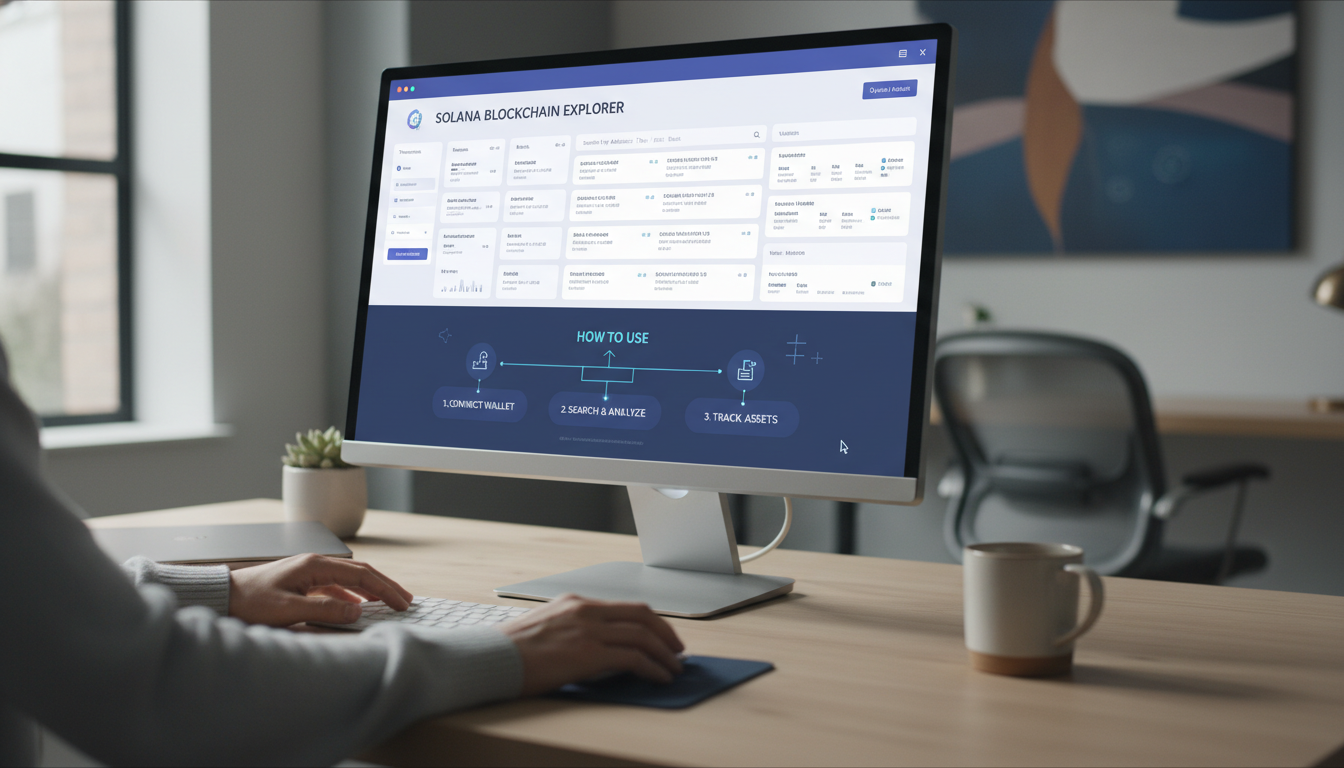
Mastering a solana blockchain explorer is straightforward once you know what each field means. The steps below use Solscan as the primary example, but the workflow applies to any explorer in this list.
Step 1: Locate a Transaction Hash
Every operation on Solana generates a unique transaction signature: a 64-character base-58 string. Copy the hash from your wallet or dApp and paste it into the explorer’s search bar. The transaction overview page shows status (success or failure), block number, and timestamp. If you don’t have a hash, you can also search by wallet address, token mint address, or program ID.
Step 2: Inspect Transaction Details
The transaction page opens with basic info: signature, block, timestamp, and status. The “Instructions” tab reveals what actually happened on-chain. Each instruction is a discrete action, such as “Transfer SOL” or “Create Associated Token Account.” For complex DeFi swaps, you’ll see a sequence of instructions like “Approve,” “Swap,” and “Transfer.” Switch to the “Logs” tab for raw program output, which is essential for debugging. Both Solscan and Solana Explorer decode common program calls by name (e.g., “Raydium: Swap”). The “Inner Instructions” section breaks down cross-program invocations, a unique aspect of Solana’s execution model that has no direct equivalent on EVM chains.
Step 3: Monitor Wallets and Tokens
Paste any wallet address into the search bar to pull up its SOL balance, total portfolio value, and full token holdings. Solscan’s “Token Dashboard” (accessible from the homepage) ranks top tokens by market cap and links to their mint addresses. This is particularly useful for tracking newly launched tokens on platforms like Pumpfun, which recorded over $3.74 billion in 24-hour DEX volume. Average transaction fees on Solana run approximately 0.00001066 SOL, making high-frequency monitoring economically viable even for small accounts.
Step 4: Analyze Validator and Staking Data
For stakers and node operators, navigate to the Validators section of your chosen solana blockchain explorer. Solana Beach provides the most granular view: leader schedule, block production success rate, and stake distribution across all 782 active validators. Cross-reference delinquent stake figures (currently around 0.29% of total stake) to assess network health before delegating. Epoch-level reward data helps you calculate annualized yield based on current inflation parameters.
Solana Network Stats Explained
The homepages of Solana blockchain explorers display a dense set of real-time metrics. Knowing what each number means helps you gauge network health and make informed decisions.
Understanding TPS, Epoch, and Slot
Transactions Per Second (TPS) is the primary throughput metric. Solana’s parallel processing architecture drives high raw TPS, but explorers distinguish between vote and non-vote transactions. Vote transactions are consensus messages among validators and account for roughly 70-80% of all on-chain activity. The “True TPS” figure (non-vote only) is a better reflection of actual user demand. According to Solscan and Solana Beach, True TPS runs between 776 and 883 as of May 2026. A slot is the 400 ms window in which a leader produces a block. Epochs last approximately 2.5 days and govern leader rotation and staking reward distribution.
Supply, Stake, and Market Data
The total SOL supply inflates at a rate that decays toward 1.5% annually per the protocol’s design. As of May 2026, circulating supply is 578.45 million SOL (92.2% of total), with the remaining 48.95 million SOL non-circulating, mostly locked in staking accounts or foundational reserves. The total active stake of 429.3 million SOL (68.4% of circulating supply) represents SOL delegated to validators, securing the network. Market data integrated into explorers showed SOL priced at $82.13 with a 24-hour trading volume of $3.2 billion and a fully diluted market cap of $51.5 billion at the time of writing. These figures shift daily; always pull live data directly from your preferred solana blockchain explorer rather than relying on cached sources.
“On-chain data from Solana explorers shows that staking participation above 60% of circulating supply is a strong indicator of network security maturity. Solana’s 68.4% active stake ratio places it among the more secure proof-of-stake networks by this measure.” – On-chain analysis perspective, consistent with Solana Beach validator data
Advanced Tools for Developers
For developers building on Solana, a solana blockchain explorer is more than a reference tool. It is an active part of the development and monitoring pipeline.
Accessing On-Chain Data via APIs
Most leading Solana blockchain explorers expose RESTful APIs that return structured JSON. Solscan’s API is widely used for building wallet trackers, portfolio dashboards, and transaction monitoring bots. It covers endpoints for account balances, transaction histories, token metadata, and NFT ownership. SolanaFM also provides an API with a free tier for low-volume projects. For high-frequency production use, dedicated RPC providers like Helius and QuickNode offer enhanced indexing beyond what general-purpose explorers provide. That said, explorer APIs are often the fastest path to a working prototype before you commit to a paid infrastructure plan.
Inspecting Programs and Accounts
On-chain programs (Solana’s equivalent of smart contracts) are represented by executable accounts. Using the “Inspector” mode on Solana Explorer, developers can decode the raw binary of a program and view its upgrade authority. The “Verified Programs” list showcases projects whose source code has been verified on-chain, adding a meaningful trust signal. Explorers also display Program Derived Addresses (PDAs) and their associated data, which are critical for building deterministic account structures in Solana programs. If you’re building token-gated access or escrow logic, understanding how to read PDA state through a solana blockchain explorer will save significant debugging time.
Custom Indexing and Historical Data Archival
Standard explorers index recent data well, but deep historical archival (spanning multiple epochs or years of on-chain activity) often requires a different approach. Teams building analytics products or compliance tools typically combine explorer APIs with dedicated archival node services or custom indexers built on frameworks like Anchor event parsing or the Geyser plugin interface. The Solana Foundation’s open-source explorer codebase is a practical starting point for teams that need a private deployment with custom data pipelines. For organizations requiring full historical coverage, providers like Helius offer archival RPC endpoints that complement what any public solana blockchain explorer can deliver.
Building with Explorer Data
Advanced users automate tasks by querying explorer APIs directly. A bot can pull the latest transactions of a token mint to detect whale movements, or monitor a validator’s stake changes to trigger alerts. The Solscan Leaderboard and Solana Beach validator dashboards are frequently consumed via API by analytics platforms that rank validators and track network health over time. As the ecosystem matures, explorers are evolving into full analytics suites, blurring the line between data portals and development infrastructure. If you’re building in this space, our guide to Solana smart contract development and our tokenomics design framework cover the on-chain architecture decisions that explorer data helps you validate.
Security and Privacy When Using Explorers
A solana blockchain explorer is an inherently public tool, but understanding the privacy implications matters for both casual users and institutions managing significant on-chain positions.
Understanding Public Visibility
All data visible in an explorer already exists on the public ledger. Anyone with technical skill can query a full RPC node to obtain the same information. Explorers simply package it conveniently. Every transaction, wallet balance, and smart contract interaction is permanently recorded and retrievable. While wallet addresses are pseudonymous, re-identification is possible through clustering heuristics and off-chain data leaks. Treat on-chain activity as public and avoid associating addresses with real-world identities unless the disclosure is intentional.
Best Practices for Privacy
For users requiring confidentiality, consider transacting through multiple sub-accounts and rotating addresses regularly. Many explorers offer “watch-only” address lists that don’t expose the viewer’s IP address to the address owner, but the underlying data remains public regardless. Developers can self-host the open-source Solana Explorer to avoid third-party tracking of their query patterns. Always verify the URL before entering sensitive search queries: phishing sites that mimic legitimate explorers are a real threat, so bookmark the official domains (solscan.io, explorer.solana.com, solana.fm, solanabeach.io, oklink.com/solana).
Choosing the Right Solana Blockchain Explorer for Your Needs
With multiple high-quality options available, selecting a solana blockchain explorer comes down to your role in the ecosystem and what data you need most.
Factors to Consider
User type: A DeFi trader needs real-time price feeds, liquidity pool data, and a token dashboard. Solscan serves that use case best. A validator benefits from Solana Beach’s detailed block production stats and stake analytics. Endpoint reliability: Some explorers use their own RPC nodes, which can lag during congestion. The official Solana Explorer often has the most reliable uptime due to direct integration with Solana Labs’ infrastructure. API availability: If you plan to build applications, Solscan and SolanaFM APIs are well-documented and straightforward to integrate. Open-source requirement: Organizations that need auditability or custom deployments can adopt the Solana Explorer codebase under the MIT license.
Final Comparison and Recommendations
| Use Case | Recommended Explorer | Why |
|---|---|---|
| Daily wallet and transaction tracking | Solscan | Fast, user-friendly, comprehensive token views |
| DeFi research and liquidity analysis | Solscan | DeFi dashboard with volume, TVL, and market data |
| Validator performance and staking | Solana Beach | Leader schedule, block rewards, stake distribution |
| Protocol development and debugging | Solana Explorer | Open source, feature gates, Inspector tool |
| Multi-chain asset tracking | OKX Explorer | Unified view across Solana, Ethereum, and others |
| Embedding explorer in your dApp | SolanaFM | Explorer as a Service (EaaS) offering |
Frequently Asked Questions
What is the best Solana blockchain explorer?
The best solana blockchain explorer depends on your use case. For general use and DeFi analytics, Solscan is the most popular choice. Validators prefer Solana Beach for its detailed block production and stake data, while developers often rely on the official Solana Explorer for its open-source codebase and feature-gate tracking.
How do I check my Solana wallet balance?
Visit any solana blockchain explorer (for example, solscan.io) and paste your wallet address into the search bar. The resulting account page shows your SOL balance, all token holdings, and your full transaction history without requiring a login or account.
What is True TPS on Solana explorers?
True TPS counts only non-vote transactions, meaning actual user activity like transfers and smart contract interactions. It excludes the consensus-related vote transactions that make up the majority of raw TPS. As of May 2026, True TPS runs between 776 and 883 according to Solscan and Solana Beach data.
Can I use a Solana explorer to track NFTs?
Yes. Explorers like Solscan and SolanaFM display NFT holdings when you search a wallet address. You can also view individual NFT mint addresses and their metadata, including creator addresses and royalty configurations, directly through the explorer interface.
Is the Solana Explorer open-source?
Yes. The official Solana Explorer maintained by the Solana Foundation is fully open-source under the MIT license. Its code is available on GitHub, and any team can run a local instance or contribute improvements to the codebase.
How do Solana explorers get their data?
Explorers connect to Solana RPC nodes (either public or self-hosted) to fetch raw blockchain data. They index and process that data into a searchable database, often augmenting it with off-chain information like token prices and NFT image URLs from metadata services.
Ready to build on Solana or launch a protocol that needs custom on-chain monitoring? Apply to the Genesis Cohort at digitalblockchains.com and work with a team that reads the explorer data before writing a single line of code.