The main benefits of blockchain technology are cryptographic security, transparent immutability, and decentralized trust that removes intermediaries. These properties enable faster, cheaper, and more reliable transactions across finance, supply chain, and healthcare.
Key Takeaways
- Enhanced Security: Cryptographic hashing and consensus mechanisms make data tamper-proof across every node in the network.
- Transparency and Traceability: Every transaction is recorded permanently and visible to all permissioned participants.
- Decentralization: No central point of failure or control, which increases resilience against attacks and outages.
- Efficiency Gains: Smart contracts automate processes, cutting manual intervention and reducing errors.
- Cost Reduction: Eliminating intermediaries lowers fees by 15–25% on average for cross-border payments.
- Enterprise Momentum: The enterprise blockchain market reached $12.77 billion in 2025, with Fortune 500 adoption accelerating.
Understanding Blockchain Technology
What Is Blockchain?
Blockchain technology is an advanced database mechanism that allows transparent information sharing within a business network. It is a decentralized ledger that records transactions and assets in a peer-to-peer network, according to AWS. Unlike traditional databases, blockchain stores data in blocks linked together cryptographically, ensuring an unalterable record of all activities.
At its core, a blockchain is a chain of data blocks, each containing a unique hash that ties it to the previous block. This structure provides immutability: once data is added, it cannot be changed without altering all subsequent blocks, which requires full network consensus. That fundamental property is what makes the blockchain technology so durable in security-critical applications.
How Blockchain Works
A blockchain network operates through a series of steps that guarantee data integrity and decentralized validation:
- Transaction Initiation: A user requests a transaction, which is broadcast to a peer-to-peer network of nodes.
- Block Creation: The transaction is grouped with others to form a new block of data.
- Validation and Consensus: Nodes independently validate the block using a consensus mechanism (e.g., Proof of Work or Proof of Stake). Once a majority agrees, the block is added to the chain.
- Ledger Update: The blockchain updates across all nodes, and the transaction becomes immutable.
This process eliminates the need for a central authority, which is precisely why decentralization ranks among the most cited this type of technology in enterprise deployments.
The Main Benefits of Blockchain Technology

Enhanced Security and Immutability
Blockchain’s security architecture is built on cryptographic hashing. Each block contains a hash of its own data and the previous block’s hash, creating a tamper-evident chain. Any attempt to alter a transaction would require recomputing all subsequent hashes, a computational impossibility on a well-distributed network. Banque Delubac & Cie notes that consensus mechanisms make data modification virtually impossible, cementing blockchain’s reputation for security.
Immutability is a foundation of trust in financial and contractual applications. Once recorded, transactions cannot be reversed or altered, providing a reliable audit trail. This characteristic is one of the clearest this kind of blockchain technology for fraud prevention and regulatory compliance.
“There’s really a shift in the way that some technologists are thinking about this, in regards to how we can use smart contracts and how we can use the technology of blockchain, which especially is helpful for things like immutability – the ability to lock something in and say that ‘this cannot be changed from here on out.'” – Sean Roberts, Advisory Manager, Grant Thornton
Transparency and Traceability
Transparency is a critical advantage that distinguishes blockchain from conventional record-keeping. Every transaction is visible to all participants with permissioned access, creating a shared source of truth. This is especially valuable in supply chains, where tracking a product from origin to consumer is complex and fraud-prone. Blockchain enables real-time visibility, reducing disputes and strengthening accountability.
Traceability goes hand in hand with transparency. All data is stored chronologically and linked by cryptographic evidence, making it straightforward to audit the entire lifecycle of an asset. For manufacturers, this means improved inventory management and faster response to recalls or disruptions.
Decentralization and Resilience
Decentralization removes the single point of failure inherent in centralized systems. In a blockchain, data is distributed across thousands of nodes, each holding a full copy of the ledger. If one node fails or is compromised, the network continues to operate securely. This resilience is a key benefit for critical infrastructure and financial systems.
The absence of a central authority also reduces the risk of censorship or manipulation. Transactions are validated by network consensus, not a single entity. As a result, the the benefits of blockchain technology include enhanced trust between parties who may not know each other, enabling peer-to-peer transactions without intermediaries.
Efficiency and Cost-Saving Benefits

Smart Contracts and Automation
Smart contracts are self-executing programs stored on the blockchain that automatically enforce agreements when predefined conditions are met. They eliminate the need for manual intervention, reducing processing times and human errors. A smart contract can release payment automatically upon delivery confirmation, streamlining operations without a single phone call or email.
The automation potential extends to complex workflows like lease agreements and royalty distributions. Grant Thornton highlights that smart contracts can trigger payments programmatically, cutting administrative overhead significantly. Sony Music Entertainment Japan has deployed blockchain for digital rights management, reporting improved productivity and measurable cost reductions across licensing workflows.
Reduced Transaction Costs
By eliminating intermediaries such as banks, brokers, or clearinghouses, blockchain slashes transaction fees. Cross-border payments become faster and cheaper without correspondent banking networks. According to Employbridge, automated blockchain payments can be sent anywhere in the world without a middleman, potentially reducing costs by 15–25% on average.
In traditional finance, settlement of securities often takes days and involves multiple parties. The SEC has approved stock exchanges using blockchain to settle trades almost instantly, reducing back-office complexity and errors. This efficiency gain is increasingly recognized as one of the technology for capital markets. Worldwide spending on blockchain solutions topped $6.6 billion in 2021 and was projected to surpass $19 billion in 2024, reflecting how seriously enterprises are pricing in these savings.
Pros and Cons of Blockchain Technology
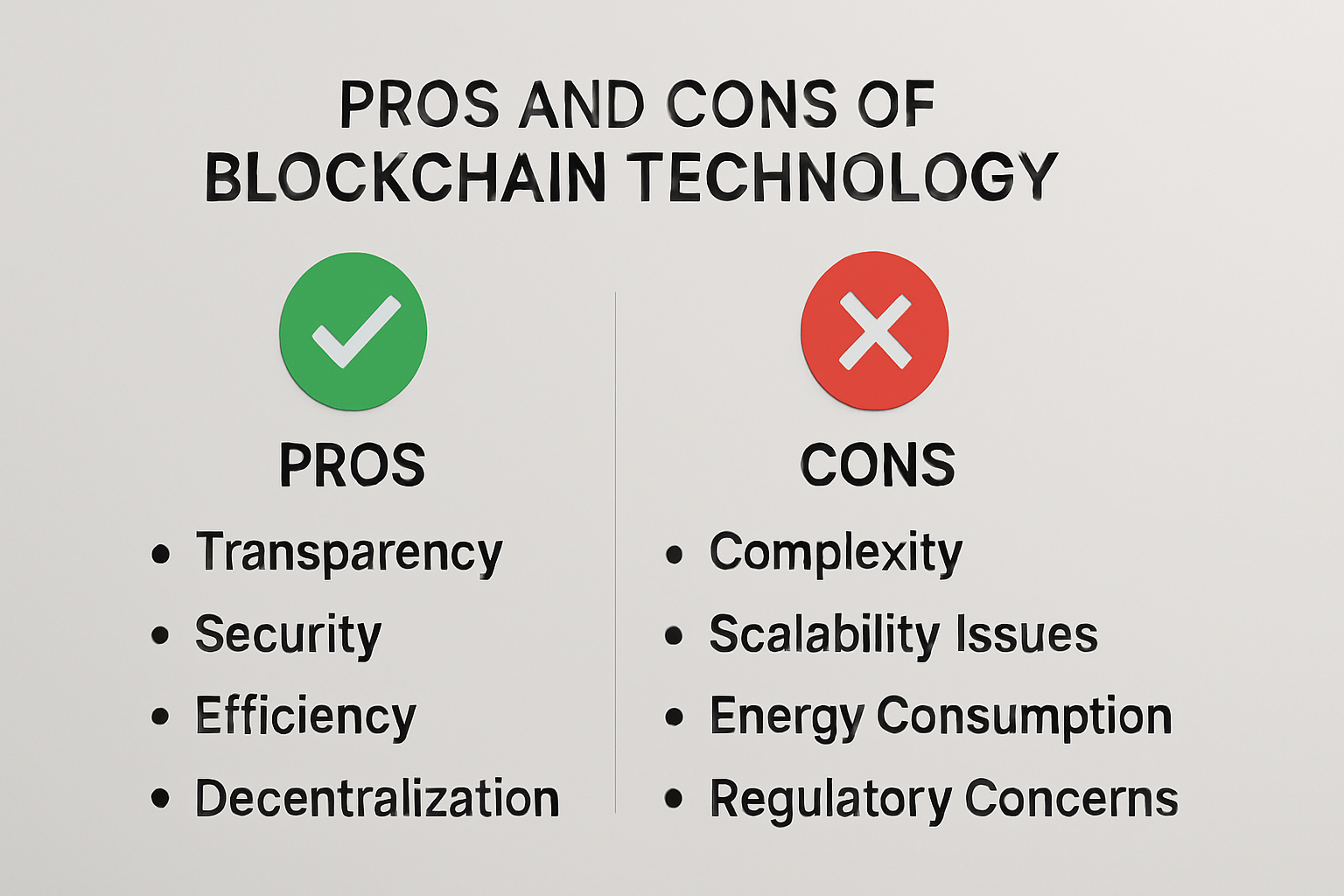
Pros
- Tamper-proof records: Cryptographic linking makes historical data effectively immutable once confirmed.
- Reduced intermediary costs: Direct peer-to-peer settlement cuts fees by 15–25% in cross-border scenarios.
- Automated execution: Smart contracts enforce agreements without manual oversight, reducing errors and delays.
- Auditability: Every transaction carries a permanent, timestamped record accessible to permissioned parties.
- Resilience: Distributed architecture means no single node failure can bring down the network.
- New business models: Tokenization of real-world assets, DAOs, and NFTs open revenue streams that legacy systems cannot support.
Cons
- Scalability limits: Bitcoin processes roughly 7 transactions per second versus Visa’s thousands, a gap that layer-2 solutions are still closing.
- Energy consumption: Bitcoin’s annual energy draw is estimated at 170–180 TWh as of 2026, drawing sustained environmental criticism.
- Regulatory ambiguity: Around 60% of organizations cite regulatory uncertainty as a top deployment barrier, according to recent industry surveys.
- Irreversibility risk: Losing a private key means permanent asset loss with no recovery mechanism.
- Interoperability gaps: Most blockchains cannot natively communicate with each other, requiring bridges or middleware like Polkadot or Cosmos.
- Implementation complexity: Migrating legacy systems to blockchain requires significant technical investment and change management.
Realizing the Main Benefits of Blockchain Technology in Key Industries
Supply Chain and Manufacturing
Blockchain delivers end-to-end visibility in supply chains. Every movement of goods, from raw materials to finished products, is recorded on an immutable ledger. This enables manufacturers to detect inefficiencies, prevent counterfeits, and respond proactively to delays. Employbridge notes that blockchain provides a single source of truth for producers, distributors, and partners, improving collaboration across the four key areas of supply chain visibility, asset tracking, data security, and automated payments.
During the COVID-19 pandemic, blockchain’s traceability proved invaluable for verifying vaccine authenticity and managing medical supplies, as reported in a PMC study. Such use cases underline the tangible impact of these capabilities in critical scenarios.
Finance and Cross-Border Payments
The financial sector has been an early adopter of blockchain. Banks use permissioned networks to streamline interbank settlements and trade finance. AWS cites the example of Singapore Exchange Limited, which built a blockchain-based payment system to handle thousands of transactions daily, eliminating manual reconciliation entirely.
Cross-border transactions, traditionally slow and costly, benefit enormously from this architecture. Payments settle in minutes rather than days, with fees significantly lower than correspondent banking routes. This is transforming remittances and international business payments, making the main benefits highly visible in global commerce.
Healthcare and Medical Records
In healthcare, blockchain secures patient data while enabling controlled sharing between providers. Immutable ledgers ensure that medical records are accurate and tamper-proof, reducing the risk of fraud and errors. Smart contracts can automate insurance claims processing, accelerating reimbursements from weeks to hours.
Pharmaceutical companies are also exploring blockchain to combat counterfeit drugs by tracking batches from manufacture to dispensing. The transparency and traceability aspects address a global problem that costs the industry billions annually, showcasing yet another dimension of the main benefits of blockchain technology in regulated sectors.
DAOs and Decentralized Governance
Decentralized Autonomous Organizations represent one of blockchain’s most structurally significant applications. A DAO encodes governance rules directly into smart contracts: token holders vote on proposals, treasury disbursements execute automatically, and no central board can override the outcome. This model removes the need for traditional corporate hierarchy while maintaining accountability through on-chain records.
As of 2026, DAOs govern billions of dollars in protocol treasuries across DeFi, with platforms like Compound, Uniswap, and MakerDAO operating entirely through on-chain governance. For builders exploring this model, our DAO creation guide covers the technical and legal architecture in detail.
Unique Benefits: Combating Counterfeits and IoT Integration
Product Provenance and Anti-Counterfeiting
One often-overlooked benefit is blockchain’s ability to verify product authenticity. By recording the entire journey of a luxury good, pharmaceutical, or electronic component, companies can guarantee to consumers that items are genuine. Each transfer of ownership is logged, and a simple QR code scan can reveal the product’s full history, protecting brands and buyers alike.
This application extends to agriculture and food safety. Walmart and IBM piloted blockchain-based food traceability, reducing the time to trace a food item from days to seconds. That speed improvement not only builds consumer trust but also dramatically reduces the financial impact of recalls, illustrating a capability that traditional databases simply cannot replicate.
Blockchain and the Internet of Things (IoT)
The convergence of blockchain and IoT creates a secure, automated ecosystem where devices can transact autonomously. In energy, AWS reports that blockchain-based platforms enable homeowners to sell excess solar power directly to neighbors, with smart meters recording and settling transactions without human intervention.
In logistics, IoT sensors combined with blockchain can automatically trigger payments upon delivery, verify cold chain integrity, and update records in real time. This integration addresses IoT’s long-standing security and trust issues, making it a compelling extension of the main benefits of blockchain technology into physical infrastructure.
Consensus Algorithms: PoW vs. PoS and Beyond
How Consensus Shapes the Benefits You Get
Consensus algorithms are the engine behind blockchain’s security guarantees. Proof of Work (PoW), used by Bitcoin, requires miners to solve computationally expensive puzzles. This makes attacks prohibitively costly but limits throughput to roughly 7 transactions per second and drives Bitcoin’s estimated 170–180 TWh annual energy consumption as of 2026.
Proof of Stake (PoS), adopted by Ethereum after The Merge, replaces computational work with economic collateral. Validators stake ETH as a security deposit; dishonest behavior results in slashing (loss of staked funds). The energy reduction is dramatic: Ethereum’s post-Merge consumption dropped by over 99% compared to its PoW era, according to the Ethereum Foundation. Newer variants like Delegated PoS (used by EOS and Tron) and Nominated PoS (used by Polkadot) further tune the trade-off between decentralization, speed, and security.
For enterprise deployments, Byzantine Fault Tolerant (BFT) algorithms like PBFT or HotStuff power permissioned networks such as Hyperledger Fabric, enabling thousands of transactions per second with finality in under a second. The choice of consensus mechanism directly determines which of the main benefits of blockchain technology your architecture can deliver at scale.
Interoperability: Polkadot, Cosmos, and Cross-Chain Infrastructure
Why Isolated Blockchains Limit the Full Benefit
A blockchain that cannot communicate with other networks is an island. Most real-world deployments require data or value to move between chains, and that is where interoperability protocols become critical infrastructure.
Polkadot addresses this through a relay chain architecture. Parachains (application-specific blockchains) connect to the central relay chain, sharing its security while communicating freely with each other via Cross-Consensus Messaging (XCM). Cosmos takes a different approach with the Inter-Blockchain Communication (IBC) protocol, allowing sovereign chains to pass packets of data and tokens without a central hub controlling the process.
Both models reduce the fragmentation that currently limits enterprise adoption. When supply chain data on one chain needs to trigger a payment on another, interoperability is not optional. It is the infrastructure layer that makes the main benefits of blockchain technology composable across ecosystems. For a deeper look at how protocol infrastructure choices affect token launches and DAO design, see our tokenomics architecture guide.
Environmental Impact and Mitigation Strategies
Addressing the Energy Criticism Directly
Bitcoin’s energy footprint is real and deserves honest treatment. At an estimated 170–180 TWh annually as of 2026, it consumes more electricity than many mid-sized countries. Critics are right to raise this, and the industry has responded with several mitigation approaches.
The most structurally significant shift is the migration from PoW to PoS, which Ethereum demonstrated at scale. Beyond consensus changes, a growing share of Bitcoin mining now runs on stranded or curtailed renewable energy, particularly hydroelectric and wind sources in regions where that power would otherwise go unused. Carbon offset programs and on-chain carbon credit markets (built on blockchains like Toucan Protocol) are also emerging as complementary tools. None of these fully resolve the critique for PoW networks, but they represent a serious engineering and economic response rather than a dismissal.
“The energy debate around blockchain is real, but it conflates all blockchains with Bitcoin. Post-Merge Ethereum uses roughly the same electricity as a small town. The question is not whether blockchain uses energy – everything does – but whether the value created justifies the cost.” – Ethereum Foundation, post-Merge energy analysis, 2022
Comparison of Blockchain Types
Public vs. Private vs. Consortium vs. Hybrid
Choosing the right blockchain architecture is crucial to realizing its benefits. The table below outlines the primary types:
| Type | Decentralization | Security | Speed | Use Cases |
|---|---|---|---|---|
| Public | Fully decentralized | High (consensus-based) | Slower | Cryptocurrencies, open platforms |
| Private | Centralized control | Access restricted | Faster | Enterprise internal systems |
| Consortium | Semi-decentralized | Shared control | Moderate | Intercompany operations |
| Hybrid | Mix of public/private | Customizable | Variable | Sensitive data with public audit |
Each type presents trade-offs, and the selection directly influences which of the main benefits of blockchain technology are prioritized: transparency, speed, or control.
Challenges and Limitations
Scalability and Energy Consumption
Blockchain networks, especially those using Proof of Work, face scalability bottlenecks. Bitcoin processes only about 7 transactions per second, compared to Visa’s thousands. Bitcoin’s energy consumption is estimated at 170–180 TWh annually as of 2026, drawing sustained environmental criticism. Newer consensus mechanisms like Proof of Stake reduce energy use by over 99%, but scalability remains an active area of research, with layer-2 solutions like the Lightning Network and Ethereum rollups providing the most promising near-term relief.
Regulatory and Privacy Concerns
Regulatory uncertainty persists, with around 60% of organizations citing it as a barrier to adoption according to recent industry surveys. Data privacy is another challenge: blockchain’s transparency can conflict with regulations like GDPR, which require data to be modifiable or deletable. The irreversible nature of transactions also means that losing a private key results in permanent loss of assets. User education on key management is not a nice-to-have; it is a prerequisite for safe adoption at scale.
Future Outlook and Enterprise Adoption
Growing Enterprise Adoption
The enterprise blockchain market reached $12.77 billion in 2025, and analysts project continued growth. Approximately 60% of Fortune 500 companies are actively exploring or implementing blockchain solutions, focusing on supply chain, finance, and identity management. Interoperability protocols and advancements in layer-2 scaling are expected to address many current limitations over the next 2–3 years.
The Evolution of Blockchain Technology in 2026
In 2026, blockchain is evolving beyond cryptocurrencies into a foundational layer for Web3. Tokenization of real-world assets, from real estate to carbon credits, is gaining traction and promising to improve market liquidity and accessibility. Integration with AI and IoT is opening new automation frontiers. As these trends mature, the main benefits of blockchain technology – security, transparency, and efficiency – will become more integral to digital transformation strategies across every sector that moves value or manages records.
Frequently Asked Questions
What are the main benefits of blockchain technology?
The main benefits of blockchain technology are enhanced security via cryptographic immutability, transparency from a shared distributed ledger, and operational efficiency through smart contracts and decentralized trust. These features reduce fraud, lower costs, and enable novel business models that legacy systems cannot support.
How does blockchain improve security?
Blockchain uses cryptographic hashes to link blocks, making tampering immediately evident across the entire chain. Consensus mechanisms require majority network agreement for any changes, while decentralization eliminates single points of failure. This layered approach resists both external hacks and internal manipulation.
Which industries benefit most from blockchain?
Supply chain and manufacturing gain traceability and anti-counterfeiting capabilities. Finance benefits from faster settlements and lower fees. Healthcare sees secure, auditable data sharing, and energy leverages peer-to-peer trading. DAOs and DeFi protocols represent an entirely new category of blockchain-native business models.
What are the disadvantages of blockchain?
Key drawbacks include scalability limits causing slow transaction speeds, high energy consumption for PoW networks, regulatory ambiguity, and irreversible transactions that can lead to permanent asset loss if private keys are misplaced. Interoperability between different blockchains also remains a significant engineering challenge.
Will AI replace blockchain?
No. AI and blockchain serve complementary roles: AI excels at pattern recognition and decision-making, while blockchain provides a trusted, decentralized record. Their integration enables smarter, more autonomous systems without compromising auditability or security.
How is blockchain different from a traditional database?
A traditional database is centrally managed, allowing data modification and deletion by an administrator. Blockchain is decentralized, append-only, and cryptographically secured, making it effectively immutable. This difference makes blockchain the right tool for scenarios requiring trust among parties who do not share a common authority.