Blockchain courses are structured learning programs that teach distributed ledger technology, smart contracts, and decentralized systems, with formats ranging from free tutorials to university certificates. The best programs combine theory with hands-on projects and recognized credentials.
Key Takeaways
- Blockchain courses serve all skill levels, from complete beginners to experienced developers building production smart contracts.
- Certifications from platforms like Coursera, Cyfrin, and Blockchain Council validate real skills and improve employability across 145+ countries.
- The global blockchain market is projected to reach $94 billion by 2027, with an estimated 3.5 million jobs by 2028 (Blockchain Council).
- Practical courses covering smart contract development and testnet exercises produce more job-ready graduates than theory-only programs.
- Choosing the right course depends on career goals, learning style, and budget. Free options like Cyfrin are genuinely rigorous.
Why Learn Blockchain in 2026?

Explosive Industry Growth
The blockchain industry is accelerating faster than most enterprise technology sectors. The global blockchain market is growing at a 66.2% compound annual growth rate and is projected to reach $94 billion by 2027, according to the Blockchain Council. Enterprise adoption is spreading across finance, supply chain, healthcare, and government at a pace that outstrips available talent. A 2020 Deloitte survey found that 77% of executives believed they would lose competitive advantage without adopting blockchain, and 53% had already integrated it into their core infrastructure. Enrolling in blockchain courses now puts you ahead of that demand curve, not chasing it.
High Salaries and Global Demand
Blockchain expertise commands premium compensation across the board. The average salary for a blockchain developer sits around $185,000, and demand spans over 150 countries, with an estimated 3.5 million blockchain jobs expected by 2028 (Blockchain Council). Completing specialized blockchain courses can fast-track entry into roles like smart contract developer, blockchain architect, DeFi analyst, or protocol product manager. Cyfrin Updraft alone has helped over 200,000 students begin their blockchain careers, which is a meaningful signal about where self-directed learning is heading.
Types of Blockchain Courses Available
University-Backed Certificate Programs
University-backed blockchain courses offer the strongest credential signal for career switchers and corporate professionals. The University at Buffalo’s Blockchain Specialization on Coursera carries a 4.6-star rating across 9,100+ reviews and covers cryptography, smart contracts, and test-driven development over 3 to 6 months. MIT Professional Education’s Blockchain: Disruptive Technology (MIT program page) focuses on distributed ledgers, encryption, and consensus mechanisms in a 6-week online format. Cornell’s eCornell Blockchain Essentials certificate costs $3,750 and targets business applications rather than deep technical implementation. Each of these programs carries institutional prestige that resonates with hiring managers outside the native Web3 ecosystem.
Self-Paced Online Platforms
Self-paced platforms give you flexibility without sacrificing depth, and the catalog has matured significantly. Coursera hosts INSEAD’s Introduction to Blockchain Technologies (4.7 stars, 2,500+ reviews) and Duke University’s Decentralized Finance (DeFi): The Future of Finance (4.8 stars, 2,100+ reviews). LinkedIn Learning‘s Blockchain: Beyond the Basics has attracted over 53,900 viewers, which reflects real appetite for intermediate-level content. These courses typically include hands-on labs, peer-graded assignments, and shareable certificates of completion.
Professional Certification Bodies
Industry certifications validate job-ready expertise in ways that academic programs sometimes miss. The Certified Enterprise Blockchain Professional (CEBP) by 101 Blockchains is widely recognized by employers, according to an independent review of 30+ blockchain courses (Javarevisited). The Blockchain Council offers 24+ programs trusted by professionals at Microsoft, IBM, and KPMG across 145 countries. These certifications emphasize real-world implementation and carry CPD accreditation, making them particularly valuable for corporate career advancement where HR systems recognize formal credentials.
“The demand for blockchain professionals is not a future projection – it’s a present reality. Enterprises are struggling to find engineers who can bridge protocol-level understanding with business implementation.” – Blockchain Council, 2025 Industry Report
What Skills Do Blockchain Courses Cover?

Foundational Concepts
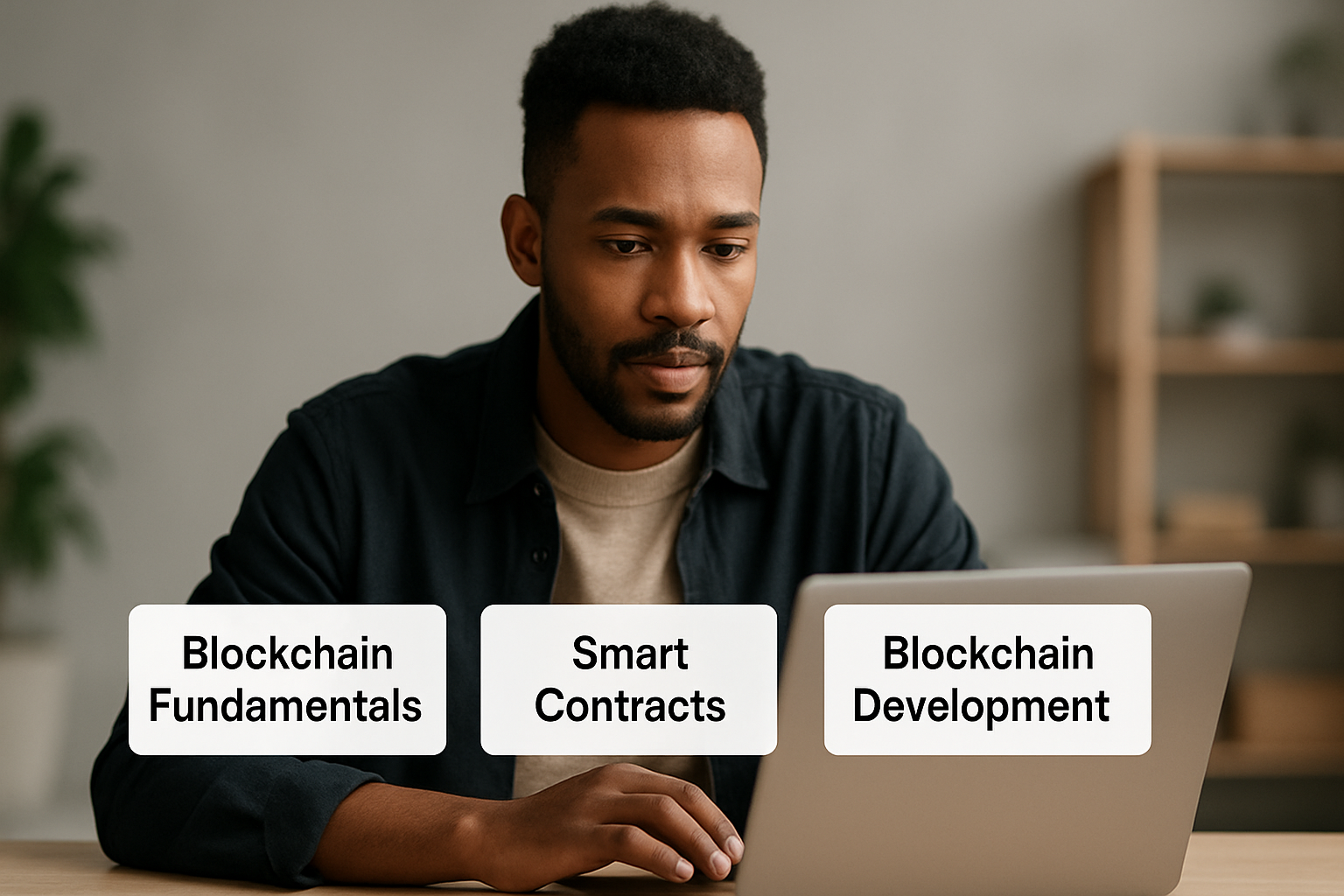
Every quality blockchain course starts with three non-negotiable fundamentals. Distributed ledgers record transactions across a network without a central authority. Cryptographic hashing ensures data integrity at every block. Consensus mechanisms like proof-of-work and proof-of-stake enable trustless agreement between nodes that don’t know each other. You’ll also learn how public-key infrastructure and digital signatures secure on-chain identities. Cyfrin’s Blockchain Basics, for example, dedicates an entire module to wallets, gas mechanics, and the full lifecycle of a blockchain transaction across 58 lessons.
Practical Development Skills
Advanced blockchain courses move beyond theory into production-grade coding. Smart contract development using Solidity is the core skill, practiced on Ethereum testnets before any mainnet deployment. Platforms like Cyfrin guide learners through setting up wallets, sending test transactions, and interacting with decentralized exchanges (DEXs). Hands-on experience with frameworks like Foundry and Hardhat, combined with a working understanding of account abstraction (EIP-4337), separates academic knowledge from job-ready competence. This is the gap most self-taught developers struggle to close.
Advanced Topics and Specializations
As you progress, blockchain courses explore layer-2 scaling solutions including rollups and ZK-sync, oracle networks like Chainlink, and DeFi primitives such as lending protocols, stablecoins, and automated market makers. Newer programs now address the convergence of generative AI and blockchain. INSEAD’s Generative AI and Blockchain course on Coursera (4.8 stars) examines agentic systems and AI security in decentralized contexts. Enterprise-focused tracks cover Hyperledger Fabric, Corda, and supply chain use cases where permissioned blockchains dominate.
How to Choose the Best Blockchain Course: A Step-by-Step Guide

Step 1: Define Your Learning Goals
Start by deciding what role you’re building toward. Developer tracks require intensive coding in Solidity and Rust, while business-oriented blockchain courses emphasize use-case analysis and governance frameworks. Duke University’s Blockchain Business Models (4.7 stars, 398 reviews) on Coursera is built for strategists. Cyfrin’s tracks are built for engineers. Picking the wrong track wastes months, so be honest about where you’re headed before you commit.
Step 2: Evaluate Curriculum and Hands-On Projects
Look for courses that mirror real-world workflows, not just slide decks. The best programs, like the University at Buffalo specialization, include test-driven development and full application design projects. Check whether the syllabus covers on-chain transactions, testnet deployment, and smart contract debugging. Cyfrin’s 58-lesson course walks you through sending your first transaction and interacting with DEXs, which is the kind of practical depth that actually transfers to a job.
Step 3: Check Instructor Expertise and Reviews
Instructors should be active practitioners, not just academics. Cyfrin’s courses are led by smart contract auditors and working engineers. INSEAD’s faculty are recognized for blockchain research at the intersection of business and technology. Course ratings and student volume provide useful signal: Princeton’s Bitcoin and Cryptocurrency Technologies on Coursera holds 3,100+ reviews at a 4.6 rating, indicating sustained learner trust over multiple years. LinkedIn Learning’s courses often feature industry veterans like Jonathan Reichental, who brings enterprise context that pure protocol courses miss.
Step 4: Consider Certification and Cost
Many platforms offer free tiers or trial periods before you commit. Cyfrin Updraft courses are permanently free at the foundational level, while Coursera specializations range from $39 to $79 per month. University certificates like Cornell’s cost $3,750 and carry institutional prestige. Professional certifications from 101 Blockchains or Blockchain Council require a fee but typically include lifetime validity and CPD accreditation. Match the credential to your career stage: a free Cyfrin certificate signals technical ability; a Cornell certificate signals institutional credibility.
Comparison Table: Top Blockchain Courses in 2026
| Course | Platform | Duration | Level | Key Topics | Price |
|---|---|---|---|---|---|
| Blockchain Specialization | Coursera (University at Buffalo) | 3–6 months | Intermediate | Smart contracts, cryptography, development | From $39/mo |
| Blockchain Basics | Cyfrin Updraft | 6 hours | Beginner | Wallets, gas, consensus, L2s, real-world use cases | Free |
| Blockchain: Disruptive Technology | MIT Professional Education | 6 weeks (online) | All levels | Distributed ledgers, encryption, PoW/PoS, Ethereum | Contact for pricing |
| Blockchain Essentials | Cornell eCornell | 3 months | Beginner | Blockchain applications, business problems | $3,750 |
| Certified Enterprise Blockchain Professional | 101 Blockchains | Self-paced | All levels | Enterprise blockchain, implementation strategies | Contact for pricing |
Prices are approximate and subject to change. Many platforms offer free trials or financial aid.
Pros and Cons of Taking Blockchain Courses
Pros
- Structured learning paths reduce the time it takes to go from zero to job-ready compared to unguided self-study.
- Recognized credentials from Coursera, Cornell, and Blockchain Council carry weight with hiring managers in both Web3 and enterprise environments.
- Hands-on projects in top programs build a portfolio that demonstrates practical ability, not just theoretical knowledge.
- Free options exist at a genuinely rigorous level. Cyfrin Updraft’s foundational content is permanently free and covers real development workflows.
- High salary ceiling: blockchain developer compensation averages around $185,000, making the investment in education defensible even at premium price points.
Cons
- Quality varies widely. Many courses on mass-market platforms are outdated, covering 2017-era concepts that don’t reflect current protocol architecture.
- Premium programs are expensive. University certificates like Cornell’s $3,750 program are out of reach for many learners without financial aid.
- Certifications alone don’t get you hired. Without a portfolio of deployed contracts or audited code, credentials carry limited weight in technical interviews.
- The field moves fast. A course published 18 months ago may already be missing critical topics like EIP-4337, ZK-rollups, or cross-chain interoperability.
Free vs. Paid Blockchain Courses: Which is Right for You?
Advantages of Free Blockchain Courses
Free blockchain courses like Cyfrin’s Blockchain Basics provide rigorous, regularly updated content without financial commitment. They’re ideal for testing whether the field suits you before investing in a paid program. Coursera’s free audit tier and Princeton’s Bitcoin and Cryptocurrency Technologies course (4.6 stars, 3,100+ reviews) let you access university-level material at no cost. The honest caveat: free courses often lack personalized support, graded assignments, or shareable certificates that employers can verify.
When to Invest in Paid Courses
Paid blockchain courses unlock deeper learning and career-validating credentials that free tiers can’t match. Certifications from 101 Blockchains, eCornell, or MIT carry direct weight with hiring managers who don’t have time to evaluate GitHub portfolios. Structured programs with mentorship, capstone projects, and peer review, like Duke’s DeFi specialization, justify the cost for career changers who need a credential to open doors. The lifetime access and community offered by premium tracks can meaningfully accelerate your transition into a high-salary role.
Future-Proof Your Career with Blockchain
Emerging Trends: AI and Blockchain Convergence
As AI and blockchain converge, new interdisciplinary courses are emerging to address the overlap. INSEAD’s Generative AI and Blockchain course (4.8 stars) on Coursera covers agentic systems, AI personalization, and responsible AI in decentralized contexts. This is not a niche topic. On-chain data and protocol research increasingly show AI agents interacting with smart contracts autonomously, which creates entirely new attack surfaces and governance challenges. Staying current with these developments is not optional for anyone building serious infrastructure.
Continuous Learning Path
Blockchain is not a one-time skill acquisition. Even after completing foundational programs, professionals pursue advanced topics like zero-knowledge proofs, MEV mitigation, and cross-chain interoperability. Platforms like Cyfrin Updraft offer lifetime access to all content, enabling continuous upskilling as protocols evolve. The developers who stay relevant are the ones who treat learning as an ongoing practice, not a credential to collect and shelve.
“Blockchain developers who combine smart contract security knowledge with DeFi protocol architecture are among the most sought-after engineers in the market. The gap between supply and demand at that level remains significant.” – Messari Research, 2025
If you’re serious about building in this space, also read our breakdown of smart contract development fundamentals and our guide to tokenomics design for protocol builders. Both go deeper than any single course will take you.
Ready to move from learning to building? Apply to the Genesis Cohort at Digital Blockchains and work alongside engineers who deploy production-grade smart contracts, not just study them.
Frequently Asked Questions
What are the prerequisites for blockchain courses?
Most beginner blockchain courses require no prior blockchain knowledge, though a basic understanding of programming and cryptography helps. Developer-focused courses typically expect familiarity with Python or JavaScript before introducing Solidity or Rust.
How long does it take to complete a blockchain course?
Duration ranges from 6 hours for Cyfrin’s Blockchain Basics to 3 to 6 months for full specializations on Coursera. Self-paced professional certifications can be completed in a few weeks with consistent daily study.
Are blockchain certificates recognized by employers?
Yes. Certificates from Coursera, Cornell eCornell, and Blockchain Council are recognized by employers in both Web3 and enterprise settings. The Certified Enterprise Blockchain Professional is particularly valued in corporate environments, according to independent course reviews.
Can I get a job after completing one blockchain course?
A single course is rarely enough on its own, but a well-structured specialization with hands-on projects can prepare you for entry-level roles. The key is building a portfolio of deployed contracts or audited code that demonstrates practical ability beyond the certificate.
Do these courses cover DeFi and NFTs?
Yes. Many blockchain courses now include DeFi and NFT content. Cyfrin’s Blockchain Basics covers DEXs, stablecoins, and real-world assets (RWAs), while Duke’s DeFi specialization goes deep on lending protocols and yield mechanics.
What is the difference between public and private blockchains in courses?
Public blockchains like Ethereum are permissionless and fully transparent. Private blockchains like Hyperledger Fabric are enterprise-focused with restricted access and known validators. Intermediate blockchain courses typically compare both architectures and explain when each model is appropriate.