Blockchain app development is the process of building software that operates on decentralized networks, using smart contracts and cryptographic consensus to ensure transparency, security, and tamper-resistant data.
Key Takeaways
- app development involves building decentralized applications that use distributed ledgers for security, transparency, and immutability.
- According to Gartner, blockchain business value will reach $176 billion by 2025 and exceed $3.1 trillion by 2030.
- Over 85 million blockchain wallet users were recorded by early 2023, per Blockchain.com.
- The median annual salary for blockchain developers in the U.S. sits at $136,000, with senior roles exceeding $200,000 (Coursera).
- Platform selection – Ethereum, Solana, or Hyperledger – directly determines scalability, cost, and ecosystem fit.
- AI-assisted auditing and code generation can compress development cycles by roughly 30%, but deep protocol expertise remains non-negotiable.
What Is Blockchain App Development?
 What Is Blockchain App Development? – blockchain app development | Digital Blockchains” class=”wp-image-1059″ loading=”lazy” width=”1792″ height=”1024″ />
Definition and Core Components
this type of development is the end-to-end process of designing, coding, and deploying software that uses a distributed ledger to store and verify data. Unlike traditional applications that rely on a central server, blockchain apps run on peer-to-peer networks where every node maintains a copy of the ledger. The core components include smart contracts (self-executing code that automates business logic), consensus mechanisms (Proof of Stake or Proof of Work) that validate transactions without intermediaries, and cryptographic hashing that ensures data immutability. According to Gartner, blockchain business value will grow from $176 billion in 2025 to over $3.1 trillion by 2030, which signals the scale of what builders are positioning for right now.
How Blockchain Apps Differ from Traditional Apps
Traditional applications store data on a single server or cloud provider, with a central authority controlling access and updates. Blockchain apps distribute data across thousands of nodes, making them resistant to censorship and single points of failure. They also provide transparency by default: all transactions are visible on the public ledger, while user identities stay protected through pseudonymous addresses.
This architectural shift demands a fundamentally different development approach. Developers must account for gas fees (transaction costs on networks like Ethereum), on-chain vs. off-chain data tradeoffs, and the irreversibility of smart contract deployments. A supply-chain app, for instance, lets every counterparty track a product’s journey in real time, replacing paper-based systems that are slow, expensive, and easy to manipulate.
The Role of Smart Contracts in Modern Blockchain Applications
A smart contract is a program stored on the blockchain that automatically executes when predetermined conditions are met. In this kind of development, smart contracts replace middlemen: escrow services in DeFi lending, royalty distributions in NFT marketplaces, and governance votes in DAOs. They are written in specialized languages like Solidity (Ethereum) or Rust (Solana) and, once deployed, cannot be altered.
That immutability is both the feature and the risk. A bug is permanent. This is why thorough auditing is not optional – it is a structural requirement of the development lifecycle. Here is a minimal Solidity example showing a basic escrow pattern:
// SPDX-License-Identifier: MIT

    }

    }

    }
}
This pattern is the foundation for everything from freelance payment platforms to on-chain real estate closings. The logic is simple; the security surface is not.
The Step-by-Step Blockchain App Development Process

Phase 1: Ideation and Goal Definition
Every successful blockchain app project starts with a clear use case. Identify a pain point that decentralization actually solves: reducing cross-border payment fees, proving product authenticity, or enabling peer-to-peer energy trading. Document the business objectives, target users, and success metrics before writing a single line of code.
Critically, run a feasibility check. Sometimes a conventional database with API integrations is the right answer. Blockchain adds complexity and cost; it should earn its place in the architecture. The World Economic Forum recognized blockchain as one of the top 7 global trends set to reshape society this decade, but that recognition does not mean every data problem needs a distributed ledger.
Phase 2: Technical Design and Platform Selection
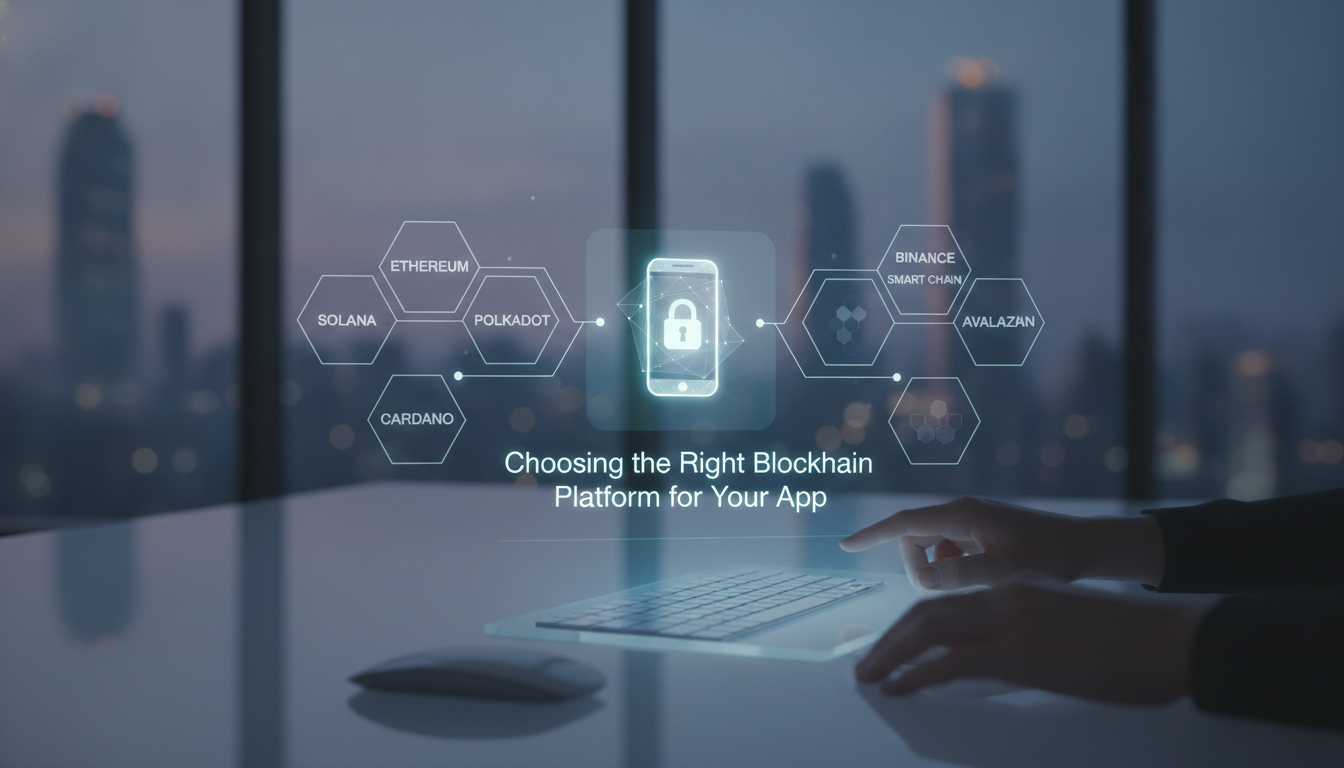
Once the concept is validated, choose the appropriate blockchain network. For public, permissionless applications requiring maximum decentralization, Ethereum, Solana, or Polygon are common choices. For enterprise-grade solutions with privacy and permissioning requirements, Hyperledger Fabric or R3 Corda excel. Key criteria include transaction throughput (Solana handles roughly 65,000 TPS vs. Ethereum’s 15-30 TPS post-merge), finality time, and developer ecosystem depth.
Design the data architecture next. Decide which data lives on-chain (critical state, ownership records) and which can reside off-chain (large files, user-specific metadata). Map out the smart contract logic, API layers, and user-facing interfaces. This phase sets the blueprint for the entire blockchain app development lifecycle – decisions made here are expensive to reverse.
Phase 3: Development, Testing, and Deployment
Development follows an agile methodology with sprints focused on smart contracts, backend APIs, and frontend UI. Use established frameworks like Truffle or Hardhat for Ethereum-based projects to compile, test, and deploy contracts. Testing is non-negotiable: unit tests for every contract function, integration tests on testnets (Sepolia, Mumbai), and formal verification where the stakes justify it.
Security audits by firms like Trail of Bits or Quantstamp should be mandatory before any mainnet launch. After deployment, serve the frontend via decentralized storage (IPFS) or traditional cloud, and monitor network performance post-launch. Upgrades may require proxy patterns (EIP-1967) or governance proposals, so plan for that from day one.
Choosing the Right Blockchain Platform for Your App
Public vs. Private vs. Consortium Blockchains
The choice between public and private blockchains hinges on trust and access requirements. Public blockchains (Ethereum, Solana) allow anyone to participate, ensuring full transparency but often at higher cost and lower privacy. Private blockchains (Hyperledger Fabric) restrict participation to invited entities, offering higher throughput and confidentiality – ideal for supply-chain consortia. Consortium blockchains sit in the middle, governed by a defined group of organizations.
In blockchain app development, this decision must align with compliance needs. A healthcare app handling patient data may require a permissioned chain. A DeFi protocol demands censorship resistance. There is no universal answer; there is only the right fit for the specific threat model and regulatory environment.
Top Platforms Compared
| Platform | Type | Consensus | Smart Contract Language | Throughput (TPS) | Typical Cost | Best For |
|---|---|---|---|---|---|---|
| Ethereum | Public | Proof of Stake | Solidity, Vyper | ~15–30 | High gas fees | DeFi, NFTs, DAOs |
| Solana | Public | Proof of History + Stake | Rust, C | ~65,000 | Very low | High-frequency trading, gaming |
| Hyperledger Fabric | Private/Consortium | Pluggable (PBFT, Raft) | Go, Java, Node.js | ~3,000+ | Medium (infra) | Enterprise supply-chain, healthcare |
| Polygon | Public (L2 sidechain) | Proof of Stake | Solidity | ~7,200 | Very low | Scalable dApps, Ethereum-compatible |
| Polkadot | Public (multi-chain) | Nominated Proof of Stake | Rust (Substrate) | ~1,000 | Moderate | Interoperability, parachains |
Factors to Consider When Picking a Chain
Beyond raw TPS, evaluate development maturity. Ethereum has the largest developer community and tooling depth; Solana offers speed but demands Rust fluency. Gas fees shape user adoption: Polygon’s low fees attract mass-market apps where Ethereum’s costs would kill retention. Interoperability is increasingly critical – Polkadot’s cross-chain message passing (XCMP) lets apps communicate across blockchains without centralized bridges.
Also factor in regulatory posture. As of 2026, public chains face DeFi-specific rules in the EU under MiCA and evolving guidance from the SEC. These rules affect how you can structure token issuance and smart contract permissions. Build for the regulatory environment you expect to operate in three years from now, not just today.
Security and Compliance in Blockchain Apps

Smart Contract Auditing Best Practices
Smart contract vulnerabilities have cost the industry billions in losses, making audits structurally indispensable. A thorough audit covers reentrancy, overflow/underflow, front-running, and access control flaws. Start with automated tools like Slither and MythX for static analysis, then bring in a reputable firm for manual review. Post-audit, run a bug bounty program on platforms like Immunefi to incentivize white-hat researchers to find what the auditors missed.
In blockchain app development, security is not a one-time checkpoint. It is an ongoing process. Every upgrade, every new integration, every parameter change is a new attack surface. Treat it accordingly.
“The vast majority of DeFi exploits are not novel cryptographic attacks – they are basic smart contract logic errors that a thorough audit would have caught. The tooling exists. The discipline to use it consistently does not always.” – Trail of Bits, Smart Contract Security Assessment Guidelines
Regulatory Considerations in 2026
As of 2026, jurisdictions including the European Union (MiCA), Singapore, and the United Kingdom have enacted comprehensive crypto-asset regulations. Apps dealing with tokens must comply with securities laws, requiring legal analysis under frameworks like the Howey Test in the U.S. Anti-Money Laundering (AML) and Know Your Customer (KYC) rules apply to wallets and exchanges. Smart contracts are being scrutinized directly; developers must embed compliance hooks – transfer restrictions for stablecoins, for example – into the contract code itself, not just the frontend layer.
Data Privacy and Encryption Techniques
Public blockchains offer pseudonymity, not privacy. To protect sensitive data, blockchain app development increasingly relies on zero-knowledge proofs (ZKPs): cryptographic methods that verify a statement’s truth without revealing the underlying data. Protocols like zkSync Era and Polygon Miden enable private transactions at scale. Hashing personal data off-chain and storing only the hash on-chain can also satisfy GDPR’s “right to erasure” requirements – the underlying data can be deleted while the on-chain record remains intact.
Understanding Decentralized vs. Centralized Architectures
On-Chain vs. Off-Chain Data Storage
Storing large files on-chain is prohibitively expensive. A single kilobyte on Ethereum can cost tens to hundreds of dollars in gas depending on network congestion. Most production apps use hybrid models: critical data (ownership records, cryptographic hashes) goes on-chain, while bulky assets (images, documents, video) reside on decentralized storage networks like IPFS or Arweave. The app references the content via its hash on the blockchain, preserving integrity without paying for on-chain storage at scale.
Scalability Solutions: Layer-2 and Sidechains
Layer-2 (L2) solutions like Arbitrum and Optimism process transactions off-chain and submit fraud proofs to the Ethereum mainnet, pushing throughput to thousands of TPS while reducing fees by 90-99% compared to L1. Sidechains like Polygon operate their own consensus but can bridge assets to Ethereum. Developers must weigh the security assumptions of each L2 carefully: some inherit Ethereum’s full security model, others rely on a smaller validator set with different trust assumptions.
For blockchain app development targeting mass adoption, L2 selection is often the deciding factor between a product that scales and one that stalls at 10,000 users.
Hybrid Architectures for Enterprise Use
Enterprises frequently blend on-premise systems with blockchain components. A manufacturer might use Hyperledger Fabric for internal supply-chain traceability while exposing purchase orders on a public chain via an API gateway. This keeps sensitive data private while providing public verifiability for counterparty audits. Tools like Chainlink CCIP facilitate cross-chain and cross-system communication in these hybrid setups, bridging the gap between legacy infrastructure and decentralized networks.
Blockchain App Development Use Cases Across Industries
Finance and Decentralized Finance (DeFi)
DeFi remakes traditional financial services – lending, borrowing, trading – using smart contracts instead of banks. Platforms like Uniswap (automated market maker) and Aave (lending protocol) show how blockchain app development can deliver permissionless, 24/7 access to capital markets. The total value locked (TVL) in DeFi surpassed $100 billion in 2025, driven by innovations like liquid staking and real-world asset (RWA) tokenization. RWAs alone are projected to represent a multi-trillion-dollar opportunity by 2030, according to BIS research.
Supply Chain and Logistics
Counterfeit goods impose enormous costs on the global economy annually. Blockchain tackles this by creating an immutable record of each step from raw materials to end consumer. IBM’s Food Trust platform, built on Hyperledger Fabric, lets retailers trace a bag of mangoes back to the farm in seconds rather than days. IoT sensors feed real-time temperature and location data into smart contracts, automating insurance payouts when conditions are breached. The result is faster dispute resolution and a verifiable audit trail that paper-based systems simply cannot provide.
Healthcare and Digital Identity
Medical records are siloed across providers, leading to errors and treatment delays. A blockchain-based health platform can give patients sovereign control over their data, granting access via cryptographic keys rather than fax requests. MedRec, a prototype from MIT, uses Ethereum to manage access permissions while storing actual records off-chain. For digital identity, the World Wide Web Consortium (W3C) standardized Decentralized Identifiers (DIDs), and projects like Microsoft ION anchor DID documents on Bitcoin, enabling password-less authentication at scale.
“Decentralized identity is not just a privacy feature – it is infrastructure. When users control their own credentials, entire categories of data breach risk disappear from the equation.” – W3C Decentralized Identifier Working Group, DID Core Specification
Skills, Certifications, and Career Path for Blockchain Developers
Core Technical Skills Required
Becoming a productive blockchain developer requires a specific stack of knowledge. At the foundation: solid command of at least one systems or scripting language (JavaScript, Python, Go, or Rust), familiarity with cryptographic primitives (hashing, digital signatures, Merkle trees), and a working understanding of distributed systems. From there, the specialization branches by ecosystem.
Ethereum developers need deep Solidity fluency, knowledge of the EVM execution model, and hands-on experience with development frameworks like Hardhat and Foundry. Solana developers need Rust and an understanding of the account model, which differs fundamentally from Ethereum’s contract model. Enterprise blockchain work on Hyperledger Fabric requires Go or Java chaincode development and an understanding of channel architecture and endorsement policies.
Certifications Worth Pursuing
Several certifications carry real weight in the hiring market. The Certified Blockchain Developer (CBD) from Blockchain Council covers protocol fundamentals and smart contract development. The Ethereum Developer Certification from the Ethereum Foundation tests practical Solidity and tooling knowledge. For enterprise tracks, Hyperledger Fabric certification from The Linux Foundation is recognized by major system integrators. These credentials do not replace portfolio work, but they signal baseline competency to hiring teams evaluating hundreds of applicants.
Global Talent and Adoption Landscape
North America leads blockchain investment, contributing roughly 46% of global blockchain technology market growth, with the U.S. expected to spend $41 billion on blockchain by 2025. China, Singapore, and the UAE are also major hubs, with government-backed blockchain initiatives accelerating enterprise adoption. The U.S. Bureau of Labor Statistics projects 22% growth in software developer roles from 2024 to 2034, and blockchain specialization commands a significant salary premium above that baseline. Coursera reports the median U.S. blockchain developer salary at $136,000, with senior protocol engineers regularly clearing $200,000.
Cost Breakdown and Budgeting for Blockchain App Development
Factors That Influence Development Costs
Several variables determine the budget for a blockchain app development project: complexity of smart contracts (a simple token vs. a DeFi protocol with yield farming and governance), choice of blockchain (Ethereum gas costs vs. Solana’s minimal fees), team composition (in-house vs. outsourced), and compliance requirements (legal reviews, security audits). According to a Riseup Labs guide, a typical project ranges from $50,000 for an MVP to over $250,000 for a full-featured enterprise solution.
Average Cost Ranges by App Type
| App Type | Features | Estimated Cost (USD) | Timeline |
|---|---|---|---|
| Token/NFT marketplace | Minting, listing, wallet integration | $60,000 – $120,000 | 3–5 months |
| DeFi lending platform | Liquidity pools, yield optimization, governance | $150,000 – $350,000 | 6–12 months |
| Supply-chain tracker | IoT data ingestion, audit trail, permissioned roles | $100,000 – $250,000 | 5–8 months |
| Enterprise identity KYC | Zero-knowledge proofs, DID integration, compliance APIs | $200,000 – $500,000 | 8–14 months |
Hidden Expenses and Ongoing Costs
Beyond initial development, factor in gas fees for contract deployment and user transactions ($10-$50 per complex Ethereum interaction at moderate congestion), security audit fees ($10,000-$50,000+ depending on contract complexity), node infrastructure ($200-$1,000/month for managed RPC providers), and legal compliance ($20,000-$100,000 depending on jurisdiction and token structure). Many teams underestimate continuous monitoring and maintenance, which typically adds 15-20% of the initial build cost annually. Smart contract upgrades via proxy patterns (EIP-1967) also require ongoing development effort and re-auditing.
Pros and Cons of Blockchain App Development
Pros
- Immutability and auditability: Every transaction is permanently recorded and publicly verifiable, reducing fraud and dispute resolution costs.
- Elimination of intermediaries: Smart contracts automate trust, cutting out banks, brokers, and clearinghouses and reducing fees for end users.
- Censorship resistance: Public blockchains have no single point of control, making applications resilient to takedowns and data manipulation.
- Programmable money: DeFi protocols enable financial products – lending, derivatives, insurance – that execute automatically without human intervention.
- Global accessibility: Anyone with an internet connection and a wallet can interact with a blockchain app, regardless of geography or banking access.
Cons
- Irreversibility of bugs: A flawed smart contract cannot be patched like traditional software. Exploits can drain funds permanently with no recourse.
- High development complexity: Blockchain app development requires specialized skills across cryptography, distributed systems, and protocol-specific tooling – talent that commands premium salaries.
- Gas fee volatility: On high-demand networks like Ethereum, transaction costs can spike unpredictably, degrading user experience during peak periods.
- Regulatory uncertainty: Evolving rules across jurisdictions create compliance risk, particularly for token-based applications and cross-border DeFi protocols.
- Scalability constraints: Base-layer blockchains still face throughput limits; L2 solutions add complexity and introduce new trust assumptions.
The Future of Blockchain App Development in 2026 and Beyond
AI and Blockchain Convergence
Artificial intelligence is reshaping blockchain app development by automating testing, generating boilerplate code, and detecting anomalies in real time. AI-powered monitoring tools like CertiK’s Skynet continuously analyze on-chain activity to flag suspicious patterns before they become exploits. Developers use GitHub Copilot with Solidity extensions to write contracts faster, though AI is not yet a substitute for deep protocol knowledge. The practical result: teams ship roughly 30% faster while maintaining rigorous security standards, because AI handles the repetitive scaffolding while humans focus on the logic that actually matters.
Zero-Knowledge Proofs and Enhanced Privacy
ZK-rollups are becoming the default scaling solution, combining high throughput with cryptographic privacy guarantees. In 2026, zkSync Era and StarkNet host hundreds of applications – from DeFi to gaming – that inherit Ethereum’s security at a fraction of the cost. ZK technology also enables private voting in DAOs and confidential cross-border payments, addressing a key barrier to enterprise blockchain adoption that public ledger transparency previously created.
Industry Adoption and Talent Demand
The blockchain job market remains intensely competitive. The U.S. Bureau of Labor Statistics projects 22% growth in software developer roles from 2024 to 2034, with blockchain specialization commanding a salary premium above that baseline. As more Fortune 500 companies move from pilot programs to production blockchain deployments, demand for skilled blockchain app development talent will only intensify. The developers who understand both the protocol layer and the product layer will be the ones building the infrastructure that matters.
Blockchain app development is a multidisciplinary craft that merges cryptography, economics, and full-stack engineering. Follow a structured process, select the right platform for your threat model, and treat security as infrastructure rather than an afterthought. The builders who get those fundamentals right are the ones whose protocols will still be running in a decade.
If you are serious about building on-chain, apply to the Genesis Cohort at Digital Blockchains. We work with founders and protocol teams who are building infrastructure that lasts.
Frequently Asked Questions
What is blockchain app development?
Blockchain app development is the process of building software that uses a decentralized, distributed ledger for data storage and smart contracts for automated logic. It provides transparency, security, and censorship resistance that centralized architectures cannot match.
How much does blockchain app development cost?
Costs vary widely based on complexity and platform. A simple token app can start at $50,000, while a full DeFi platform with governance and yield optimization may exceed $350,000. Security audits, legal compliance, and ongoing maintenance add 15-20% annually on top of the initial build.
Which programming languages are used for blockchain apps?
Solidity dominates Ethereum and EVM-compatible chains. Rust is the primary language for Solana and Polkadot’s Substrate framework. Hyperledger Fabric supports Go, Java, and Node.js chaincode.
Will AI replace blockchain developers?
AI assists with code generation, static analysis, and anomaly detection, but it cannot replace the deep protocol design and security expertise required for complex decentralized systems. Human oversight remains essential, particularly for smart contract architecture and threat modeling.
How long does it take to build a blockchain app?
An MVP can be delivered in 3-5 months. A production-grade DeFi or enterprise application typically requires 8-14 months, including testnet deployment, security audits, and regulatory review.
What are the biggest challenges in blockchain app development?
The primary challenges are managing gas fee volatility, scaling to high transaction volumes without sacrificing security, ensuring smart contract correctness before deployment, and navigating evolving regulatory frameworks across multiple jurisdictions.