A crypto AI trading bot is automated software that uses machine learning to analyze market data, identify patterns, and execute cryptocurrency trades around the clock. These systems remove emotional bias and adapt strategies in real time based on shifting market conditions.
Key Takeaways
- trading bots use machine learning to analyze markets and execute trades 24/7 without emotional interference.
- Top platforms include Cryptohopper (customizable, 1.15M+ traders), Stoic AI (institutional-grade, $230M AUM), and open-source Freqtrade (51,700+ GitHub stars).
- Always backtest strategies, start with paper trading, and use API keys with trading permissions only. Never grant withdrawal access.
- The CFTC confirmed Mirror Trading International stole over $1.7 billion in bitcoin from 23,000 victims using a fake AI bot Ponzi scheme.
- Algorithmic trading drives an estimated 60-75% of volume in major traditional markets, according to Kraken’s educational resources. Crypto is catching up fast.
- No this type of bot can guarantee profits. Overfitting, security vulnerabilities, and regulatory uncertainty are real risks every operator must manage.
Crypto markets never sleep, and human traders simply cannot monitor price swings around the clock. Algorithmic trading already drives an estimated 60-75% of volume in traditional markets, according to resources cited by Kraken. AI-powered automation is now bringing that same efficiency to crypto, enabling both retail and institutional traders to compete in a data-driven environment. But not all bots are created equal. Below, I break down exactly how they work, compare the leading platforms, and cover the risks you must understand before plugging in your API keys.
What Is a Crypto AI Trading Bot?

Definition and Core Components
A this kind of trading bot is a software application that combines automated execution with artificial intelligence to manage cryptocurrency trades. Unlike simple rule-based bots that follow fixed “if-this-then-that” logic, an AI bot uses machine learning models to process vast datasets: price history, order books, news sentiment, and social media signals, all to predict price movements and adjust strategy on the fly.
Core components include a data ingestion engine (collects real-time and historical data), a machine learning model (trained to find repeatable patterns), a backtesting module (simulates strategies on past data), and an execution layer (connects to exchanges via API). Most serious platforms also integrate risk management tools: stop-loss orders, trailing stops, and portfolio diversification rules.
How AI Differs from Rule-Based Bots
Traditional trading bots rely on static technical indicators. Buy when the 50-day moving average crosses above the 200-day. They cannot learn from new conditions. A the ai trading bot, by contrast, employs adaptive learning. A machine learning model might detect that a certain candlestick pattern’s reliability has degraded during high volatility and automatically reduce position sizes. That flexibility matters in crypto, where correlations and volatility regimes shift faster than any fixed ruleset can track.
“AI technology can’t predict the future or sudden market changes,” warns the U.S. Commodity Futures Trading Commission. “Don’t believe the scammers.”
How Does a Crypto AI Trading Bot Work?

Data Ingestion and Preprocessing
The first step is gathering structured and unstructured data at scale. This includes price ticks, volume, order book depth, blockchain on-chain metrics, social media sentiment, news headlines, and macroeconomic indicators. AI models require clean, normalized inputs, so bots preprocess this information, filling gaps and removing noise before it ever reaches the model. According to Stoic AI’s published documentation, their quant team analyzed millions of data points over years of research and invested over $9 million in R&D to build robust data pipelines supporting a 5-year live trading track record.
Machine Learning Models in Trading
Common model architectures include deep neural networks, gradient boosting machines, and reinforcement learning agents. A well-designed bot might use a recurrent neural network (RNN) to forecast short-term price movements from sequences of past returns, while a random forest classifier handles the entry decision. The AI continuously retrains as new data arrives. Freqtrade, an open-source bot with over 51,700 GitHub stars, lets developers implement custom machine learning strategies and optimize them through rigorous backtesting.
Execution and Risk Management Systems
Once a signal is generated, the execution layer places orders via exchange APIs. A robust crypto ai includes risk controls such as maximum drawdown limits, position sizing algorithms, and automatic stop-loss triggers. Platforms like Cryptohopper offer trailing stops that follow price movements, locking in profits while protecting against reversals. Bots can also manage portfolios across multiple exchanges simultaneously, something no manual trader can replicate at scale.
Pros and Cons of Using a Crypto AI Trading Bot
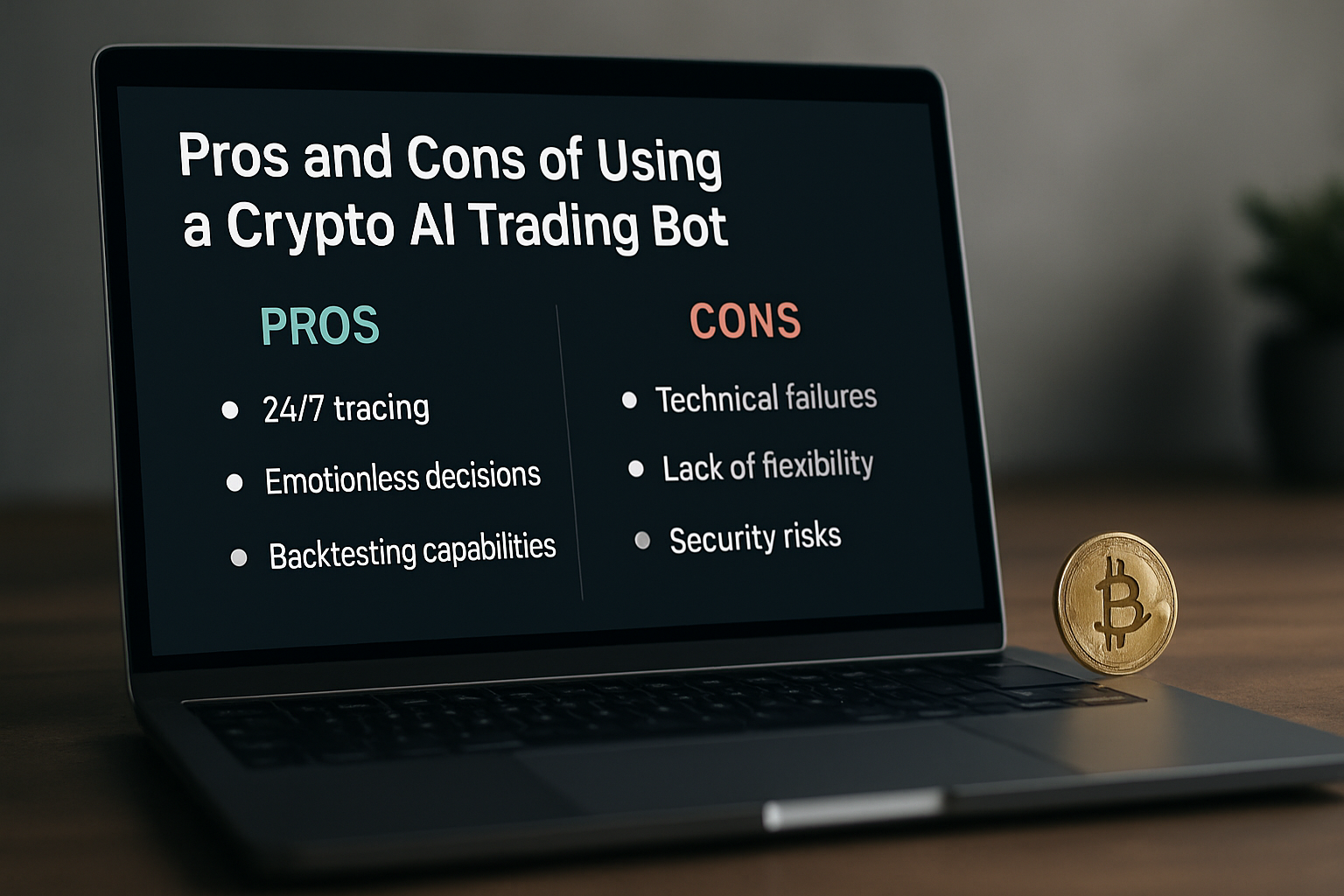
Pros
- 24/7 operation: A trading bot never sleeps, never misses a signal, and executes in milliseconds across thousands of trading pairs.
- Emotion-free execution: No panic selling during dips, no FOMO buying at peaks. The bot follows the data, not the narrative.
- Adaptive strategies: Machine learning models retrain on fresh data, detecting regime changes and adjusting parameters without human intervention.
- Scalability: A single bot can monitor hundreds of assets and manage positions across multiple exchanges simultaneously.
- Backtesting and simulation: Most platforms let you stress-test strategies against years of historical data before risking real capital.
Cons
- Overfitting risk: A model that fits historical data perfectly often fails in live markets. Backtests can be dangerously misleading without realistic slippage and fee assumptions.
- Security exposure: API key mismanagement or using a malicious platform can result in total loss of trading capital.
- No profit guarantee: Per the CFTC, no AI system can predict the future. Bots lose money in adverse conditions, sometimes faster than a human would.
- Regulatory complexity: Automated trading sits in a gray zone in many jurisdictions, especially when managing third-party funds.
- Technical barrier: Self-hosted solutions like Freqtrade require server management, Python knowledge, and ongoing maintenance.
Advantages of Using an AI Trading Bot for Crypto

24/7 Market Monitoring and Execution Speed
Cryptocurrency exchanges never close. A this type of bot scans thousands of trading pairs simultaneously and executes trades in milliseconds, capitalizing on opportunities that human traders miss entirely. This constant vigilance is especially valuable for arbitrage strategies, where price differences between exchanges disappear in seconds. Cryptohopper, for instance, supports over 12 exchanges and has served more than 1,151,419 traders precisely because speed and availability matter.
Emotion-Free, Data-Driven Decisions
Fear and greed drive most market cycles. A this kind of trading bot follows the data, not the hype. It won’t panic-sell during a dip or chase a pump. According to a Kraken survey, 47% of U.S. crypto holders believe AI-driven token strategies will outperform the broader market, reflecting growing confidence in algorithmic decision-making over gut instinct.
Adaptive Learning and Strategy Evolution
Markets change. A static strategy that worked in 2023 may fail in 2026. AI bots retrain on recent data, detecting regime changes and adjusting parameters without human intervention. If volatility spikes, the bot might tighten stop-losses or rotate to a mean-reversion approach automatically. That kind of real-time adaptation is simply not possible with fixed-rule systems.
Risks and Common Pitfalls of Crypto AI Trading Bots
Overfitting and Backtesting Fallacies
A strategy that perfectly fits historical data may fail catastrophically in live markets. Overfitting is a classic machine learning problem: the model learns noise rather than signal. Always verify that backtest results include realistic transaction costs, slippage, and liquidity constraints. Platforms like Cryptohopper provide paper trading modes to test strategies in simulated live conditions before risking real capital. This step alone eliminates most preventable losses.
Security Vulnerabilities and Scams
The biggest risk is handing API keys to a malicious operator. The CFTC’s customer advisory documents a case where Mirror Trading International stole over $1.7 billion in bitcoin from 23,000 victims, promising a “proprietary AI bot” with guaranteed 10% monthly returns. It was a Ponzi scheme. Always use non-custodial bots that never request withdrawal rights, and audit API permissions regularly. Stoic AI, for example, is explicitly non-custodial: your funds stay on your exchange account at all times.
Regulatory Uncertainty
Regulators worldwide are still working through both crypto and AI policy. In some jurisdictions, running an automated trading bot may require licenses if you manage third-party funds. Even personal use creates tax complexity, since every trade may be a taxable event. AI algorithms can also inadvertently trigger market manipulation rules, exposing users to legal risk. The CFTC actively prosecutes fraudulent schemes, and staying current on local regulations is non-negotiable.
Choosing the Right Crypto AI Trading Bot
Key Features to Look For
When evaluating a the ai trading bot, prioritize these criteria:
- Exchange compatibility: Does it support your preferred exchanges (Binance, Coinbase, Kraken, Bybit, KuCoin)?
- Backtesting engine: Can you test strategies on historical data with realistic fills and fees?
- Strategy options: Do you want plug-and-play templates or the ability to write custom algorithms in Python?
- Security architecture: Is the bot non-custodial? Does it offer two-factor authentication and encrypted API storage?
- Transparency: Open-source code (like Freqtrade) lets you audit the logic. Proprietary bots should have a verifiable live track record, not just backtested equity curves.
- Pricing: Consider monthly subscriptions, performance-based fees, or self-hosted zero-cost options. Cryptohopper’s paid plans start around $19/month, while Stoic AI operates on an AUM-based model managing $230 million across 18,000+ clients.
Comparison of Top Crypto AI Trading Bots
| Platform | Key AI Features | Exchanges Supported | Pricing Model | User Base |
|---|---|---|---|---|
| Cryptohopper | AI algorithm, strategy marketplace, copy trading, DCA, trailing stops | Binance, Coinbase, Kraken, Bybit, KuCoin, 12+ others | Free trial; paid plans from ~$19/mo | 1,151,419+ traders |
| Stoic AI | Quant-driven, market-neutral, index and carry strategies, fully automated | Binance, Coinbase, Bybit, KuCoin, Crypto.com | Percentage of AUM or flat fee | 18,000+ clients, $230M AUM |
| Freqtrade | Open-source, machine learning optimization, customizable Python strategies, FreqAI module | Binance, Kraken, Bybit, OKX, Gate.io, many others | Free (self-hosted) | 51,700+ GitHub stars |
| ETM AI Trading Robot (iOS) | Three risk levels, AI signals, educational content | Not publicly specified | Free with in-app purchases | 4.7/5 App Store rating |
Step-by-Step Setup Guide for Beginners
Getting started with a safe, non-custodial bot takes six steps:
- Choose a reputable platform: Review the comparison table above. For beginners, Cryptohopper’s free trial and guided interface are a practical starting point.
- Connect your exchange via API: Generate API keys from your exchange (e.g., Binance) with trading permissions only. Never enable withdrawal access. Paste the key and secret into the bot dashboard.
- Select or build a strategy: Browse the marketplace for pre-configured templates, use the AI strategy builder, or write your own in Python if you’re technical. Cryptohopper’s strategy marketplace includes templates combining multiple technical indicators and candlestick pattern recognition.
- Backtest thoroughly: Run the strategy against historical data. Review drawdown figures, win rates, and equity curves. Adjust for realistic fees and slippage before drawing any conclusions.
- Deploy in paper trading mode: Let the crypto ai simulate live trades without real money for at least one week. Observe behavior across different market conditions.
- Start small with real capital: Once confident, allocate a small fraction of your portfolio. Monitor closely and be ready to intervene if the bot behaves unexpectedly.
Advanced AI Techniques Powering Modern Trading Bots
Sentiment Analysis and Natural Language Processing
Many top-tier bots now incorporate NLP models to gauge market sentiment from Twitter, Reddit, and financial news outlets. A sudden spike in negative sentiment can trigger an automated sell before the price drops. Kraken’s educational material notes that generative AI tools like GPT-4 can summarize news and feed sentiment scores directly into trading logic. This gives a meaningful edge in markets where narratives drive price action as much as fundamentals do.
Reinforcement Learning for Dynamic Portfolios
Reinforcement learning (RL) trains an agent to maximize cumulative rewards by interacting with a simulated environment. An RL-based trading bot can learn to dynamically weight a portfolio of cryptocurrencies based on momentum and volatility signals. Unlike supervised models, RL adapts to non-stationary distributions, making it well-suited for crypto’s constantly shifting conditions. Freqtrade’s FreqAI module makes RL experiments accessible to developers without requiring a research team.
Social Trading and Signal Marketplaces
Beyond pure automation, platforms like Cryptohopper offer signal marketplaces where experienced traders publish their strategies and signals for others to subscribe to and copy. This social layer adds a human intelligence component on top of algorithmic execution. A beginner can subscribe to a proven signal provider, let the this type of bot execute those signals automatically, and study the logic over time. It’s a practical bridge between manual trading experience and full automation.
Carry Trades and Market-Neutral Strategies
Stoic AI’s quant approach goes beyond simple trend-following. Their platform implements carry strategies that exploit funding rate differentials in perpetual futures markets, and market-neutral index strategies designed to generate returns regardless of whether Bitcoin is up or down. These institutional-grade approaches, previously accessible only to hedge funds, are now available to individual traders through a three-step setup. With $230 million in cumulative assets managed and a 5-year live trading track record, Stoic AI represents what institutional-grade automation looks like at the retail level.
How to Avoid AI Trading Bot Scams and Fraud
Red Flags of a Fraudulent Bot
The CFTC advisory identifies these common characteristics of fraudulent this kind of trading bot schemes:
- Guaranteed high returns: No real AI can promise 10% monthly or 200% annually. The Mirror Trading International case proved exactly what happens when people believe those claims.
- Aggressive affiliate programs: Schemes that pay commissions for recruiting new users are often pyramid structures, not trading operations.
- Anonymous teams: Reverse image search team photos. Stock photos or stolen identities are immediate disqualifiers.
- No verifiable track record: Demand live, audited performance statements, not just backtested equity curves that anyone can fabricate.
- Pressure to deposit quickly: Legitimate platforms never push you to fund an account on a deadline.
Best Practices for Security
Always use dedicated exchange sub-accounts with limited permissions for any the ai trading bot. Review API key permissions regularly and revoke unused keys. Enable two-factor authentication on both your exchange and bot platform. Keep the bulk of your holdings in a hardware wallet and only maintain active trading capital on the exchange. If a bot operator insists on full custody of your crypto, treat that as a hard stop.
“Victims lost nearly 30,000 bitcoins in one CFTC-prosecuted case,” per the CFTC customer advisory on AI trading bots. “Scammers use AI as a buzzword to create the illusion of legitimacy.”
The Future of Crypto AI Trading Bots
Integration with DeFi and On-Chain Analytics
As decentralized finance matures, AI bots will increasingly execute trades directly on blockchain protocols. MEV (Maximal Extractable Value) bots already use AI to identify profitable liquidations and arbitrage opportunities on DEXs. Looking ahead, expect bots that monitor whale wallet movements, governance proposals, and liquidity pool shifts in real time, adjusting positions across both CeFi and DeFi without human input. If you’re building in this space, our Digital Blockchains blog covers protocol infrastructure and DeFi architecture in depth.
Democratization Through Open Source and No-Code Tools
Open-source projects like Freqtrade are cutting the barrier to entry significantly. No-code interfaces and drag-and-drop strategy builders mean a non-technical trader can deploy a sophisticated crypto AI trading bot in under an hour. Coupled with cheaper cloud computing, the gap between retail and institutional capability is narrowing fast. Stoic AI’s model of institutional-grade quant strategies for individual traders, managing $230M for 18,000+ clients with a three-step setup, is a preview of where the industry is heading.
AI Crypto Tokens as an Emerging Asset Class
Beyond automation tools, AI-native crypto tokens are emerging as a distinct investment category. According to Kraken’s research, 47% of U.S. crypto holders believe AI token strategies will outperform the broader market. Projects building on-chain AI inference, decentralized compute networks, and AI-governed DAOs represent a new layer of the stack. A well-configured crypto AI trading bot can be programmed to track and trade these assets specifically, combining thematic exposure with algorithmic execution.
For a deeper look at how tokenomics and protocol design intersect with automated trading, see our analysis on token launch strategy and DAO architecture at Digital Blockchains.
Frequently Asked Questions
What is the best crypto AI trading bot for beginners?
Cryptohopper is widely recommended for beginners due to its intuitive interface, free trial, and extensive tutorial library. It supports over 12 exchanges, offers pre-built strategy templates, and includes a social trading feature that lets you copy experienced traders. More than 1,151,419 traders have used the platform as of 2026.
Can AI trading bots really make money in crypto?
Yes, but profits are never guaranteed. Performance depends on the strategy, market conditions, and risk settings. A crypto AI trading bot can improve execution efficiency and remove emotional mistakes, but it can also lose money, especially in unpredictable or low-liquidity markets. The CFTC is explicit: no AI system can predict the future.
Are crypto AI trading bots legal?
In most jurisdictions, using a crypto AI trading bot for personal trading is legal. However, managing funds for others or deploying certain manipulative strategies can violate securities and commodities laws. Always check local regulations and your exchange’s terms of service before deploying any automated system.
How do I choose between a cloud-based and a self-hosted bot?
Cloud-based bots like Cryptohopper and Stoic AI are easier to set up and maintain but carry monthly subscription costs and require trusting a third-party platform. Self-hosted bots like Freqtrade give you full control and zero ongoing fees but require server management, Python proficiency, and ongoing security maintenance. Your technical comfort level should drive this decision.
What percentage of crypto trading is done by bots?
Exact figures for crypto are difficult to verify, but algorithmic trading drives an estimated 60-75% of volume in major traditional markets, according to Kraken’s educational resources. The 24/7 nature of crypto and low barrier to API access make bot usage especially prevalent, with platforms like Cryptohopper alone serving over 1.15 million traders.
Should I trust AI trading bot reviews on YouTube and Reddit?
Be skeptical. Many influencers promoting a crypto AI trading bot are paid affiliates who overstate results. Cross-reference multiple independent sources, look for verified user experiences on neutral forums, and always read the official documentation. If a bot promises a specific monthly return, treat that as a disqualifying red flag, not a selling point.
Ready to build with institutional-grade infrastructure? Apply to the Genesis Cohort at digitalblockchains.com and work with a team that reads whitepapers before breakfast and ships before lunch.