TARS AI crypto is the native token ecosystem of a Solana-based protocol built to deploy, tokenize, and trade AI agents on-chain. TAI, the native token, powers staking, governance, and agent bonding curves across the full product suite.
Key Takeaways
- ai crypto (TAI) is a Solana infrastructure protocol enabling one-click deployment and tokenization of AI agents.
- The native token TAI fuels staking, agent bonding curves, and governance, with a maximum supply of 1 billion tokens.
- The protocol holds a Solana Foundation AI grant and has been accepted into the Google Startup Program, Apple Developer Program, and Adobe Technology Partner network.
- TAI trades on Bybit, Gate, KuCoin, MEXC, and Bitstamp, with a circulating supply between 586 million and 892 million and a market cap around $9-10 million as of mid-2026.
- TARS AI executed $15M TAI and $30M TAI buybacks in 2025, funded entirely by ad and sponsorship revenue.
- Proof of Intelligence (POI) running inside Trusted Execution Environments (TEE) ensures verifiable, tamper-proof agent outputs.
What Is TARS AI Crypto?
TARS AI crypto is the native token TAI and the broader TARS AI protocol: an AI-focused infrastructure layer on the Solana blockchain that lets anyone create, own, and monetize AI agents without deep coding skills. According to CoinMarketCap, TARS AI is “one of the first AI-focused ecosystems on the Solana blockchain” and aims to advance the integration of AI and Web3 technologies. The project is backed by a Solana Foundation AI grant and has been accepted into the Google Startup Program, signaling meaningful institutional confidence for a micro-cap protocol.
The ecosystem includes an AI console, a proprietary search engine (TGPT), a voice assistant named Sona, and an upcoming AI marketplace for tokenized AI commodities. At its core, tars ai crypto is more than a speculative token. It is the economic backbone of an on-chain AI economy that gives Solana users access to commercial AI applications at a fraction of typical cloud costs, with consumer AI services priced up to 90% below traditional cloud providers.
Why TARS AI Matters in 2026
The convergence of AI and crypto has become one of the defining narratives of 2026. With the global AI market projected to surpass $800 billion this year, protocols that deliver tangible AI tooling on-chain are capturing serious developer attention. TARS AI runs on Solana, a chain known for sub-second finality and fees measured in fractions of a cent, making AI interactions feasible at scale. First-mover positioning on Solana Mobile through Sona and integration with over 200 apps give tars ai crypto a distribution edge that most competing AI protocols simply do not have.
The Role of TAI in the Ecosystem
TAI is the native utility token of the TARS AI ecosystem. It serves multiple purposes: paying for AI services, staking to earn rewards, participating in governance, and providing liquidity for tokenized AI agents. Every time a new agent deploys on the TARS AI Market, it launches on a bonding curve paired with TAI, creating sustained structural demand for the token. The protocol also runs aggressive buyback programs where revenue from ads and sponsorships is directed entirely toward purchasing and removing TAI from circulation, tightening supply over time.
How TARS AI Works: Architecture and Technology
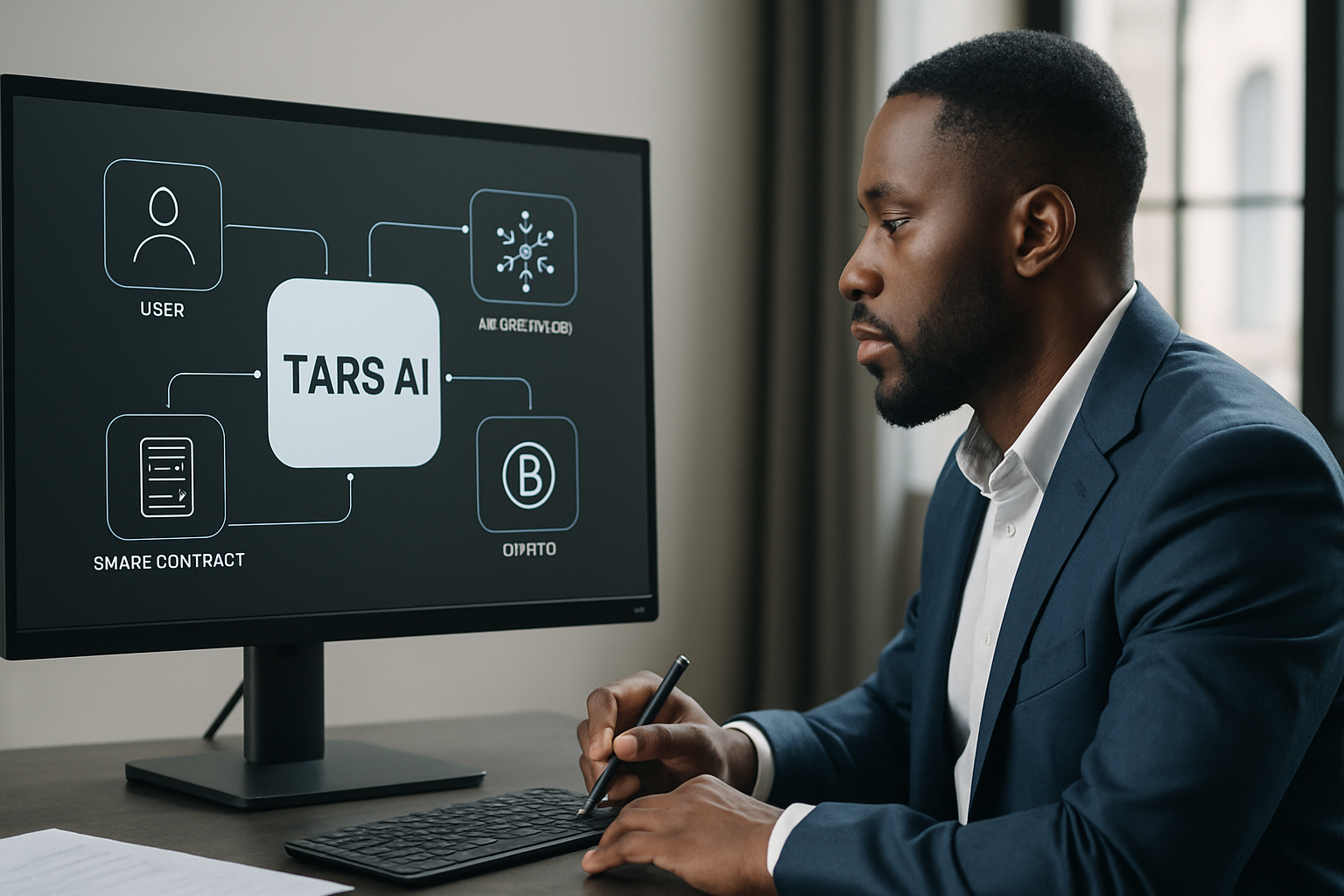
TARS AI is built as a modular, AI-native infrastructure layer on Solana. Unlike centralized AI services, it uses blockchain to ensure transparency, verifiable execution, and permissionless access. The architecture comprises several interlocking components that serve both technical builders and non-technical users.
AI Console: The Super-App
The AI Console is the primary entry point into the tars ai crypto ecosystem. Described by the team as a “super-app,” it aggregates all modular AI applications under one interface. Users can access language models, configure AI agents, and monitor their agent portfolios without juggling multiple dApps. The console is designed to reduce complexity and lower the barrier for Web2 users migrating to Web3.
Agent Tokenization and Bonding Curves
One of TARS AI’s most technically interesting features is the ability to tokenize AI agents in under five minutes. Using a one-click deployment flow, anyone can create an AI agent, define its personality and cognitive history (including cloning from an existing X/Twitter profile), and issue a tradable token via a fair stealth launch. Each agent token is paired with TAI on a native bonding curve, meaning the agent’s success directly drives demand for the TAI token. This creates a direct economic link between agent utility and token value that most competing protocols lack.
Proof of Intelligence (POI) and TEE
To guarantee that agents operate autonomously without human interference, TARS AI introduces Proof of Intelligence (POI). Agents run inside Trusted Execution Environments (TEE), generating verifiable cryptographic proof that every output was produced by the AI without manipulation. This is critical for financial agents that manage portfolios or execute trades, as it provides auditable, tamper-proof execution records. No comparable on-chain verification standard exists natively in competing Solana AI protocols as of mid-2026.
TARS AI Token (TAI) Tokenomics
The tars ai crypto token, TAI, has a well-defined supply structure. The maximum supply is capped at approximately 999.99 million tokens. As of mid-2026, CoinGecko reports a circulating supply of roughly 586.68 million TAI with a fully diluted valuation around $9.46 million, while Crypto.com places the circulating figure closer to 892 million. The discrepancy reflects ongoing token unlock events. The market cap sits around $9.42 million at a price near $0.0106, with approximately 70,180 on-chain holders recorded by CoinMarketCap.
Buyback and Burn Mechanism
In 2025, TARS AI executed a series of aggressive token buybacks. Round 2, completed in April 2025, bought back 15,000,000 TAI. Round 3, completed in May 2025, upped that to 30,000,000 TAI, the largest single buyback in the project’s history. All funds come from newly launched ad and sponsorship revenue streams and are directed entirely toward TAI buybacks. By permanently removing tokens from circulation, the protocol creates deflationary pressure that rewards long-term holders.
Staking and GPU NFT Rewards
TAI holders can stake their tokens to mint non-tradable GPU NFTs, which mine additional TAI as rewards. This GPU staking model aligns with the protocol’s AI theme: stakers effectively contribute to the computational backbone of the ecosystem. Specific staking APR figures vary based on network participation levels and are not published as fixed rates, so prospective stakers should check the official TARS AI staking portal for current yields before committing capital.
Token Unlock Schedule
The gap between CoinGecko’s 586 million circulating figure and Crypto.com’s 892 million figure points to a meaningful unlock schedule still in progress. Tokens unlock gradually, which means sell pressure from early allocations remains a factor to monitor. Buyers of tars ai crypto should review the official vesting schedule on the TARS AI documentation before sizing positions, as unlock events have historically coincided with short-term price weakness across comparable micro-cap protocols.
Live Price and Market Stats
Real-time TAI price, market cap, and volume can be monitored on CoinMarketCap, CoinGecko, and Crypto.com. As of this writing, the price sits near $0.0106, down roughly 97-98% from its all-time high of $0.4941 on December 13, 2024, but slightly above the all-time low of $0.009923 recorded on June 21, 2026. The 24-hour trading volume runs between $650K and $750K across all venues, and the token ranks around #991-#995 on CoinMarketCap.
Key Products of the TARS AI Ecosystem
TARS AI has shipped a suite of products that demonstrate the practical intersection of AI and Web3. The table below compares the major offerings currently live or in active development.
| Product | Description | Status |
|---|---|---|
| AI Console | Super-app for modular AI tools and ecosystem access | Live |
| Sona | Voice-first virtual assistant for Solana Mobile, controls 200+ apps | Beta (Live) |
| TARS Search Engine (TGPT) | Native LLM merging AI insights with real-time blockchain data | Live |
| AI Market | Marketplace for tokenized AI agents and commodities | Coming Soon |
| GPU Staking | Stake TAI to mint GPU NFTs and mine TAI rewards | Live |
| Consumer AI | AI services priced up to 90% below traditional cloud | Live |
Sona: Solana’s Native AI Assistant
Sona is a voice-first virtual assistant designed exclusively for Solana Mobile. It provides a near-zero learning curve interface that lets users control over 200 apps through natural language commands. Sona uses conversational AI to answer questions, execute transactions, and surface on-chain insights. As a first-mover on Solana’s mobile-first strategy, Sona positions tars ai crypto as a serious contender in consumer crypto adoption, a segment most infrastructure protocols ignore entirely.
TARS Search Engine (TGPT)
TGPT is the protocol’s proprietary large language model (LLM) that indexes both on-chain and off-chain data. It returns conversational answers enriched with real-time blockchain data, making it particularly useful for traders, researchers, and DeFi users who need contextual information without leaving the Web3 environment. Think of it as a Perplexity-style interface with native Solana data feeds baked in.
AI Market and Agent Frameworks
The upcoming AI Market will allow users to deploy, tokenize, and trade AI agents across Solana. TARS AI supports multiple agent frameworks including its proprietary framework, Eliza, Rig, Solana Agent Kit (pioneered by SendAI), and Akira (generative code), giving builders meaningful flexibility. This interoperability is designed to make TARS the primary liquidity hub for AI assets on Solana, aggregating demand from multiple agent ecosystems rather than locking builders into a single stack.
TARS AI Partnerships and Institutional Backing
TARS AI’s credibility comes from a string of high-profile partnerships and program acceptances that are unusually strong for a protocol at this market cap level. These relationships validate the technology and open doors to enterprise distribution channels.
Strategic Partnerships
In 2024, TARS Protocol received an AI grant from the Solana Foundation. It subsequently entered the Google Startup Program and, in June 2025, was accepted into the Apple Developer Program, gaining access to advanced APIs and testing infrastructure. Also in 2025, it became an Adobe Technology Partner. Adobe powers roughly two-thirds of the Fortune 500 and processes over 30.5 trillion transactions annually, making this partnership a meaningful enterprise distribution signal. An expanded institutional partnership with Uphold provides tars ai crypto direct access to Uphold’s global institutional network.
“TARS AI is one of the first AI-focused ecosystems on the Solana blockchain, aiming to advance the integration of AI and Web3 technologies.” – CoinMarketCap project description
Research Collaborations
The protocol has partnered with Messari and multiple AI research institutions to drive innovation at the intersection of AI and Web3, as noted by Bitstamp Learn in their protocol overview. These research ties give the team early access to on-chain analytics and market intelligence that smaller protocols typically cannot access.
CertiK Security Audit
Security is a stated priority. TARS AI has undergone a smart contract audit by CertiK, one of the industry’s leading security firms, receiving a score of 3.6 out of 100. That score is low by CertiK’s scale and reflects the protocol’s early stage rather than a clean bill of health. Prospective participants should treat this as a baseline data point, not a full security endorsement, and monitor for updated audit reports as the codebase matures.
“Smart contract security audits from firms like CertiK provide a baseline integrity check, but scores below 50 indicate meaningful residual risk in early-stage protocols.” – CertiK Security Leaderboard methodology notes
How to Buy TARS AI Crypto: Step-by-Step
Acquiring tars ai crypto is straightforward, with TAI listed on both centralized and decentralized exchanges. Follow these steps to buy and secure TAI safely.
- Choose an Exchange: TAI is available on Bybit, Gate, KuCoin, MEXC, Bitstamp, and Bitvavo. Bybit’s TAI/USDT pair typically carries the deepest centralized liquidity. Bitvavo’s TAI/EUR pair has historically captured around 15-19% of total daily volume according to CoinGecko data.
- Create and Verify an Account: Sign up and complete KYC on your chosen exchange. Verification typically takes a few minutes to a few hours depending on the platform.
- Deposit Funds: Fund your account with USDT, USDC, or fiat (EUR or USD on Bitstamp). Use the Solana network for deposits where available to minimize fees.
- Navigate to the TAI Market: Search for the TAI/USDT or TAI/EUR pair. Review the current price and order book depth before placing an order.
- Place an Order: A market order executes instantly at the current price. A limit order lets you specify your entry price. For a micro-cap with moderate liquidity, limit orders reduce slippage risk.
- Secure Your Tokens: After purchase, transfer TAI to a non-custodial Solana wallet such as Phantom, Solflare, or Backpack to retain full self-custody.
Decentralized Options
If you prefer to buy directly on-chain, TAI is tradable on Raydium and other Solana DEXes. Swap SOL for TAI using the verified contract address Hax9LTgsQkze1YFychnBLtFH8gYbQKtKfWKKg2SP6gdD (confirm on Solscan before transacting). Always verify the contract address independently to avoid counterfeit token scams, which are common on Solana DEXes.
Staking After Purchase
Once you hold TAI, you can stake it via the official TARS AI staking portal to earn rewards. Connect your wallet, select a staking pool, and lock TAI to mint GPU NFTs. Rewards accrue over time and can be claimed periodically. Given that specific APR figures fluctuate with network participation, check the portal directly for current rates before committing.
TARS AI Price Analysis and Market Performance
The tars ai crypto market has seen extreme volatility since TAI’s launch. After reaching an all-time high of $0.4941 on December 13, 2024, the token entered a prolonged downturn, bottoming at $0.009923 on June 21, 2026, a decline of roughly 97-98%. As of this writing, the price sits near $0.0106, representing a modest recovery from the low. The market cap stands around $9.42 million with approximately 70,180 on-chain holders.
Volume and Liquidity Profile
Daily trading volume typically runs between $650K and $750K across all venues. CoinGecko data shows Bybit’s TAI/USDT pair generating roughly $93,000 in 24-hour volume, while Bitvavo’s TAI/EUR pair captures a leading share of total volume at approximately 15-19%. Liquidity is reasonable for a micro-cap: 2% market depth sits around $2,000-$7,000 on most pairs, as reported by CoinMarketCap. Traders should use limit orders to manage slippage on larger positions.
Sentiment and Social Metrics
Community sentiment is mixed. CoinMarketCap’s community tracker shows a majority of voters bullish on TAI, while Reddit discussions reflect more caution about the token’s recovery timeline. Coinbase’s social tab, powered by LunarCrush, shows a 4.7-star sentiment score with a roughly even split between bullish and neutral tweet classifications. Social activity around tars ai crypto tends to spike around buyback announcements and partnership news.
Peer Comparison and Ranking
Compared to similar Solana AI tokens, TAI’s market cap of roughly $9-10 million places it well below Nosana (NOS) in absolute size. However, its feature set and partnership roster suggest a higher intrinsic value proposition relative to market cap. The buyback mechanism could support price recovery if the AI Market launch drives sustained on-chain activity and developer adoption accelerates through 2026.
TARS AI vs Competitors: Feature Comparison
To understand where tars ai crypto stands, it helps to compare its core features with two other prominent AI-crypto projects: Nosana (a decentralized GPU compute network on Solana) and SingularityNET (an established AI marketplace on Ethereum and Cardano). The table below highlights TARS AI’s key differentiators.
| Feature | TARS AI (TAI) | Nosana (NOS) | SingularityNET (AGIX) |
|---|---|---|---|
| Primary Chain | Solana | Solana | Ethereum / Cardano |
| AI Agent Deployment | One-click, under 5 min | Not native | Via marketplace |
| Agent Tokenization | Yes, bonding curve with TAI | No | No |
| Dedicated AI Search Engine | Yes (TGPT) | No | No |
| Virtual Assistant | Sona (voice-first) | No | No |
| GPU Staking | Yes | Core focus | No |
| Proof of Intelligence | Yes (TEE-based) | No | No |
| Key Partnerships | Solana Foundation, Google, Adobe, Apple, Uphold | Solana-focused | Varied |
TARS AI differentiates itself through an all-in-one approach: combining agent creation, tokenization, a voice assistant, and an AI-native search engine in a single protocol. This integrated suite creates network effects that single-focus projects may struggle to replicate. For builders evaluating where to deploy AI agents on Solana, the breadth of the TARS AI stack is a genuine competitive advantage.
Pros and Cons of TARS AI Crypto
TARS AI crypto has a compelling technical story, but it carries real risks that any serious participant should weigh carefully before allocating capital.
Pros
- Strong partnership roster: Solana Foundation grant, Google Startup Program, Apple Developer Program, Adobe Technology Partner, and Uphold institutional network access are unusually strong credentials for a sub-$10M market cap protocol.
- Deflationary buyback mechanism: Revenue-funded buybacks of 15M and 30M TAI in 2025 demonstrate a real commitment to supply reduction, not just whitepaper promises.
- Integrated product suite: AI Console, TGPT, Sona, GPU staking, and the upcoming AI Market create multiple demand vectors for TAI rather than relying on a single use case.
- Proof of Intelligence (POI): TEE-based verifiable execution is a technically meaningful differentiator for financial and autonomous agent use cases.
- Consumer AI pricing: Services priced up to 90% below traditional cloud providers lower the barrier for real-world adoption.
Cons
- Severe price drawdown: A roughly 97-98% decline from the December 2024 all-time high of $0.4941 reflects either extreme overvaluation at launch or a significant loss of market confidence, possibly both.
- Low CertiK score: A CertiK audit score of 3.6 indicates meaningful residual smart contract risk for a protocol handling real user funds.
- Token unlock pressure: The gap between CoinGecko’s 586 million and Crypto.com’s 892 million circulating supply figures signals ongoing unlock events that create persistent sell pressure.
- Micro-cap liquidity risk: A market cap around $9-10 million and 2% market depth of $2,000-$7,000 per pair means large orders move the price significantly.
- AI Market not yet live: The flagship tokenized AI marketplace, which underpins much of the TAI demand thesis, remains in development as of mid-2026.
The Future of TARS AI Crypto
TARS AI crypto occupies a specific niche at the crossroads of artificial intelligence and the high-performance Solana blockchain. With a live product suite, aggressive buybacks, and blue-chip partnerships, the project is building the infrastructure for an on-chain AI economy. The token’s steep decline from its peak is a clear reminder of the sector’s volatility and the execution risk that remains.
The next milestones to watch are the launch of the tokenized AI Market, expansion of Sona’s capabilities across more Solana Mobile devices, and any further institutional integrations. As the protocol monetizes through ads and partnerships, the pressure on TAI supply could intensify through continued buybacks, potentially supporting price action if demand-side adoption keeps pace. For those who believe AI and crypto are converging into a durable infrastructure category, tars ai crypto offers a technically credible, if speculative, position in that thesis.
If you are building at the intersection of AI and Web3, or evaluating protocol infrastructure for your next project, apply to the Genesis Cohort at digitalblockchains.com to build alongside serious practitioners in the space.
Frequently Asked Questions
What is TARS AI in crypto?
TARS AI is an AI infrastructure protocol on Solana that lets users deploy and trade tokenized AI agents. Its native token, TAI, is used for payments, staking, governance, and agent bonding curves within the ecosystem. According to CoinMarketCap, it is one of the first AI-focused ecosystems on the Solana blockchain.
How high will TARS AI go?
No credible price target can be stated with confidence given the token’s micro-cap status and 97-98% drawdown from its all-time high of $0.4941. A return to previous highs would represent a very large multiple from current prices, but that depends entirely on successful AI Market launch, sustained developer adoption, and broader market conditions. Treat any price prediction for tars ai crypto as speculation, not analysis.
Does TARS AI have a future?
TARS AI has meaningful fundamentals: a Solana Foundation grant, Google, Apple, and Adobe partnerships, a live product suite, and a revenue-funded buyback program. Execution risk remains high, as the flagship AI Market is not yet live and the CertiK audit score of 3.6 indicates residual security concerns. The protocol’s future depends on shipping the AI Market and growing real on-chain usage.
Where can I buy TARS AI crypto?
TAI is available on Bybit, Gate, KuCoin, MEXC, Bitvavo, Bitstamp, and Raydium (DEX). Always verify the contract address independently: Hax9LTgsQkze1YFychnBLtFH8gYbQKtKfWKKg2SP6gdD on Solscan before transacting on any DEX.
What is the total supply of TAI?
The maximum supply of TAI is approximately 999.99 million tokens. As of mid-2026, the circulating supply sits between 586 million (CoinGecko) and 892 million (Crypto.com), with remaining tokens unlocking on a gradual schedule. The 15M and 30M TAI buybacks executed in 2025 have reduced the effective circulating supply below raw unlock figures.
How does TARS AI protect against bot manipulation?
TARS AI uses Proof of Intelligence (POI) combined with Trusted Execution Environments (TEE) to ensure agents operate autonomously and generate verifiable cryptographic proofs of their outputs. This makes it technically auditable whether an agent action was produced by the AI or manipulated externally, which is a critical requirement for financial agent use cases.